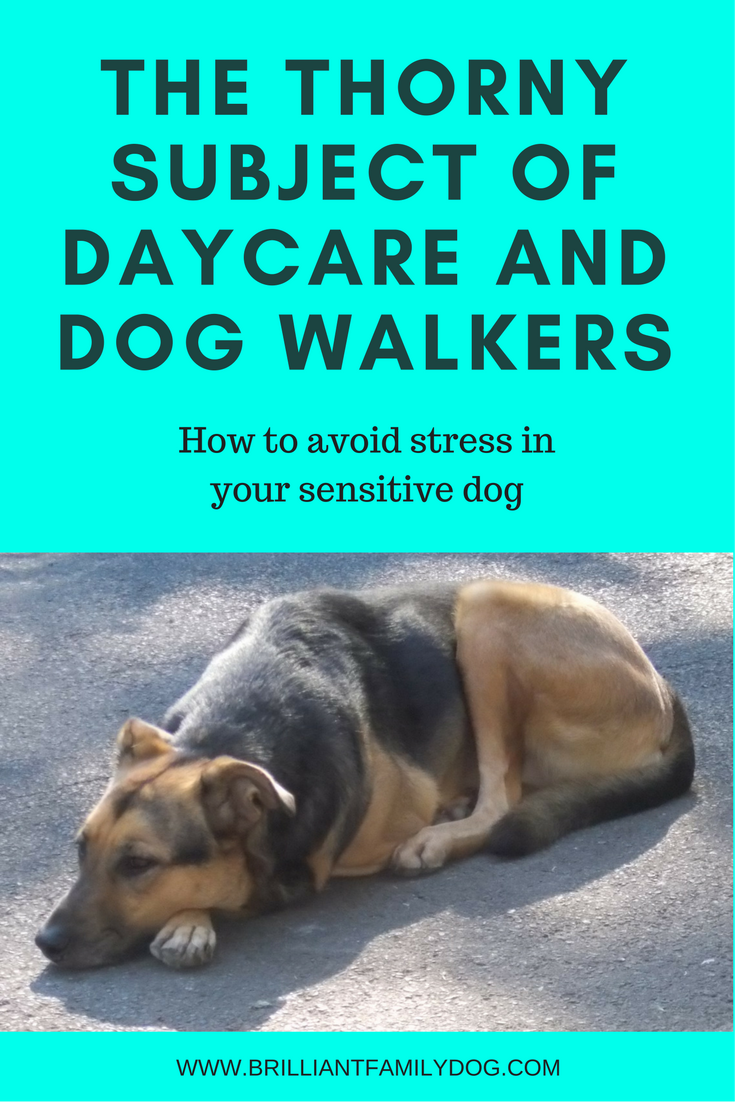
The thorny subject of daycare and dog walkers

An excerpt from the Chapter on Stress in the forthcoming books, Essential Skills for your Growly but Brilliant family dog This article was first published on positively.com and is reprinted here with permission.

You’re invited to a family wedding for the weekend - great! But what will you do with your dog?

There’s always going to be a time when you need your dog to be minded for a period. Maybe you have some days when you can’t get away from work in the middle of the day to tend to her, perhaps you have to go away for a day for work or family reasons, or maybe you yearn for a holiday abroad.

(You may be missing a trick here! Holidaying with your dog, exploring your own country’s wonderful forests, moors, and beaches with your dog is an absolute delight. You need some preparatory training in place, then you’re away!)

But having a back-up minder who you’ve already checked out and approved is a good move, in case of an urgent absence from home.

The first place people tend to think of is a Doggy Daycare, or Boarding Kennels as they used to be known. They are assured by non-dog-owning friends - and the kennels - that their dog will be “fine!” and that they’re worrying too much.

In my experience, people don’t worry nearly enough! So anxious are they to solve their problem that they’ll buy into anything they’re told by the kennels.

Daycare or a dogwalker?

I am not going to tar all daycares and dogwalkers with the same brush. There are some excellent ones with committed, dedicated, and educated staff. But I will say that it’s very hard to find one convenient to you which is truly a safe place for your dog to learn and develop. 

Think of the skills you need as a parent to prevent open warfare in your own household! Then picture a gang of dogs being thrown together for a walk - or all day in a confined area - in the care of people who frequently have no dog training or behaviour qualifications whatever.

“I love dogs” may help, but it’s not a qualification.

And given how long it takes us to learn how to care for our own species - and that a lot of what people think about dogs is wrong - you’re going to be lucky to find somewhere safe for your dog.

I was recently shown a promotional video for a daycare by someone who’s been sending her very reactive German Shepherd pup there for months. Even in this 30-second video - meant to show how wonderful the place was - I could see bullying and intimidation of this pup by other dogs, and no-one going to her aid. Imagine what this sensitive puppy is subjected to for ten hours a day, five days a week! No wonder her reactivity is already extreme at only six months of age.

What the owner thought of as being “perfectly happy at daycare” was in fact a dog that spent all day trying to avoid the other dogs (quite impossible with those numbers of loose dogs) - shut down, in other words. Not fine at all.

Keep in mind also that it seems to be common practice in many establishments for dogs to be dished out aversive “corrections” - from lead-snaps to water sprays, rough handling,  and much shouting.

A holiday camp?

For me, being transported to a holiday camp would be a nightmare! For many dogs, daycare is viewed with the same suspicion I view that holiday camp. A very perceptive reader sent me this query recently: “My question is, what do you think of daycare for dogs? Are the dogs actually happy about it, or do dog owners just like to imagine they are?”

My personal solution to an enforced absence from home is to have someone I trust to come in to let the dogs out in the garden and play with them for a while during the day. If I were leaving them for a longer time, I’d look into booking a house-sitter with the necessary knowledge to deal with reactive dogs - and that would be hard to find. I would not have my reactive dog walked out of the house - no harm in her getting her exercise in garden play for a short while.

If anything goes wrong in a daycare or with a dogwalker, you will be paying for that for years - possibly the rest of your dog’s life. It may or may not have been their fault, but it happened.

Think hard, and do a lot of homework, before going for that option.


For news about the release of these new books, go to www.brilliantfamilydog.com/growly and join us. You'll find all the information about my first four books here.
 

The thorny subject of daycare and dogwalkers

Give your dog an instant safe haven on walks

This post of mine first appeared on positively.com and is reprinted here with permission. More than two thousand readers liked it enough to share it on Facebook. So I thought you'd like to see it too!

We’ve all seen a small child clinging to Mom’s neck while he safely views the world from under her hair.

A little puppy has the same need for a safe haven.

You may have seen your own puppy hurtle in from the garden when there’s an alarming noise, and dive into her bed. Plunging into the den at speed is an important instinctive survival mechanism for vulnerable pups.

Gradually your whole home will become a safe haven for your dog, a place she can always feel comfortable and relaxed.

But what about when you’re out and about?

A Safe Haven in the Big Bad World

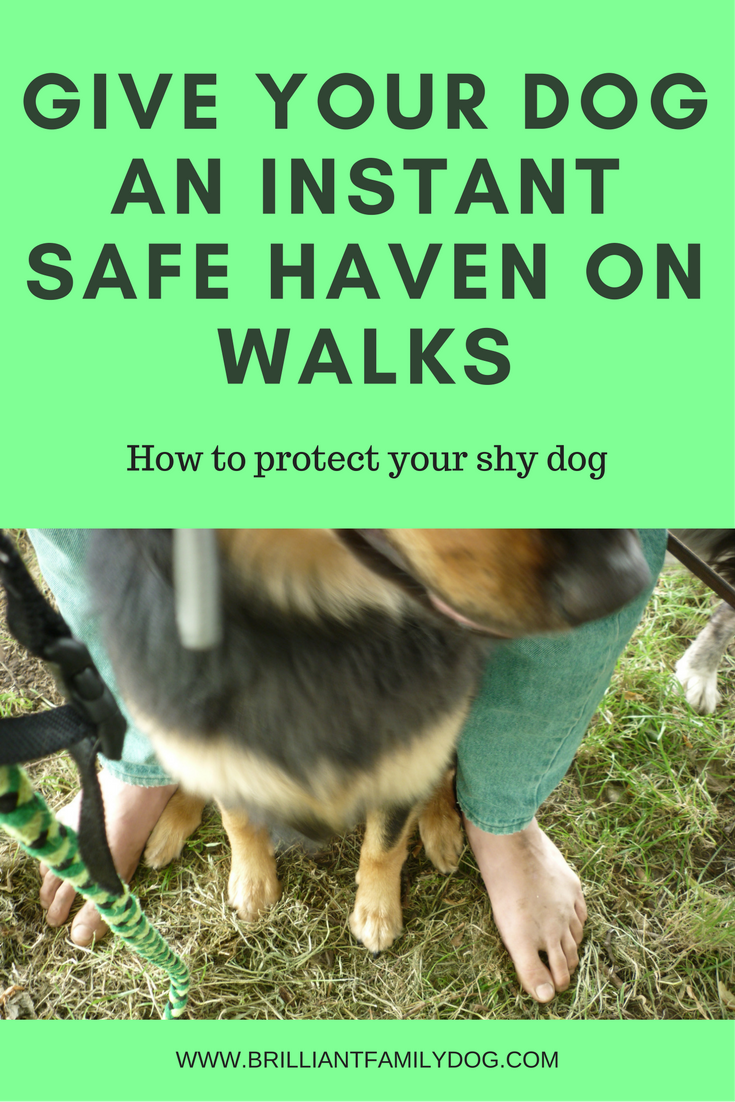
For a puppy, your safe haven will be between your feet. You should always protect your puppy from incursions from other eager puppies or dogs (or children, shopkeepers, parades with oompahs, sheep, noisy trucks …). If she backs herself between your feet she needs reassurance that she can safely watch the world from there.

Don’t worry - she’ll come out in her own good time, as she gains the confidence you can give her. Forcing her to confront her fears will only make them stronger, so give her time.

Quite a few puppies start puppy classes from under their owner’s chair! That’s fine, if that’s what makes them feel less vulnerable. By week 2 or 3 those same puppies are out and about exploring. Letting the pup choose when to venture forth is key.

All Grown Up

But once your dog is grown and bigger, what do you do?

You’re walking your dog on a leash and something appears that worries her. Now for many dogs a quick glance and appraisal of the situation is enough, and on you go.

But what if your dog is fearful or reactive? A dog who is always surprised by anything new appearing in her environment, and whose first response is often to bark to get it to go away?

If that’s your dog, then you need to know that with a reactive dog, Distance is your Friend. The first thing you need to do is get further away from whatever it is that’s alarming her (big dog? paper bag? person talking on their phone?).

But sometimes that’s not so easy!

If you’re walking on the street and someone approaches you with cries of “Oh what a lovely dog!” “Hallo doggie doggie!” “Dogs like me!” etc, you need something quicker - and perhaps more socially acceptable! - than turning on your heel and walking smartly away.

Distance, Close Up

Here are some actions I’ve found helpful for Lacy - a very pretty dog who attracts attention, but doesn’t want it!

1. Talk to the hand! As someone is approaching and just ready to dive on Lacy, I step side-on in front of her, hold up my hand like a traffic cop, and say “Hang on!” This normally brings the approaching hazard to a full stop and gives me time to organise the next step.

2. Carwash

New Puppy? Shy dog? | A safe place for your dog when worried | FREE EMAIL COURSE | #newpuppy, #puppypottytraining, #puppytraining | www.brilliantfamilydog.com

This is where Lacy runs back round my right leg and dives between my legs from behind. She’s now sitting in her safe haven between my feet. I can squeeze my legs softly on her shoulders to make her feel more secure. She’ll often put herself there if worried, without me having to say “Carwash!”

There are three huge advantages to this position.

•    One is that as Lacy goes round my leg her leash is now behind that leg. So even if the “oncoming hazard” still bends over, she can’t lunge forward to intercept them.

•    But this second one’s a winner: Very few people are going to make so bold as to bend over right in your personal space and reach down between your legs to touch your dog! Success!

•    And the third one is to lighten the social mood a little. Once Lacy is in Carwash, I can lift my hand in greeting saying, “Say Hi!” Lacy will lift her paw in a big high five swipe.

So she’s still “said hello” to the persistent hazard, without having had to risk her life by emerging from her safe haven.

I can hear some of you mumbling … if your dog is very large and you are not - what can you do? You don’t want to end up astride your dog!

Try a simple Get Behind. Send your dog round you so that, again, your leash is behind your legs, and your dog is peeping out by your hip. If your oncoming nuisance is unusually persistent, you can move slightly to body block them. Eventually they’ll get the message that they’re welcome to chat to you, but not to your dog, who has taken a vow of silence when it comes to strangers.

But All Dogs Love People: Really?

There’s a lot of social pressure on us to have a dog that conforms to the popular view that all dogs are friendly and welcome cuddles. But, of course, like people, some just “want to be alone”.

It’s not our dog’s job to provide cuddles and dogginess to the general population. In the same way that strangers don’t reach down and scoop your baby up from his stroller saying “I love babies!” - imagine! - they also don’t have the right to touch your dog without permission from you (and her).

If your dog likes nothing more than chatting to new people, then go for it, and enjoy her enjoyment. But if your dog is shy, allow her to retire to her safe haven without having to interact with scary strangers.

She’ll thank you for it.

Have you found a good strategy for keeping your scaredy-dog calm? Let us know in the Comments below!

And for more ideas for helping your anxious dog, get your free e-course My Dog Doesn’t Like Other Dogs: How to Stop the Barking and Lunging


Is your dog or your little puppy throwing up more challenges than you anticipated? Watch our free Workshop and find how to change things fast!

 A safe haven for your dog when out

The barking dog in the garden at no.11

Getting your anxious dog past gardens bristling with menacing, stamping, frothing, barking dogs is hard enough.

But if you have to run that gauntlet every day to get anywhere from your home, your dog’s anxiety will build and build.

Prompted by a question from a reader, I’m giving you today an excerpt from my forthcoming books devoted to improving the life of the Growly Dog: Essential Skills for your Growly but Brilliant Family Dog.

As my correspondent put it:

“Some days going out is a noisy, barking, snarling (from one of the other dogs), tugging mess.”

If a friend wanted you to come to the edge of a 200-foot cliff to admire the view out to sea, you may be filled with terror at the thought. If he grabs you and drags you even one step nearer the edge you’re going to panic, shout, pull back from him. If he lets you go and allows you to get on your hands and knees, perhaps you may crawl a little closer to the edge.

Perhaps you’ll get a glimpse of the beautiful view, and feel able to crawl a yard nearer the next day. This is a gradual process. Maybe that’s as near as you’ll ever get to the cliff-edge (you certainly wouldn’t get me standing at the edge!) and that will do.

This type of fear will never get better on its own

It will tend to grow and grow till quite possibly your dog resists having her harness and lead put on, as she knows she has to do the “terror run” as soon as you leave the house. I would suggest giving your dog a holiday from this stress, by taking her to your walking place in the car for a few days.

Once her hormones have settled and she’s not filled with dread at the front door, you can start giving her some control over the walk, by letting her make the decisions.

The only decision she can’t make is to join in the noise and dancing. If that happens it will mean you’ve got too close and you’re undoing the benefit of the few walkless days.

So you’re going for a walk around your neighbourhood and you decide that today is the day you’re going to work on passing the Barking Dog in the Garden at No.11. Usually you can only get past no.11 while dragging your screaming dog with you.

Your aim is not going to be to breeze past no.11 in a happy cloud (though that will come later - really!) but to give your dog time, at a comfortable distance, to assess the Barking Dog. Keeping mindful of traffic on this road, give your dog a good length of lead and let her just stand and watch no.11.

When she breaks off and looks to you for guidance on where to go next, allow her to wander a few steps. If she’s going towards no.11 slow-stop her and wait, with soft hands.

Empower your dog!

Let her make the decisions about when and where she wants to move, and only intervene if you can see things are going pear-shaped.

During this session you may get within a couple of houses of no.11 without any bad reaction from your dog, the Barking Dog barking all the while. Maybe that’s enough for today?

Make a note of the tree or fence you reached, and start a bit further back from that tomorrow. Maybe then you’ll get a good few yards further without incident.

And yes, one day you’ll be able to walk past no.11 - probably on the other side of the road - with happy smiles and a carefree manner from both of you! I am always pleased and proud when I walk my four past a yapping gateway we have to pass. My group of four includes two reactors. They cast a glance towards the yappers and carry on trotting by.

Takeaways

The essence of this system is to

  1. make haste slowly - progress at a pace which allows your dog to stay comfortable

  2. give your dog the power to make her own decisions

  3. mark good decisions enthusiastically

  4. allow your dog time to assess the situation - it’s often way longer than you expect!

  5. remember your object is not to get past no.11 but for your dog to stay calm and feeling in control


Remember the clifftop and your friend’s enthusiasm to share his pleasure in the beautiful view?

The view is not beautiful if you are terrified.


This is an edited extract from my forthcoming books Essential Skills for your Growly but Brilliant Family Dog


Is your dog throwing up more challenges than you anticipated? Watch our free Masterclass and find how to change things fast!

Why is my dog barking and lunging at other dogs?

“She’s such a lovely dog at home!”

And that’s normally the case. Just because a dog has an issue with other dogs does not mean she’s a bad dog in every way.

You know what a smashing dog she is at home - a Brilliant Family Dog! - and you’d like others to see what you see.

Instead of what they see: A fury of teeth, claws, and noise, who looks as though she wants to kill them, their children, and their dog.

I know just how you feel, because I’ve been there! And changing the way Lacy views the world has been a fascinating journey that has resulted in being able to help lots of other Lacys and their ragged owners.

Lacy is deeply suspicious of everyone and everything on the planet. Her response? To shriek at it to go away; to look her most ferocious; to keep things out of her space by leaping and lunging at them. The most adorable and affectionate (and intelligent) dog at home - with a great sense of humour - she was viewed by everyone else as some kind of deranged monster. But she's come on so much that she is now able to help me working with other reactive and fearful dogs.

It will help you to know from the outset that this type of behaviour is normally the result of fear. Not nastiness, aggression, “dominance”, or any of those other labels. Just plain tail-wetting fear.

Your dog is afraid of the oncoming dog. She needs to keep it away!

So she bares her teeth, makes herself look bigger, and shouts at him.

It’s likely that you get upset and try and rein her in or drag her away. It’s likely that the oncoming dog’s owner is alarmed (and probably looking down their nose at you). And it’s quite likely that the other dog will say “Who’re you lookin’ at?” and join the barking party.

The whole episode is upsetting and exhausting.

You start to walk your dog at the Hour of the Difficult Dog, late in the evening, when everyone is trying to avoid everyone else.

Is this why you got a companion dog?

Let’s have a look at what you can do to change things.

1. First thing is to stop walking your dog

What??? Let me explain.

Can you imagine that you had to walk along a narrow and uneven cliff path with a 200 foot drop. There is nothing to hold on to. The ground is crumbly and sometimes you skid and dislodge a lump of rock that bounces down the cliff and splashes silently into the sea below.

For most people this would be a living nightmare, a “terror run”. You would be desperate to get out of the situation. Your hormones would be racing through your body.

You eventually get home and begin to calm down.

The next day you have to walk the path again.

And the next day …

Quite soon you’re in a state of permanent panic. You dread the cliff path.

You need a break from this terror. Your hormones need to settle so you can see the world clearly. As does your dog.

You won’t stop walking your dog for ever. Just give her a few days’ break so that she can get back to normal. You can play great games at home to give her some exercise.

As neither of you is enjoying the walk, nobody will miss it.

After that, this bit is easy:

2. Teach her that she never has to meet another dog ever again (until she wants to)

And by this I don’t mean you are sentenced to the Hour of the Difficult Dog for ever.

Back to you and your terror run again: rather than staying at home for ever, you have a companion who can guide you. As you approach the cliff path, he turns you away from it and says, “Let’s go this way,” and heads right away from the edge.

Can you imagine the relief you feel? No need to plead with him and say, “Please don’t make me go on the path!” He guides you away to safer ground every time he sees a dangerous path. Your trust in him grows. You begin to enjoy your seaside walks.

So it is with your dog. The moment you see another dog or person heading your way, you give a cheery “Let’s go!” and head in the opposite direction. Your dog will enjoy the fact that she doesn’t have to get upset and go through the shouting routine.

You want to avoid narrow lanes where there’s no escape, so you may have to take a longer route to get where you want to go - or even drive till you are at an open space.

But you don’t want to avoid dogs.

She won’t learn what you want her to learn unless you do it, so eschew the Hour of the Difficult Dog and go out where you will see dogs - but at a safe distance.

These two things alone will make a huge difference to your dog, your walks, your relationship with your dog, and your enjoyment of life with her. If you did nothing else, this will improve the situation dramatically.

But this is just a start: naturally there are lots more things you will be able to do! There are techniques which I’ll show you. But the first thing you need to do to a wound is to stop it bleeding. Only then can you start the healing process.

First, realise that your dog is afraid, and is as uncomfortable as you are. Reasoning with her will not work. Until you can get help from a force-free professional, avoidance is the short-term answer.

Second, remember that you are her guardian and protector - give her the help she needs to cope with our world.

No idea how to start?  This free e-course will get you going: 

THIS E-COURSE IS A BONUS FOR YOU WHEN YOU SIGN UP TO RECEIVE EDUCATIONAL EMAILS AND OCCASIONAL OFFERS FROM ME. YOU CAN UNSUBSCRIBE AT ANY TIME.
Privacy Policy

Is there hope for my growly dog?

People sometimes approach me for help when they’ve just about reached the end of their tether. They’ve tried this trick and that idea - usually things that their next-door neighbour suggested, or something they saw on one of the more sensational dog-training programs on tv - and their dog is getting worse.

It’s a shame they’ve let things go on for so long, as just like us and our piano lessons - practice makes perfect! The more your dog is allowed to do the thing you don’t like, the more he’ll do it.

But I’m usually able to cheer them up and show them that there is hope for their dog! I have never yet come across a fearful, anxious, reactive, growly (choose your name) dog that does not improve with force-free training.

And usually the change is dramatic.

People find that not only is there light at the end of the tunnel, but the tunnel itself is much shorter than they thought.

Once they understand why their dog is acting as she is, that she’s not all bad but that she just has difficulties in some areas of her life, and that what they do can have an enormous impact on their dog’s confidence, they happily launch into the training offered.

They start seeing results immediately. Suddenly they’re able to rejoin the human race! They can take their dog on outings, perhaps for the first time ever; they can enjoy picnics again; they no longer have to hide from other people and dogs like a vampire cowering from the sunlight.

Don’t be afraid to ask for help

So if you are despairing of your dog’s anti-social behaviour, seek help now. Don’t wait till there’s much more to undo, when your dog’s confidence may be at rock-bottom. There’s no time like the present, and - as long as you’re working with an experienced, qualified, force-free trainer - you will get results.

If the problem is reactivity to strangers or other dogs, a Certified Behavior Adjustment Training Instructor is what you want. There may not be one in your area, but many will work remotely, using video and Skype for their sessions.

While anyone can call themselves a dog trainer (and then appear on tv spouting dangerous advice), the true professional trainer or behaviourist has spent years, and lots of money, on studying and qualifying in their chosen field. They will belong to an organisation which has a clear code of practice to adhere to, and they will be continually studying, learning, and growing their knowledge and understanding. Many professionals who work with reactive or growly dogs have learned because of having a growly dog of their own - so they are very sympathetic. No-one will look down their nose at you and your dog!

Be ready to put in plenty of work yourself. The trainer - however good - cannot wave a magic wand over your dog! It’s you who lives with your dog, so it’s you who needs to work with her. But you will get a carefully-crafted program with plenty of resources to help you succeed.

You are not alone! And just that realisation goes a long way. As one correspondent wrote to me:

“When my amazing, cuddly, lovable dog starting acting very reactive on the leash, I felt totally alone! I would watch other people walk their dogs calmly down the street, passing people, kids on bikes, other dogs, and I was so jealous of them. Everything you write about describes my dog perfectly and it is so nice to know that a) There are many other people dealing with this, and b) There is hope!”

Your dog’s behaviour may mystify you, but there is help out there. Your first stop? Get our free email course for Growly Dogs

And for an in-depth, guided online course with masses of support, start with this free Masterclass

Resources:

Free 4-part Growly Dog e-course

CBATI Directory

Pet Professional Guild

Association of Pet Dog Trainers UK

Association of Pet Behaviour Counsellors UK

Karen Pryor Academy

Is your dog throwing up more challenges than you anticipated? Watch our free Masterclass and find how to change things fast!


Why is my lovely dog so aggressive on walks?

I’d like to watch animals on tv in peace!

Many dogs don’t seem to “see” the tv at all. It’s just noisy wallpaper to them, and not worth a glance - even when there’s a screech, a bang, shouting, an explosion … They totally ignore it.

But there are some who enjoy watching it, will cock their ears to study the images, and look and listen calmly.

And then! There are those who go ballistic when an animal, a fish, a bird, an insect - anything other than a human - ventures onto the screen. They may hurl themselves - with a cascade of barking - at the television, now covered in snuffles and nose-smears, or they may back off barking.

So nature programmes, advertisements featuring pets, and dog programmes in particular, can be the trigger for extreme angst and noise in your dog.

Cricket the Whippet will watch for a while if the screen continually shows dogs or wolves, but she’s mildly curious, not upset.

Coco Poodle on the other hand, became a basket-case as soon as he spotted a bear, or a swan, or a cartoon cat in a cat food ad. As for lots of dogs running towards the camera, he would completely lose it. He’d plunge at the screen, genuinely frightened at this incursion of apparently real tigers or wolves into his home.

Bob says of his young dog Tedd that “if he sees another dog on the tv he runs and barks at the screen: amusing at times, but watching 'The Incredible Journey' would be a no-no.”

What to do?

Once we discovered we had this problem with Coco’s 2d-image reactivity, we actually took the opposite course, and started recording animal programmes and leaving them playing (usually silently, so that the repetition didn’t drive the rest of the household mad).

So we became intimate with the private life of the wolf pack in Yellowstone, we saw endless clear rounds and knocked poles at the Horse of the Year Show, and just lately, Crufts has been a wonderful opportunity to get lots of calm dog-watching in.

New Puppy? New Rescue Dog? Does your dog bark at the tv? | FREE EMAIL COURSE | #newpuppy, #newrescuedog, #dogtraining | www.brilliantfamilydog.com

Crufts is the world’s biggest dog show, and while many watch it to see the procession of show dogs in the breed rings, my interest is in the performance dogs. If you go to Youtube and search on Crufts 2016 you’ll find hours of videos of flyball, agility, dancing dogs, gundog displays, and so on. Connect things so you can play these on your big screen and you can enjoy watching them with your dog.

I always have some treats near to hand, so as soon as the image appears on-screen - and before Coco has even drawn breath to bark - I say “Yes!” and hold a treat by the side of his muzzle. This means he has to turn away from the screen to take the treat - thus breaking his obsessional gaze - then he’s free to look again. More Yeses, more treats. And over and over again till he can watch the screen in a genuine state of calm. Aficionados will recognise this as a form of “Look at That”, a brilliant calming game devised by Leslie McDevitt of Control Unleashed fame.

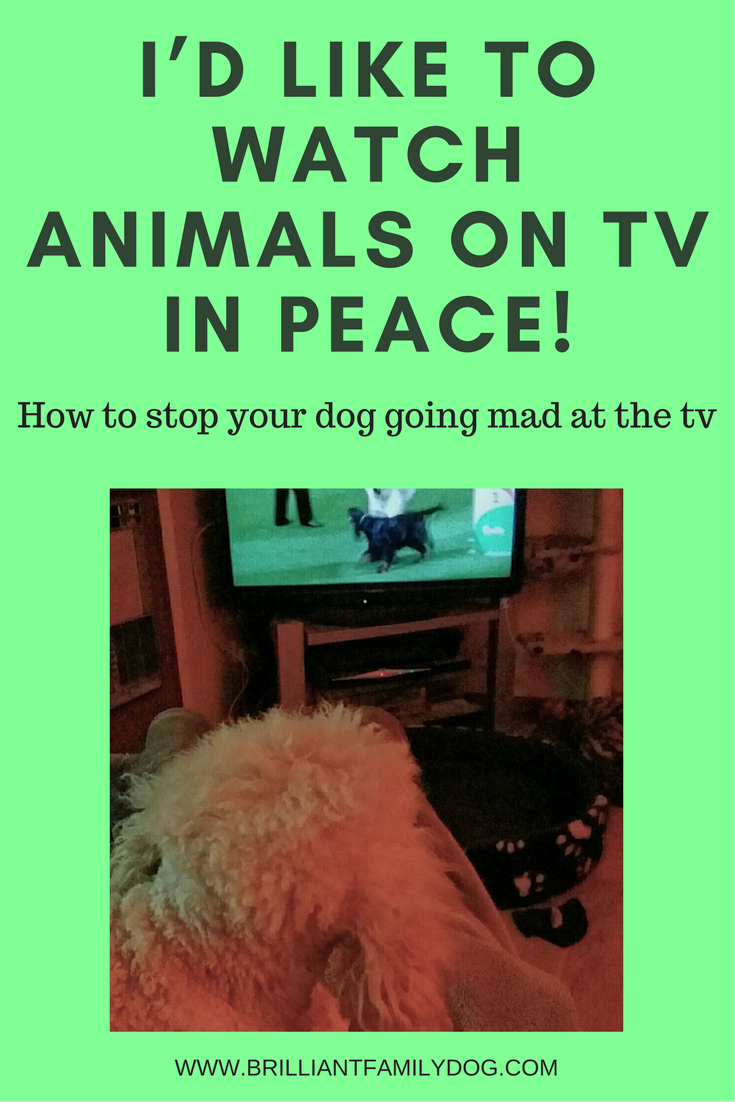
Here you can see Coco on my lap, quietly watching some breed judging at Crufts.

To fix or not to fix

But if you like watching tv programmes with animals in, this is something you’ll want to fix.

Keep in mind that it’s a fear reaction, and it’s pointless trying to punish an emotional response. Use the Coco Method above to settle your dog and get him to realise that he’s quite safe and nothing is going to burst through the screen and attack us.

Quite soon your dog will point out creatures on-screen and look for his reward for staying calm and quiet. Treat away!


More tips to deal with daily annoyances here.


Now we can watch dogs on tv in peace

Is your dog throwing up more challenges than you anticipated? Watch our free Masterclass and find how to change things fast!


Here’s another blog that you might want to read:

Yes, you and your dog can now watch animals on tv!