The thorny subject of daycare and dog walkers

An excerpt from the Chapter on Stress in the forthcoming books, Essential Skills for your Growly but Brilliant family dog This article was first published on positively.com and is reprinted here with permission.

You’re invited to a family wedding for the weekend - great! But what will you do with your dog?

There’s always going to be a time when you need your dog to be minded for a period. Maybe you have some days when you can’t get away from work in the middle of the day to tend to her, perhaps you have to go away for a day for work or family reasons, or maybe you yearn for a holiday abroad.

(You may be missing a trick here! Holidaying with your dog, exploring your own country’s wonderful forests, moors, and beaches with your dog is an absolute delight. You need some preparatory training in place, then you’re away!)

But having a back-up minder who you’ve already checked out and approved is a good move, in case of an urgent absence from home.

The first place people tend to think of is a Doggy Daycare, or Boarding Kennels as they used to be known. They are assured by non-dog-owning friends - and the kennels - that their dog will be “fine!” and that they’re worrying too much.

In my experience, people don’t worry nearly enough! So anxious are they to solve their problem that they’ll buy into anything they’re told by the kennels.

Daycare or a dogwalker?

I am not going to tar all daycares and dogwalkers with the same brush. There are some excellent ones with committed, dedicated, and educated staff. But I will say that it’s very hard to find one convenient to you which is truly a safe place for your dog to learn and develop. 

Think of the skills you need as a parent to prevent open warfare in your own household! Then picture a gang of dogs being thrown together for a walk - or all day in a confined area - in the care of people who frequently have no dog training or behaviour qualifications whatever.

“I love dogs” may help, but it’s not a qualification.

And given how long it takes us to learn how to care for our own species - and that a lot of what people think about dogs is wrong - you’re going to be lucky to find somewhere safe for your dog.

I was recently shown a promotional video for a daycare by someone who’s been sending her very reactive German Shepherd pup there for months. Even in this 30-second video - meant to show how wonderful the place was - I could see bullying and intimidation of this pup by other dogs, and no-one going to her aid. Imagine what this sensitive puppy is subjected to for ten hours a day, five days a week! No wonder her reactivity is already extreme at only six months of age.

What the owner thought of as being “perfectly happy at daycare” was in fact a dog that spent all day trying to avoid the other dogs (quite impossible with those numbers of loose dogs) - shut down, in other words. Not fine at all.

Keep in mind also that it seems to be common practice in many establishments for dogs to be dished out aversive “corrections” - from lead-snaps to water sprays, rough handling,  and much shouting.

A holiday camp?

For me, being transported to a holiday camp would be a nightmare! For many dogs, daycare is viewed with the same suspicion I view that holiday camp. A very perceptive reader sent me this query recently: “My question is, what do you think of daycare for dogs? Are the dogs actually happy about it, or do dog owners just like to imagine they are?”

My personal solution to an enforced absence from home is to have someone I trust to come in to let the dogs out in the garden and play with them for a while during the day. If I were leaving them for a longer time, I’d look into booking a house-sitter with the necessary knowledge to deal with reactive dogs - and that would be hard to find. I would not have my reactive dog walked out of the house - no harm in her getting her exercise in garden play for a short while.

If anything goes wrong in a daycare or with a dogwalker, you will be paying for that for years - possibly the rest of your dog’s life. It may or may not have been their fault, but it happened.

Think hard, and do a lot of homework, before going for that option.


For news about the release of these new books, go to www.brilliantfamilydog.com/growly and join us. You'll find all the information about my first four books here.
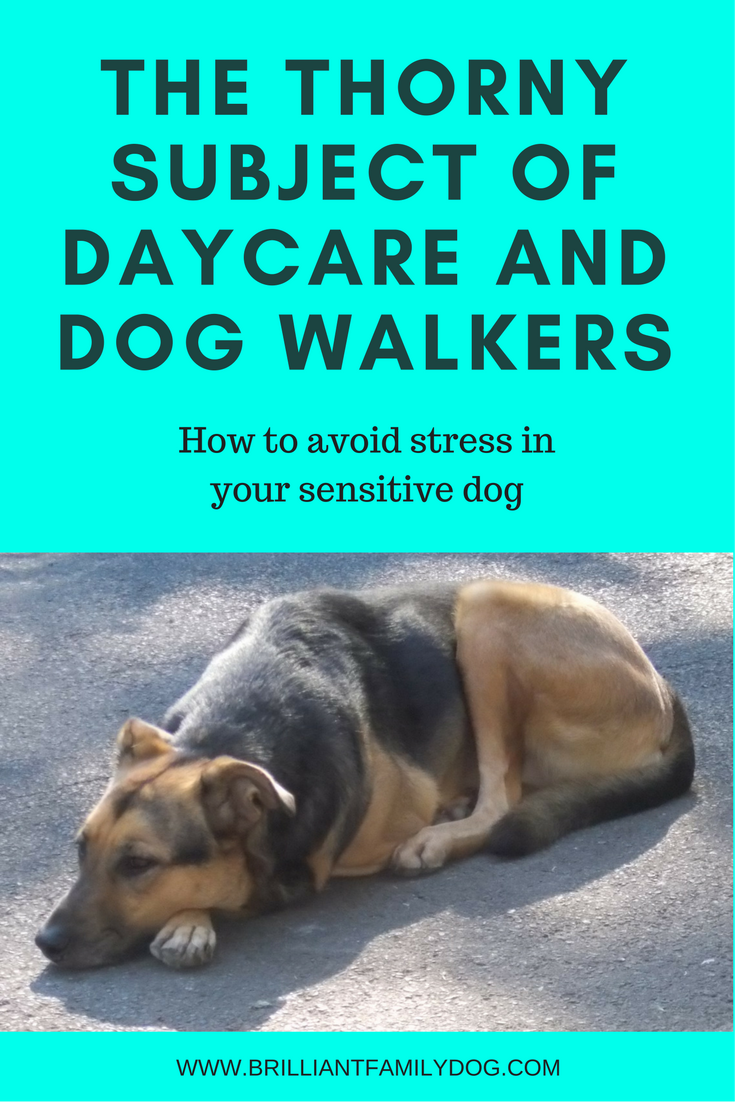
 

The thorny subject of daycare and dogwalkers

Give your dog an instant safe haven on walks

This post of mine first appeared on positively.com and is reprinted here with permission. More than two thousand readers liked it enough to share it on Facebook. So I thought you'd like to see it too!

We’ve all seen a small child clinging to Mom’s neck while he safely views the world from under her hair.

A little puppy has the same need for a safe haven.

You may have seen your own puppy hurtle in from the garden when there’s an alarming noise, and dive into her bed. Plunging into the den at speed is an important instinctive survival mechanism for vulnerable pups.

Gradually your whole home will become a safe haven for your dog, a place she can always feel comfortable and relaxed.

But what about when you’re out and about?

A Safe Haven in the Big Bad World

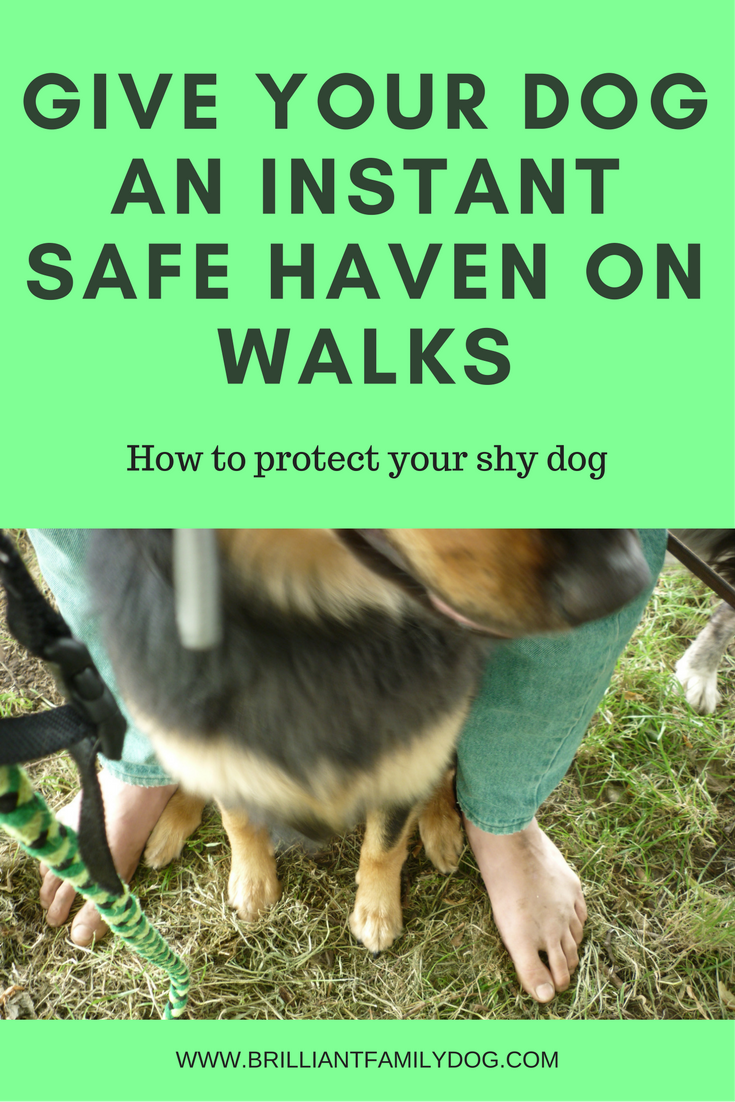
For a puppy, your safe haven will be between your feet. You should always protect your puppy from incursions from other eager puppies or dogs (or children, shopkeepers, parades with oompahs, sheep, noisy trucks …). If she backs herself between your feet she needs reassurance that she can safely watch the world from there.

Don’t worry - she’ll come out in her own good time, as she gains the confidence you can give her. Forcing her to confront her fears will only make them stronger, so give her time.

Quite a few puppies start puppy classes from under their owner’s chair! That’s fine, if that’s what makes them feel less vulnerable. By week 2 or 3 those same puppies are out and about exploring. Letting the pup choose when to venture forth is key.

All Grown Up

But once your dog is grown and bigger, what do you do?

You’re walking your dog on a leash and something appears that worries her. Now for many dogs a quick glance and appraisal of the situation is enough, and on you go.

But what if your dog is fearful or reactive? A dog who is always surprised by anything new appearing in her environment, and whose first response is often to bark to get it to go away?

If that’s your dog, then you need to know that with a reactive dog, Distance is your Friend. The first thing you need to do is get further away from whatever it is that’s alarming her (big dog? paper bag? person talking on their phone?).

But sometimes that’s not so easy!

If you’re walking on the street and someone approaches you with cries of “Oh what a lovely dog!” “Hallo doggie doggie!” “Dogs like me!” etc, you need something quicker - and perhaps more socially acceptable! - than turning on your heel and walking smartly away.

Distance, Close Up

Here are some actions I’ve found helpful for Lacy - a very pretty dog who attracts attention, but doesn’t want it!

1. Talk to the hand! As someone is approaching and just ready to dive on Lacy, I step side-on in front of her, hold up my hand like a traffic cop, and say “Hang on!” This normally brings the approaching hazard to a full stop and gives me time to organise the next step.

2. Carwash

New Puppy? Shy dog? | A safe place for your dog when worried | FREE EMAIL COURSE | #newpuppy, #puppypottytraining, #puppytraining | www.brilliantfamilydog.com

This is where Lacy runs back round my right leg and dives between my legs from behind. She’s now sitting in her safe haven between my feet. I can squeeze my legs softly on her shoulders to make her feel more secure. She’ll often put herself there if worried, without me having to say “Carwash!”

There are three huge advantages to this position.

•    One is that as Lacy goes round my leg her leash is now behind that leg. So even if the “oncoming hazard” still bends over, she can’t lunge forward to intercept them.

•    But this second one’s a winner: Very few people are going to make so bold as to bend over right in your personal space and reach down between your legs to touch your dog! Success!

•    And the third one is to lighten the social mood a little. Once Lacy is in Carwash, I can lift my hand in greeting saying, “Say Hi!” Lacy will lift her paw in a big high five swipe.

So she’s still “said hello” to the persistent hazard, without having had to risk her life by emerging from her safe haven.

I can hear some of you mumbling … if your dog is very large and you are not - what can you do? You don’t want to end up astride your dog!

Try a simple Get Behind. Send your dog round you so that, again, your leash is behind your legs, and your dog is peeping out by your hip. If your oncoming nuisance is unusually persistent, you can move slightly to body block them. Eventually they’ll get the message that they’re welcome to chat to you, but not to your dog, who has taken a vow of silence when it comes to strangers.

But All Dogs Love People: Really?

There’s a lot of social pressure on us to have a dog that conforms to the popular view that all dogs are friendly and welcome cuddles. But, of course, like people, some just “want to be alone”.

It’s not our dog’s job to provide cuddles and dogginess to the general population. In the same way that strangers don’t reach down and scoop your baby up from his stroller saying “I love babies!” - imagine! - they also don’t have the right to touch your dog without permission from you (and her).

If your dog likes nothing more than chatting to new people, then go for it, and enjoy her enjoyment. But if your dog is shy, allow her to retire to her safe haven without having to interact with scary strangers.

She’ll thank you for it.

Have you found a good strategy for keeping your scaredy-dog calm? Let us know in the Comments below!

And for more ideas for helping your anxious dog, get your free e-course My Dog Doesn’t Like Other Dogs: How to Stop the Barking and Lunging


Is your dog or your little puppy throwing up more challenges than you anticipated? Watch our free Workshop and find how to change things fast!

 A safe haven for your dog when out

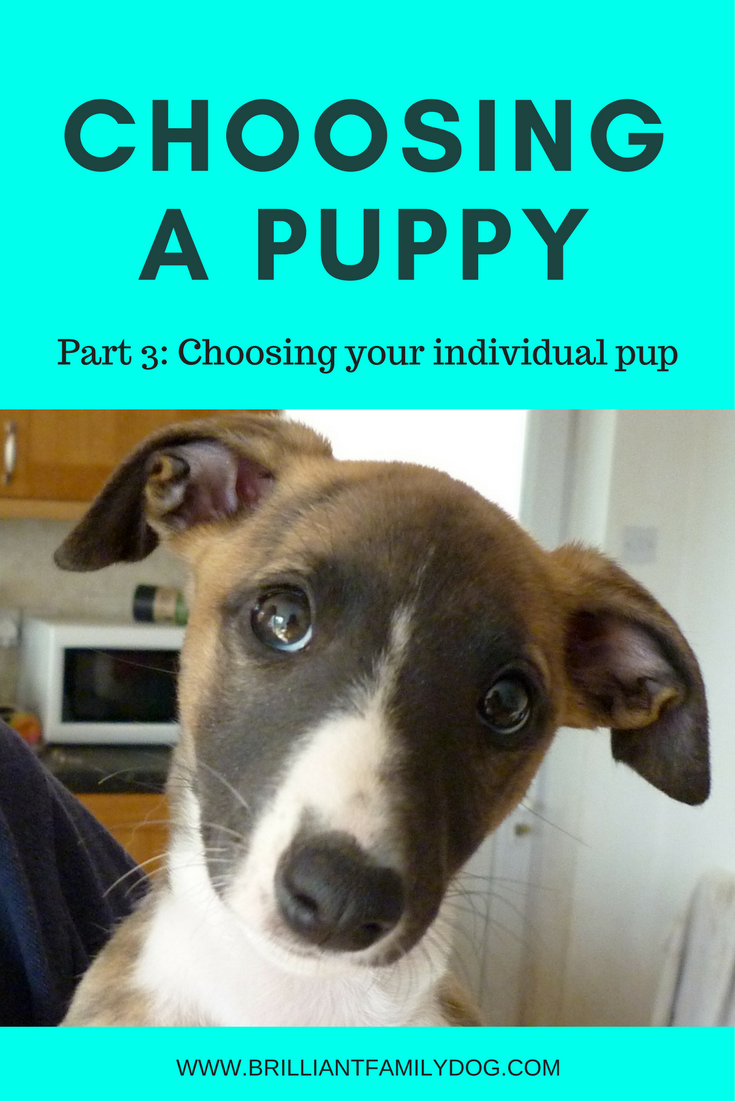
Choosing a Puppy, Part 3

Part 3: Here’s the fun bit!

And for the big challenge!

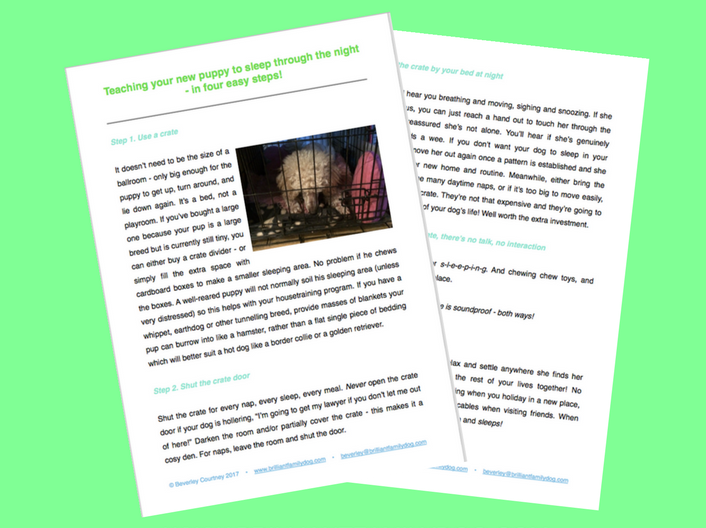
Learn how to get a good night's sleep from your puppy's first night with this cheatsheet

THIS GUIDE IS A BONUS FOR YOU WHEN YOU SIGN UP TO RECEIVE EDUCATIONAL EMAILS AND OCCASIONAL OFFERS FROM ME. YOU CAN UNSUBSCRIBE AT ANY TIME PRIVACY POLICY

New Puppy? Want to get some sleep?! | FREE GUIDE | #newpuppy, #puppypottytraining, #puppytraining | www.brilliantfamilydog.com

Your carefully-chosen breeder will help you here. She’s a fanatic for her breed, usually totally devoted to her own dogs and her own line that she’s working hard to improve. She will have spent many hours with this litter of pups. While everyone else thinks they look identical, she’ll have given them all nicknames and can tell them apart at a glance. She knows their fads and foibles, their faults and failings. She also knows their best points.

Of course, the breeder of a carefully-reared crossbreed from a much-loved pet in a family home will also know her puppies well and be able to advise.

While you’re entitled to see the whole litter together, the breeder will bring out for you the pups that are available - and which she considers suitable for your family and experience.

It’s a good idea to visit them twice if possible. The first time they could be half-asleep and dopey and give you a wrong impression. Puppies who appear to be bullying their siblings at 6 weeks will have been taught some manners and bite inhibition by their littermates by the time you see them again at 8 weeks.

Have fun choosing your puppy

I like to play with the puppy and see how interested he is with my toys. I’ll bring several different sorts. Interacting with toys at this early age is a good indicator of a strong retrieve later on (great for playing ball on the beach …) and general teachability.

Unless you are of a shy and retiring disposition yourself, don’t feel sorry for the shyest puppy (unless the breeder considers this is the one for you: shyness in a litter is relative!).

And all that homework you did? This is the moment of the great pay-off! Because you don’t have to consider all those other very important questions any more, you are free to follow your heart.

Spend some time with the puppies the breeder is offering you … and see which one you fall in love with.

Follow your heart.

Just let yourself fall in love.

And something surprising might happen

When I went to choose Cricket the Whippet, I’d spent several months narrowing down the type of whippet I wanted, the breeder (who had the same concerns about breed health as I had), and the mating. The breeder kept me updated with photos and info - first about the dam’s pregnancy and whelping, and then about the pups’ personalities.

I wanted a bitch. There were three bitches. The breeder was going to choose her favourite for her showing and breeding program, and I had first pick of the other two. I first visited them at 5-6 weeks.

All three puppies - Poppy, Daisy, and Hannah - were delightful. Poppy outgoing and friendly, Daisy energetic and comical, Hannah sweet and shy.

It was Daisy who “spoke to me”. She was the one I really wanted. The breeder had told me she was going to decide between keeping Poppy and Daisy at 7 and a half weeks.

So I told her I’d really like Daisy, but would be perfectly happy with Hannah if Daisy had been chosen by them. The funny thing was that I just didn’t relate to Poppy at all. Nothing at all wrong with Poppy, she was a lovely puppy - it just wasn’t love at first sight for me.

As it turned out, Poppy was the pup they chose to keep, I got Daisy who became “Cricket”, and Hannah went to the delighted third person who had been waiting patiently for us to decide.

Now get this - I had actually wanted a solid colour (same colour all over) which Hannah was, and Daisy was a brindle with white markings. But the heart ruled the head and Cricket is very much loved, adored, and admired.

You just don’t know!

But getting all the thorny questions about breeding and health ironed out first gave me complete freedom when I met the pups.

Now you know what to do: go choose your lovely new companion!

Get everything ready in advance with our free email course.

You can find the first post in this series here.

For some lessons to get you started as soon as your puppy arrives with you, check out our Wild Puppy mini-course here


New Puppy?

Watch our free Workshop and learn how to communicate effectively with your dog or your new puppy, right from the start!

 Choosing a Puppy, Part 1

 Choosing a Puppy, Part 2

Choosing a Puppy, Part 2

Part 2: Where should I get my puppy from?

You’ve got an idea from the last post of what type, size, sex, and age of dog you’re looking for. Now, in Choosing a Puppy, Part 2, you can source your puppy.

• Breeder

Super critical! 

There are some fantastic breeders, dedicated to the improvement of their breed, and fanatical about rearing the best puppies possible. They invest a lot of money in genetic testing to ensure their puppies do not suffer from inherited problems (e.g. Hip Dysplasia, Eye diseases, temperament issues). They devote three months of their life to each litter. They really earn their money! They will give you a detailed Puppy Pack, with pedigree, registration forms, medical history, diet history, breed-specific advice, and so on.

• Then there are those who have a pet dog who has pups. If there is enough hybrid vigour in the mix you may get away with the absence of genetic testing, as long as the puppies are reared right. These puppies are often reared in the home with lots of love and attention from family and friends, so can be a good bet temperamentally. This would be the old-fashioned household mongrel dog, now sadly disappearing through over-zealous neutering programs. You may be taking pot-luck on size, type, and health.

• Sadly there are many people who I refer to as greeders. Their interest is in getting as much as possible for as little investment of time and money as possible. They often focus on the most popular breed of the time - currently the troubled brachycephalic breeds like Pugs and French Bulldogs - or more often the fashionable “designer breeds”. Greeders usually focus on small dogs, as they can pack more into their sheds and they cost less to feed. They may try and offload the puppies at 6 weeks for some spurious reason (the real reason is laziness - this is the most labour-intensive stage of puppy-rearing). No genetic testing is usually done. In my experience it’s not uncommon for dogs from these greeders to develop chronic conditions like Hip Dysplasia within their first six months of life, necessitating lifelong medication or surgery. This suffering is appalling when it could so easily have been avoided. These people couldn’t care less.

• The worst of these greeders are the puppy farms aka puppy mills, who have lots of tricks to fool you into buying something that was reared in a filthy cage in a cellar or shed, with no human contact. The poor, overbred bitches live a life of loneliness and misery till they’re thrown out as spent. Often these puppies are much older than is claimed. They even charge a lot of money for them! You’ll soon be paying much, much, more for behavioural and veterinary help to try to partially repair the damage these monsters have inflicted. A disproportionate number of dogs bought off the internet classified listings die within their first year. Do NOT feel sorry for the puppy and take it, even knowing or suspecting its background. You will pay for the whole of the dog’s life. Worse, you are giving money to help further this cruel trade.

As one otherwise intelligent businesswoman said to me, as she regarded her puppy who had clunky hips, wonky teeth, and was afraid of his own shadow, “I can’t believe I fell for those tricks”.

• You’ll find advice about all this through your national kennel club. Here’s the UK Kennel Club’s page. Many kennel clubs have a breeder assessment scheme.

Meeting your prospective puppy

• Your first viewing

Very important

When you first visit a litter, do NOT take the family with you. You’d be better taking a friend who hates dogs and will not be beguiled by the cute little fluffy puppies! Decide on your priorities before you go in, and interview the breeder carefully. Ask penetrating questions and require thorough answers with written proof. A genuine breeder will be interviewing you at the same time, to see if you are a suitable owner for their precious puppies.

The pups should be spotlessly clean and smell sweet, with no tangles or mats, no sticky bum, no runny eyes. Their mother should be interested but not concerned at you handling her pups. (This is an important pointer to the litter’s temperament later on.)

• Buying

Oh so critical!

On no account agree to a puppy on your first visit. You are looking at a commitment for the next 12-17 years: be fully prepared to WALK AWAY.

• Beware of a breeder who wants you to take a bitch and rear puppies from it for them. It’s your choice what you do with your dog. It’s not uncommon for a breeder to prevent you being able to register progeny at your national kennel club without their permission. They are trying to protect the health and standards of the breed and protect their puppies from those greeders.

Now you have some concrete issues to research. See how this will all pay off in the next post.

Thinking ahead - enrol in our free e-course on how to change the things you may not appreciate in your new puppy into the things you like - all force-free, of course!

RESOURCES:

dogstrust.org.uk/buyeradvice

Get your free guide to Errorless Housetraining and have it all done in a week or two!

THIS GUIDE IS A BONUS FOR YOU WHEN YOU SIGN UP TO RECEIVE EDUCATIONAL EMAILS AND OCCASIONAL OFFERS FROM ME. YOU CAN UNSUBSCRIBE AT ANY TIME.
Privacy Policy

Choosing a Puppy, Part 1

Part 1: Narrowing down the choice

The time has come at last! You’ve decided that you are going to get a puppy for your family. Excitement is running high, ideas are fantastical.

Your older boy sees this new dog as a companion in his muddy adventures. Your younger girl views it as something to love and cuddle, brush and comb. You have fantasies about a dog curled up at your feet when your work is done and you at last hit the armchair. And perhaps your partner thinks of something butch and manly to show off at the pub from time to time.

How on earth can you combine all this into one dog?

The truth is that while different breeds have different mindsets and hard-wired behaviours, the individual dog will have his own ideas.

Just like when you have children you get what you’re given, so with puppies. It doesn’t matter how carefully you choose your puppy, he’s still going to have a mind of his own.

So you’re going to need to do a bit of educating your family so that everyone is not disappointed with the new arrival! Find out what it is they are expecting, and guide them to more realistic expectations.

But choosing the right breed or type in the first place is a huge help!

The right dog for your family

You’ll need to consider these points:

• Size

Critical

The larger the dog the more expensive he’ll be to feed, house, and take to the vet. Small dogs can be more inclined to jump up and scrabble (small child hazard). Very large dogs need very large beds, very large cars, very large floorspace. (Deerhounds traditionally live in castles …)

• Coat-type

Importance depends on your time and housekeeping standards

Double-coated dogs can shed year-round in our heated homes. Fluffy dogs will need a full groom every six weeks or so. (You can easily do this yourself - the groomer’s bills will add up alarmingly.) Long coats get muddy and tangled. Very fine-coated dogs get cold and need a jumper in the winter.

• Gender

Not terribly important

When you’ve decided on your breed or type, you’ll find that either dogs or bitches of that breed match your family better. They have very different characteristics, and of course size can vary a lot between the sexes. If you have an open mind you will have more choice in the litter.

• Original purpose of the breed

Critical

Hunting dogs (e.g. labradors, beagles, spaniels) will go all day long in any weather. Lapdogs (Shih Tsus, Chihuahuas) will expect a lap and as little weather as possible. Sighthounds (e.g. Whippets) want to sprint for ten minutes then sleep for 23 and a half hours. Jack Russell Terriers think they are German Shepherds. If your family is an outdoorsy one all year round, then you can get a dog used to striding over moors and mountain. If going to the shops is a big adventure for you, then something happy to mooch about at home is required. Be very honest about this.

Whatever the breed, familiarise yourself with the genetic health issues pertaining to each breed or type (your Kennel Club should be able to guide you here) and look for breeders who perform the relevant tests. You can never guarantee anything, but you can sure stack the odds in your favour by doing this essential research.


You'll find a handy download about breed characteristics to be aware of here:

THIS FREE ECOURSE IS A BONUS FOR YOU WHEN YOU SIGN UP TO RECEIVE EDUCATIONAL EMAILS AND OCCASIONAL OFFERS FROM ME. YOU CAN UNSUBSCRIBE AT ANY TIME.
Privacy Policy


• Age

New Puppy? | Choosing a puppy Part 1 - See your chosen puppy early, at 5-6 weeks old | FREE EMAIL COURSE | #newpuppy, #puppypottytraining, #puppytraining | www.brilliantfamilydog.com

Absolutely critical

Your pup should be 7-8 weeks when he comes home with you. I would not take a puppy a day older. I’d walk away empty-handed - that’s how important I consider this. And you should not take a puppy younger than 7 weeks, for any reason.

Visit your puppy at least once before you finally decide. 5-6 weeks is a good age to visit.

Your puppy’s primary socialisation window slams shut at 14-16 weeks. You can never get this time back again. Do not listen to any sob stories or cajoling from the breeder of the pups. See written proof of the dog’s age. WALK AWAY if you are not convinced.

• Rearing

Critical

How has this puppy been reared so far? In a shed? in the house? Some dogs will manage to overcome a poor start in life because of the resilience of their personality. Sadly, many never fully recover from a poor start. Family pet puppies should be reared inside the house - in the busiest part of the house. They should have an enriched environment with lots of different things to interact with. Here’s an example of a thoughtful breeder’s set-up for her puppies. These pups have been given the best chance to grow up with no fear and anxiety problems rearing their ugly heads later on.

• Price

Irrelevant

The “running costs” of the dog will very quickly overtake any significance in the cost price. I tend to forget to ask the price till I’ve chosen the puppy. Proper, caring breeders are not looking to fleece you.


Chew over these points till next time, when I’ll give you more detailed advice on how to find your puppy.

You'll need to get your name down for the free e-course on common puppy problems.

Check out Errorless Housetraining page too - this free cheatsheet will get you started fast when the time comes!

Meanwhile, arm yourself with good, force-free puppy-training info. You’d be surprised if I didn’t direct you to my books now, wouldn’t you? So I won’t surprise you. Go to my Books page where you’ll find years of experience with young puppies and their new families distilled into four how-to books, and see how you can get the first two books completely free!

Is your dog or your little puppy throwing up more challenges than you anticipated? Watch our free Workshop and find how to change things fast!

Are you paying your dog MORE for what you don’t want him to do?

We all come across everyday problem behaviours with our dog that may seem difficult to resolve. Owners are often baffled as to how to approach this and have resorted to saying “NO” ever more loudly. With little result.

But quite often, the things we don’t like our dog to do have started, or escalated, because we have our focus on the wrong area.

Dogs do what works

If an action of theirs gets a consequence they like, they’ll do it again. And again. And again and again. If that action gets a poor consequence, or no consequence at all, they’ll give it up and try something else. Sometimes, what you think is going to stop him, actually makes your dog worse. “All this attention and shouting,” he thinks, “I’ll have to do this again!”

Keep in mind that they’ve always got to be doing something. They can’t NOT do anything.

So all we have to do is make sure to reward what we like, immediately and enthusiastically, to get our dog to realise that that is a profitable course of action.

It’s all about choice

We have choice points all day, every day:

  • “Will I get up now or hit the snooze button?”

  • Coffee or tea?

  • Breakfast or none?

  • Red jumper or blue jumper?

and so on throughout the day.

Your dog also has choices all day long:

  • “Shall I bark at the window or watch quietly?”

  • “Will I lie down in the kitchen during cooking, or try to steal food?”

  • Jump up at the visitor or sit?

  • Chew the chair leg or my toy?

and so on.

Your job is not to TELL your dog what he should be doing, but observe his actions and be sure to throw a party whenever he makes the right choice.

Watch our free Workshop and learn how to communicate effectively with your dog or your new puppy, right from the start!

“But he’ll never choose to sit for visitors!”

And this is where we do intervene, but only to manage the situation to prevent what we don’t want to happen. Putting him on lead and standing on the lead would be a good interim management technique for greeting visitors. Meanwhile your dog learns during training sessions that a Sit is a good choice and will always earn him a reward. This could be treats, a game, or an opportunity to greet that visitor!

If you

Reward what you like,

Ignore what you don’t like, and

Manage what you can’t ignore,

you’ll be on track for developing a responsiveness in your dog that may amaze you!

Here’s what Sophie said after giving this a try for just a couple of weeks:

“Just thought that I would let you know that your brilliant idea of rewarding for the behaviour that we want has helped Odin to become a very calm and patient puppy when it’s our dinner time. He will lie down nicely and play with his toys while we're eating. :) “

No “NOOOOOs”. No “Ah-ahs”. No frustrated nagging. No tellings-off. Just selecting the action she liked and rewarding it solved the problem for Sophie.

So how do I start with this?

I’d like you to pick just one thing that is annoying you about your dog, decide what you’d like him to do instead, then heavily reward him every time he makes the right choice. Don’t make this too hard - keep it simple!  The simpler you make the problem, the faster your dog will work out the solution.

Be sure that all family members are on the same page here! And after a week you should be seeing a vast improvement.

And for extra help, get our free e-mail course on puppy problems.


Tell me in the comments below what you picked, and how it’s going. I shall look forward to seeing just how resourceful you can be!