Summer dog hazards

We’re having quite a mixed bag of weather in the UK this summer! From the hottest July day ever to cool summer soakings. So it’s worth taking a look at how these hazards can affect your dog. We all know that cars can turn into killing ovens within minutes on a sunny day, whether the windows are open or not.

But there are other times dogs can get dangerously overheated:

  • Dogs can only lose heat through their pads and their tongues. If your dog has been racing about in warm or close weather, you can tell from the style of his panting just how hot he is.

If his tongue becomes very wide in a big spoon shape it means his body is doing its best to get rid of excess heat. If he’s breathing really fast and his sides are heaving, long after exercise, then you need to cool him and monitor his movements.


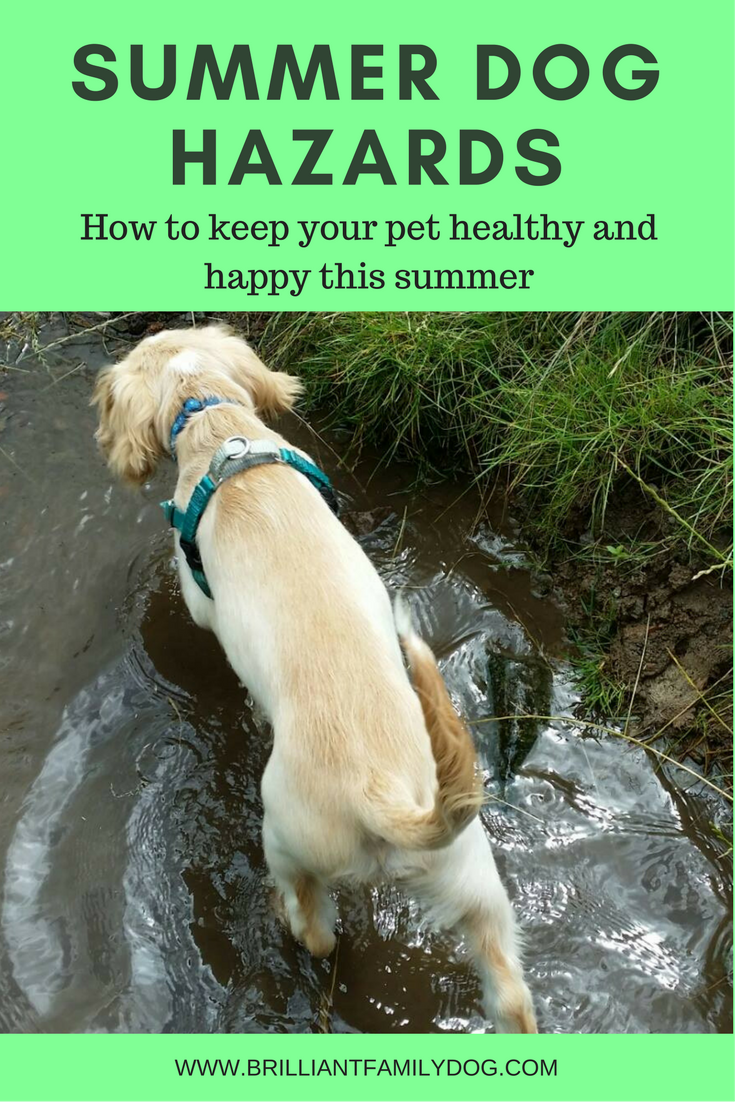
  • Swimming is a great way for a dog to keep cool in warm weather. The evaporation draws plenty of heat off the body. If there’s no water to swim in (paddling pools are great fun), you can wet his head to help cool him, and I’m a great fan of the wet t-shirt!

A cool stream is the perfect place for a hot puppy

A cool stream is the perfect place for a hot puppy

Soak the shirt, wring it out a bit, then put it on your dog, tying the excess in a knot on his back near his tail to keep it from flapping around his hind legs. You’ll need to resoak it regularly depending on how sunny it is.

Small dogs can fit a child’s t-shirt - or, of course, you can buy custom dog shirts. Some are made of fabric that retain the moisture longer and are marketed as cooling shirts.

And a tip from Ellie the Briard in Italy - fill a plastic water bottle with cold water, screw the cap on tight, and see how long it takes your dog to turn it into a fountain!


  • Puppies find it harder to regulate their body heat, so they can get too cold or too hot quite quickly. If they get wet and the weather is cool, you need to dry them carefully. They don’t have an undercoat - their puppy fluff will become their undercoat when the coarser guard hairs grow - so they can chill fast.


  • Dogs with non-pigmented skin, usually found like little pink maps above the nose, can suffer from sunburn, so suncream suitable for children can be used. It has to be safe if swallowed. 

Some white dogs (and cats) have the same problem round their eyes and on the edges of the ears - prime areas for skin cancers to develop - so they need sun protection through the whole summer.


  • From midsummer, grass seeds prove a nuisance. Their sharp points can penetrate skin and work their way in. It takes me a while to go over my crew after each walk to remove them all. That alone is a good reason for keeping paw hair trimmed and feet neat, so the seeds can’t get into the foot and travel up inside the leg.


  • Sunbathing snakes are a hazard to watch for. Urgent veterinary attention will be needed for a bite - usually to the face of the curious dog.


  • Bee and wasp stings can usually be dealt with at home, if not multiple. Remember B for Baking Soda (for Bee stings) and W for … Vinegar (for Wasp stings). Bit of a stretch, that, but it helps me remember! One sting is acid and the other is alkali, so you need to neutralise them.


  • More summer country walks will mean more ticks climbing on board. You can get a handy gadget to remove them. It may take a few days before they’re clearly visible. They look like a small baked bean sticking out of the hair.


This is just a brief rundown of summer hazards. It’s worth having a look in Google, especially for your area, so you are forearmed.

And to help keep your dog where you want him, have a look at this free e-course about everyday dog problems.

If you need help putting this theory into practice, be sure to watch our free Workshop on getting your dog to LISTEN, without nagging, cajoling, or bribery!

Summer dog hazards

Less control but more understanding saved this rescue dog

  • You couldn’t find a nicer pair of people. A smashing young couple whose lives were dedicated to helping others. So wouldn’t you think they’d be able to manage a new dog in their household?

Sadly, no! Well-intentioned as they were, they had a fear of the dog doing something bad, and this gave them the wrong approach. 

Jimbob was a rescue dog. He’d had a bad start in life, lived with someone who was harsh with him, and he’d developed lots of strategies for survival. When he arrived with his new owners, he simply carried on doing the things he’d learned. And they had no idea how to deal with this.

His repertoire included:

  • Chewing everything

  • Escapology

  • Inability to relax

  • Destruction (his crate, his bed, furniture …)

  • Refusing to relinquish prize articles he’d found

  • Growling, teeth-baring, snapping

Defiant and Stubborn?

Jimbob’s owners had unwittingly managed to escalate the situation by challenging him over all of this. They misread his survival strategies as defiance, his refusal to comply as stubbornness. Fortunately when they realised they needed help they scrapped the coercive trainer they’d been going to and chose a force-free trainer, viz me.

So we started to work with Jimbob instead of against him.

His owners worked hard and made speedy progress. They were surprised not only at how willing Jimbob was to learn, but how easy it became to divert him from one of his annoying habits into one of the new games which they were teaching him. 

After only a few sessions (and much dedicated homework from his family) Jimbob was happy to go into his crate and find the things given to him to chew there. He was free to rip up his own blankets if he wished and not a word would be said.

He no longer growled or bared his teeth, because his owners now knew how to get what they wanted without threatening him. 

  • They started playing new games with him that engaged his breed-specific instinctive drives (hunting and sniffing, mainly)

  • They taught him tricks

  • They interacted with him in a relaxed way

  • They stopped trying to control this wayward creature and instead rejoiced in giving him more freedom

  • And they ended the day with a happy, sleepy dog!

By the time their course was over, Jimbob could sleep in his crate while they worked at their desks, and was happy to rest there quietly when they were out.


Before: “He steals food all the time. Destroys cushions, blankets, curtains, parquet flooring - happens daily. Growling, snarling.”


After: “Thank you so much for all your help with Jimbob; he is certainly much less boisterous and we feel a lot happier and more confident in relating to him and encouraging him in his positive behaviours. It is actually easier than I thought to ask Jimbob to do something, rather than just telling him (or telling him off) all the time.”


While I was able to give this couple lots of techniques to change Jimbob’s ways, it was the change in their attitude to their new pet that formed the basis of their success. 

Is your dog or your little puppy throwing up more challenges than you anticipated? Watch our free Workshop and find how to change things fast!


Find some of the strategies we used in the detailed lessons in this free e-course:

THIS FREE ECOURSE IS A BONUS FOR YOU WHEN YOU SIGN UP TO RECEIVE EDUCATIONAL EMAILS AND OCCASIONAL OFFERS FROM ME. YOU CAN UNSUBSCRIBE AT ANY TIME.
Privacy Policy


The thorny subject of daycare and dog walkers

An excerpt from the Chapter on Stress in the forthcoming books, Essential Skills for your Growly but Brilliant family dog This article was first published on positively.com and is reprinted here with permission.

You’re invited to a family wedding for the weekend - great! But what will you do with your dog?

There’s always going to be a time when you need your dog to be minded for a period. Maybe you have some days when you can’t get away from work in the middle of the day to tend to her, perhaps you have to go away for a day for work or family reasons, or maybe you yearn for a holiday abroad.

(You may be missing a trick here! Holidaying with your dog, exploring your own country’s wonderful forests, moors, and beaches with your dog is an absolute delight. You need some preparatory training in place, then you’re away!)

But having a back-up minder who you’ve already checked out and approved is a good move, in case of an urgent absence from home.

The first place people tend to think of is a Doggy Daycare, or Boarding Kennels as they used to be known. They are assured by non-dog-owning friends - and the kennels - that their dog will be “fine!” and that they’re worrying too much.

In my experience, people don’t worry nearly enough! So anxious are they to solve their problem that they’ll buy into anything they’re told by the kennels.

Daycare or a dogwalker?

I am not going to tar all daycares and dogwalkers with the same brush. There are some excellent ones with committed, dedicated, and educated staff. But I will say that it’s very hard to find one convenient to you which is truly a safe place for your dog to learn and develop. 

Think of the skills you need as a parent to prevent open warfare in your own household! Then picture a gang of dogs being thrown together for a walk - or all day in a confined area - in the care of people who frequently have no dog training or behaviour qualifications whatever.

“I love dogs” may help, but it’s not a qualification.

And given how long it takes us to learn how to care for our own species - and that a lot of what people think about dogs is wrong - you’re going to be lucky to find somewhere safe for your dog.

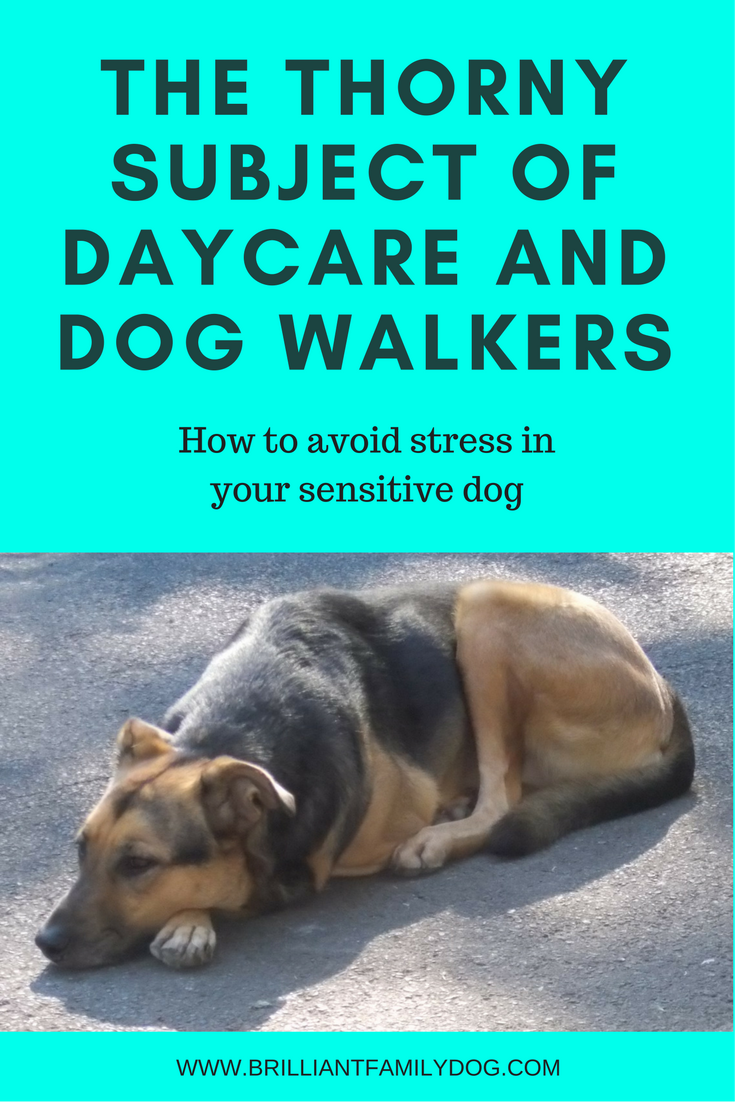
I was recently shown a promotional video for a daycare by someone who’s been sending her very reactive German Shepherd pup there for months. Even in this 30-second video - meant to show how wonderful the place was - I could see bullying and intimidation of this pup by other dogs, and no-one going to her aid. Imagine what this sensitive puppy is subjected to for ten hours a day, five days a week! No wonder her reactivity is already extreme at only six months of age.

What the owner thought of as being “perfectly happy at daycare” was in fact a dog that spent all day trying to avoid the other dogs (quite impossible with those numbers of loose dogs) - shut down, in other words. Not fine at all.

Keep in mind also that it seems to be common practice in many establishments for dogs to be dished out aversive “corrections” - from lead-snaps to water sprays, rough handling,  and much shouting.

A holiday camp?

For me, being transported to a holiday camp would be a nightmare! For many dogs, daycare is viewed with the same suspicion I view that holiday camp. A very perceptive reader sent me this query recently: “My question is, what do you think of daycare for dogs? Are the dogs actually happy about it, or do dog owners just like to imagine they are?”

My personal solution to an enforced absence from home is to have someone I trust to come in to let the dogs out in the garden and play with them for a while during the day. If I were leaving them for a longer time, I’d look into booking a house-sitter with the necessary knowledge to deal with reactive dogs - and that would be hard to find. I would not have my reactive dog walked out of the house - no harm in her getting her exercise in garden play for a short while.

If anything goes wrong in a daycare or with a dogwalker, you will be paying for that for years - possibly the rest of your dog’s life. It may or may not have been their fault, but it happened.

Think hard, and do a lot of homework, before going for that option.


For news about the release of these new books, go to www.brilliantfamilydog.com/growly and join us. You'll find all the information about my first four books here.


The thorny subject of daycare and dogwalkers

Give your dog an instant safe haven on walks

This post of mine first appeared on positively.com and is reprinted here with permission. More than two thousand readers liked it enough to share it on Facebook. So I thought you'd like to see it too!

We’ve all seen a small child clinging to Mom’s neck while he safely views the world from under her hair.

A little puppy has the same need for a safe haven.

You may have seen your own puppy hurtle in from the garden when there’s an alarming noise, and dive into her bed. Plunging into the den at speed is an important instinctive survival mechanism for vulnerable pups.

Gradually your whole home will become a safe haven for your dog, a place she can always feel comfortable and relaxed.

But what about when you’re out and about?

A Safe Haven in the Big Bad World

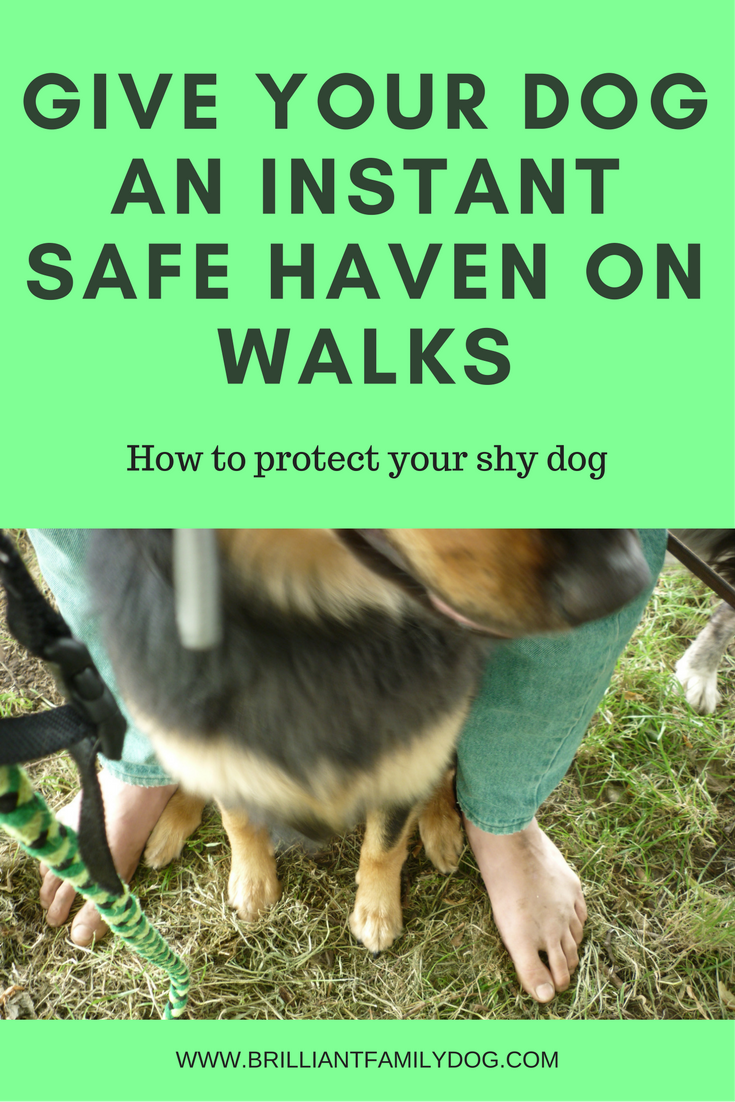
For a puppy, your safe haven will be between your feet. You should always protect your puppy from incursions from other eager puppies or dogs (or children, shopkeepers, parades with oompahs, sheep, noisy trucks …). If she backs herself between your feet she needs reassurance that she can safely watch the world from there.

Don’t worry - she’ll come out in her own good time, as she gains the confidence you can give her. Forcing her to confront her fears will only make them stronger, so give her time.

Quite a few puppies start puppy classes from under their owner’s chair! That’s fine, if that’s what makes them feel less vulnerable. By week 2 or 3 those same puppies are out and about exploring. Letting the pup choose when to venture forth is key.

All Grown Up

But once your dog is grown and bigger, what do you do?

You’re walking your dog on a leash and something appears that worries her. Now for many dogs a quick glance and appraisal of the situation is enough, and on you go.

But what if your dog is fearful or reactive? A dog who is always surprised by anything new appearing in her environment, and whose first response is often to bark to get it to go away?

If that’s your dog, then you need to know that with a reactive dog, Distance is your Friend. The first thing you need to do is get further away from whatever it is that’s alarming her (big dog? paper bag? person talking on their phone?).

But sometimes that’s not so easy!

If you’re walking on the street and someone approaches you with cries of “Oh what a lovely dog!” “Hallo doggie doggie!” “Dogs like me!” etc, you need something quicker - and perhaps more socially acceptable! - than turning on your heel and walking smartly away.

Distance, Close Up

Here are some actions I’ve found helpful for Lacy - a very pretty dog who attracts attention, but doesn’t want it!

1. Talk to the hand! As someone is approaching and just ready to dive on Lacy, I step side-on in front of her, hold up my hand like a traffic cop, and say “Hang on!” This normally brings the approaching hazard to a full stop and gives me time to organise the next step.

2. Carwash

New Puppy? Shy dog? | A safe place for your dog when worried | FREE EMAIL COURSE | #newpuppy, #puppypottytraining, #puppytraining | www.brilliantfamilydog.com

This is where Lacy runs back round my right leg and dives between my legs from behind. She’s now sitting in her safe haven between my feet. I can squeeze my legs softly on her shoulders to make her feel more secure. She’ll often put herself there if worried, without me having to say “Carwash!”

There are three huge advantages to this position.

•    One is that as Lacy goes round my leg her leash is now behind that leg. So even if the “oncoming hazard” still bends over, she can’t lunge forward to intercept them.

•    But this second one’s a winner: Very few people are going to make so bold as to bend over right in your personal space and reach down between your legs to touch your dog! Success!

•    And the third one is to lighten the social mood a little. Once Lacy is in Carwash, I can lift my hand in greeting saying, “Say Hi!” Lacy will lift her paw in a big high five swipe.

So she’s still “said hello” to the persistent hazard, without having had to risk her life by emerging from her safe haven.

I can hear some of you mumbling … if your dog is very large and you are not - what can you do? You don’t want to end up astride your dog!

Try a simple Get Behind. Send your dog round you so that, again, your leash is behind your legs, and your dog is peeping out by your hip. If your oncoming nuisance is unusually persistent, you can move slightly to body block them. Eventually they’ll get the message that they’re welcome to chat to you, but not to your dog, who has taken a vow of silence when it comes to strangers.

But All Dogs Love People: Really?

There’s a lot of social pressure on us to have a dog that conforms to the popular view that all dogs are friendly and welcome cuddles. But, of course, like people, some just “want to be alone”.

It’s not our dog’s job to provide cuddles and dogginess to the general population. In the same way that strangers don’t reach down and scoop your baby up from his stroller saying “I love babies!” - imagine! - they also don’t have the right to touch your dog without permission from you (and her).

If your dog likes nothing more than chatting to new people, then go for it, and enjoy her enjoyment. But if your dog is shy, allow her to retire to her safe haven without having to interact with scary strangers.

She’ll thank you for it.

Have you found a good strategy for keeping your scaredy-dog calm? Let us know in the Comments below!

And for more ideas for helping your anxious dog, get your free e-course My Dog Doesn’t Like Other Dogs: How to Stop the Barking and Lunging


Is your dog or your little puppy throwing up more challenges than you anticipated? Watch our free Workshop and find how to change things fast!

 A safe haven for your dog when out

The barking dog in the garden at no.11

Getting your anxious dog past gardens bristling with menacing, stamping, frothing, barking dogs is hard enough.

But if you have to run that gauntlet every day to get anywhere from your home, your dog’s anxiety will build and build.

Prompted by a question from a reader, I’m giving you today an excerpt from my forthcoming books devoted to improving the life of the Growly Dog: Essential Skills for your Growly but Brilliant Family Dog.

As my correspondent put it:

“Some days going out is a noisy, barking, snarling (from one of the other dogs), tugging mess.”

If a friend wanted you to come to the edge of a 200-foot cliff to admire the view out to sea, you may be filled with terror at the thought. If he grabs you and drags you even one step nearer the edge you’re going to panic, shout, pull back from him. If he lets you go and allows you to get on your hands and knees, perhaps you may crawl a little closer to the edge.

Perhaps you’ll get a glimpse of the beautiful view, and feel able to crawl a yard nearer the next day. This is a gradual process. Maybe that’s as near as you’ll ever get to the cliff-edge (you certainly wouldn’t get me standing at the edge!) and that will do.

This type of fear will never get better on its own

It will tend to grow and grow till quite possibly your dog resists having her harness and lead put on, as she knows she has to do the “terror run” as soon as you leave the house. I would suggest giving your dog a holiday from this stress, by taking her to your walking place in the car for a few days.

Once her hormones have settled and she’s not filled with dread at the front door, you can start giving her some control over the walk, by letting her make the decisions.

The only decision she can’t make is to join in the noise and dancing. If that happens it will mean you’ve got too close and you’re undoing the benefit of the few walkless days.

So you’re going for a walk around your neighbourhood and you decide that today is the day you’re going to work on passing the Barking Dog in the Garden at No.11. Usually you can only get past no.11 while dragging your screaming dog with you.

Your aim is not going to be to breeze past no.11 in a happy cloud (though that will come later - really!) but to give your dog time, at a comfortable distance, to assess the Barking Dog. Keeping mindful of traffic on this road, give your dog a good length of lead and let her just stand and watch no.11.

When she breaks off and looks to you for guidance on where to go next, allow her to wander a few steps. If she’s going towards no.11 slow-stop her and wait, with soft hands.

Empower your dog!

Let her make the decisions about when and where she wants to move, and only intervene if you can see things are going pear-shaped.

During this session you may get within a couple of houses of no.11 without any bad reaction from your dog, the Barking Dog barking all the while. Maybe that’s enough for today?

Make a note of the tree or fence you reached, and start a bit further back from that tomorrow. Maybe then you’ll get a good few yards further without incident.

And yes, one day you’ll be able to walk past no.11 - probably on the other side of the road - with happy smiles and a carefree manner from both of you! I am always pleased and proud when I walk my four past a yapping gateway we have to pass. My group of four includes two reactors. They cast a glance towards the yappers and carry on trotting by.

Takeaways

The essence of this system is to

  1. make haste slowly - progress at a pace which allows your dog to stay comfortable

  2. give your dog the power to make her own decisions

  3. mark good decisions enthusiastically

  4. allow your dog time to assess the situation - it’s often way longer than you expect!

  5. remember your object is not to get past no.11 but for your dog to stay calm and feeling in control


Remember the clifftop and your friend’s enthusiasm to share his pleasure in the beautiful view?

The view is not beautiful if you are terrified.


This is an edited extract from my forthcoming books Essential Skills for your Growly but Brilliant Family Dog


Is your dog throwing up more challenges than you anticipated? Watch our free Masterclass and find how to change things fast!

Why is my dog barking and lunging at other dogs?

“She’s such a lovely dog at home!”

And that’s normally the case. Just because a dog has an issue with other dogs does not mean she’s a bad dog in every way.

You know what a smashing dog she is at home - a Brilliant Family Dog! - and you’d like others to see what you see.

Instead of what they see: A fury of teeth, claws, and noise, who looks as though she wants to kill them, their children, and their dog.

I know just how you feel, because I’ve been there! And changing the way Lacy views the world has been a fascinating journey that has resulted in being able to help lots of other Lacys and their ragged owners.

Lacy is deeply suspicious of everyone and everything on the planet. Her response? To shriek at it to go away; to look her most ferocious; to keep things out of her space by leaping and lunging at them. The most adorable and affectionate (and intelligent) dog at home - with a great sense of humour - she was viewed by everyone else as some kind of deranged monster. But she's come on so much that she is now able to help me working with other reactive and fearful dogs.

It will help you to know from the outset that this type of behaviour is normally the result of fear. Not nastiness, aggression, “dominance”, or any of those other labels. Just plain tail-wetting fear.

Your dog is afraid of the oncoming dog. She needs to keep it away!

So she bares her teeth, makes herself look bigger, and shouts at him.

It’s likely that you get upset and try and rein her in or drag her away. It’s likely that the oncoming dog’s owner is alarmed (and probably looking down their nose at you). And it’s quite likely that the other dog will say “Who’re you lookin’ at?” and join the barking party.

The whole episode is upsetting and exhausting.

You start to walk your dog at the Hour of the Difficult Dog, late in the evening, when everyone is trying to avoid everyone else.

Is this why you got a companion dog?

Let’s have a look at what you can do to change things.

1. First thing is to stop walking your dog

What??? Let me explain.

Can you imagine that you had to walk along a narrow and uneven cliff path with a 200 foot drop. There is nothing to hold on to. The ground is crumbly and sometimes you skid and dislodge a lump of rock that bounces down the cliff and splashes silently into the sea below.

For most people this would be a living nightmare, a “terror run”. You would be desperate to get out of the situation. Your hormones would be racing through your body.

You eventually get home and begin to calm down.

The next day you have to walk the path again.

And the next day …

Quite soon you’re in a state of permanent panic. You dread the cliff path.

You need a break from this terror. Your hormones need to settle so you can see the world clearly. As does your dog.

You won’t stop walking your dog for ever. Just give her a few days’ break so that she can get back to normal. You can play great games at home to give her some exercise.

As neither of you is enjoying the walk, nobody will miss it.

After that, this bit is easy:

2. Teach her that she never has to meet another dog ever again (until she wants to)

And by this I don’t mean you are sentenced to the Hour of the Difficult Dog for ever.

Back to you and your terror run again: rather than staying at home for ever, you have a companion who can guide you. As you approach the cliff path, he turns you away from it and says, “Let’s go this way,” and heads right away from the edge.

Can you imagine the relief you feel? No need to plead with him and say, “Please don’t make me go on the path!” He guides you away to safer ground every time he sees a dangerous path. Your trust in him grows. You begin to enjoy your seaside walks.

So it is with your dog. The moment you see another dog or person heading your way, you give a cheery “Let’s go!” and head in the opposite direction. Your dog will enjoy the fact that she doesn’t have to get upset and go through the shouting routine.

You want to avoid narrow lanes where there’s no escape, so you may have to take a longer route to get where you want to go - or even drive till you are at an open space.

But you don’t want to avoid dogs.

She won’t learn what you want her to learn unless you do it, so eschew the Hour of the Difficult Dog and go out where you will see dogs - but at a safe distance.

These two things alone will make a huge difference to your dog, your walks, your relationship with your dog, and your enjoyment of life with her. If you did nothing else, this will improve the situation dramatically.

But this is just a start: naturally there are lots more things you will be able to do! There are techniques which I’ll show you. But the first thing you need to do to a wound is to stop it bleeding. Only then can you start the healing process.

First, realise that your dog is afraid, and is as uncomfortable as you are. Reasoning with her will not work. Until you can get help from a force-free professional, avoidance is the short-term answer.

Second, remember that you are her guardian and protector - give her the help she needs to cope with our world.

No idea how to start?  This free e-course will get you going: 

THIS E-COURSE IS A BONUS FOR YOU WHEN YOU SIGN UP TO RECEIVE EDUCATIONAL EMAILS AND OCCASIONAL OFFERS FROM ME. YOU CAN UNSUBSCRIBE AT ANY TIME.
Privacy Policy