5 Surefire Tips to Get Your Dog to Jump Up on People


There’s a ring at the doorbell.

While you make your way to the door your dog is running rings around you, barking, jumping, grabbing at toys. 

You yell “Stop! Get down! Be quiet!” Now you’re both barking!

You open the door and your dog launches himself at your visitor, striking her amidships, sending her reeling.

You yell “Stop! Get down! Be quiet!” 

Your visitor staggers through the door with your dog dancing in front of her on hind legs, grabbing at her sleeve and leaving drooly smears on her bag.

You yell “Stop! Get down! Be quiet!” 

Like this? For more simple remedies like this one, and lots of how-to’s, join us here!

THIS FREE ECOURSE IS A BONUS FOR YOU WHEN YOU SIGN UP TO RECEIVE EDUCATIONAL EMAILS AND OCCASIONAL OFFERS FROM ME. YOU CAN UNSUBSCRIBE AT ANY TIME.
Privacy Policy

Your panting dog stands still for a moment.

You yell at him for being a bad dog.

Your visitor says “I won’t stay,” and starts to make her escape.

As she leaves you grab at your dog’s collar to stop him running out after her.

You close the door and shake your head in exasperation at your happy dog.

Look familiar? 

Here are my 5 Surefire Tips to ensure that this happens every time:

  1. Make sure dog is super-excited and racing around loose, barking

  2. Shout “Get off! Stop! NO!”, wave arms, dance, add to the excitement

  3. Give dog lots of attention for jumping on people and no attention whatever when his feet are on the floor

  4. Make sure dog knows that wherever he goes and whatever he does, it’s WRONG

  5. Don’t bother to train your dog. After all your old dog didn’t do it (though he was 12, come to think of it)


WAIT! You don’t want this to happen? 

You really want to change things? Ok - have a look at these:

  1. To contain the flying excitement, clip a lead onto your dog’s collar and put your foot on the lead so that he’s still free to sit, stand or lie down, but can’t jump up

  2. Greet your guest and ask them to ignore dog

  3. When your dog is sitting or standing patiently, ask guest to hold their palm out for the dog to sniff

  4. Reward your dog with a treat and gushing praise as you draw him gently back to your side

  5. Cleverclogs stuff: teach him to go to his bed near the door when the doorbell rings, and stay till invited off


Practice makes Perfect - so try this out with a friend who is prepared to wait outside the door while you take your time and calmly lead up your dog without having to worry about someone waiting for you. 

You could practice each stage with your friend, so that if your dog tries to leap up when the door opens to reveal the visitor, you can simply close the door gently and open it again when he’s calmed down a bit. 

Your dog will soon understand that it’s his good choices that enable you to open the door and admit the visitor! Such empowerment will have him making those good decisions over and over again.

Your regular visitors will be astonished and amazed, and glad that they’re able to wear ordinary clothes to visit you instead of disposable overalls. 

And they won’t need the ear-defenders any more either!

Maybe your dog’s been doing this since forever - but you can change it! It’ll take a bit of time and application, but you’ll be so glad when you can welcome a visitor to your home without them getting mobbed! You’ll be proud of what you’ve achieved, proud of your dog, and relieved that you’re no longer the big bad shouting joy-killer.


Is your dog or your little puppy throwing up more challenges than you anticipated? Watch our free Workshop and find how to change things fast!

Puppy dogs' tails tell their own story

Wouldn’t it be great if we had tails!

Dogs’ tails are so expressive. You can see what they’re thinking when you’re behind them, beside them, at a distance. There is a whole chapter in the Dog Body Language Primer on Tails. You may not have heard of this volume, but all dogs get it downloaded into their brains at birth - it’s how they naturally express themselves.

And we - people - tend to dismiss it. “Oh, he’s wagging his tail - he must be happy.”

Some of the time he’s wagging his tail - yes, he’s happy. But some of the time he wags his tail out of anxiety, anger, anticipation. Many a person has been bitten by a dog with a wagging tail!

It’s how they are wagging it that’s important

Did you know, for instance, that when a dog is greeting someone he knows and loves, he’ll wag his tail to the right? Sometimes, when really delighted to see his person, the whole back-end will wag to the right. Your dog will be in a kind of banana-shape as he runs towards you, tail a-wag on his right side, ecstatic grin on his face.

You can see some great info in this article by Stanley Coren which tells you about some of the finer points of tail carriage and movement. But if you just realise that your dog is speaking to you through his tail, you’ll learn an awful lot of his lingo by just tail-watching. 

The skeleton all being connected, it’s impossible, of course, for the tail to go a particular way without affecting the whole body posture. A terrier standing with tail stiff and erect will also have a stiff and erect body, stiff face, closed mouth, and unblinking eyes. A spaniel in full pleasurable wiggle will have trouble keeping any part of himself still - he’ll stay close to the ground, wriggling in a blur.

And a gundog on point will do just that - stand as still as a statue, every fibre pointing towards his prey, foreleg poised, neck stretched forward, tail stretching straight back: one big arrow pointing at the bird.

So you need to look at the whole dog when you decide whether this dog is friendly or not. His body - and especially his tail - will tell you more than just a bland “He’s happy”.

For lots more puppy essentials, get our free e-course on everyday dog problems and their force-free solutions.


Is your dog or your little puppy throwing up more challenges than you anticipated? Watch our free Workshop and find how to change things fast!

New Puppy owners start here!

10 Tips for creating a great vet visit for your dog

Let’s face it, visiting the vet could feel to your dog like visiting the dentist feels to many of us!

Dragging an unwilling dog through the door, then trying to stop her panting, pacing, and barking at everything that moves, is stressful for both of you.

Your puppy’s first visits to the vet will have involved being stabbed with needles and possibly having things stuck up her nose or her bum or down her throat. If not carefully managed - giving your pup a reason to enjoy the visits - this can turn into a fear of the vet.

And if you have a rehomed dog, she may have had unfortunate experiences at the vets in the past. She may have been afraid and then punished for her fear.

If you can ensure your dog enjoys her visit to the vet, then life is going to be much easier on future visits - and, of course, that’s exactly what vets and their staff want too! It’s no fun for them to wrestle with a distressed dog when they need to examine and administer treatment fast.

The more relaxed your dog is, the easier it will be for the vet to examine, assess, and treat her. If your dog is injured in an accident, you want her to feel as comfortable as possible in order to recover quickly - not be stressed and terrified. You’ll already be distressed and upset yourself, and anxiety is very “catching”. If you know your dog is ok with vet visit procedures this will be one less thing to worry about.

So let’s look at a few things which will turn your vet visit into a happy adventure:

1. Be prepared

Take your dog’s mat or bed or some other kind of “security blanket” - perhaps a favourite cuddly toy - which will relax her. If this is a routine visit you can also take treats, chews, and food toys for her to enjoy on her mat. Take care that other dogs are at a safe distance where food is involved, just in case.

2. Party time - not

A vet visit is not a doggy social occasion! By all means, chat to the others in the waiting room. Just be sure your dog doesn’t join in the conversation. Take a place well away from the main door with all its frantic comings and goings.

3. Cats and rabbits in their cages

are already disorientated and apprehensive - they don’t need a big snuffly nose at their cage door, frightening the living daylights out of them!

4. Other dogs in the waiting room

Why are they there? They may be contagious, or hopping with parasites, so you don’t want any contact between your pet and them. Or they may be frightened, or in pain, and will not welcome attention from your dog (or, possibly, from you). If you’re in pain and someone starts badgering you, there’s a good chance you’ll snap at them! Dogs are no different. I have seen the unpleasant consequences of a puppy being allowed to jump up on such a dog. Keep your eye on your dog and your lead short, and don’t get distracted chatting to someone.

5. A long wait

If your appointment is delayed because the vet has an emergency - and the waiting room is heaving with miaowing, whining, squawking, and barking, customers - leave your mobile number with the receptionist and head off for a walk. There’s no need to spend twenty minutes working hard to keep your dog calm if it can be avoided.

6. Park your Dog

When you’re occupied with the staff - sorting your bill or getting instructions for your meds - a good place to put your dog is between your feet. Stand on the lead so he can’t wander off. 

7. Take your time

You can ask to bring your fearful dog in at the beginning or the end of surgery times and possibly through a back entrance, avoiding the Waiting Room altogether. When my fearful dog Lacy had to go in for surgery, I requested to stay with her till she had become drowsy. We had a darkened room to ourselves where I read a book while soothing my anxious dog on her mat. By the time the vet nurse led her away she remarked that Lacy was calmer than most “ordinary” dogs. If your vet is really unsympathetic (this is unusual if you’ve explained things in a non-demanding way) you can vote with your feet and find a vet more suited to caring for your dog.

8. A Greeting? Or an Assault?

Imagine you’re going to visit that dentist. You are standing in reception when the dentist reaches into your mouth and starts poking about inside it. Your reaction? Horror! You need to give someone permission to manhandle you, and when we accept the dentist’s invitation to sit in The Chair, we are giving that permission. In the same way, you can lift your dog onto the examination table for the vet to attend to him, rather than the vet approach him when he’s standing on the floor, turning what the dog thought was going to be a greeting into what seems like an assault. If your dog is large you can ask him to step up onto a chair then onto the table. Involving the patient in the treatment will lessen the stress considerably.

9. Safety first

If you know that your dog is very nervous and given to panic, train her to accept a basket muzzle beforehand. If the vet staff have reason to believe they are going to get bitten, then naturally they will need to muzzle your dog. How much easier if your dog already associates the muzzle with treats and good experiences, and you put the muzzle on her yourself!

10. There is a place for a social visit!

The Vets has a very strong, characteristic smell. You need to associate that smell with good things. Visiting the waiting room on other occasions - when it’s quiet - your dog can have friendly and non-confrontational interactions with staff. Your dog might get some treats for sitting on the scales so you can track her weight, or simply have the chance to snuffle about and learn that the distinctive smell of the vets is just part of life and not doom-laden. In my experience this is something that vet staff welcome. One vet told me, “I wish all my clients did this!” They do not relish having to fight with distressed and panicky dogs who may end up biting! It’s in everyone’s interest for your dog to enjoy vet visits.

Every time we take our dog to the vet we need to be thinking of the next visit. Having a plan and a few props will help you to relax and enjoy the visit too.


For more workarounds for everyday problems with your dog get this free e-course.


And if your dog is especially anxious, this is the free email course for you

THIS E-COURSE IS A BONUS FOR YOU WHEN YOU SIGN UP TO RECEIVE EDUCATIONAL EMAILS AND OCCASIONAL OFFERS FROM ME. YOU CAN UNSUBSCRIBE AT ANY TIME PRIVACY POLICY

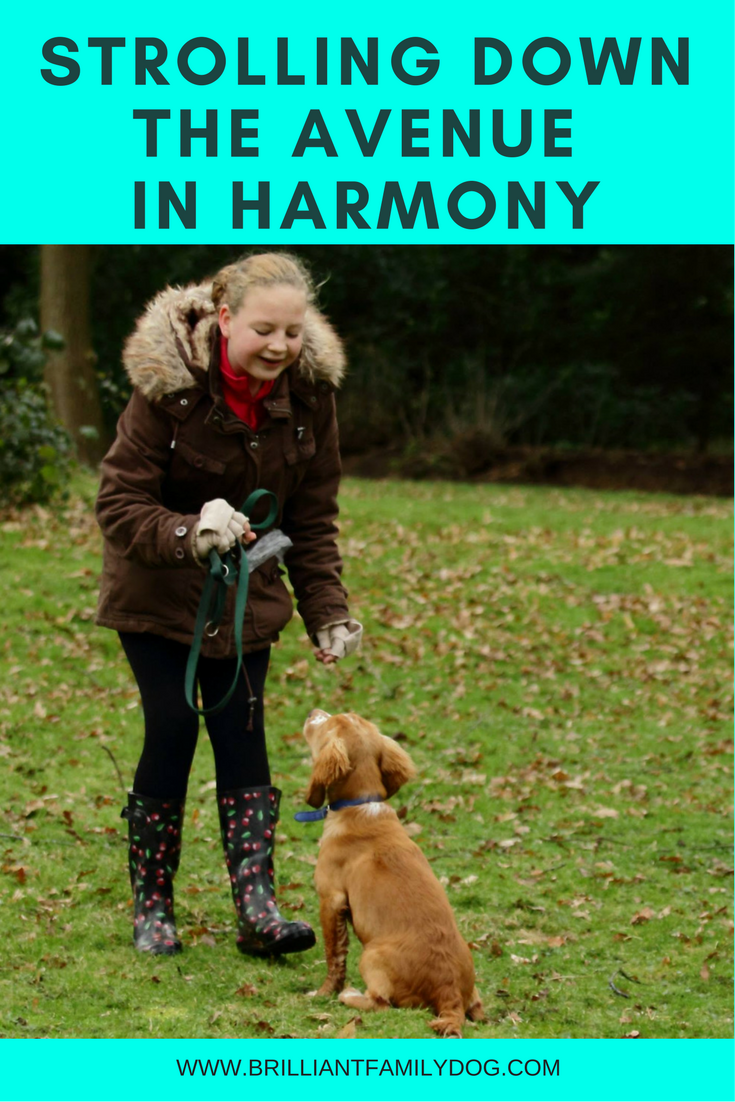
Strolling down the avenue, arm in arm


Is that how you’d like your dogwalks to be?

That metaphor - of enjoying life together with respect for each other - doesn’t just apply to strolling along the street. It applies to everything you and your dog do together.

  • Can you imagine just how much easier life would be if you never had to argue, command, or reprimand your dog?

  • How would you like it if she just fell in with your wishes without you even having to voice them?

  • When you want her to do something, would you like to change her present response to you of “Make me!” to “Okey dokey, sounds good to me”?

Instead of focussing on individual actions like Sit or Walking nicely on the Lead, look deeper.

Look at what’s going on between you all the time

If your dog is putting her head down, leaning into her collar and pulling away from you constantly, this is not a pleasant walk enjoyed together!

If, when you ask her to sit, she shuffles, looks from side to side and when she sees no escape she slowly and grudgingly sits, then this is not a willing response, freely given.

In other words your dog isn’t enjoying fitting in with you! This often happens when she feels she’s forced into complying, instead of having a choice.

So it may surprise you to know that the answer to these problems (and the slow sit and distracted pulling are just two symptoms of many I could list) is not to practice millions of sits, or miles of road walking.

Instead you need to focus on the tit for tat of daily life.

Focus on what you want

Attentive puppy

You don’t ignore or snap at your partner all day long, then expect to enjoy a lovely holiday together! It’s all the tiny exchanges - smiling as you pass each other on the stairs, offering a cup of coffee, helping to carry things without waiting to be asked, showing interest in their activities and opinions - that shape a relationship.

And do you ask or suggest things to your partner, rather than commanding or ordering?

So it is with your dog. If you focus on all the little things, the big things will fall into place.

  1. Always reward your dog when she’s doing something you like. Never ask her without being prepared to follow through to her reward. (Remember, a reward is anything your dog finds rewarding - a treat, a cuddle, dinner, access to the garden, a game …)

  2. Ignore things you don’t appreciate. Think, “Do I really want to have a fight over this?”

  3. Manage your dog’s life and environment just enough to ensure that she can’t do the things you don’t like.

That is the recipe for peace and harmony in the home. You probably did it with your children. You probably do it with your partner.

Just extend your patience and understanding to your pet and you will start to see results everywhere.


And for more detailed suggestions for making this all go swimmingly, get our free email course here!

Living in harmony with your dog

Summer dog hazards

We’re having quite a mixed bag of weather in the UK this summer! From the hottest July day ever to cool summer soakings. So it’s worth taking a look at how these hazards can affect your dog. We all know that cars can turn into killing ovens within minutes on a sunny day, whether the windows are open or not.

But there are other times dogs can get dangerously overheated:

  • Dogs can only lose heat through their pads and their tongues. If your dog has been racing about in warm or close weather, you can tell from the style of his panting just how hot he is.

If his tongue becomes very wide in a big spoon shape it means his body is doing its best to get rid of excess heat. If he’s breathing really fast and his sides are heaving, long after exercise, then you need to cool him and monitor his movements.


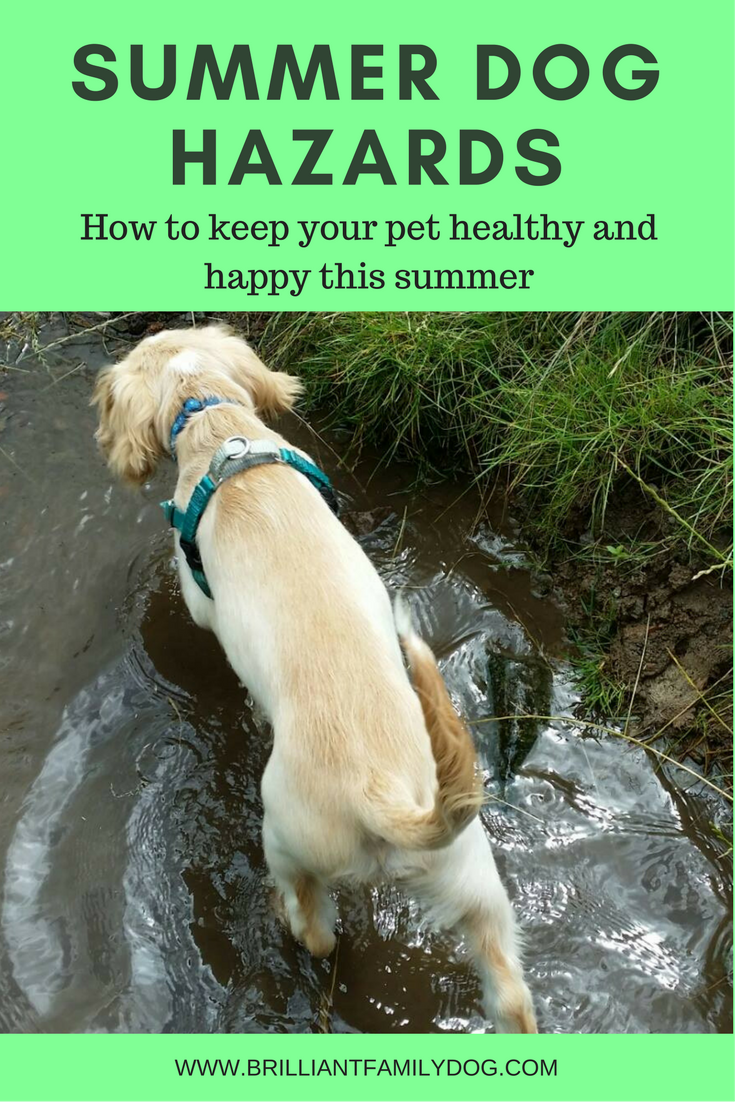
  • Swimming is a great way for a dog to keep cool in warm weather. The evaporation draws plenty of heat off the body. If there’s no water to swim in (paddling pools are great fun), you can wet his head to help cool him, and I’m a great fan of the wet t-shirt!

A cool stream is the perfect place for a hot puppy

A cool stream is the perfect place for a hot puppy

Soak the shirt, wring it out a bit, then put it on your dog, tying the excess in a knot on his back near his tail to keep it from flapping around his hind legs. You’ll need to resoak it regularly depending on how sunny it is.

Small dogs can fit a child’s t-shirt - or, of course, you can buy custom dog shirts. Some are made of fabric that retain the moisture longer and are marketed as cooling shirts.

And a tip from Ellie the Briard in Italy - fill a plastic water bottle with cold water, screw the cap on tight, and see how long it takes your dog to turn it into a fountain!


  • Puppies find it harder to regulate their body heat, so they can get too cold or too hot quite quickly. If they get wet and the weather is cool, you need to dry them carefully. They don’t have an undercoat - their puppy fluff will become their undercoat when the coarser guard hairs grow - so they can chill fast.


  • Dogs with non-pigmented skin, usually found like little pink maps above the nose, can suffer from sunburn, so suncream suitable for children can be used. It has to be safe if swallowed. 

Some white dogs (and cats) have the same problem round their eyes and on the edges of the ears - prime areas for skin cancers to develop - so they need sun protection through the whole summer.


  • From midsummer, grass seeds prove a nuisance. Their sharp points can penetrate skin and work their way in. It takes me a while to go over my crew after each walk to remove them all. That alone is a good reason for keeping paw hair trimmed and feet neat, so the seeds can’t get into the foot and travel up inside the leg.


  • Sunbathing snakes are a hazard to watch for. Urgent veterinary attention will be needed for a bite - usually to the face of the curious dog.


  • Bee and wasp stings can usually be dealt with at home, if not multiple. Remember B for Baking Soda (for Bee stings) and W for … Vinegar (for Wasp stings). Bit of a stretch, that, but it helps me remember! One sting is acid and the other is alkali, so you need to neutralise them.


  • More summer country walks will mean more ticks climbing on board. You can get a handy gadget to remove them. It may take a few days before they’re clearly visible. They look like a small baked bean sticking out of the hair.


This is just a brief rundown of summer hazards. It’s worth having a look in Google, especially for your area, so you are forearmed.

And to help keep your dog where you want him, have a look at this free e-course about everyday dog problems.

If you need help putting this theory into practice, be sure to watch our free Workshop on getting your dog to LISTEN, without nagging, cajoling, or bribery!

Summer dog hazards

Less control but more understanding saved this rescue dog

  • You couldn’t find a nicer pair of people. A smashing young couple whose lives were dedicated to helping others. So wouldn’t you think they’d be able to manage a new dog in their household?

Sadly, no! Well-intentioned as they were, they had a fear of the dog doing something bad, and this gave them the wrong approach. 

Jimbob was a rescue dog. He’d had a bad start in life, lived with someone who was harsh with him, and he’d developed lots of strategies for survival. When he arrived with his new owners, he simply carried on doing the things he’d learned. And they had no idea how to deal with this.

His repertoire included:

  • Chewing everything

  • Escapology

  • Inability to relax

  • Destruction (his crate, his bed, furniture …)

  • Refusing to relinquish prize articles he’d found

  • Growling, teeth-baring, snapping

Defiant and Stubborn?

Jimbob’s owners had unwittingly managed to escalate the situation by challenging him over all of this. They misread his survival strategies as defiance, his refusal to comply as stubbornness. Fortunately when they realised they needed help they scrapped the coercive trainer they’d been going to and chose a force-free trainer, viz me.

So we started to work with Jimbob instead of against him.

His owners worked hard and made speedy progress. They were surprised not only at how willing Jimbob was to learn, but how easy it became to divert him from one of his annoying habits into one of the new games which they were teaching him. 

After only a few sessions (and much dedicated homework from his family) Jimbob was happy to go into his crate and find the things given to him to chew there. He was free to rip up his own blankets if he wished and not a word would be said.

He no longer growled or bared his teeth, because his owners now knew how to get what they wanted without threatening him. 

  • They started playing new games with him that engaged his breed-specific instinctive drives (hunting and sniffing, mainly)

  • They taught him tricks

  • They interacted with him in a relaxed way

  • They stopped trying to control this wayward creature and instead rejoiced in giving him more freedom

  • And they ended the day with a happy, sleepy dog!

By the time their course was over, Jimbob could sleep in his crate while they worked at their desks, and was happy to rest there quietly when they were out.


Before: “He steals food all the time. Destroys cushions, blankets, curtains, parquet flooring - happens daily. Growling, snarling.”


After: “Thank you so much for all your help with Jimbob; he is certainly much less boisterous and we feel a lot happier and more confident in relating to him and encouraging him in his positive behaviours. It is actually easier than I thought to ask Jimbob to do something, rather than just telling him (or telling him off) all the time.”


While I was able to give this couple lots of techniques to change Jimbob’s ways, it was the change in their attitude to their new pet that formed the basis of their success. 

Is your dog or your little puppy throwing up more challenges than you anticipated? Watch our free Workshop and find how to change things fast!


Find some of the strategies we used in the detailed lessons in this free e-course:

THIS FREE ECOURSE IS A BONUS FOR YOU WHEN YOU SIGN UP TO RECEIVE EDUCATIONAL EMAILS AND OCCASIONAL OFFERS FROM ME. YOU CAN UNSUBSCRIBE AT ANY TIME.
Privacy Policy