“Designer Dogs”: what are they really made of?

It’s all the rage - dogs with cute monikers. 

You can find a Jackapoo, Cockerpoo, Labradoodle, Goldendoodle, Jackahuahua, Maltipoo, Puggle, Schnoodle, Cavapoo, Yorkipoo … and I have yet to discover the name of a Shih-Tsu crossed with a Poodle.

In many cases, people are seduced by the cuteness of the name and the celebrities who have also been seduced - and bought one. 

It tends to be first-time puppy buyers who go down this route, as they often have little understanding of breed characteristics. 

It’s not just about looks!

The problem is that as many of the crosses are inappropriate, you end up with a much more challenging dog than if you had gone for either a pedigree dog from a first-class breeder, or a genuine mixed-breed mutt from the shelter.

As a friend put it recently, describing a cocker spaniel x poodle (a so-called “cockerpoo”) she’d met:

“You have a dog who couldn’t care less about people crossed with a dog who wants to rule the world - not a good combination.”

I have found that this tremendously popular cross creates a lot of problems for the new puppy-owners I work with. It’s one of the most difficult crosses to manage and needs skill and knowledge of the characteristic behaviour of both breeds involved. I’m quite sure that the funny name is what has swayed many of these buyers. This is why I never use the cutesy titles people give me for their dog (which they usually say in an exaggerated way and accompanied by a shy giggle “It’s a cockerpooooooo!”). I call them what they are: a spaniel x poodle. That way I can keep their make-up in the front of my mind when working with them.

Oh, and having one parent from a non-shedding breed means you have on average a 50% chance of your puppy being non-shedding, or suitable for allergy-sufferers and the houseproud. Puppies barely shed any hair in the first year anyway, so the new owner doesn’t find out the truth for some time.

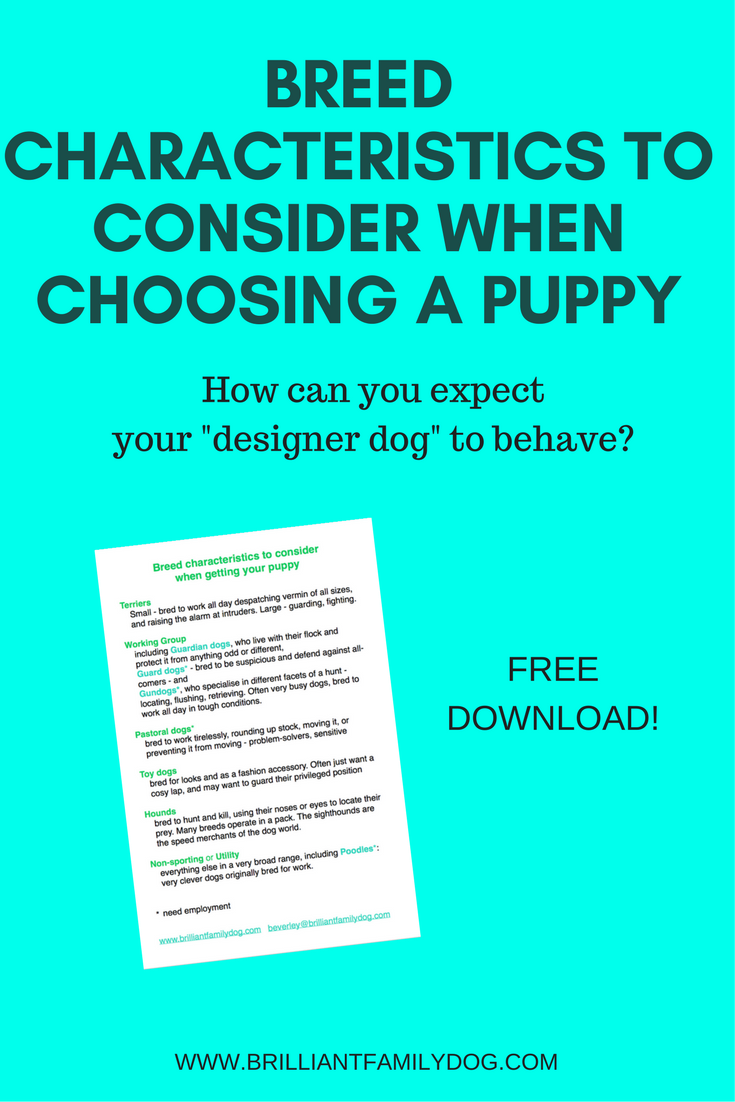
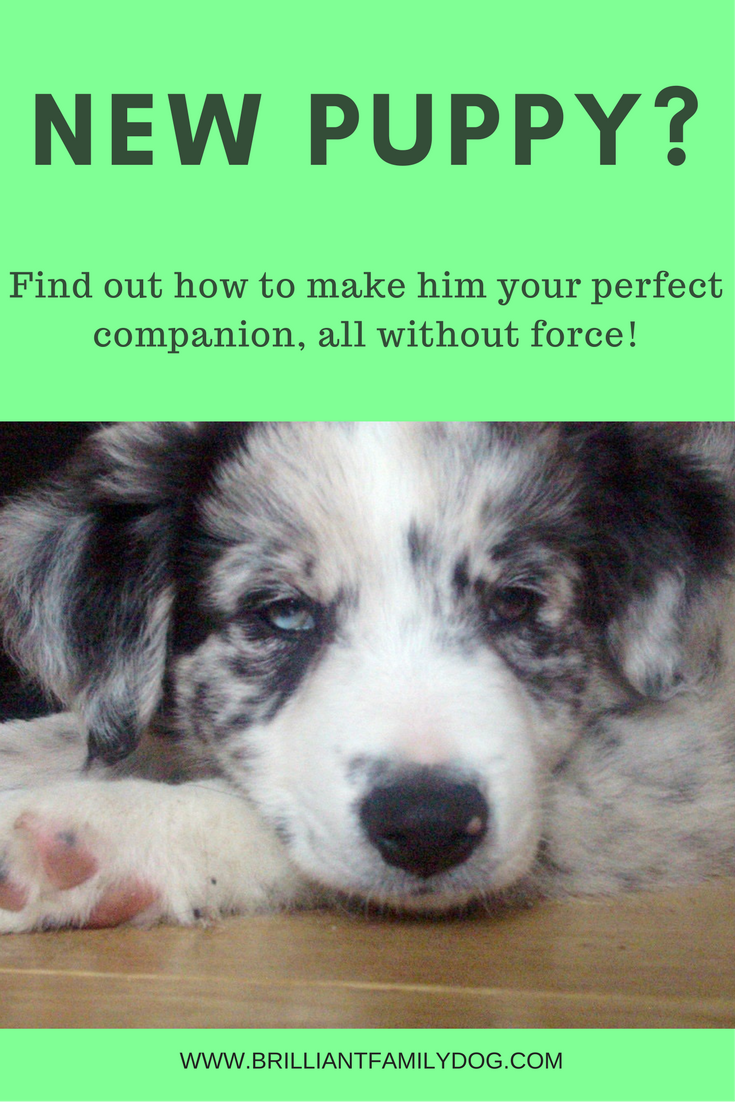
New Puppy? New Rescue Dog? | FREE GUIDE TO DOG BREED CHARACTERISTICS | #newpuppy, #puppypottytraining, #puppytraining | www.brilliantfamilydog.com

What happens when you mix them up?

Get our free download
to help you see the different characteristics of different breeds -
and what a combination could result in!

THIS GUIDE IS A BONUS FOR YOU WHEN YOU SIGN UP TO RECEIVE EDUCATIONAL EMAILS AND OCCASIONAL OFFERS FROM ME. YOU CAN UNSUBSCRIBE AT ANY TIME.
Privacy Policy

You need to look at the characteristics of the breeds you are crossing. A terrier, for instance, has been bred for centuries to hunt down and kill small rodents. This is why they are so popular on farms and in stables. They need to have an outlet for this instinctive drive. If you expect them to perch on a velvet cushion all day long because they’ve been crossed with some kind of fluffy, you are going to build up tremendous frustration and conflicts in your little dog.


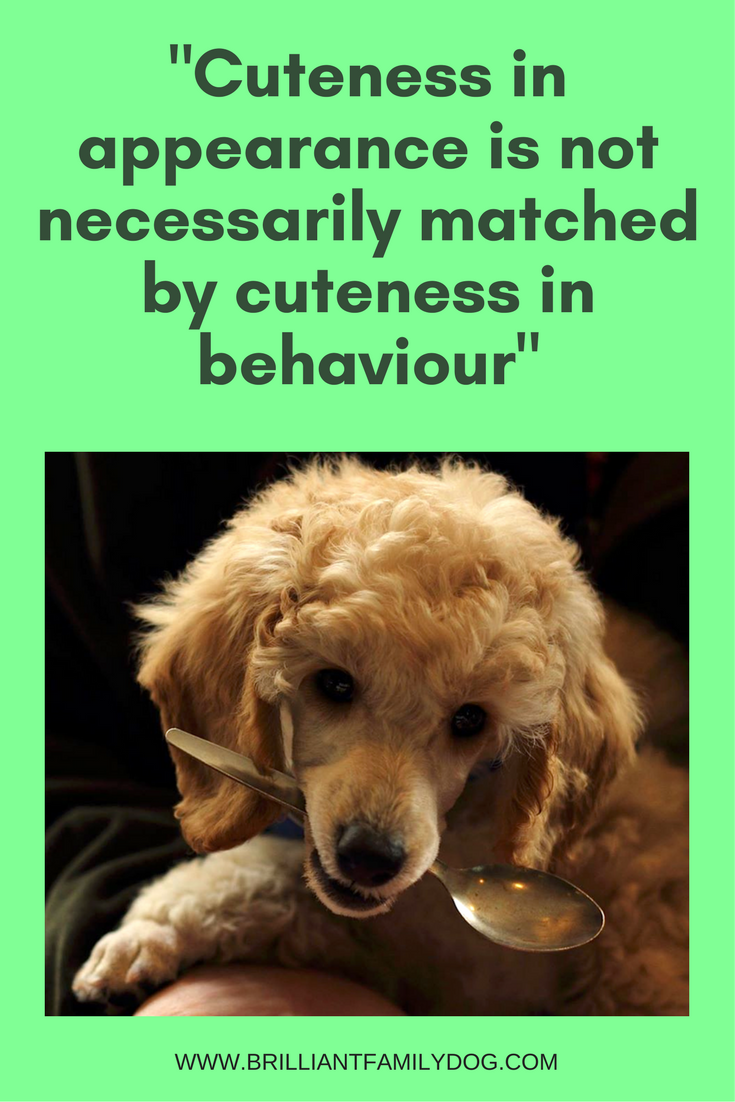
Cuteness in appearance is not necessarily matched by cuteness in behaviour.

We all know people who look just like one parent while having all the personality traits of the other. 

Another friend was toying with the idea of mating his two dogs - a reactive, longhaired, collie bitch and a cuddly, fast, whippet. He thought he would get lots of fluffy cuddly puppies. Genetics is a tricky and unpredictable game - even for those who know a lot about it. I warned him he may instead get a litter of very fast reactive dogs. 

Fortunately he realised that in any case his reactive bitch should not be bred from. “Reactive” is a catchall word for fearful, anxious, defensive. There would be a high likelihood of all the puppies following their mother’s example and being reactive too. The world does not need another six or ten reactive dogs!

And this leads me to the source of most of these “designer” dogs. 

What difference does the breeder make?

Good pedigree breeders spend a lot of time and money on producing the best puppies they can. The genetic testing they do is expensive and time-consuming. They choose pairings with enormous care, studying the history of the lines for behaviour, temperament, and health, and will only breed from the very best. 

They then devote months to caring for the bitch and rearing these puppies in an enriched environment - usually their kitchen and living room - taking special care over their socialisation and temperament, then carefully vetting prospective owners. The best remain available for advice and guidance throughout the life of the dog.

Do you think the same level of attention is given by the puppy farmers who produce many of these crosses? Do you think they pay for those expensive tests? Do you think they start off with the best possible stock? No pedigree breeder would let their puppies go to such a person, so they’re starting off with inferior animals right off the bat.

UK TV Vet Marc Abraham says, “You end up cross-breeding breeds which each often have their own genetic faults. So Labradors are prone to hip problems, and Poodles to eyesight problems. Cross-breed them and you get puppies prone to both conditions.”


Another Frankenstein

While these dogs tend to attract the inexperienced, they are by and large not a dog for the first-time buyer.

Even the person who bred the first, notorious, “Labradoodle” (a mistaken attempt to provide a guide dog for a blind person with allergies), Wally Conron, says, “I opened a Pandora's box, that's what I did. I released a Frankenstein. So many people are just breeding for the money. So many of these dogs have physical problems, and a lot of them are just crazy. I've done so much harm to pure breeding and made so many charlatans quite rich. I wonder whether we bred a designer dog—or a disaster!" 

People will pay absurd amounts of money for these unfortunate puppies. They don’t realise they are being duped by callous people who are cashing in on a craze. They fall for the puppy mill tricks and believe the puppy they’re getting is from the bitch that they’re shown, and reared in the comfortable house they visit. 

Some sharper buyers have doubts, but they still go ahead with the purchase as they want to “rescue” the puppy - thus perpetuating this evil trade.

Sadly, many of these puppies are bred from sickly breeding-machine bitches who are kept caged in appalling conditions, with none of the social environment that makes for a stable and healthy dog. 

The UK Kennel Club, who campaign actively against the puppy farmers, conducted research that indicated that one in five puppies bought via social media or the internet dies before it’s six months old. “It is irresponsible breeding and it is done purely to make money”, says the KC Secretary Caroline Kisko.

Before all you owners of designer dogs berate me in the comments, saying how lovely and healthy your dog is - I can tell you that you are one of the lucky ones. 

So what dog should I get?

There are people who spend more time and attention buying a new washing machine than they devote to choosing the right dog - a real live creature with an individual personality - to share their home for the next 12 - 15 years.

So what options are there for getting a healthy, well-bred, carefully-reared puppy?


1. You can go to a careful, genuine, breeder.

 In the UK the Kennel Club has a list of approved breeders - but you still need to do your own vetting! That’s especially so with a breed that has serious genetic problems, like the Cavalier King Charles Spaniel, at least 70% of whom will have developed a debilitating and painful brain disease by their sixth birthday. 

2. You can get a neighbourhood mutt born to a family pet in a home local to you.

For someone whose beloved family pet has a litter of pups this is the highlight of their year, and massive amounts of time and love will be lavished on the pups. If there is enough cross-breeding there will be plenty of hybrid vigour. You will be able to meet the dam and quite possibly the sire too. Puppies reared with loving care in a busy family home have the best start in life. 

3. Or, of course, you can take pot luck on a rescue dog from a shelter. 

This can be a winner all round. But unsurprisingly, many of them have baggage and behavioural problems, and some of those posh crosses end up in rescue because they’re so hard to manage. You need to be prepared to work with someone else’s cast-off and you may need specialist behavioural advice (make sure it’s force-free!). But the results can be fantastic and rewarding.


Either way, you should spend months on this project. 

And don’t be deceived by something as paltry as a name. Wally Conron, the Labradoodle man, freely admits that the name was invented as a marketing ploy, as nobody was interested in having a “mongrel”. Would you really spend more money on the washing machine you’re researching if it was called a “Washypot” or a “Clothesyclean”? Or if a film starlet had one?


For free training for your new puppy - of whatever type! - get your free email course here.
 

Is your dog or your little puppy throwing up more challenges than you anticipated? Watch our free Workshop and find how to change things fast!

Breed characteristics that affect your puppy’s behaviour
Cuteness in appearance doesn’t necessarily mean cuteness in behaviour!
 

Can my dog be stressed? - Part 1

This post was first published on positively.com and is reprinted here with permission.

Those of us who have a reactive, anxious, or fearful dog, work very hard to make life easier for them (and us!).

We try this idea and that technique, perhaps with distressingly little success. Some days our dog just seems worse!

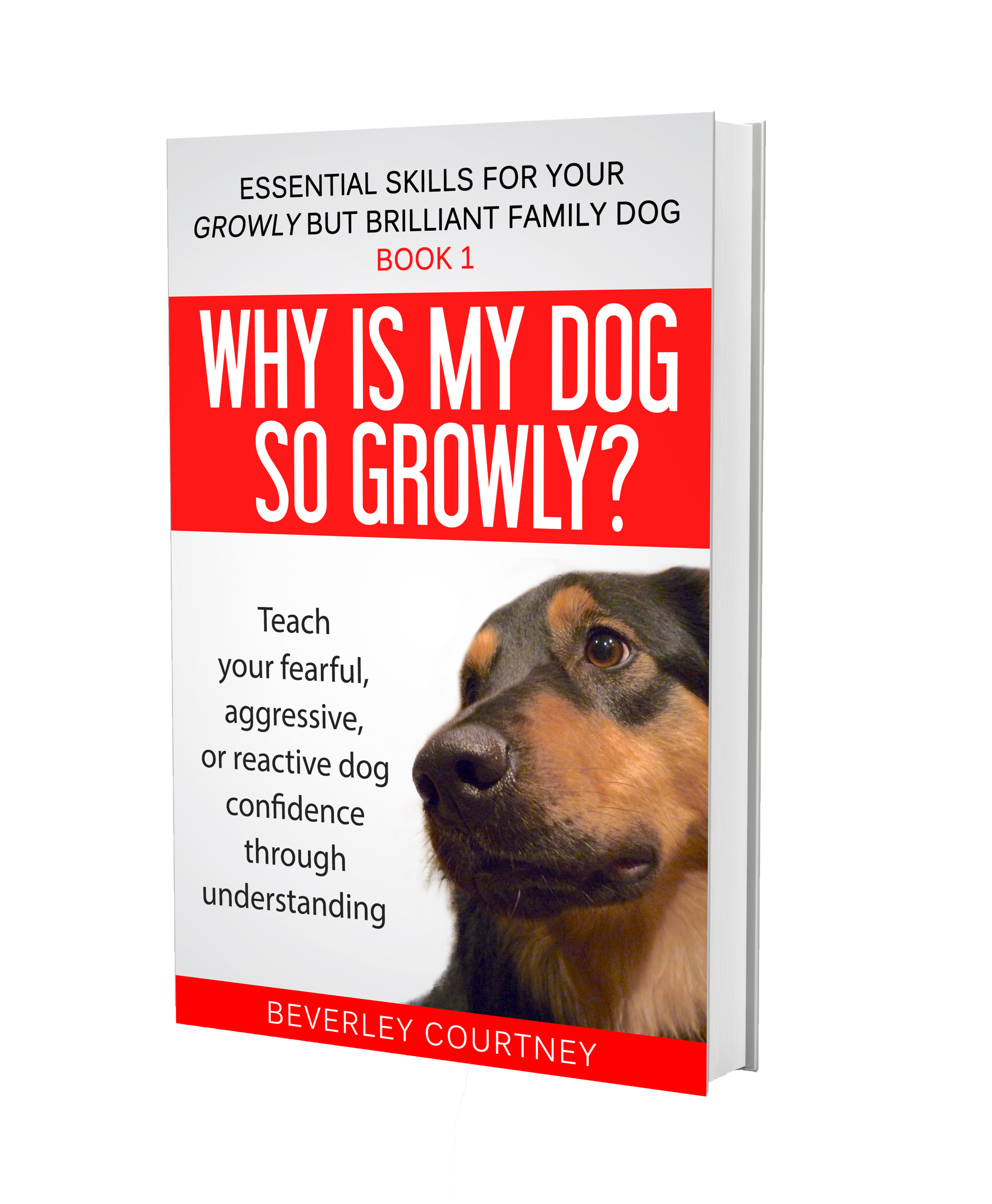
Here is the first of three articles based on excerpts from my book Essential Skills for your Growly but Brilliant Family Dog, Book 1 Why is my dog so growly? - which points out an area which will be affecting your dog mightily.

While you’re doing your best to improve the situation and you take a look at what may be making things worse, you cannot overlook stress.

  • Stress causes reactions to be exaggerated

  • Stress causes us to snap

  • Stress wears us out

And there are some areas of your dog’s life that are building stress that will really surprise you.

1. Too many walks

“What!” you squawk! “I thought I had to take my dog out for a walk every single day! I thought I was doing the right thing!”

Well, like so much in life, that depends. It depends on how your dog is experiencing these walks.

A happy-go-lucky dog who loves meeting people and other dogs will relish his daily walks. But that’s not the dog you have, or you wouldn’t be reading this.

It may be that your dog gets sick with anxiety at the very thought of a walk. The walk may consist of you getting upset or telling him off while he runs the gauntlet of narrow paths, fence-running dogs, squealing children, dog walkers walking their dog straight towards him, traffic noises, people wanting to pat his head …

This is not an enjoyable walk for an anxious, shy, or reactive dog!

There are two reasons for walking your dog. One is for exercise. The other is for socialisation. Clearly the second reason here is a fail. So cut your losses, exercise your dog with vigorous play in the garden or on solo walks in a relatively dog-free zone - a forest trail, for instance - and save road walks for when your dog is calm and you can avoid most of the hazards.

Energy-burning games

Dog training, new puppy, puppy training, dog behavior | Training your new puppy in challenging activities - how to reduce stress | FREE EMAIL COURSE | #newpuppy, #dogtraining, #puppytraining, #dogbehavior | www.brilliantfamilydog.com

There are great games you can play with your dog to exercise him - without ever having to leave your home. Free running and jumping about till your dog’s sides are heaving, his tongue lolling, and his eyes shining, are what you want for exercise.

If you have outside space you can play with balls or frisbees, reinforcing the connection between you all the while. Tug is a game that uses a load of energy - and you can really go to town on harnessing your dog’s instinctive drives by playing with a flirt-pole.

The joy of these games is that you can use them to build your dog’s impulse control at the same time. He’ll learn never to jump up or snatch the toy from your hand in Tug. And the flirt-pole teaches the collection and restraint needed for a successful bunny-hunt.

And no, it won’t turn your dog into a predatory nightmare. I used the flirt-pole to build Cricket the Whippet’s impulse control around small furry things, with the result that I can call her off rabbits. I have known dogs who were so full-on in their play that their owners had to wear thick gloves to play with them and stay in one piece! Once the dog learns the rules of the game, it becomes rewarding for both parties - and no more need for gloves.

If you have no outside space, you can rely on Tug to tire your dog out - especially as you’re getting him to use his brain in this puzzle too.

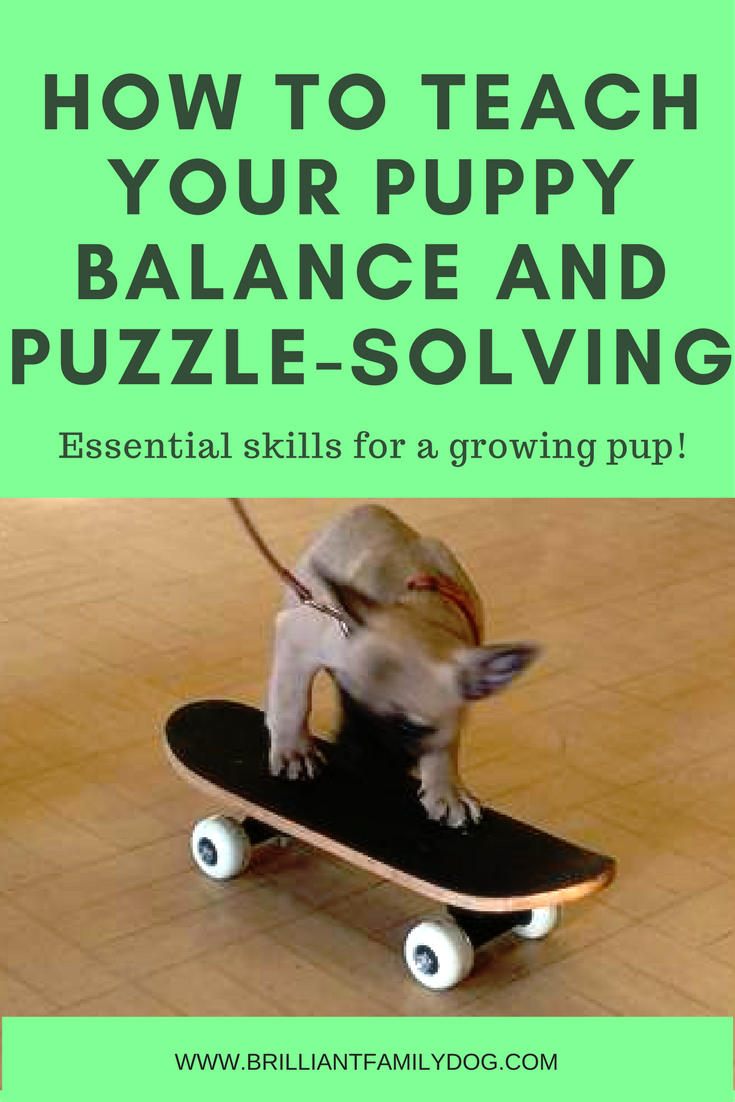
Using wobble cushions and planks will help to build muscles and balance that your dog didn’t know he had. Walking down the stairs, then walking up again backwards, step by step, is a skill which uses lots of brain and brawn.

Hide and Seek is always a popular, tiring, and satisfying, game, especially if you have children to join in. My boys used to love rolling themselves up in their duvets and waiting to be found - which didn’t take long with all the squealing going on!

Choose a good time for an outing

Once your dog is rested from having to face the daily challenge of a walk, you should see some calmness entering the picture.

Then when you feel ready, you can take him out. The aim of Puppy Socialisation is to expose your pup as much as possible to all the experiences of our world - while the puppy enjoys the experience. The same goes for your older dog. Taking him places where he is scared or uncomfortable is just tormenting him without any good resulting: in fact this could make him more fearful.

So find a quiet time when you can take your dog out for a walk, and be flexible with your plans! You can turn away from anything your dog finds upsetting.

The garbage truck is collecting and making a huge noise? Just turn and go the other way. There’s a school outing of excited children heading towards you? Go! Heavy rain is making the traffic very noisy? Head home.

Resist the temptation to say “I always go this way,” and go right, then left, through the street market, across the railway bridge … Your walk can just be the same 100 yards in front of your house repeated several times!

As long as your dog is viewing this as a positive experience, then you are succeeding. Know that you can assess the benefit of the walk - to both of you - and give yourself permission to decide where to walk your dog, and whether to walk at all.

What is the result we want?

We’re focussing on the outcome here - calm walks with a happy and relaxed dog. If your daily walks are not a step in this direction, then you need to cut them right back.


Read the second excerpt here.

Did you find this excerpt of interest? This is what Book 1 looks like.

Click here for a free e-course to help remove the stress from your life, and your dog’s life - and news about the new book!


How to teach your puppy balance and puzzle-solving

5 Surefire Tips to Get Your Dog to Jump Up on People


There’s a ring at the doorbell.

While you make your way to the door your dog is running rings around you, barking, jumping, grabbing at toys. 

You yell “Stop! Get down! Be quiet!” Now you’re both barking!

You open the door and your dog launches himself at your visitor, striking her amidships, sending her reeling.

You yell “Stop! Get down! Be quiet!” 

Your visitor staggers through the door with your dog dancing in front of her on hind legs, grabbing at her sleeve and leaving drooly smears on her bag.

You yell “Stop! Get down! Be quiet!” 

Like this? For more simple remedies like this one, and lots of how-to’s, join us here!

THIS FREE ECOURSE IS A BONUS FOR YOU WHEN YOU SIGN UP TO RECEIVE EDUCATIONAL EMAILS AND OCCASIONAL OFFERS FROM ME. YOU CAN UNSUBSCRIBE AT ANY TIME.
Privacy Policy

Your panting dog stands still for a moment.

You yell at him for being a bad dog.

Your visitor says “I won’t stay,” and starts to make her escape.

As she leaves you grab at your dog’s collar to stop him running out after her.

You close the door and shake your head in exasperation at your happy dog.

Look familiar? 

Here are my 5 Surefire Tips to ensure that this happens every time:

  1. Make sure dog is super-excited and racing around loose, barking

  2. Shout “Get off! Stop! NO!”, wave arms, dance, add to the excitement

  3. Give dog lots of attention for jumping on people and no attention whatever when his feet are on the floor

  4. Make sure dog knows that wherever he goes and whatever he does, it’s WRONG

  5. Don’t bother to train your dog. After all your old dog didn’t do it (though he was 12, come to think of it)


WAIT! You don’t want this to happen? 

You really want to change things? Ok - have a look at these:

  1. To contain the flying excitement, clip a lead onto your dog’s collar and put your foot on the lead so that he’s still free to sit, stand or lie down, but can’t jump up

  2. Greet your guest and ask them to ignore dog

  3. When your dog is sitting or standing patiently, ask guest to hold their palm out for the dog to sniff

  4. Reward your dog with a treat and gushing praise as you draw him gently back to your side

  5. Cleverclogs stuff: teach him to go to his bed near the door when the doorbell rings, and stay till invited off


Practice makes Perfect - so try this out with a friend who is prepared to wait outside the door while you take your time and calmly lead up your dog without having to worry about someone waiting for you. 

You could practice each stage with your friend, so that if your dog tries to leap up when the door opens to reveal the visitor, you can simply close the door gently and open it again when he’s calmed down a bit. 

Your dog will soon understand that it’s his good choices that enable you to open the door and admit the visitor! Such empowerment will have him making those good decisions over and over again.

Your regular visitors will be astonished and amazed, and glad that they’re able to wear ordinary clothes to visit you instead of disposable overalls. 

And they won’t need the ear-defenders any more either!

Maybe your dog’s been doing this since forever - but you can change it! It’ll take a bit of time and application, but you’ll be so glad when you can welcome a visitor to your home without them getting mobbed! You’ll be proud of what you’ve achieved, proud of your dog, and relieved that you’re no longer the big bad shouting joy-killer.


Is your dog or your little puppy throwing up more challenges than you anticipated? Watch our free Workshop and find how to change things fast!

Puppy dogs' tails tell their own story

Wouldn’t it be great if we had tails!

Dogs’ tails are so expressive. You can see what they’re thinking when you’re behind them, beside them, at a distance. There is a whole chapter in the Dog Body Language Primer on Tails. You may not have heard of this volume, but all dogs get it downloaded into their brains at birth - it’s how they naturally express themselves.

And we - people - tend to dismiss it. “Oh, he’s wagging his tail - he must be happy.”

Some of the time he’s wagging his tail - yes, he’s happy. But some of the time he wags his tail out of anxiety, anger, anticipation. Many a person has been bitten by a dog with a wagging tail!

It’s how they are wagging it that’s important

Did you know, for instance, that when a dog is greeting someone he knows and loves, he’ll wag his tail to the right? Sometimes, when really delighted to see his person, the whole back-end will wag to the right. Your dog will be in a kind of banana-shape as he runs towards you, tail a-wag on his right side, ecstatic grin on his face.

You can see some great info in this article by Stanley Coren which tells you about some of the finer points of tail carriage and movement. But if you just realise that your dog is speaking to you through his tail, you’ll learn an awful lot of his lingo by just tail-watching. 

The skeleton all being connected, it’s impossible, of course, for the tail to go a particular way without affecting the whole body posture. A terrier standing with tail stiff and erect will also have a stiff and erect body, stiff face, closed mouth, and unblinking eyes. A spaniel in full pleasurable wiggle will have trouble keeping any part of himself still - he’ll stay close to the ground, wriggling in a blur.

And a gundog on point will do just that - stand as still as a statue, every fibre pointing towards his prey, foreleg poised, neck stretched forward, tail stretching straight back: one big arrow pointing at the bird.

So you need to look at the whole dog when you decide whether this dog is friendly or not. His body - and especially his tail - will tell you more than just a bland “He’s happy”.

For lots more puppy essentials, get our free e-course on everyday dog problems and their force-free solutions.


Is your dog or your little puppy throwing up more challenges than you anticipated? Watch our free Workshop and find how to change things fast!

New Puppy owners start here!

10 Tips for creating a great vet visit for your dog

Let’s face it, visiting the vet could feel to your dog like visiting the dentist feels to many of us!

Dragging an unwilling dog through the door, then trying to stop her panting, pacing, and barking at everything that moves, is stressful for both of you.

Your puppy’s first visits to the vet will have involved being stabbed with needles and possibly having things stuck up her nose or her bum or down her throat. If not carefully managed - giving your pup a reason to enjoy the visits - this can turn into a fear of the vet.

And if you have a rehomed dog, she may have had unfortunate experiences at the vets in the past. She may have been afraid and then punished for her fear.

If you can ensure your dog enjoys her visit to the vet, then life is going to be much easier on future visits - and, of course, that’s exactly what vets and their staff want too! It’s no fun for them to wrestle with a distressed dog when they need to examine and administer treatment fast.

The more relaxed your dog is, the easier it will be for the vet to examine, assess, and treat her. If your dog is injured in an accident, you want her to feel as comfortable as possible in order to recover quickly - not be stressed and terrified. You’ll already be distressed and upset yourself, and anxiety is very “catching”. If you know your dog is ok with vet visit procedures this will be one less thing to worry about.

So let’s look at a few things which will turn your vet visit into a happy adventure:

1. Be prepared

Take your dog’s mat or bed or some other kind of “security blanket” - perhaps a favourite cuddly toy - which will relax her. If this is a routine visit you can also take treats, chews, and food toys for her to enjoy on her mat. Take care that other dogs are at a safe distance where food is involved, just in case.

2. Party time - not

A vet visit is not a doggy social occasion! By all means, chat to the others in the waiting room. Just be sure your dog doesn’t join in the conversation. Take a place well away from the main door with all its frantic comings and goings.

3. Cats and rabbits in their cages

are already disorientated and apprehensive - they don’t need a big snuffly nose at their cage door, frightening the living daylights out of them!

4. Other dogs in the waiting room

Why are they there? They may be contagious, or hopping with parasites, so you don’t want any contact between your pet and them. Or they may be frightened, or in pain, and will not welcome attention from your dog (or, possibly, from you). If you’re in pain and someone starts badgering you, there’s a good chance you’ll snap at them! Dogs are no different. I have seen the unpleasant consequences of a puppy being allowed to jump up on such a dog. Keep your eye on your dog and your lead short, and don’t get distracted chatting to someone.

5. A long wait

If your appointment is delayed because the vet has an emergency - and the waiting room is heaving with miaowing, whining, squawking, and barking, customers - leave your mobile number with the receptionist and head off for a walk. There’s no need to spend twenty minutes working hard to keep your dog calm if it can be avoided.

6. Park your Dog

When you’re occupied with the staff - sorting your bill or getting instructions for your meds - a good place to put your dog is between your feet. Stand on the lead so he can’t wander off. 

7. Take your time

You can ask to bring your fearful dog in at the beginning or the end of surgery times and possibly through a back entrance, avoiding the Waiting Room altogether. When my fearful dog Lacy had to go in for surgery, I requested to stay with her till she had become drowsy. We had a darkened room to ourselves where I read a book while soothing my anxious dog on her mat. By the time the vet nurse led her away she remarked that Lacy was calmer than most “ordinary” dogs. If your vet is really unsympathetic (this is unusual if you’ve explained things in a non-demanding way) you can vote with your feet and find a vet more suited to caring for your dog.

8. A Greeting? Or an Assault?

Imagine you’re going to visit that dentist. You are standing in reception when the dentist reaches into your mouth and starts poking about inside it. Your reaction? Horror! You need to give someone permission to manhandle you, and when we accept the dentist’s invitation to sit in The Chair, we are giving that permission. In the same way, you can lift your dog onto the examination table for the vet to attend to him, rather than the vet approach him when he’s standing on the floor, turning what the dog thought was going to be a greeting into what seems like an assault. If your dog is large you can ask him to step up onto a chair then onto the table. Involving the patient in the treatment will lessen the stress considerably.

9. Safety first

If you know that your dog is very nervous and given to panic, train her to accept a basket muzzle beforehand. If the vet staff have reason to believe they are going to get bitten, then naturally they will need to muzzle your dog. How much easier if your dog already associates the muzzle with treats and good experiences, and you put the muzzle on her yourself!

10. There is a place for a social visit!

The Vets has a very strong, characteristic smell. You need to associate that smell with good things. Visiting the waiting room on other occasions - when it’s quiet - your dog can have friendly and non-confrontational interactions with staff. Your dog might get some treats for sitting on the scales so you can track her weight, or simply have the chance to snuffle about and learn that the distinctive smell of the vets is just part of life and not doom-laden. In my experience this is something that vet staff welcome. One vet told me, “I wish all my clients did this!” They do not relish having to fight with distressed and panicky dogs who may end up biting! It’s in everyone’s interest for your dog to enjoy vet visits.

Every time we take our dog to the vet we need to be thinking of the next visit. Having a plan and a few props will help you to relax and enjoy the visit too.


For more workarounds for everyday problems with your dog get this free e-course.


And if your dog is especially anxious, this is the free email course for you

THIS E-COURSE IS A BONUS FOR YOU WHEN YOU SIGN UP TO RECEIVE EDUCATIONAL EMAILS AND OCCASIONAL OFFERS FROM ME. YOU CAN UNSUBSCRIBE AT ANY TIME PRIVACY POLICY

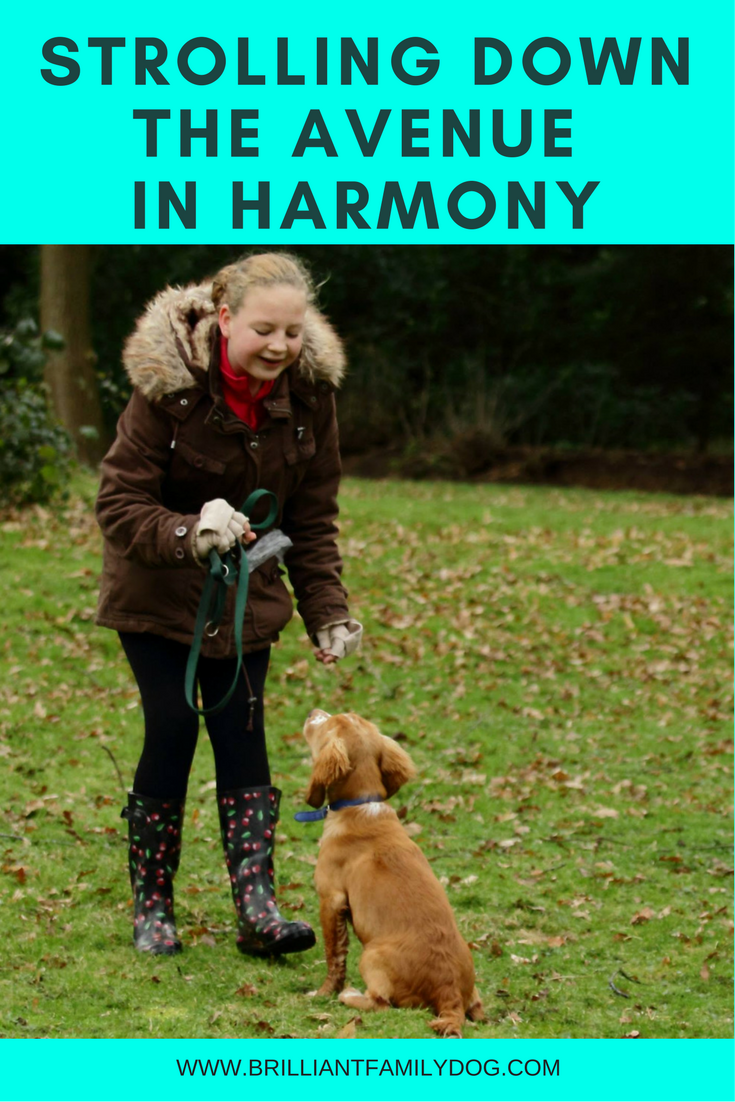
Strolling down the avenue, arm in arm


Is that how you’d like your dogwalks to be?

That metaphor - of enjoying life together with respect for each other - doesn’t just apply to strolling along the street. It applies to everything you and your dog do together.

  • Can you imagine just how much easier life would be if you never had to argue, command, or reprimand your dog?

  • How would you like it if she just fell in with your wishes without you even having to voice them?

  • When you want her to do something, would you like to change her present response to you of “Make me!” to “Okey dokey, sounds good to me”?

Instead of focussing on individual actions like Sit or Walking nicely on the Lead, look deeper.

Look at what’s going on between you all the time

If your dog is putting her head down, leaning into her collar and pulling away from you constantly, this is not a pleasant walk enjoyed together!

If, when you ask her to sit, she shuffles, looks from side to side and when she sees no escape she slowly and grudgingly sits, then this is not a willing response, freely given.

In other words your dog isn’t enjoying fitting in with you! This often happens when she feels she’s forced into complying, instead of having a choice.

So it may surprise you to know that the answer to these problems (and the slow sit and distracted pulling are just two symptoms of many I could list) is not to practice millions of sits, or miles of road walking.

Instead you need to focus on the tit for tat of daily life.

Focus on what you want

Attentive puppy

You don’t ignore or snap at your partner all day long, then expect to enjoy a lovely holiday together! It’s all the tiny exchanges - smiling as you pass each other on the stairs, offering a cup of coffee, helping to carry things without waiting to be asked, showing interest in their activities and opinions - that shape a relationship.

And do you ask or suggest things to your partner, rather than commanding or ordering?

So it is with your dog. If you focus on all the little things, the big things will fall into place.

  1. Always reward your dog when she’s doing something you like. Never ask her without being prepared to follow through to her reward. (Remember, a reward is anything your dog finds rewarding - a treat, a cuddle, dinner, access to the garden, a game …)

  2. Ignore things you don’t appreciate. Think, “Do I really want to have a fight over this?”

  3. Manage your dog’s life and environment just enough to ensure that she can’t do the things you don’t like.

That is the recipe for peace and harmony in the home. You probably did it with your children. You probably do it with your partner.

Just extend your patience and understanding to your pet and you will start to see results everywhere.


And for more detailed suggestions for making this all go swimmingly, get our free email course here!

Living in harmony with your dog