The Weekly Once Over can save you a lot of vet’s bills

Fluffy puppy, long-haired dog, dog grooming, dog health | The weekly once-over can save you a lot of vet’s bills! | FREE GUIDE | #hairydog, #doggrooming, #activedog | www.brilliantfamilydog.com

Run your hands over your dog’s body. It’s key to maintaining your dog’s health. Reach every nook and cranny! You want to check up for cuts, scratches, foreign bodies, hot areas, sore bits, tangles and mats.

You can do this methodically, once a week. Or you can do what a lot of people do - that is to use cuddle time as an opportunity to feel all over your dog and check him out. 

It’s surprising how many people miss this. It can lead to nasty problems, especially where ears and feet are involved. The fashionable fluffy dogs have lots of fluff-related problems. 

One fluffy dog I was boarding for the day was squatting to poo but nothing dropped to the ground. I checked him out. He had a basket of hair matted with dried poo covering his whole anal area. Yuk! Ten minutes with sharp scissors was all that was needed to remove this, trim the surrounding hair back neatly, wash him, and expose his very sore red bum to the air to heal. Fluffy dogs really need a lot of grooming to keep them healthy, and I think a lot of those who fall for these designer dogs don’t realise this before they purchase.

Did you know that an innocent-looking grass seed can become a time-bomb? If it penetrates the foot - and its pointed, torpedo shape makes this easy - it can actually work its way up the leg and reach the internal organs. That last is rare. But a rampant grass-seed loose inside your dog’s body can only lead to trouble. 

Hairy dogs have hairy ears, with hairs sometimes growing right down the ear canal. Did you know you have to pluck the hairs out? Untended, these ears can be a source of constant pain and infection.

There are lots of less dramatic things to check for, but they can all add up to a lot of discomfort and misery for the helpless dog. I met two cocker spaniels once, whose coats were so matted that they had dreadlocks and huge mats all over them. These mats were like large balls that swung as they walked. Their feet were like soup-plates. Where the hair had matted tightly, at armpits and round the ears, the skin was being pulled and pinched. What else was harboured in these mats doesn’t bear thinking about! These poor dogs were suffering constant pain and aggravation. The tragedy is that the owner just couldn’t be bothered. She had plenty of money to pay for a groomer, but couldn’t be bothered. These dogs needed to be completely shaven so their coats could start again. 

Even small mats behind the ears and between the legs can cause constant irritation. Some dogs’ hair is soft and wispy and very easily mats.

Ask for permission!

It’s important that your dog should be happy with this interference. If you’re starting with a puppy it’s standard practice to get them happy about being handled all over - lots of treats for standing still for a split second while you touch them. Time will gradually stretch out.

For an older dog, or a rescue who may have a history of fear of hands, you need to progress in the same way, but take your time. Ask permission to handle your dog, in the same way you would ask permission of a person to touch them - even if you were brushing a spider off their neck you’d still ask! So afford the same courtesy to your dog. Don’t just grab and yank and pull!

I’ll take you through a checklist here so you can ensure that none of these horrors ever befall your dog. 

The Weekly Once Over - how it’s done

I’ve alerted you to some of the dangers of neglecting the weekly once-over. So here’s how to do it.

Dog or Puppy problems? Get your free 8-lesson email course and solve them all painlessly!

THIS FREE ECOURSE IS A BONUS FOR YOU WHEN YOU SIGN UP TO RECEIVE EDUCATIONAL EMAILS AND OCCASIONAL OFFERS FROM ME. YOU CAN UNSUBSCRIBE AT ANY TIME.
Privacy Policy

Start with his mouth - especially the corners. Check there’s nothing jammed between his teeth or pressing into the gums, like shreds of a twig or bone shards. 

See that his eyes are clean and not runny. Trim excess hair from bushy eyebrows that may be poking into his eyes. Ensure he can see clearly. Don’t be a fashion victim!

Ears - these are very important - especially if you have a flop-eared dog, and/or one with a lot of ear feathering. Very hairy dogs, e.g. fluffy poodle types, will need to have the hair inside the ear removed from time to time, to prevent infection. The easiest way to do this is with a haemostat.

Fluffy puppy, long-haired dog, dog grooming, dog health | The weekly once-over can save you a lot of vet’s bills! | FREE GUIDE | #hairydog, #doggrooming, #activedog | www.brilliantfamilydog.com


Spaniels are notorious for getting ear problems. This is because their long hairy ears sweep up foreign bodies into the ear canal. The ear flap then clamps down and ensures a nice moist hotbed for triggering infections. So these busy little dogs, with their snuffling habit and love of deep cover, need their ears checked after every walk. 

The spaniel we had as our childhood family dog would go out foraging in the snow and be quite unable to get back through the fence gaps he’d gone out through. The snowballs which formed on his ears and flanks made him twice as wide and he looked like a Christmas tree! They had to be broken up and melted off before he could come back in the house and lie in front of the fire to dry.

Burrs, grass-seeds, insects, dirt, mud - all can create problems. So a quick once-over of the ears after every walk is a habit which will take no time and could prevent a lot of suffering. The best natural remedy I’ve found for this? Thornit. You’ll find it on Amazon. It will also dry up wet skin patches and helps to draw splinters. Invaluable.

Move further back

Keep working back down the neck. Check there’s no collar damage, and that his collar is still comfortable. We tend to put them on the dog and forget them till they drop off. Wear and tear can produce sharp bits which chafe. And has he got a bit tubbier since you last checked the fit?

Feel the ribs. You can feel them all? Good! That means your dog is not secretly gaining weight under his coat. 

If your dog regularly plays with other dogs, check over his flanks carefully. This is where grabs happen in a chase game. As it’s often only a skin-rip there may be no blood and no obvious sign without feeling for it. A dog’s skin is not like ours - it’s more like a loose-fitting overcoat - a breach in this protective layer can let infection in.

Check the tail for lumps and bumps. If your dog’s tail is magnificently feathered, you’ll need to hunt for twigs, bramble spines, thistles, thorns, burrs, and probably a mouse nest or two! Check anus is clean and trim the hair there if necessary.

Legs - run your hands down the legs firmly, checking for any reaction or flinching from your dog. Move the joints (only the direction they’re meant to move!) and see that there is freedom of movement. 

Feet - these should be clean, claws nice and short and blunt, the hair between the pads regularly trimmed away, and no mats or mud between the digits. This last can lead to painful “scalds” - chafed red sores between the knuckles which make walking painful. Once you remove excess hair from the pads you reduce the danger of thorns and grass-seeds penetrating the foot. These little torpedoes can actually travel up inside the leg. They may emerge again further up the leg, or in rare cases they can get into the bloodstream and cause havoc.

Best thing for trimming foot-hair? The little handheld gizmo your hairdresser uses to shave hair on the back of your neck. Very quick, very easy, no danger of cutting the webs.

My collies regularly have their feet shaven and neatened up. The poodle needs to be shaven regularly. The only one who escapes these ministrations is Cricket the Whippet who has fine hair and neat feet. Check this page for more info and some remarkable before-and-after photos on what you might consider a short-coated dog.

Underside: check his belly, armpits, genital area. Some dogs have very soft wispy hair on their undersides which mats in a moment, tweaking the skin painfully. So scissoring the wispy parts fairly short will prevent this.

All over: while you’re at it, part the hair in a few places (back of neck, rump, base of tail, for instance) and check for flea-dirts, spots, scabs, and any evidence of scratching.


This sounds a lot! But it actually takes a fraction of the time it takes to read all this. If you do this regularly this once-over should only take a minute. You can be towelling dry at the same time.

Anything you discover that needs fixing will take longer - schedule a time to deal with it the same day. A lot of things can be dealt with on a first aid basis. A stitch in time saves nine, and this regular once-over can save you a lot of vet visits! And there are natural remedies you can have always on hand. They work for the rest of the family too.


He may be reactive but he’s still a dog

Reactive dog, aggressive dog, fearful dog, dog behavior | A reactive dog is still a dog! Don’t forget to train him just the same way as any other. The relationship will blossom and life will improve | FREE EMAIL COURSE | #aggressivedog, #reactivedog…

Got a reactive dog? One who barks and lunges at innocent passers-by; grows fangs and a forked tail at the sight of another dog in the same parish; or maybe just melts with fear at the sound of a bicycle? 

I feel for you!

I’ve been working with reactive dogs for years, and I have my own two Growlies too. So I know just what you’re up against. 

Fortunately more people are becoming aware of the issues, and that means slightly more people are beginning to understand that it’s not your fault! You’re not a terrible owner, and you haven’t got a horrible dog. He’s just not fitting in with the popular perception of what a pet should be.

But, as you’ll know, your difficult dog is the perfect pet at home. You know how friendly, biddable, loving, and fun your dog is - once the fears that dance around her when out are removed. You know how to soothe her, how to play with her, how to stimulate her great brain so that she loves to do things for you.

Your dog’s still a dog

And it can be hard to remember, when you’re out and about and dealing with her demons, that at heart that’s what she is. She’s a dog. Maybe not the dog you expected when you took her on. Not the dog you’d be able to go on group walks with, not the dog to compete in agility with, not the PAT therapy dog you’d planned - visiting the old and the sick and charming them all.  

[Actually there’s a good chance you could do the group walks … in time … and you can seek out agility teachers who understand and make the necessary arrangements for your dog to feel safe. PAT dog? Just maybe … in time.]

Get our free e-course to make instant changes in your growly dog!

THIS E-COURSE IS A BONUS FOR YOU WHEN YOU SIGN UP TO RECEIVE EDUCATIONAL EMAILS AND OCCASIONAL OFFERS FROM ME. YOU CAN UNSUBSCRIBE AT ANY TIME.
Privacy Policy

We can get so taken up with all the slightly different things we have to do with our troublesome pooch - like dodging into driveways, muzzle-training, learning sharp emergency turns, never being out without a supply of tasty treats - that we can overlook the basics. Building the bond with your dog is what it’s all about.

Building an unbreakable bond

I’ve noticed recently that a number of students in my plain vanilla dog training course (not geared for reactive dogs, in other words) are reporting - with surprise - that their dog is much less reactive when out, faster to settle, less likely to kick off at the dogs on tv.

Reactive dog, aggressive dog, fearful dog, dog behavior | A reactive dog is still a dog! Don’t forget to train him just the same way as any other. The relationship will blossom and life will improve | FREE EMAIL COURSE | #aggressivedog, #reactivedog…

Working through the course lessons has turned them and their dog into a TEAM. The old acronym Together Everyone Achieves More, is never more clear than when you’re working with your dog - especially a challenging one!

And it’s wonderful to see how things improve - not with lots of work outdoors in the thick of it - but by just playing some simple but cunningly devised games with your dog on a daily basis. You can see the change within the first few minutes of them being introduced to the game. “Suddenly,” thinks your dog, “this person understands me!” And you are left open-mouthed, wondering at the speed with which your dog has learned the new games, and how eager he is to play them anywhere, any place, any time.

As Sophie said: “We are doing the training every day, a few times a day. It’s doing wonders for us at home and we are using it on walks too!”

Just for Reactive, Aggressive, Fearful - Growly Dogs

This is why, when I’m working individually with a reactive dog, I teach them these relationship-building games right at the start. Regardless of what happens outside, I want the dog and owner to get these under their belt straight away. And it’s a delight to see an owner change from trying to command their dog all the time, to allowing the dog to express his own opinion and make his own (good) decisions.

See my last two posts for more on this:

Little things DO matter - for your dog everything matters
Once you remove the friction everyone is happier

Of course, the reactive dog owner does need strategies and techniques to improve their outside life, possibly opening up more possibilities in terms of where they can walk, and whether they can enjoy a cafe stop with their dog, like everybody else seems to be able to do. These learnings are vital to the success of the training. And I’ll be going into these in huge detail in my upcoming Growly Dog Course. It’s been tested out by the first group of students, and their suggestions and requests have changed the shape of the course so that it’s now everything they wanted.

That vital bond!

But none of this will work if the relationship is not there in the first place! It may be that you’ve been focussing so much on the trickier areas of your dog’s life that you’ve let slip this vital bond. I do understand how this can happen. You can try so hard to work on what’s going on outside - when a step back into harmony inside can have far-reaching results.

As one Growly Course student put it: “Your generosity in sharing techniques and ideas about dog training in general, which is also part of our growly dog puzzle, is helpful, and much appreciated.”

She got that it’s about all the other stuff in your dog’s life with you - not just the apparently difficult parts.


Is your dog throwing up more challenges than you anticipated? Watch our free Masterclass and find how to change things fast!

Remove the friction and both dog and owner are happier

Dog training, new puppy, puppy training, dog recall training | Remove the friction from your dog training and both you and your dog will be happier! | FREE EMAIL COURSE | #newpuppy, #dogtraining, #newrescuedog, #puppytraining, #dogbehavior | www.bri…

Who’d have thought the owner of a little dog like this wouldn’t be entirely happy with him?


Harry is a happy-go-lucky Jack Russell Terrier. His behaviour is pretty normal for a lively young dog.

But his owner finds some of the things he does a source of worry.


• She doesn’t know how to cope with him running round the garden barking at birds.

• She is driven mad by his standing six feet away from her ready to bolt when she calls him.

• And she’s fed up with him jumping up to steal food off the table.


So she called me in - to deal with “Harry’s problem behaviour”.

First address the dog's "problem behaviour"

Dog training, new puppy, puppy training, dog recall training | Remove the friction from your dog training and both you and your dog will be happier! | FREE EMAIL COURSE | #newpuppy, #dogtraining, #newrescuedog, #puppytraining, #dogbehavior | www.bri…

It was fairly simple to teach Harry some new things to do in the garden instead of barking at birds. (First stop is always to accompany the dog in the garden.) Having him enjoy running fast to his owner when called was a breeze. And sorting out the food-stealing didn’t take long.

No, I’m not a genius or a miracle-worker! There are some proven (scientifically proven) methods of reaching a dog’s mind that are powerful and quick.


What takes time, though, is reaching the dog-owner’s mind.

Get your free email course to sort out lots of dog (and owner!) problems fast and painlessly

THIS FREE ECOURSE IS A BONUS FOR YOU WHEN YOU SIGN UP TO RECEIVE EDUCATIONAL EMAILS AND OCCASIONAL OFFERS FROM ME. YOU CAN UNSUBSCRIBE AT ANY TIME.
Privacy Policy

And this is where the hard work came in! Working against a culture of “them and us” and “You’ll do it because I say so” is not so easy.


Second, address the owner's "problem behaviour"

Harry’s owner had to learn that it takes two to tango. Personal relationships are complex, and it’s never one-sided. 

So in order to change Harry’s behaviour, it was essential for her to change her own.


• The first thing to change was her expectations. A dog is a living being, with its own personality. It’s not a stuffed toy who never steps out of line or has an opinion.

• Next was to change her approach from barking out orders like a sergeant-major, and instead working with her dog to get the outcome she desired without conflict.

• She learnt to play interactive games with Harry which always involved choice and impulse control on Harry’s part.

And the hardest thing of all? 

• To switch her from NO to YES.

It would be “Harry NO,” “Harry STOP,” “Get down!”, “Get off!”, ‘HARRY!!”, etc, until Harry sat quietly in front of her, at which point she said … 

nothing! 

So Harry got lots of attention when he was doing something she didn’t like, and absolutely no attention at all when he did something she did like!


Once we’d fixed this final piece of the puzzle, life changed dramatically for both of them. 

Harry was able to carry on being a happy-go-lucky young terrier, but at last knew how to please his owner. 

She in her turn, learnt to give him great feedback, to appreciate his individuality, and to enjoy the companionship she craved when she first got her pup.

***********

LATER: Harry’s owner wrote to say, “I do feel a lot of progress has been made over the time you have been visiting us - and even more than that, I feel now that I have the tools to train Harry to be the kind of dog we know he can be.” 


Watch our free Workshop to get your dog to listen, and find out just how much of the learning is for you!

Once you change what you’re doing, your dog will automatically change. Exciting!


Little things DO matter - for your dog everything matters

Dog training, new puppy, puppy training, how dogs learn | Little things do matter in dog training - get the small things right and your dog will get it! | FREE EMAIL COURSE | #newpuppy, #dogtraining, #newrescuedog, #puppytraining, #dogbehavior | www…

“It’s only the dog - he won’t notice.” 

Yes.

He will.

Dogs notice so much more than we tend to. If you come home with your dog and someone’s left a parcel on the table - doesn’t your dog race over to inspect it immediately? Anything that’s different or out of place will be subject to scrutiny. 

The dog has your home all mapped out in his mind. He knows just where everything is - or where it should be. And reflecting on this will help you “clean up” a lot of the things you ask your dog to do.

Maybe when he first learnt them he seemed to do ok.

Maybe as time has gone by, his responses are slower and woollier.

And just maybe ... it’s not his fault?

“Dogs don’t generalise very well”

You may have heard that statement on your training journey with your dog. It means that if they learn how to sit, in the kitchen, with the oven on their left and the fridge on their right, they may struggle to sit when you ask for it somewhere else. “Where’s the oven? Where’s the fridge? Oh no! Where am I meant to be?” Dogs are, as I said above, very locationally-aware.

So it’s normal training practice to teach an action, then “generalise” it by doing it in lots of different places - the bedroom, the garden, beside the car, on a walk. Gradually your dog realises that Sit simply means placing his bum on the floor, immediately, regardless of where he is (this could be a lifesaver one day).

Get your free email course to help you sort out lots of puppy and dog problems

THIS E-COURSE IS A BONUS FOR YOU WHEN YOU SIGN UP TO RECEIVE EDUCATIONAL EMAILS AND OCCASIONAL OFFERS FROM ME. YOU CAN UNSUBSCRIBE AT ANY TIME.
Privacy Policy

While you’re doing this you’ll also be “proofing” his action, so he can do it whether you are sitting, standing, facing the other way, walking … 

This is the way to get an all-weather, instant, Sit.


“I’ve sat, now what?”

Similarly, learning to sit should also include learning when to release. So that “SIT” means “Sit till I tell you otherwise”. No need to yell “STAY STAY STAY Ah-ah!” with accompanying wagging finger, at your dog, if he knows that he only moves from his sit when released. This is a detail that most pet-owners forget to teach - or rather, they don’t know they need to teach it in the first place. But doesn’t it make a lot of sense once you think about it?

If you look at it from the dog’s point of view, is a Sit something you do for a split-second before jumping up again? Or is it a careful placing of the bum on the floor … till you feel like moving? Or does it mean what it says? “Sit.” Just sit!

There's a difference for us in whether we touch a button on our phone, or press it, or hold it down. We have different words to describe those actions, otherwise it would be very hit and miss.

If we’re not clear in what we understand and mean, we’re not going to be able to convey that information to our dog - who will be so happy to oblige once he knows what it is that you want!

Maybe you’re thinking that this is a fuss over nothing - that as long as when you say “Sit” your dog (eventually) parks himself, however briefly - you’re happy? But wouldn’t you and your dog both be much happier still if you were both clear about what you wanted - about what will earn your dog a reward, in other words?

“Whoever said the small things don’t matter has never seen a match start a wildfire”
Beau Taplin

It’s clarity that will transform your dog training from “you against him”, to a team, happily co-existing and walking this earth together. 

Knowing just what you mean when you ask him to do something, will enable your dog to hit the spot every time. He can anticipate your needs (that’s terrific … except in competition, where anticipation will lose you buckets of points!), and he now has a sure way to please you and earn a reward.

So do I have to keep feeding my dog all day long?

Dog training, new puppy, puppy training, how dogs learn | Little things do matter in dog training - and the first thing you need to know is exactly what your dog finds rewarding | FREE EMAIL COURSE | #newpuppy, #dogtraining, #newrescuedog, #puppytra…

Keep in mind that a reward is whatever your dog finds rewarding! 

For many dogs food of some kind will head the list, with tasty soft food (cheese, for instance, or sausage) way up at the top. But you need to find out what else your dog finds rewarding - Running? Going out to the garden? Sleeping in the sunshine? A cuddle on the sofa? Chasing a toy? Retrieving? Nosework? A car ride?

My own four dogs would list their favourite rewards in very different orders from each other. For Cricket the Whippet, snuggling under the duvet has got to be up there, while Rollo the Border Collie loves every opportunity to stalk and herd his chickens in the garden (don’t worry, he never touches or upsets them). For Lacy and Coco, my more worried dogs, proximity to me, and interaction with me, is highly-valued and a reward in itself.

Do I really need to train my dog all the time?

The easiest way to train your dog (and I’m all for easy answers) is what I call “All Day Training”. And while this doesn’t take up much time - seconds, in fact - it does require you to be clear about what it is you want. 

And keep in mind the sad fact that something you’ve taught, and that your dog does perfectly, will gradually deteriorate. Things don’t stay static, so your dog’s sit is either getting worse or getting better. Think about it - the last few times you asked your dog to sit, what happened? Be honest! Did it take several “Sit’s” for anything at all to happen? Did he jump up again as soon as you moved?

Dog training, new puppy, puppy training, how dogs learn | Little things do matter in dog training - get the small things right and your dog will get it! | FREE EMAIL COURSE | #newpuppy, #dogtraining, #newrescuedog, #puppytraining, #dogbehavior | www…

This sort of creeping disintegration of what you thought your dog knew happens to the best of us if we are not vigilant. I’m as guilty as you are! I noticed recently that while Coco Poodle has a nice instant drop at a distance … it was only most of the time, not all of the time, and he had a tendency to move as soon as I did. 

So back to the drawing board! It’s taken only a short time giving his instant down a bit of focus on walks for us to have his “drop on the spot and stay dropped” back in full working order again.

And whose fault was it that it had gone wobbly?

MINE.

I had not been clear in what I wanted, and in what was reward-able. Once I restored clarity to the action, it was easy for Coco to oblige and get it right.

Is it me or is it the dog?

So have a critical look at what it is YOU are doing with your dog. It’s so easy to blame the dog - when it’s ourselves we should be looking at!

Want a bit of help with this? See how pleased these students are with their progress through our premium online dog training course: 


Thanks, Beverley! She's really making huge strides. Amal & Neith, GSD mix

I really can see major progress especially with his being calm. Katherine & Oliver, Labrador

The biggest thing I have learnt on Beverley Courtney's course is the need for me to speak dog - understand how they think and tune in to that.
Christine & Stan, Cocker Spaniel


Get your free email course to help you sort out lots of puppy and dog problems

THIS E-COURSE IS A BONUS FOR YOU WHEN YOU SIGN UP TO RECEIVE EDUCATIONAL EMAILS AND OCCASIONAL OFFERS FROM ME. YOU CAN UNSUBSCRIBE AT ANY TIME.
Privacy Policy

Is raw feeding safe for my dog? Let’s get to the Bare Bones

Dog behavior, dog feeding, dog diet, dog health | Is raw feeding safe for my dog? Let’s get to the Bare Bones! |  #doghealth, #dogbehavior, #rawfeedingfordogs | www.brilliantfamilydog.com

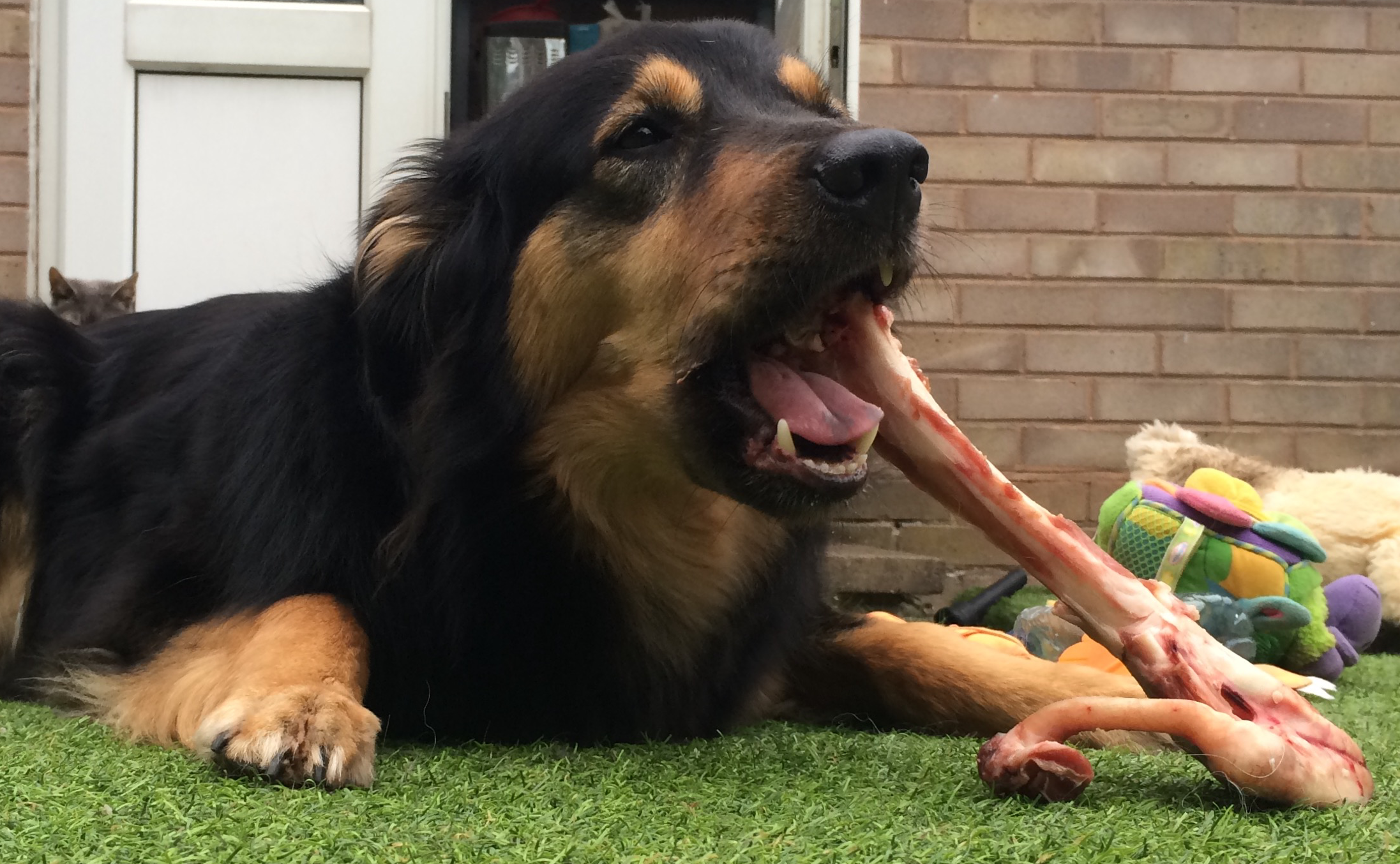
The dog with his bone. An archetypal image. Everyone knows that dogs love bones. Aesop knew. Early painters knew. Most people know not to approach a strange dog with a bone - they know it’s the highest value item and not to be shared. Or even looked at.

So WHY do people act so surprised when I tell them I feed my dogs bones as a regular part of their diet?  Indeed it’s the basis of their diet!

There seems to be an awful lot of mythology out there about bones. This has coincided with the huge upsurge over the last forty-odd years in commercially manufactured pet foods. Is this disinformation put about by the pet food companies (innocently or otherwise)?

The dog's eating system

You only have to look at a dog’s mouth and teeth to know that raw bones are what they are designed to eat. They have small ripping and tugging teeth at the front. Their canines on the front corners are what would have brought down their victim and ensured it had no escape - it would also probably dispatch the animal with these teeth. The back teeth are for cutting and crunching big bones. Dogs have a scissor bite, and can’t grind their back teeth as we do to break down cereals and vegetation. They chomp and swallow. 

Digestion takes place in the gut, not partly in the mouth as in our case. And this is why they are unable to break down cellulose and digest vegetation. One of the reasons they will go for the stomach of their prey is because the nutrients are already broken down by the time they get there (either through the long digestion process or via the four stomachs), and are therefore accessible to them.

These jaws are immensely powerful, and dogs can use their back teeth to cut through rope or crunch through bone - quite large bones too. And they can clamp down on a rope to grip it without cutting it . It’s a measure of their exquisite sensitivity and control that they can also carry a puppy or a fresh egg in their mouths without causing any damage to their burden.

Over the last few thousand years of living alongside humans, dogs have adapted to be able to eat more or less anything. But their mouth and digestive system is still the same. 

So it’s clear that raw meaty bones, with flesh to be ripped and tugged off, hard bone to crunch and mash, and marrow to be licked out, are ideal food for the dog's eating and digestive machinery. Add to this that they get a full-body workout while attacking a bone: they really have to put their back into the work! The paws will hold the bone in place while they rip food off it. They can stand on the bone and heave against it to strip off the valuable meat and sinew. They stand, lie, move around their prize. At the end of this meal - which can go on for 30 active, hardworking, uninterrupted minutes at a stretch, they are tired! Instead of hoovering up a load of flavoured carbs from a bowl in a matter of seconds, they can extend the eating sequence to a very satisfying hour or more till they have a quick wash and brush-up and doze off over their bone.

Dog behavior, dog feeding, dog diet, dog health | Is raw feeding safe for my dog? Let’s get to the Bare Bones! |  #doghealth, #dogbehavior, #rawfeedingfordogs | www.brilliantfamilydog.com

What’s more, these bones will gain in favour and flavour as they age. If you’re squeamish about this, institute a bones-only-in-the-garden-or-outside-kennel rule. (I have a no-bones-upstairs rule. They learn it very fast - just give your dog the choice of staying downstairs with his bone or coming up without it: it’s up to him.) The soft tissue is soon removed from the bone, and the resulting white bone will be revisited and chewed and gnawed for weeks. It’s not a fly hazard - certainly not in our temperate climate, though I appreciate that that could be different if you live in a hot climate. 

Is it dangerous for the dog?

I have heard horror stories about dogs getting blockages or cracked teeth from eating bones. I can only say that in 30+ years feeding a raw diet to 3-4 dogs at a time (so that’s over 100 years total!), I’ve never had such a problem. 

I don’t feed marrowbones or any weight-bearing bones of cattle, as they tend to be too hard and mature.

The essence of my dogs’ diet is that it’s at least 50% raw bone. Pigs’ trotters, chicken and turkey carcases all fit this requirement. Beef bones, even meaty ones, have a higher proportion of bone, but a couple of meals of offal or fish or raw eggs balance this out nicely. In case you’re confused by this, just remember that raw bones are fine. It’s cooked bones we’re warned against, as the cooked bones can splinter. 

It's entirely your choice what you feed your dog!

The important point about dog-feeding is that you give your dog the nutrients he requires. 

So as long as this requirement is met, you can feed whatever is convenient for you

As long as you do your homework and provide your dog with the right food, you can do it any way you like - home cooking, commercial kibble, raw meaty bones. This is not an area for crusades! 

Dog behavior, dog feeding, dog diet, dog health | Is raw feeding safe for my dog? Let’s get to the Bare Bones! |  #doghealth, #dogbehavior, #rawfeedingfordogs | www.brilliantfamilydog.com

Of course you can mix and match too. While switching kibble seems to need an adjustment period of a few days to allow the gut flora to catch up, you can feed raw straight away without this changeover period. So you may choose to have a bone day once or twice a week. 

There are some very good commercial dog foods available - indeed I always have a backup bag of food handy in case I’ve ever forgotten to defrost something. Currently my dogs are enjoying Skipper’s Salmon and Sweet Potato. Another firm favourite is Butternutbox who also have an unbelievable offer right now, just for my peeps! With four dogs you can’t just open a can of sardines if you’re caught short! I also take kibble or Butternutbox for some days on camping trips - for compactness and convenience.

A word about hygiene

Dogs are able to cope with pathogens that would make us ill. In other words, wash your hands and utensils after preparing their raw food. While it’s more awkward preparing raw treats, it’s a good thing to do with a puppy, when all his meals are coming as training rewards. You can get some terrific poultry shears and cut necks and wings up very small. 

How can I tell what commercial dog food to buy?

But bag foods are very variable in quality, and you have to do some research to find the right one. Just because it comes in a bag and has a pretty picture of a dog on it, doesn’t mean it’s any good. They are definitely not all created equal! I recommend you have a cruise round www.allaboutdogfood.co.uk and learn about what actually goes into a lot of these manufactured foods.

This site is run by a canine nutritionist and is not affiliated to a manufacturer. You will still learn a lot from it, even if you are not in the UK and have different brandnames where you live (though you’ll see some are global, and many brands belong to just the same few companies). The principles are the same, and they have a simple Nutritional Rating by percentage to make it all easier. You'll find all the ready-prepared raw foods in the 90%+ section. You see - you don't have to fell an ox every month and do it yourself!

And as a halfway house between fresh raw food and the convenience of dry kibble - UK readers may like to check out Butternutbox.com where you can get really delicious "home-cooked" food specially designed for your dog and his likes and dislikes. You can get a three-week trial entirely free, without obligation! Go check it out!

You need to research carefully and get the best food that fits your budget. The better the food you feed, the less you’ll see of your vet, so you’ll save money in the long run!

When I first signed up with my present vet he asked me what I fed. When I said “raw” he replied, “Oh, I won’t be seeing much of you, then.” He knew that I was feeding an excellent species-appropriate diet

And if you’re a vegetarian or a vegan, then that’s fine for you, but keep in mind what your dog is designed to eat. I wouldn’t feed a horse rump steak just because humans can eat it! You have to feed what the animal is programmed to eat, digest, and benefit from. You have to take even more care and study to provide the required nutrients for your dog with any form of restricted diet.

Will my dog growl over his bone?

You can introduce bones to a dog at any age but - be warned! He will say, “Oh my gosh, this is REAL food, this is the first REAL food I’ve ever had,” and he just may guard it to the death. This may appear comical in a 7-week-old puppy, but it’s not: it’s serious. So first time out, just give him his bone and let him get on with it. When he’s finished and gone out of the room, you can gather it up if you wish. If he gives you a stony glare, whites of eyes showing, lips flicking, head rock-still over his prize, then on no account try to take it from him - you may well force him to bite you. Wait till he’s out and take it then. 

Dog behavior, dog feeding, dog diet, dog health | Is raw feeding safe for my dog? Let’s get to the Bare Bones! |  #doghealth, #dogbehavior, #rawfeedingfordogs | www.brilliantfamilydog.com

Now you can embark on a program of swapping good things for equally good things. Never challenge a dog who is guarding something, and never try to take it away. Once you’ve practiced lots of swapping, he’ll know that you are not trying to take something away from him - rather give him something better. Then you can graduate to two similar bones. If you have a dog-owning friend who has some well-gnawed second-hand bones - rather than fresh, red, meaty ones - these would be an ideal start. 

My four dogs are at the moment contentedly munching bones near my desk. Every now and again they move about, swap bones, and carry on. There’s never been a bone-fight here, ever, in all those 30+ years of feeding multiple dogs bones.

And I very seldom visit the vet. Just the odd stitch for an injury. My dogs are wonderfully fit and healthy.

So by all means give your dog the bone he craves. Just be sure it’s a raw bone.

By the way, for English readers, here’s a load of money off a super food I regularly use and here’s another where you can get a big discount using this link - they provide high-quality fishy treats and foods, which are firm favourites with my crew!


RESOURCES

The Barf Diet - raw feeding bible from a vet to get you started
www.rawmeatybones.com - another vet book
www.allaboutdogfood.co.uk

www.butternutbox.com

Free email course to deal with lots of puppy and dog problems

30% off high-quality fish treats and food


Digging, Chewing, Chasing, Barking: Instinctive Drives you Love or Hate?

 First published at positively.com and reprinted with permission

Dog prey drive, bad dog behavior, dog training | Digging, Chewing, Chasing Barking: Instinctive drives you love or hate? | #newpuppy, #dogbarking, #dogbehavior | www.brilliantfamilydog.com

Instinctive drives are hard-wired behaviours with which we all come equipped. The most obvious one would be eating. We all have to eat. And trying to suppress that desire will only drive it underground. If someone’s hungry and is prevented from eating, they will steal food. If you try to control something that strongly embedded, you’ll get evasive and deceitful responses.

So too with many of the behaviours we see in our dogs. Taken to excess, these compulsions would become annoying or even dangerous. But if you can accommodate them - by giving your dog an outlet for his natural inclinations - you’ll have no trouble with them.

Don’t fight nature!

The Four Instinctive Drives people struggle with

There are four instinctive drives that people tend to complain about most. Contrary to popular perception, all dogs don’t do all these things. It’s not something you have to resign yourself to when you get a puppy. Many dogs will indulge them just a little, some just during puppyhood, and some not at all. But they can all be modified without taking the dog’s enjoyment and basic needs away from him!

Here are some ideas to get you started.

1. Digging

Particularly evident in earth dogs - terriers, ratters - though by no means confined to them. Provide digging opportunities for your digger! 


  • Half-bury old bones, plastic bottles and such like in a part of the garden you earmark for digging. Don’t leave your dog outside unattended - telling him off after the event is a waste of time. As soon as he starts digging, run excitedly to your dig-spot and start digging yourself. Encourage him to dig himself to a standstill!


  • Indoors you can play “Dig for the Toy (or Person) Under the Duvet” games. Be sure to protect the person’s face from those ravaging claws. This exciting game usually results in much laughter all round! Let them dig their bed to bits. Instead of one boring piece of padded bed, give them lots of cushions and blankets they can rearrange and tunnel into. They enjoy the release of energy in ferocious digging, so they need to be able to do it. So what if they damage their bed? It’s their bed. And you can get a new one if they shred it.


  • Digging often wanes with age. My Border Collie Rollo used to pounce on the grass and dig as a puppy - clearly he could hear something creeping about in the earth. He lets the underground traffic of mice and beetles carry on unheeded now. I captured the entertaining pouncing action though, and he’ll still rear up and dive when I say “Rabbit!” Cricket the Whippet enjoys digging so much that she is encouraged to dig her bed, and we’ve kept that behaviour of frantic digging going - long past puppyhood!


2. Chewing

If you don’t want her to chew your things, then you need to supply her with plenty of her things that she can chew. 


  • Large bones she really has to stand on and fight with are the very, very best and most popular chew toys. Choose raw beef bones - ribs or larger. She’ll soon strip off anything fleshy and happily gnaw the clean bones for months. I have a multi-dog household and there are never any bone-fights.


  • Rawhide chews are not the natural product you may think them to be. They’re heavily processed and may have lots of additives and junk.


  • Food-toys are great to soothe anxious chewers and occupy those jaws safely. You can use anything you have handy to fill them: squeezy cheese, liver pate, peanut butter (additive-free), last night’s left-over pasta and sauce. Freezing them makes them last longer. Kibble works well in containers that have to be rolled or wobbled to give up their bounty.


  • All discarded containers (like cereal boxes, toilet roll middles, plastic bottles, for instance) can become food toys. The dogs are welcome to shred them and rip them apart to reach the goodies inside. Ripping and tearing is enormously satisfying for them.


  • I would not want to give my puppy anything to chew now that I didn’t want her to chew later. Old shoes, old jumpers, best Jimmy Choos, favourite blouse: how can she tell the difference? You can launder and recycle old clothes into plaited dog ropes.

Dog prey drive, bad dog behavior, dog training | Digging, Chewing, Chasing Barking: Instinctive drives you love or hate? | #newpuppy, #dogbarking, #dogbehavior | www.brilliantfamilydog.com


3. Chasing


Chasing - you or dog-friends - in a safe area is fine. Hurtling across a road chasing a squirrel is not.


  • Equal chasing - taking turns to chase each other - makes for great excitement. In a good game dogs will adjust their pace to suit their playmate. They take turns at being chaser and chasee. The game can be fast, but not intense.


  • Flat-out, head-down chasing - leg-biting, flank-grabbing, frustrated barking - are not good. You’ll end up at the Vet with a dog needing stitches. Teach your frustrated chaser to hold a toy in his mouth when chasing. Hanging on to the toy gives him something else to focus on and bite down onto. It muffles the woofs too! If he can’t chase nicely, with or without a toy to hold, then he doesn’t get to chase live things - dogs, people, cats, etc. Some herding dogs and sighthounds need to learn how to chase safely, without nipping or grabbing.


  • Chasing crows. As long as the area is safe I’m happy to let mine chase foraging crows off the ground as we approach. They’ll never catch them, so the birds are in no danger. This tends to be a puppy thing, as they give up the unequal contest after a number of failures. But it gives the dog an outlet for that very rewarding surge of energy and focus that comes with a good chase.


  • Teach your dog to chase with rules. A flirt pole is ideal for this. He may not grab it from the air or your hand - he has to wait till you release him to pounce on it. You can build up to this level of self-control. To begin with it will be a massive outlet for his chasing desire. It will also wear him out very fast - great for days when there’s too much energy and too little opportunity to get out and use it up. Regular play with the flirt pole gives my whippet an outlet for her very strong rabbit-chasing instincts, making recalls off rabbits a snap.


  • “You can’t catch me!” A chase game round the garden with a toy reward can be great fun and use up a lot of energy (for both of you!). As long as your dog will come right to you when you want to hold her collar, playing Keep Away is fine.


4. Barking

Some breeds or types of dog are very barky. It’s pointless to attempt to suppress this barking. You will lose. Try channelling it instead.


  • Teach your dog to bark on cue. “Woof!” followed by “Quiet!”, repeat till your ears are ringing.


  • Pair “Thank you” with a treat. Then thank your dog for alerting you to the serious danger of the mother pushing her pushchair down the road past your house, or the terrifying prospect of invasion from the postman. Reward her for coming to you when you say Thank you - every time. Quite soon you’ll have a dog who draws breath to bark, thinks again and comes trotting to you for a treat. Be sure to reward her mightily for this excellent decision!


  • As soon as your dog starts barking, toss some hard treats or kibble at a hard surface (door, hard floor, cupboard door). She’ll scurry across to gobble them up, and probably look at you for more. Now you have silence and her attention! And all without shouting, yelling, or barking yourself.


  • On our own in a huge forest or an empty beach is the place where my barkers are encouraged to bark themselves silly.


If you choose to share your life with a dog, you have to take the rough with the smooth. But I’ve just given you a load of sandpaper to smooth off the rough edges a bit, without suppression, judgment, or bossiness. Use your dog’s instinctive drives as a starting point for new and exciting games you can enjoy together. 

Key takeaway? Enjoy your dog as he is, not the perfect dog you thought you wanted when you got him.

Much more to learn in our free email course for common dog problems

And if your dog is chasing or barking aggressively, head here for another free email course


Watch our free Workshop to get your dog to listen, and find out just how much of the learning is for you!

Once you change what you’re doing, your dog will automatically change. Exciting!