You've learned EVERYTHING about dogs … so why isn't it working?

You’ve hunted all over the internet

You’ve read all the books

You’ve watched the whole of Youtube

You’ve learned ALL the things.

But whenever you try to do any of the things, it just doesn’t seem to work for you.

There is nothing wrong with you!

This is 100% normal.

And the answer is NOT to watch another video, read another facebook post, follow the latest meme.

I get that you may be trying to save money by only getting the free stuff. But what is it actually costing you in terms of the quality of your life with your dog? The level of your anxiety? Your embarrassment when your dog “misbehaves”?

There is more to life than saving a few shillings. After all, as my grandmother used to say,  

There are no pockets in shrouds!

If your car broke down, would you rely on the internet to try to piece together all the conflicting advice and find out what to do, or would you take yourself off to a car mechanic?


The missing link

You have everything available to you. Really, you do.

You KNOW what you want to do with your dog … you just don’t seem to be able to get it going. Doubts and other things are always getting in the way. Whenever you try to copy what you see, it just doesn’t work. Your dog is not getting any better, and you are getting frustrated!

Perhaps you doubt your own ability to help your dog, and consider rehoming him or sending him away to someone else to “fix”. Read this post before you entertain that thought for another moment.

Thing is, you can gather information till the cows come home, but unless you have the support you need, you’re unlikely to get it working for you!

 You see, there’s one thing in all this that you’re missing.

💚 You need someone who can answer your questions.

💚 You need someone who’ll push you to do the hard stuff.

💚 You need someone who can coach you in your particular situation!

What high-flyer doesn’t have a coach? Which dog trainer didn’t work with a top dog trainer? They know they can’t do it by themselves! Even the greatest of them! In fact, the greater they are, the more they know they need a coach.

Stuck?

So if you’re feeling bogged down, stuck, unable to move forward to what you truly want your life with your dog to be, take a look at this free Workshop, which shows you what to do, how to do it, and how to get the personal help you need - all of it structured in the right order so you don’t flit from pillar to post trying to mesh impossible systems together - and inevitably fail.

And if you’ve spent hours watching videos and you’re wondering how on earth you can reach your dream of starting your own dog training business, start here.

Once you have someone working WITH you - life becomes so much easier!

Thanks massively to this course and the input of the trainers, we are making progress. CP, student in the Brilliant Family Dog Academy


My dog and I have completed the program now and I feel so much more confident that we can progress. We are enjoying our ‘no pull’ walks so much more than the previous routine. I was really starting to think of rehoming her after being pulled off my feet on several occasions. I now put much more effort into understanding her and not so much about ‘controlling’ her.” JF, student in the Brilliant Family Dog Academy


I felt completely lost at the point you're at and didn't find this Community until much later. You're definitely in the right place for help and support! VP, encouraging another student in our lovely private Community


I am only in Module 3 but I can tell you I feel more relaxed while out walking Jack. I appreciate the emails from Beverley Courtney and feel as though I have a therapist as well as a trainer! Your understanding of human behavior and how I'm reacting is just as important and I love the emphasis on the relationship I'm building with Jack. The emphasis doesn't seem to be on "fixing" the Growlies but on deepening the relationship we have with him and I love that. ND, student in From Growly Dog to Confident Dog


Thanks for your reply and advice. It’s so nice to hear about all the nuances that I would miss as a novice. It’s the very reason I joined Brilliant Family Dog. Thank you so much and for your prompt reply. JT, student in the Brilliant Family Dog Academy


Our dog’s mental state affects our own

.. And our mental state affects our dog’s!  

I come across a lot of people with reactive or anxious dogs, who are anxious and reactive themselves.

Sometimes the dog’s anxiety has affected them.

And sometimes it’s the other way round, and their anxiety has pushed their dog over the edge.

And this is why I see working with reactive dogs as a holistic exercise.

It’s not a question of giving you techniques and strategies to change your dog. Seeing it as entirely the dog’s “fault” is very short-sighted.

Our dog’s behaviour, as Susan Garrett says, is a reflection of our training.

And if that training comes from a place of angst and fear - thinking that the dog is in some way out of control or unreachable - or through the anxieties of the owner, it’s not going to be a great reflection!


Dog Training or Dog Coaching?

The reason my From Growly Dog to Confident Dog program works so well, is that it addresses the needs of both the dog and the owner.

You can’t treat the dog without treating the owner!

You are a pair. You are a team. You can’t pluck one out and ignore the other. This is one of many reasons why sending the dog away for training DOES NOT WORK!


I have gone from using 'blame transference', feeling embarrassed, ashamed, guilty and anxious to feeling confidence and calmness which has positively transferred to my dogs. PW

My dog has had a great breakthrough he's growing in confidence and so am I thanks for all your help KW

In my work as a coach, I draw people out and thereby enable them to make their own choices. (There are some techniques thrown in there too! 

And this is how I like to work with dogs - whether reactive or not - by offering them choices and letting them choose a path which makes them feel comfortable.

This way the dog’s confidence builds up over time, till what used to frighten or alarm them no longer does.

And at the same time, the owner’s fears and needs are addressed and their confidence builds too!

💥 Win-win!!  🎉

I really cannot thank you enough, as I now know that I have the confidence to teach him and he has the confidence to learn from me. Instead of being in despair, I feel that we now compliment each other. PG


It's made such a difference and it's certainly been a confidence-booster for me! I no longer dread taking him out for a walk. Thank you. LM


Just a brilliant course that gives you confidence and takes away a lot of the guilt feelings that you have an unhappy stressed dog. LR


Confidence-building for dog and owner

So if you’d like to find a way to improve life with your anxious dog, even if you struggle with fear and worry yourself - take a look at our free Masterclass, which shows you the The 3 Biggest Mistakes Growly Dog owners make - and what to do instead!

Just a quick note to let you know I'm loving your advice and guidance. You are giving me the confidence to let her be herself and she is blossoming at 8 years old! HR


I'm finding myself growing in confidence after our rough start. DW


Our walks have become more pleasurable now, and our confidence is growing each day.  MF


Dog and crawling baby ALERT!

I had this interesting enquiry recently. The family are doing just about everything right, and taking great care of their dog and their baby.


“.. She mostly likes to be in the same room as us .. She is extremely gentle and friendly with children out and about too, actively going to meet them, although she has growled quietly at children in a few instances when she has felt anxious, e g. Crawling baby went too close when she was boxed in a bit, 5 year old cousin tried unexpectedly to touch her head, friend's toddler went too close when she was eating a chew (she's not food aggressive generally). We have learnt quickly from these instances and have worked hard to ensure that she is given space from the baby and that the baby is never allowed to approach her, the dog must always come to her, and then the interaction is closely managed.

However, she's just become very anxious as the baby has started crawling and being more mobile, watching her fixedly from her armchair, and sometimes leaping off the chair to go to her.”

I was glad to see their perspicacity in understanding why their dog sometimes reacts to children, and that they are taking care to avoid these events. I told them I was impressed with what they were doing, and with their awareness.

Many people have this same concern, so I thought I’d give you the benefit of the answer I gave this enquirer.


1. Dogs need to sleep 17 hours a day.

This comes as a shock to many people! But knowing this is a lifesaver, and gets rid of a lot of problems straight away - those problems caused by the dog being frazzled, overstimulated, overtired. Just like your toddler will be shortly if not sufficiently rested!

I would ensure that all those sleeps are done in your dog’s crate in a separate room, completely out of bounds for the soon-to-be-toddler. You need to acclimatise your dog to this new arrangement so she’s happy to toddle off to her bed whenever she needs peace and quiet.

Given that the baby is still sleeping a lot you should be able to juggle this so that they aren't always awake together. If the "threat" is ever-present this is going to make you tense and alarm your dog.


2. Playpens cum room dividers

- for child or for dog - are a great help. Another lifesaver, in fact. Once your baby gets up speed crawling (they’re very fast when proficient!), and wants to get into everything, you can’t be on guard the whole time. A playpen that opens up and zigzags across the room can allow your dog to be included without worrying about your baby getting too close while you blink.


3. Baby gates are your friend!

Use them all over the place. Accustom your dog to the joy of her own safe space beyond the gate, and accompany this with lots of treats. If treats are always administered behind the gate, this will soon become a favourite place. I know you don’t want to exclude your dog - of course not! But you do need to be able to relax and enjoy your baby as well as your dog. Being on guard duty all day long is exhausting, and pretty well impossible. Make life easier for yourself and your perplexed dog by ensuring separation periodically. As your baby gets older you’ll have all evening to enjoy your dog in her armchair!


4. Give your daughter a toy dog

that looks as much as possible like your dog. She can cuddle and fuss over this toy and leave the real dog in peace. I've seen this work really well. 


5. Never leave dog and child alone together,

not even for a moment, not even while you answer the phone. Always take one of them with you. Accidents can happen so fast, and especially when we’re distracted.


Want some videos that show you exactly how to teach your puppy? Here you go:


And for more help with your dog - get our free email course on common dog problems! Lots of help for you there.

THIS FREE ECOURSE IS A BONUS FOR YOU WHEN YOU SIGN UP TO RECEIVE EDUCATIONAL EMAILS AND OCCASIONAL OFFERS FROM ME. YOU CAN UNSUBSCRIBE AT ANY TIME.
Privacy Policy


New Dog Resolutions

Here at Brilliant Family Dog we don’t do New Year’s Resolutions.

Why not?

Because resolutions are woolly wishes.

They’re pie in the sky.

They’re “Wouldn’t it be nice if …” sort of things, and not worth wasting your time on.

It’s wishing. And hoping the Wish Fairy turns up and waves her wand. Not goin’ to happen!

You may remember in the past making resolutions at the New Year that didn’t make it past Epiphany. That’s no use!


So how do we plan our future?

What we do instead is conjure up Visions.

Visions for what we want our life to actually feature.

We think of what we’d LIKE to have, fix that in our mind, and go get it! It’s pretty simple really - and … it works!

Thinking “I’d like to lose weight” is not going to get any of us anywhere!

Visualising instead, you in a summer outfit in August, feeling comfortable and free to move, then keeping that image firmly in the front of your mind, means that you have a very high likelihood of attaining it!

What happens is that you become the person in your mental image. In this case it’s clearly a person who doesn’t slouch on the sofa stuffing doughnuts!

Rather you have an image of a healthy, active person, doing what they’d like and enjoying life. This is a person who considers what they eat, how they treat their body, and how they look.

And this will govern your choices between now and August.


And for dogs??

What, you may ask, has this to do with me and my dog?

Good question!

Instead of thinking, “I have to stop my dog doing xyz”, visualise instead that image of you and your dog enjoying time together, in perfect harmony.

Instead of thinking, “My dog is difficult, he barks at everyone”, get your imagination going! See yourself and your dog outdoors - at the beach, in the forest - peaceful and calm, ignoring other dogs entirely.

BECOME the person who is at one with their dog.

BECOME the dog-owner who understands their dog

BECOME the sort of person who can look ahead and avoid situations which could be too challenging at this stage.

By doing this, you will find yourself taking the necessary steps to become this person. You’ll be on the look-out for the help and guidance you need to get there.

And a great start would be by watching our free Workshop on getting your dog to LISTEN! And joining hundreds of happy students achieving the life they always wanted with their dog.

“I started training with you 4 days ago, and Alfie is loving the recall!” AB

This from someone who DECIDED what she wanted with her dog, and became the person who went for it! And here’s another student enjoying working with her new puppy:

“I joined this group a week ago and already have learnt so much that I am putting into practice. We have always had dogs but now understand where I have been going wrong all these years. I can’t wait to start Week 2!”

See you there soon …


Do you want this kind of life with your dog?

Watch our free Workshop here

and get your first lessons in Choice Training - on me!


Why are you assaulting your dog (as he sees it)? 4 ways to get those paws clean and dry!

Your puppy has enjoyed a blissful summer of freedom, flying in and out of the back door to the garden whenever he wants. This is his life-experience so far.  

So how puzzling is it to him when, come the Autumn rains, you suddenly yell at him as he comes in, grab his feet and start vigorously towelling them?

Imagine that happening to you! You come in through the door at your friend’s house, they shout at you, grab one of your feet, hoick it up in the air, and pummel it with a towel!

You wouldn’t be very happy, and you may well say so. And that’s all your dog is doing when he growls as you attack his feet at the door.

Let’s see how we can improve this:

1. Get him used to it from the start

Whatever the time of year you start with your puppy, rehearse what you will be doing when the weather changes. So leave a towel near the door, and now and then when your pup comes in, you can lightly “dry” just one foot then let him on his way. He’ll get used to this strange Liturgy of the Feet so that when you really need to dry them, it won’t have come out of nowhere. This will form part of your ongoing program of puppy habituation and handling.


2. Have some manners!

That’s you, not the dog! In the same way you wouldn’t expect your friend to grab your feet and manhandle you at their door, your dog doesn’t need to accept this boorish behaviour either. Ask him if you can have a paw, then reward him for that before starting your drying process. If he’s on a lead you can simply stand on the trailing lead to prevent him wandering off while you ask him for each foot in turn.


3. Make life easier for yourself

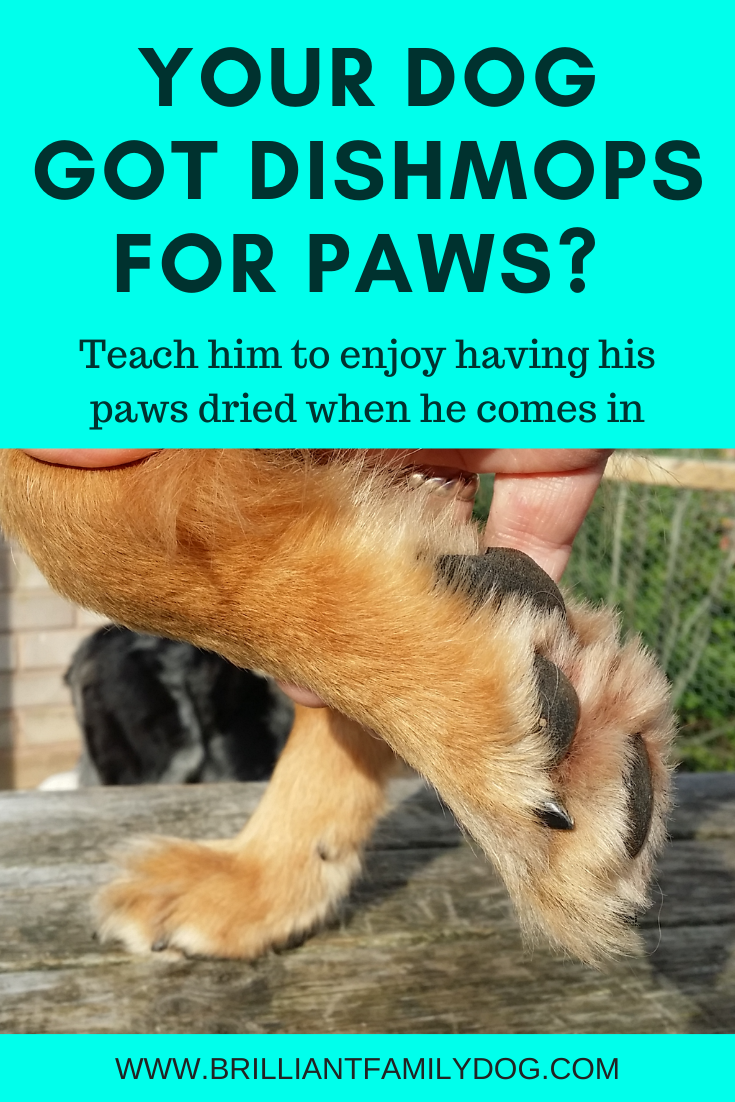
Trim the hair on his paws. Even some short-coated breeds can get bushy paws underneath. The easiest tool for this is a beard-trimmer or the type of gadget the hairdresser uses to trim the hair on the back of your neck. These can’t cut, so the paw is safe - if you use scissors you risk nicking the webbing between the toes. That would not only be painful now, but would guarantee that foot-trimming is very difficult to do in future! I find dogs enjoy the buzzing and the pleasant fuzzy sensation of the battery-operated trimmer - but you do have to introduce them to this slowly. I have my dogs upside down on my lap so I can easily reach each paw to trim. I shave between the pads, and scissor round the paw so that the feet are neat. This will save you a huge amount of mess and mud brought in by dogs with dishmops for paws. It will also help to lessen problems of grass-seeds, burrs and nasty scalds between the toes from “sticks” made of dried muddy hair, and help your dog keep his grip on tiled or boarded floors. Have a look at this post for more info.

4. “But he’s still growling at me!”

There’s a difference between a growl which is saying, “I’m really not mad about this,” and one which says, “Touch that foot and I’ll bite you.” If you have the latter problem - your dog goes still and stiff, shows the whites of his eyes, snarls and rumbles menacingly - then please find yourself a force-free trainer (Hey! I’m a force-free trainer!

Have a look at our courses with personal coaching) to show you how to change this without your dog getting distressed or you getting bitten. If it’s a mild rumble but your dog is still relaxed and floppy and can interact with you, then go back to habituating him to the towel as if he were a tiny puppy. The following steps could take a day or a month to teach: Show towel - reward; touch foot - reward; touch towel to foot - reward; gently lift foot (taking care over which way your dog’s leg bends) and touch towel to foot - reward; and so on. Until he says, “Oh goody - here’s the towel. I like the towel and its rewards.” Your reward can be an extra special bit of sausage, or a lick of a peanut-buttery spoon. The earlier you can start any desensitisation process like this, the better - hence no.1 above.

Life is so much easier if you can work with your dog instead of against him.

There’s no need to have a battle over such simple, everyday things. Make a deal with him, as you do with a child - “You do this thing you don’t like much, and I’ll give you your favourite treat.” It will become his habit to wait on the doormat while you take off his street-gear and dry his feet.

Lots more force-free answers to everyday doggy problems in our free e-course

THIS FREE ECOURSE IS A BONUS FOR YOU WHEN YOU SIGN UP TO RECEIVE EDUCATIONAL EMAILS AND OCCASIONAL OFFERS FROM ME. YOU CAN UNSUBSCRIBE AT ANY TIME.
Privacy Policy

Will I Love My Dog More Than I’ll Love My Kids?

You’ve loved your dog for ever.

Just about as long as you’ve wanted children.

You’re now settling down - you’re ready for domesticity. You’re ready to open up your perfect and precious home to crying, laughing, chewing, scribbling - messes of all kinds.

And as you plan and hope and dream, you can’t help wondering if you have enough love and patience to go round.

Will you be judged more severely as a mother than as a dog-owner?

You find yourself asking: “Will I end up loving the non-demanding dog more than the difficult and very demanding children?”


It’s a Good Question!

And a very valid one.

Few people realise what parenthood will really be like. Even if they’ve spent their lives in large extended families with masses of babies and small children, the enormity doesn’t actually hit them till they’re on their own with another, totally dependent, human being.

I guess that’s why our inbuilt yearning causes us to lumber blindly into it! Something has to keep the human race going, and mass amnesia seems as good a way as any.

And I have to say that having spent eight years training, competing with, and wholeheartedly enjoying my four dogs, I was not a little trepidatious myself while awaiting the birth of my first child.

While people who hadn’t experienced the close bond I had developed with my dogs talked excitedly of the new life I was launching and launching into, I smiled outwardly - while Inside I was anxiously wondering if the baby could possibly live up to the dogs.

Those of you who have never experienced a close bond with an animal may be bailing now, thinking I’m completely off my trolley. But stay with me - read on a bit!


My dogs had clear personalities of their own: likes, dislikes, fears, energy levels - everything was individual to them. I suppose I thought that with its slower development a baby would take longer to reveal its personality.

How wrong could I be!

The moment my child was born he was there. Himself. No-one else. And while I was shockingly totally responsible for his very survival, never mind his development and education, it was a relief to know that he was now just as real to me as my dogs were.

Only different.

A Different Kind of Loving

Just as I responded to each of my dogs as an individual, so I responded to my son as an individual. While a dog’s development can be measured in weeks and months, only years will suffice to measure a child’s development. The time invested in child-rearing is of necessity much greater than that invested in puppy-rearing.

I found it much easier than I had feared to adjust to motherhood. It was much as before, except infinitely more time-consuming. Along with the dogs there were many cats, chickens, a flock of pedigree sheep, and a herd of pedigree dairy goats. I was already a full-time nurturer. So  adapting to my second child a year or so later was pretty straightforward.

My dogs helped me by getting me out and keeping me fit, and giving me time to myself (and them) when I was able to leave the children for a while. They also helped by keeping me in touch with my other dog-competition friends, and ensuring that no morsel of food falling from the high chair ever hit the floor, thus making up for the muddy paw prints and shed hair.


But the Same Kind of Learning

The pleasant surprise in all this was that the way I worked with my dogs was exactly as effective with my children. I didn’t hit, punish, or nag my dogs. They chose to work purely for rewards.

All animals - from killer whales to chickens, from donkeys to rhinos, from dogs to children - respond to choice-based training. This has been proven scientifically for many years by university departments all over the world. There is no need to punish - punishment only serves to make the punisher feel better and doesn’t change the situation.

  • Give them the choice.

    “Would you like to wear your blue jumper or your red jumper?” is a very easy choice to offer, where you don’t care which they choose. But once they choose they are satisfied and they’ll stick with it. The dog equivalent could be “Do you want to put your lead on and go for a walk or do you want to jump around like a fool and go nowhere?” Show your dog the lead. If she keeps still to put it on then you can go out, if she flies around barking you put the lead away and try later.


  • What you focus on is what you get.

    So focus on what you want, not what you don’t want. Basically, this means you reward what you like; you ignore what you don’t like; and you manage what you can’t ignore. Both dogs and children can choose whether to comply and get a reward (liver treat or tv program, walk or ice cream), or refuse to comply and get … nothing whatsoever - no reaction at all.


  • Be consistent.

    What I had already discovered with my dogs was that being consistent made life a hundred times easier. If Yes means Yes, and No is never going to be anything other than No, you only need say these things just the once. As my wise four-year-old once remarked to a visiting child who was about to kick off whingeing and complaining because I had said No to her: “She means it, you know.” He knew that I was consistent. So it was very easy to follow clear house rules, rather than guessing “Is today the day I’ll be able to get away with throwing cake at my brother / pulling on the lead?”


  • Be reasonable.

    Be sure what you’re asking is something they already know and understand. If they’ve never been shown how to lay the table, you can’t complain when they look blankly at you. If you’ve never taught your dog to come back when he’s called, how can you possibly blame him when he doesn’t?


  • Be honest.

    Admit when you’ve made a mistake. Say sorry if you lose it. They need to see that we can be victims of the moment too.


  • Separate the doer from the deed.

    There are no naughty dogs and there are no naughty children. There are dogs and there are children who do naughty things. Labelling them changes them in your eyes (not to mention their own!) and doesn’t give them the choice whether or not to repeat the naughty thing. If they are “naughty”, then they are doomed to stay naughty.


  • Just love them anyhow.

    The dogs aren’t with us for long, and the children don’t stay children for long. Life is too short to fill our time with admonishments and blame.


Are you wondering if you’ll be able to cope with your feelings towards your pets and your children, or have you got it all sorted? I’d love to hear from you, in the comments below or here.


Want to see how I manage my dogs and my children the same way?

Watch this free Workshop and get some ideas!