Where are my spoons? Why your dog runs out of calmness

How does heat affect your dog? We all know not to leave a dog in a car - but have you thought how the heat can affect his psyche? Read this post for some eye-openers! | FREE VIDEO WORKSHOP | #anxiousdog #dogtraining, #newrescuedog, #puppytraining, #…

It’s a puzzle to so many people. Their dog is easygoing and tranquil, and out of nowhere he snarks at another dog - or snaps at a child - or even growls at you! 

Maybe your dog is not so easygoing and you have just learned to live with these “random” outbursts. You never know when he’s going to be in a good humour, and when he’s going to have a meltdown.

But you CAN know! 

If you’re aware of what’s using up your dog’s patience stores, you’ll be able to manage him so that he doesn’t run out entirely, and be left with no way to go except have an outburst.

What you need to learn about is known as Trigger Stacking. And at the moment we have a huge extra trigger that many people simply aren’t aware of.

Heatwave!

In the UK at the moment we are enjoying (or suffering!) extreme weather. Weeks of temperatures in the high 70s and 80s (that's the high 20s in new money) - we’re not used to it at all!

So spare a thought for your dog, who has to wear his full fur coat regardless of the weather. 

You doubtless know all the commonsense advice for dogs and hot weather: 

• Ensure plenty of fresh water is available

• Brush out the winter coat as far as possible, and trim and shear hairy beasties

• Cut back on walks - maybe none at all for a few days, and certainly only at the cool ends of the day

There’s more to keeping your dog cool in the summer than his physical comfort. It can also help with dog anxiety and general dog behavior. Read this post for some eye-openers! | FREE VIDEO WORKSHOP | #anxiousdog #dogtraining, #newrescuedog, #puppytr…

• Limit access to the garden UNLESS you have a paddling pool to entertain your dog, or unless he has enough sense to find a shady spot and stay there

• Check temperature of the ground with your hand. Have you seen people doing the hoppy dance on a hot beach when they have no shoes on? 

• Don’t leave your dog in a car, even with the windows open, without taking measures to keep it cool. This will include covering all the windows, ensuring a through draught, running an aircon, and - of course - parking in the shade.

• Consider a cooling mat for a double-coated breed, or a cooling shirt. A wet t-shirt will work well too, but you need to keep wetting it.

• Frozen food-toys may be popular

• Observe speed of panting and shape of tongue - a long spoon-shaped tongue means your dog is working hard to get rid of heat 


Heatstroke in dogs can be quick, and deadly. So please take the precautions above to ensure your dog is protected.

Hothead

But you also need to consider how this heat is impacting his mental state.

I’d like you to take a quick detour and bone up on Spoon Theory. This explains so well how limited stores of energy have to be farmed and managed carefully. The same applies for our dogs with their limited store of tolerance. 

Before you even step out of the door on a hot day, your dog is stressed. He’s already used up a boatload of spoons and may be running critically low. This could apply to the calmer dog as well as the “reactive” or growly dog.

You know how quickly you can get annoyed when you're uncomfortable - especially if you're not used to the heat? Think of airport rows and road rage in hot traffic jams.
There’s more to keeping your dog cool in the summer than his physical comfort. It can also help with dog anxiety and general dog behavior. Read this post for some eye-openers! | FREE VIDEO WORKSHOP | #anxiousdog #dogtraining, #newrescuedog, #puppytr…

Lots of people will be out and about in holiday mode, with dogs who are only walked on high days and holydays, and everyone will be hot and bothered.

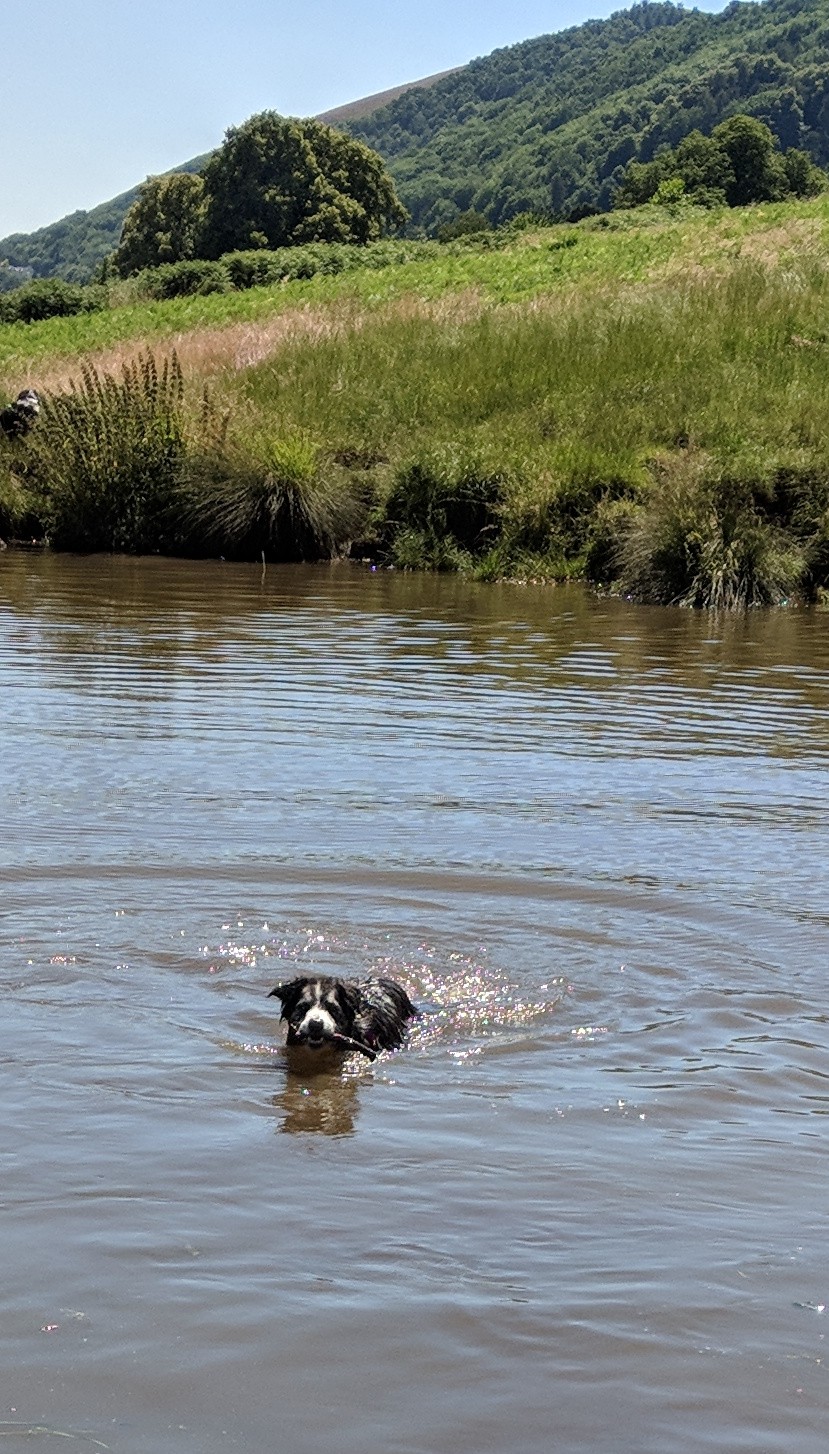
So seek out quieter walks, shaded walks - if you can find a place for your dog to swim, so much the better! - and cut out the ball-throwing till the worst of this heat is over. It will be over soon enough, and all us Britishers can go back to talking about the weather in disparaging terms! 

And if you live in a permanently hot place, you’ll have worked out your own ways of keeping your home cool, and strategies to get about outside without boiling. A reader from Texas told me that she can only take her dog out for 20’ at 5 am - after that it’s into the hundreds and impossible. 


Triggers, and spoons

Armed with this knowledge, you can now look at your dog in a different way. Hopefully a more understanding and tolerant way. He’s not being difficult - he’s struggling in circumstances he finds hard at the best of times, and may now be finding impossible.

In the greater scheme of things, it really doesn’t matter if your dog doesn’t go for a walk for several days - or even weeks. And contrary to what you may be thinking, you may be surprised to find that your normally hyper dog in fact gets calmer and more manageable, the less he’s walked!

Help him by managing his day carefully when outside influences are making it harder for him. He’s relying on you! 



Start the change with your reactive, anxious, aggressive - Growly - dog with our free Masterclass packed with ideas and strategies, all force-free


How training your dog can help you train people

How can you protect your dog from well-meaning people who want to pet him? Here are some easy dog training techniques to kindly control your dog and train your visitor! FREE VIDEO WORKSHOP | #shydog, #dogtraining, #newrescuedog, #puppytraining, #dog…

Some people are good at greeting dogs. And some are … not. It’s not a skill we’re born with (think how long it takes to teach children how to greet people politely!), so we have to teach those who approach us how to greet our dog - or, indeed, whether they may greet her at all!

If your dog is like Greta Garbo, who famously said, “I want to be left alone,” then no greeting is required. This is where you’ll have to use your dog training skills to prevent a quick lunge from the visitor, now wailing “But dogs like me!” as they jump back alarmed from a snap.

You may have dogs who lurve people and want to jump all over them. Yapping NO at your dog, flapping your hands and yanking the lead is not going to cut it. You need to teach your ebullient dog how to greet strangers - and for this you need the stranger’s co-operation!

So how can you get the people you meet to comply?

You can use the same mantra we use for our dogs - 

Reward what you like
Ignore what you don’t like
Manage what can’t be ignored

This means that if your visitor does what you ask, they earn the reward of greeting your dog. If they do inappropriate things (in your dog’s eyes) then you ignore their efforts as you focus on directing them to what you do want, and manage the situation so they can’t interfere with your dog.

Let’s have a closer look at this.


The shy, anxious, or fearful dog

Evasion skills for your shy or worried dog

How can you protect your dog from well-meaning people who want to pet him? Here are some easy dog training techniques to kindly control your dog and train your visitor! FREE VIDEO WORKSHOP | #shydog, #dogtraining, #newrescuedog, #puppytraining, #dog…
  • Carwash - teach your dog to run behind you and appear peekaboo-style between your legs. Few strangers will grope between your legs to get at your dog

  • Get behind - lurking behind your legs may work better for very large or very shy dogs

  • Down - can get them out of arm’s reach of invasion

  • Muzzle - If your dog has a tendency to lunge and snap, teach her to be happy in her muzzle. This will relax you as you’re not worried about damage, and does tend to keep people away. They think this dog is dangerous - in fact she’s safer than an unmuzzled dog


Where you can help

  • Get between your dog and the kindly visitor intent on grabbing her

  • Use your body to block the path to your dog, and keep moving as necessary to stay in the way

  • Asking the would-be greeter questions and taking control of the meeting, will distract them from their “Hello doggy” plans

  • Maybe just keep walking! With a quick “Morning!” as you pass

  • Or use the tried and tested policeman STOP hand signal. This is immensely effective at stopping people in their tracks, giving you time to arrange your dog where you want her, and allowing you to compose a suitable sentence to keep the person at a comfortable distance. You don't have to make excuses for your dog. Just think of a quick way of getting the person to do what you want. Practice this at home with a friend, so you feel brave enough to do it!

  • Talk to your dog quietly and politely - this may impress your would-be greeter that you don’t have to yell and grab this particular dog


The over-exuberant dog

If a meeting is appropriate, give clear instructions on how to greet your dog. You’ll train your dog how to do his part, using friends to help you. This means he’ll know this “game” when you want to use it in the wild.

Bouncy Goldie pup Alfie shows how to greet people

Greeting skills for a bouncy dog

  • Hand touch (your hand to start with)

  • Release cue (“Go say hi”, only when dog is sitting and calm)

  • Timing of reward (when he’s turned back to you)


Your clear instructions should be brief and simple. For instance, “just hold your hand down by your side so he can sniff it”. This tends to stop people leaning over your dog and grabbing or patting, ruffling or thumping. It also stops your dog leaping up to nose-dot them as they can inspect their hand instead.

By the time your dog has sniffed the hand to gain all the information he needs about the person, he’s already back with you for his treat. Job done.

Crowd control

Unless you know for a fact that the person wanting to chat to you and your dog will listen to you, follow your instructions, and understand what you’re doing - don’t let them near enough to cause trouble.

All this work you’ve put in to understanding how your dog’s mind works and how to get the best from her? It’s just the same with people! You can take a quick overview of the situation, remember my mantra above, make rapid decisions about whether a greeting should or should not happen, and take control of the meeting.

This way you won’t be caught out by those who think they know more about your dog than you do, and avoid the embarrassment of muddy pawmarks on the person’s clothes … or worse.

Remember if your dog thinks she has to defend herself against this invasive person, she’ll be more alarmed about the next person you pass, and may even consider a pre-emptive strike (leap out and snap) to keep them away.


Is your dog throwing up more challenges than you anticipated? Watch our free Masterclass and find how to change things fast!

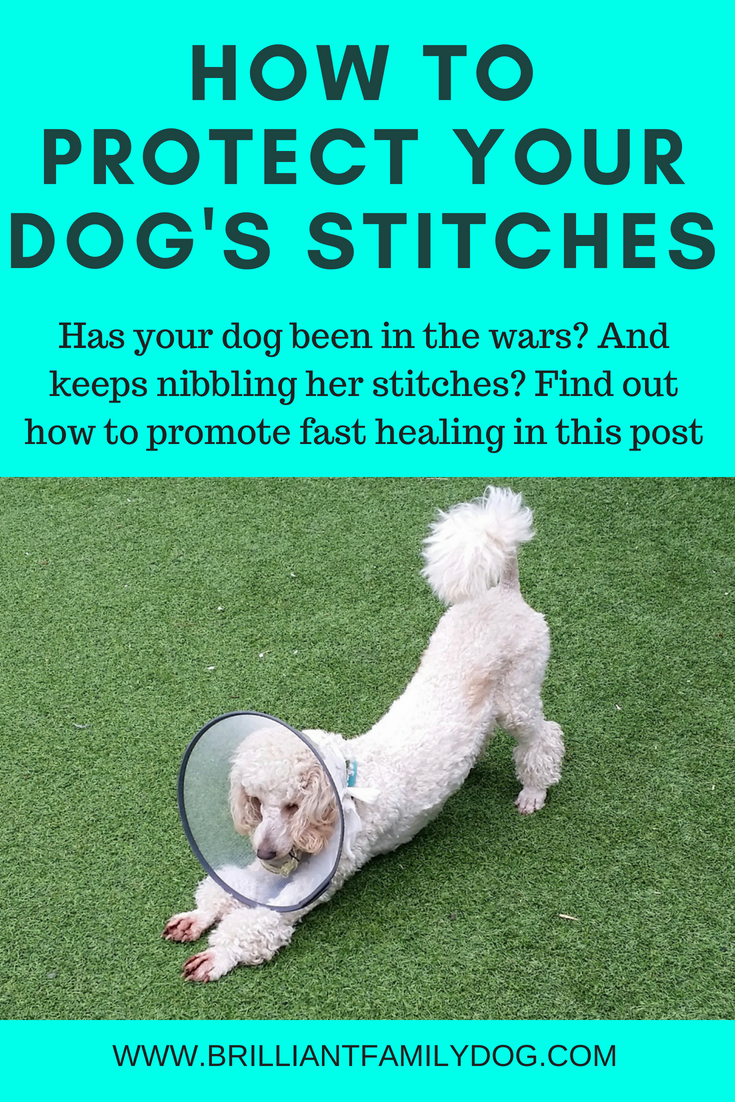
How to stop your dog damaging her stitches

Is your dog injured? And nibbling his stitches? You have to protect the wound to promote healing, but there are many ways to do this! | FREE EMAIL COURSE | dog training, dog health | #doghealth, #dogbehavior, #dogscratching | www.brilliantfamilydog.…

At some stage in his or her life, your dog will need stitches. Could be for neutering, a gash or tear, or something more serious.  

Some dogs will lick obsessively at a wound. This causes skin changes, it inhibits healing, and can introduce infection. So it’s essential that the wound is allowed to heal without being licked and nibbled at.

Many years ago one of my dogs came back from the vet wearing a modified wastepaper bin on his head. They’d cut the base out of it, leaving nasty ragged plastic edges. While protecting the wound they had made in surgery, it created sore patches and cuts all around his neck where it chafed. 

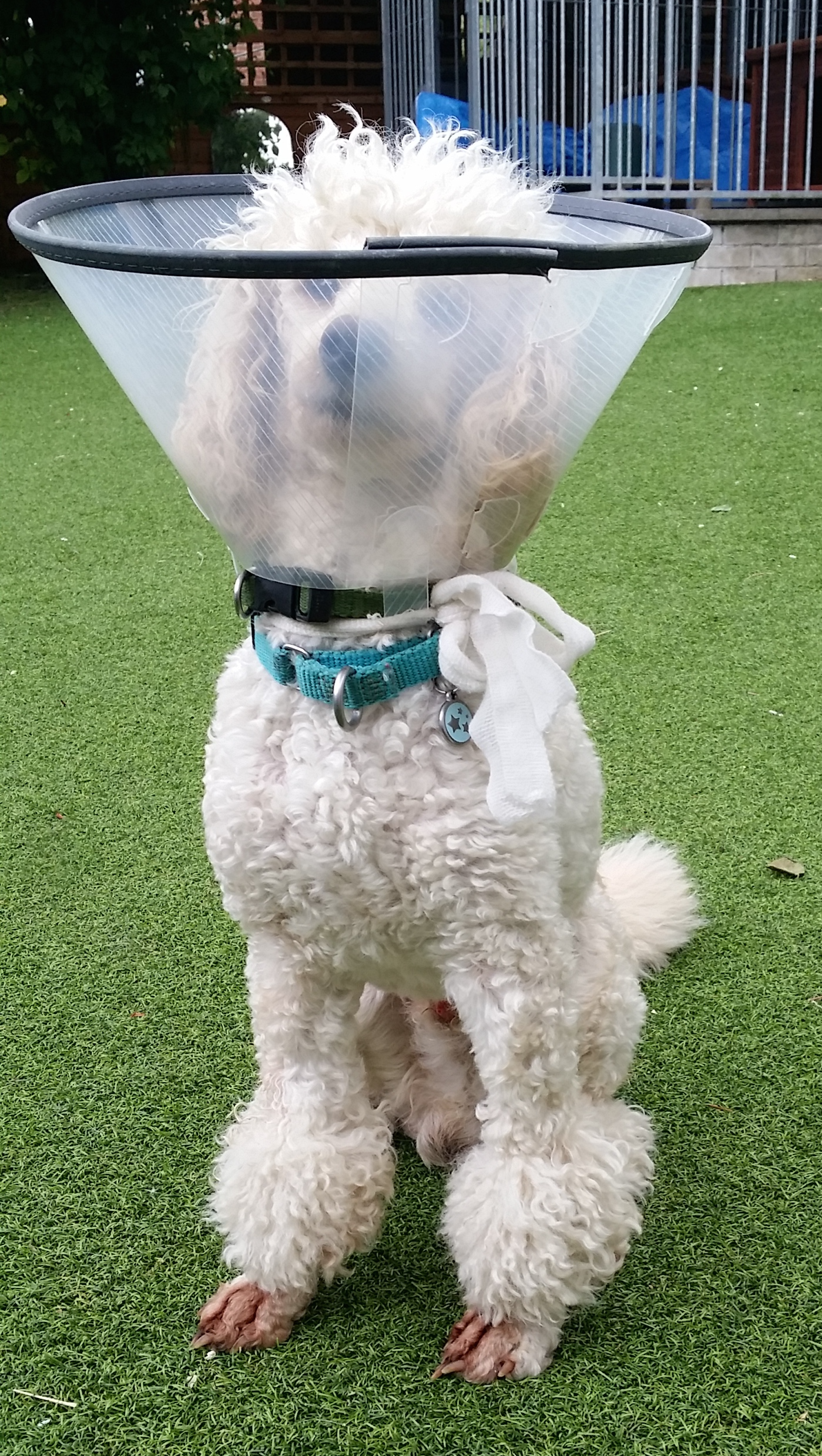
Vets now use a ready-made collar which comes packed flat. This is known as an “Elizabethan” or “Buster” collar to attach to your dog’s own collar. These are large lampshade-type constructions which will fit any size dog. 

They annoy mightily, but they don’t do any damage. Except when the dog catches it in a doorway and it digs into his neck. Or gets food all over the edges. Or is unable to get a drink without spilling the water bowl.

For indoor use only

If your dog needs this to protect the wound, then go for it. But if he’s well enough to go for a walk with you, please take it off! It crashes into things, its appearance will cause problems with other dogs, and it distorts your dog’s hearing so that when you call he’ll head off in the direction he’s facing - as that’s where the sound seems to be coming from! 

If your dog is busy running around, sniffing, and being a dog, he won’t be licking his wound.

There are alternatives. I haven’t tried one, but there are cushion-type collars that are supposed to prevent the dog turning his head round to reach the wound. I guess these could be very effective, depending on the position of the wound, and the elasticity of the dog. For dogs who are able to turn and meet themselves coming back, this probably wouldn't work.

A t-shirt that covers the area may be quite enough. Depending on the size of your dog, you can put a child’s or adult’s t-shirt on him. Tie all the excess material in a knot over his rump, so he can still pee without getting in a mess. 

If your dog can’t leave the wound alone, then obviously the bonnet stays firmly on. 

There are lots of crafty tips and tricks to help make life easy for you and your dog in my books. And what's more, you can get them direct from me, right on this site, and save yourself some money! www.brilliantfamilydog.com/books

Coco looks like Buzz Lightyear in his bonnet! You have to protect the wound to promote healing, but there are many ways to do this | FREE EMAIL COURSE | dog training, dog health | #doghealth, #dogbehavior, #dogscratching | www.brilliantfamilydog.com

Not just licking!

Another time when it’s essential is when the wound is on the face or head. A quick scratch with a powerful hind leg can do untold damage in seconds. Dogs never seem to do the minimum scratching necessary to relieve the irritation - they scratch for what seems a pre-determined period, by which time the stitches may all be ripped out. Keep your hat on!

Here's Coco doing his Buzz Lightyear impression ...

But I’ve found that often nothing at all is needed. If I’m watching over my dog I can interrupt any interest in the wound site. The techniques good vets use these days mean that the incision is often tiny and can have minimal stitches or staples or glue to hold it together. So you don’t get the pulling and tweaking you can get with lots of stitches.

Years ago a surgeon told me that they had reduced healing time in his wards dramatically by making the bandages impossible for the patient to interfere with - thus letting the healing take place unhindered - and by having a lounge between the different-sex wards where patients could mingle. This added interest gave them something else to focus on! 

You can do the same by ensuring your dog can’t get at the wound, and by giving him lots of other things to amuse him, including walks, or play in your garden, if appropriate and advised by your vet. Otherwise you can stick to “brain games” - searching, chewing, unwrapping, etc, or just plain ole companionship.

So try relieving your dog of the burden of the dreadful bonnet! You may find it’s only needed occasionally if at all.


Want some ideas on dealing with everyday dog and puppy problems? Get your free email course and get some imaginative answers

THIS E-COURSE IS A BONUS FOR YOU WHEN YOU SIGN UP TO RECEIVE EDUCATIONAL EMAILS AND OCCASIONAL OFFERS FROM ME. YOU CAN UNSUBSCRIBE AT ANY TIME.
Privacy Policy


And here are some games that will help distract your dog from her stitches, at the same time building a terrific bond between you!


How Can Your Family Dog Teach Your Children Empathy?

Can your dog teach your children empathy? Oh yes! And so easily. Plenty of ideas and resources in this post | FREE EMAIL COURSE | Dog training, new puppy, puppy training, dogs and children | #newpuppy, #dogtraining, #newrescuedog, #puppytraining, #d…

“You have to share.” 

This is a concept we all want our children to learn. Preferably before they become known as the mean kid at playschool. 

Nagging your child whenever he has something - but wants to keep it to himself - is not the way we want to interact with our family. Being told to share can push a reluctant sharer the wrong way and increase his feelings that his possessions are being threatened.

And it can backfire. Witness toddler Connor who wanted a taste of his mother’s glass of wine. When told no, he gathered up all the authority a 2-year-old can muster and said, “You have to share.”

So, to dodge this particular minefield, how about bringing in a helper who will teach your child the joy of sharing without any pressure - or even parental input?

Your Family Dog!

There she is, waiting in the wings, always happy to oblige with a bit of company.

Careful introductions

You have doubtless put plenty of effort into ensuring that child and dog got off to a good start - starting early in pregnancy acclimatising your dog to baby gear, sounds, smells (see Resources below for help with this). 

Puppies and children need no-pressure interactions from the start. Plenty of ideas and resources in this post | FREE EMAIL COURSE | Dog training, new puppy, puppy training, dogs and children | #newpuppy, #dogtraining, #newrescuedog, #puppytraining, …

Exposure to each other should be limited and always actively supervised. The child should never be allowed to badger the dog, and - of course - you never leave any child alone with any dog, not even for a moment, not even while you answer the phone. Always take one of them with you.

You’ll need to teach the dog a default  Leave it - check out the step-by-step book here - so that boundaries (toys, food, beds) are clear and there's no confusion. And your baby will need to learn the same trick! It’s part of learning respect for others and their space and things. 

Oh, and no cutesy pictures of the baby crawling on or hugging the dog please! A little study of Dog Body Language will show you how close many of these babes you see on the internet are to a bite.

Toddlers and older children

So, having carefully worked through all that, the pay-off is that your small child should already have a firm relationship with your dog, enjoying the fun she brings to play, and the comfort of a soft, fluffy friend to commune with when in need of company or reassurance.

You can encourage your child to include the dog in his plans. You can encourage him to think of her needs. 

Puppies and children are a mix made in heaven. But things could go badly wrong! Check out the ideas and resources in this post | FREE EMAIL COURSE | Dog training, new puppy, puppy training, dogs and children, dog biting child | #newpuppy, #dogtraini…
  • “What’s Maisie having for dinner?” Your child can help prepare her something he knows she likes, and learn to see to her needs before he gets his own supper.

  • “Where’s Maisie going to sit?” you may ask when being shown a splendid “treehouse” in the hedge. This is probably just a muddy hole with some branches over it - but it’s an important construction! And there may well be a place for your dog built in to the plan already.

  • “Shall we bring Maisie?” You can discuss how Maisie may feel about the proposed outing, and whether she’d be happier coming or staying at home.

  • “Do you think Maisie would like to be left alone to sleep now?” Oh how important this one is! Maisie has a right to her own privacy, and will need to sleep at least as much as your baby does. You can juggle the waking and sleeping times so that there are only very few times when both are active and need that constant supervision from you. An under-rested dog is just the same as a fractious overtired toddler - she can’t cope when she needs to be asleep and is being poked and prodded. Don’t test your dog’s patience!

Spontaneous Sharing

Sharing his treehouse, his games, his excitement, his sadness - and sometimes the food he doesn’t want to eat, secretly dropped into Maisie’s waiting mouth below the table - will give your small child a way to express himself and his feelings without the complications of human interactions or sibling competition. 

If he doesn’t want to feature the dog in one of his games or imaginings right now, then she’ll be happy to doze in her bed till she’s needed. No offence taken.

He will learn the pleasure of sharing in a simple, natural way - without us having to keep telling him.

Putting the dog’s needs first, helping her with the things she can’t do herself, and appreciating the things she can do so much better than he can - having her find lost shoes, for instance - will teach your child empathy faster than any other way I know.

The Darlings in Peter Pan had Nana. You have your own nursemaid. Put her to work for you!

Dog or Puppy problems? Get your free 8-lesson email course and solve them all painlessly!

THIS FREE ECOURSE IS A BONUS FOR YOU WHEN YOU SIGN UP TO RECEIVE EDUCATIONAL EMAILS AND OCCASIONAL OFFERS FROM ME. YOU CAN UNSUBSCRIBE AT ANY TIME.
Privacy Policy

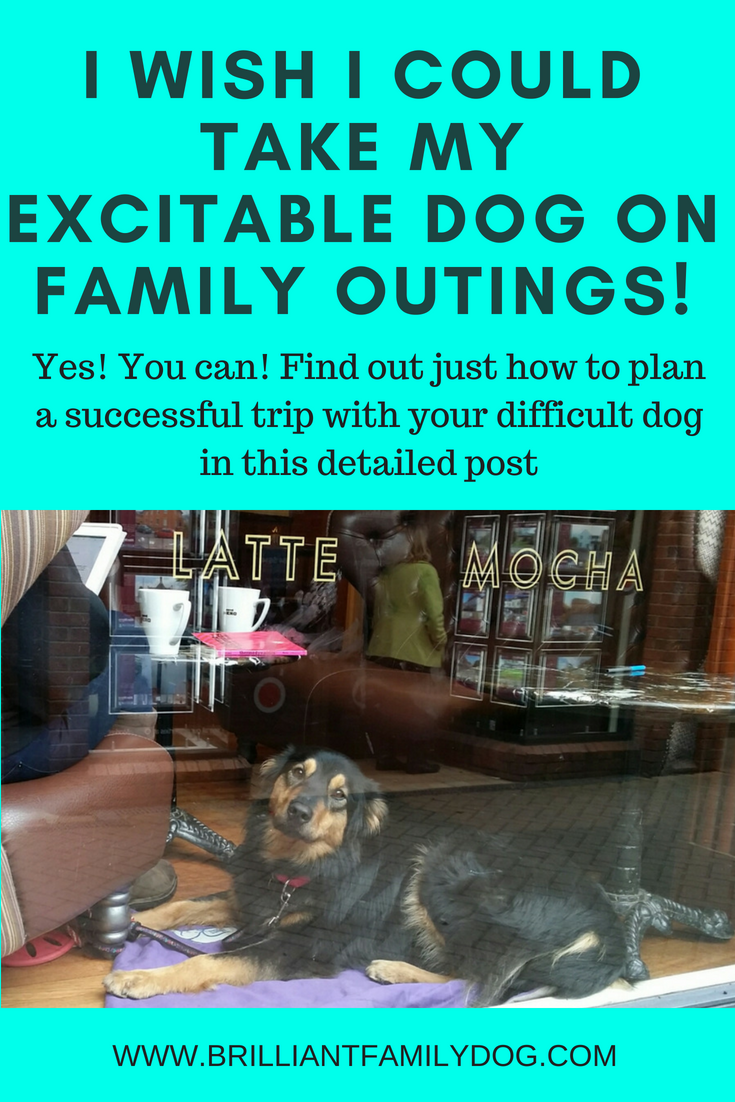
I wish I could take my excitable dog on family outings!

Do you long to take your tricky dog on family outings? You can! Follow the suggestions here and you can make it work, and really enjoy your family dog | FREE EMAIL COURSE | Reactive dog, problem dog, fearful dog, dog behavior | #problemdog, #reactiv…

Yes! You can!

One of the reasons you got a family dog was the enticing thought of outings - to the pub, the cafe, the beach, forest parks … What could be nicer than enjoying a walk in beautiful scenery, and ending the visit in congenial surroundings with everyone tucking in to good food and drink?

But the reality arrived in your fluffy bundle of puppyness, and you soon discovered that your family dog had other ideas about how life should work!

So you may have a dog who’s ebullient, boisterous, loves everyone, and you feel you can’t inflict that on a pubful of people wanting a peaceful refreshment stop. 

Or maybe your dog is reactive - shy, anxious, “aggressive” - and struggles to be in the same space as strange people and - worse - their strange dogs.

Your ideas of family outings with your dog have been put on hold for an indefinite period, until … until what? Until he gets to age 11 and calms down a bit? Until he suddenly decides he’s no longer afraid of people and dogs? Until he’s able to pass a dog on the path without a meltdown?

You could be waiting a long time!

So let’s speed this up - a lot. 

A portable parking spot

One game all dogs should learn is how to relax on their mat. Once your dog knows that if the mat is on the floor, then he should be on it, calmly waiting for you to reward him for staying there, then you can consider going out to places.

For precise, step-by-step, instructions on how to achieve this, go to my Books page where you’ll find that a whole book on calming your dog down is free! Yes, really …

Want to take your dog on a picnic? Follow the suggestions here to prepare, and you can make it work, and really enjoy your family dog | FREE EMAIL COURSE | Reactive dog, problem dog, fearful dog, dog behavior | #problemdog, #reactivedog, #dogtrainin…

I can’t tell you the number of students who have found this skill so useful - at home, when friends visit, in cafes, on trains, on buses, at training class, on holiday, at the shops, at friends’ houses, at the vet’s - the list is endless.

If you’re starting with a puppy, so much the better. This can all be part of her valuable socialisation program.

“We thought about delaying getting our new German Shepherd puppy because we had already arranged a short holiday with friends. Our breeder persuaded us that we shouldn’t wait and that a holiday was an ideal time to have our puppy bond with us. So we collected our 8 week old puppy and spent 2 weeks getting to know one another, then headed off with our friends by car and then ferry to the Isle of Skye. Before she was 11 weeks old, puppy Elva had been in the car, on a train, and on a ferry - and she took it all in her stride. People might worry about meeting enough people in the important socialisation phase in a puppy’s life but everywhere we went, she was a people-magnet with everyone wanting to pet her. She loved all the attention and we loved that she was interacting with so many people!

I’d had concerns about travelling with a puppy but we’d started crate training right away. Our travel crate was invaluable in the car and a great place for a tired puppy while we went out for dinner with our friends. By evening, she was more than happy to sleep quietly in her crate until we came back.”

Amanda and Elva, German Shepherd puppy

And Ellen travelled a lot with her Border Collie pup Selkie, even at only four months!

“The games have helped greatly with making puppy trips easier and laying the foundations of good communication. She's particularly great on her mat on buses, trains and in pubs!

 
Teaching your dog to lie on her mat is an invaluable skill for being able to go on family outings later | FREE VIDEO COURSE | Reactive dog, problem dog, fearful dog, dog behavior | #problemdog, #reactivedog, #dogtraining, #growlydog | www.brilliantf…

Mat is King!

So matwork will get you part of the way there - and may be all you need for your excitable dog. You also have to make life as easy as possible for your worried dog.

For this you need to work on techniques and strategies to help him adjust to our world - there are plenty here to get started on at Brilliant Family Dog

And the most important thing for your reactive dog is distance. So a good place to start would be an establishment with a large, open, garden where you can get away from other people and be out of their way. If you go to a crowded place and your dog surprises you by being “fine” with all the busyness, think again. It’s more likely that your dog is exhibiting a learned helplessness - he can’t escape, it’s all too stressful, so he shuts down and waits for it all to be over. 

So heading off on this type of outing can only be done when you know there’s a good chance that with all your preparatory training, your dog will be able to cope. 

Forward planning

Either way, you need to plan this trip! 

Here’s a wonderful example of just how effective this can be, from Kerina, one of the students on From Growly Dog to Confident Dog

“We had aimed to go to the pub today and had it planned out to the letter. If either of the dogs got too stressed we wouldn’t stay for lunch, just a drink. We plotted the route yesterday.

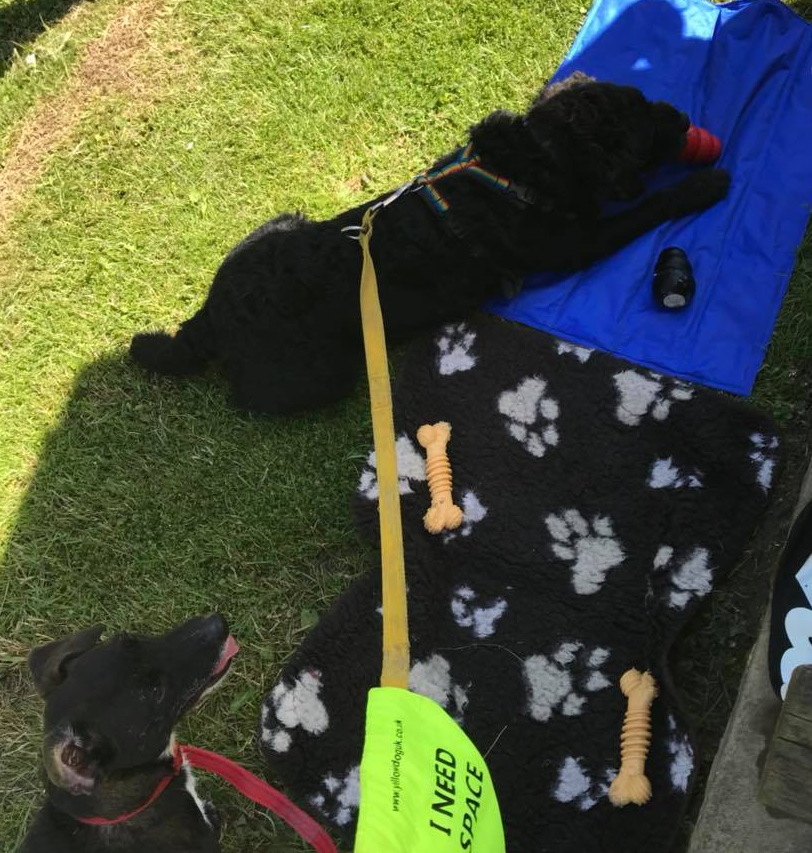
I was prepared, had packed toys for the dogs, frozen kongs, coolmat for Spud and blanket for Robin, water from home and some kibble and treats. We chose a table that was at the side, right by the river, and both dogs settled.”

Teaching your dog to lie on her mat is an invaluable skill for being able to go on family outings later | FREE VIDEO COURSE | Reactive dog, problem dog, fearful dog, dog behavior | #problemdog, #reactivedog, #dogtraining, #growlydog | www.brilliantf…


Later the dogs enjoyed more of their river walk and a swim. They couldn’t have had such fun from the day without the thought Kerina and her sister put into it.

It didn’t take much to take all this stuff with them - think how much a toddler’s family has to pack for a couple of hours! - but it paid off many times over.

An important part of Kerina’s plan was to abort the trip if things weren’t going well. Always be ready to get out of Dodge. If your dog is stressed it’s not going to be much fun for any of you. And if your dog’s having an exciting walk, with lots of running and sniffing, be sure to factor in plenty of downtime. That’s when those prepared foodtoys and the mat come into their own. 

So get everything ready, do all the training first, plan a trip, plan your exit strategy, and enjoy the family outings you were so looking forward to when you decided to get a dog to share your life. 

Yes, it can happen.


Is your dog throwing up more challenges than you anticipated? Watch our free Masterclass and find how to change things fast!

I'm too busy to train my dog

Teach your dog everything you want him to learn, one minute at a time! | FREE EMAIL COURSE | Dog training, new puppy, puppy training, dog retrieve training | #newpuppy, #dogtraining, #newdog, #puppytraining, #dogbehavior | www.brilliantfamilydog.com

Gone are the days when you had to march round a hall for what seemed like hours on end to train your dog. Those bad ole days when we were instructed to practice only whole exercises instead of breaking them down into tiny component steps.

No longer do you have to prepare a training session like a military campaign, getting everything in place before you fetch your controlled and manipulated dog from the white room he’d been placed in so that he didn’t get too excited/bored/whatever. 

Want some shortcuts to this system?

Watch our free Workshop.

You don’t have to take copious notes on what you do in every session. Note-taking certainly has a place, and if you’re a professional animal trainer, working with a host of different animals every day, it’s a must. But for the average dog-owner, with just one dog to work with, you should know what you last did and how to progress it next. 

Most of my training is done on the fly, as part of my everyday life with my dogs.

A delightful morning greeting! | All-Day Training, force-free training | #dogtraining, #puppytraining | www.brilliantfamilydog.com

First thing in the morning, for instance, my dogs are released from their beds to give a delightful morning greeting. Here’s Lacy’s morning smile to me, leaning over my pillow … What could be nicer?

Straight downstairs and they all sit at the garden door waiting for it to open and to be let out by name, individually. 

So already we’ve used matwork, impulse control, turn-taking, and waiting for - and acting on - a personal release cue. These all have their own intrinsic rewards - no need for treats or toys. 

While the others do their business, Rollo will be too busy watching the hens emerging from their house for another day of clucking and scratching. His “Hurry up” cue sends him straight to the pee-side of the garden for some action. Back inside again, they are free to greet the cat, keep me company getting ready for the day, to chew bones, lie on their beds - generally amuse themselves. So that takes more impulse control, self-confidence, feeling comfortable in their own skins. 

And so it goes on, through the day. While I work they can do what they like. An off-switch is an essential here! Preparing for a walk or van-journey incorporates impulse control and patterning. 

Coco waits quietly on his mat at the coffee shop | FREE EMAIL COURSE | dog training, matwork, dog impulse control | #dogtraining, #dogimpulsecontrol, #dogrelaxation | www.brilliantfamilydog.com

A visit to the shops or cafe brings in more of their everyday training. Here’s Coco on his mat at the coffee shop, waiting for victims to come through the door to greet him (so he thinks). More matwork, more impulse control, polite greetings. 

Once we’re out we either have an exploring walk, or play with toys (each dog has their own toy so that there aren’t any mid-air collisions or spats), and the two that have difficulty with things suddenly happening - strange dogs, people, children, bikes, plastic bags, or hot air balloons - get to work on their reactivity with carefully-designed strategies for them to adopt instead of barking, lunging, and shrieking. I help them cope with the hazard, then on we go again. Here we’ll have used a number of reactivity-geared techniques, counter-conditioning, recall, loose lead walking, retrieve, stop mid-hurtle, down, sit, and any other tricks I fancy asking for. 

I’ll walk one, two, three, or four, dogs as the fancy takes me, and as the need arises. Multiple dogs in a home can soon turn into a gang of hoodlums if their individual needs aren’t catered for.  


William Henry Davies had it, when he penned his well-known poem Leisure. He knew the value of living in the moment:

What is this life if, full of care,
We have no time to stand and stare.

No time to stand beneath the boughs
And stare as long as sheep or cows.

No time to see, when woods we pass,
Where squirrels hide their nuts in grass.

No time to see, in broad daylight,
Streams full of stars, like skies at night.

No time to turn at Beauty's glance,
And watch her feet, how they can dance.

No time to wait till her mouth can
Enrich that smile her eyes began.

A poor life this if, full of care,
We have no time to stand and stare.


Breaking down what you end up with into tiny steps

Those recalls, for instance, aren’t something you teach by telling your dog to sit, marching away, facing him like a statue, then barking out a command for him to come to this imposing figure, and sit. Life is not an army camp! And your wayward dog is not going to learn by you just yelling at him when he’s a couple of hundred yards away, hoping that somehow, miraculously, he’ll understand what’s wanted. 

When I call my dog I want him to respond to me with a “Hey! That’s my name!”, a head-turn towards me (a stop and turn if they’re racing away), whole-body turn - then a race towards me where they’ll be greeted not with a stony face, but with joy. No requirement to sit - just to race back. So each of those parts is taught entirely separately, and only occasionally put together as a whole. And each of those parts is practiced in isolation, regularly. 

Practice makes perfect

Yes there are little impromptu training sessions dotted about the day, one dog at a time, while the others wait their turns on their beds - or perhaps all at once to see who’s listening!

Lacy searches a car smaller.png

And when I’m teaching a completely new skill - scentwork (in the photo Lacy is searching a car for contraband), teaching them their sign to give consent when I want to handle or groom them, fun things like stacking beakers or dinner bowls, fetching and carrying things for me, formal obedience stuff, like Sendaway or dressage-style Heelwork - these will be slightly more planned, but still slotted in for a minute or two here or there. In the back of my mind I know what I want to achieve, and what small steps need to be taken to get to the desired result. Then I just peg away at it when we are all in the mood.

In short, instead of planning training times with my dogs, which would inevitably be postponed because time slid away, or I felt too tired, or I’ve timed things wrong and they are now exhausted from a long walk . . . I grab the moments I already spend with them and use those times to teach new things or practice old tricks. (It’s all tricks to them.)

We don’t line our children up in the morning and give them a ten-minute lesson on what we want them to learn, then ignore them for the rest of the day! We interact with them all day long - a word here, a story there, a little advice or teaching slid in to a conversation, appreciation for something they’ve done which pleases us. We don’t need to allocate special time for all this - it all happens as the day unfolds, during the time we are already spending with them. 

And that’s what happens with my dogs here. A frequent note to self that “What you expect is what you get,” ensures that I keep the training going at all times - although to my dogs it’s just daily life, interaction with me and each other, cuddles, food, fun.

This is what I call “All-Day Training” - just bits, slotted in here and there.

Who’s doing the training?

How many people have a dog of eight or ten years old, and say - “Oh, Harry never comes back when he’s called,” as if somehow it’s Harry’s fault that they never took the time to teach him!

It’s never too late to teach your dog skills that not only may save his life, but which make daily life so much more congenial. If you wait till the time is right, all your ducks are in a row, and you are going to “do some training”, you’ll have missed the boat. 

Full of care, you’ll have missed out on the squirrels and the stars, and the smile in the eyes.

Forget about formal sessions. Forget about sits and downs and marching about on a lead. Stick to All-Day Training and see how easy it is. 

If you want to find out how to break things down and teach one minute at a time, check out my Online Courses, and my step-by-step books. Develop the bond between you and your dog, enjoy watching him blossom as you work together, and things will all pan out very nicely.

You’ll be a family.


And for lots of quick ways to learn some of the things in this article - and which you can fit anywhere in your busy day - get our free email course here

THIS FREE ECOURSE IS A BONUS FOR YOU WHEN YOU SIGN UP TO RECEIVE EDUCATIONAL EMAILS AND OCCASIONAL OFFERS FROM ME. YOU CAN UNSUBSCRIBE AT ANY TIME.
Privacy Policy

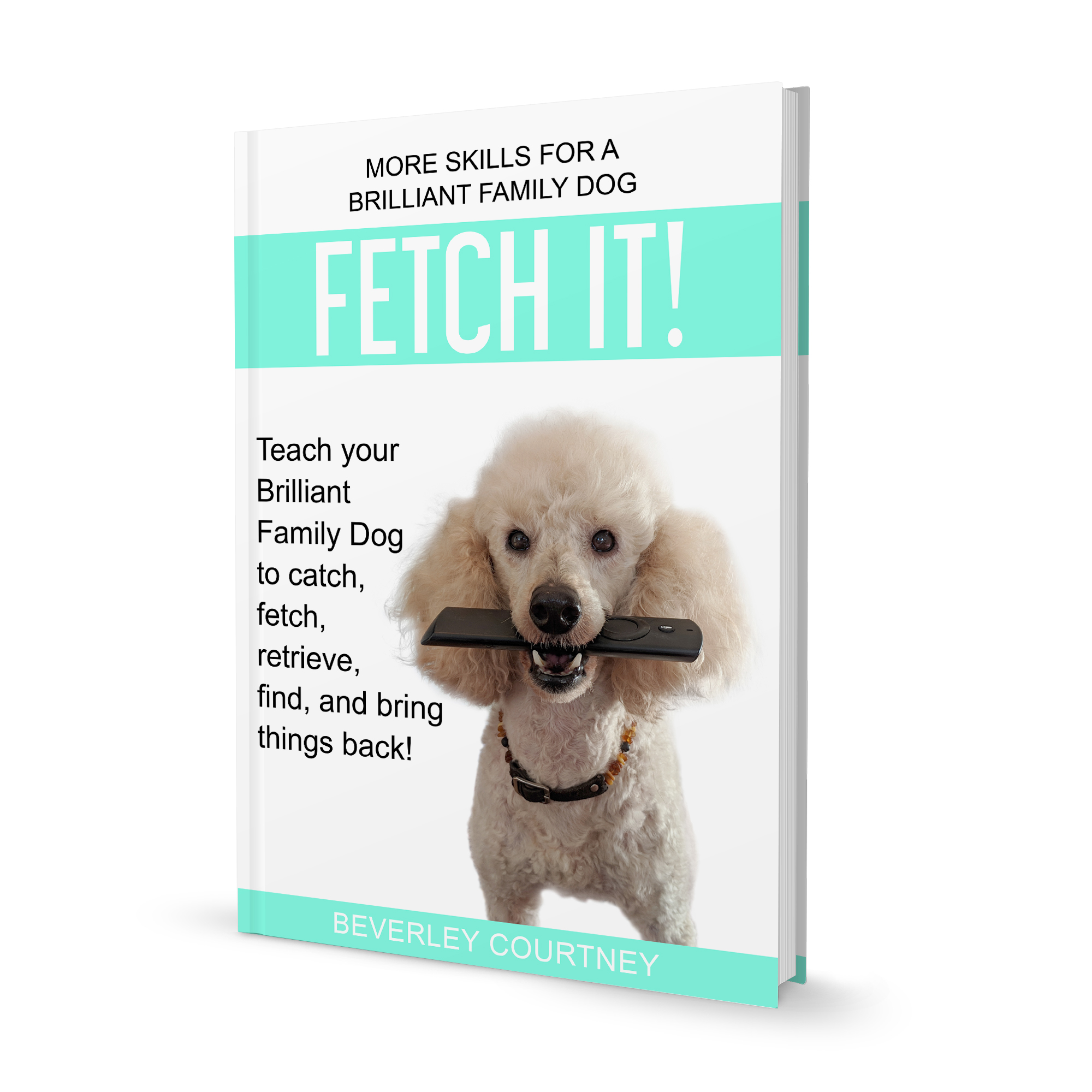
Want to turn your dog into a star retriever? Check Fetch it! Teach your Brilliant family Dog to catch fetch, retrieve, find and bring things back! and enjoy a new relationship with your dog.