Lost your car keys? Get your dog to find them for you!

Teach your dog to retrieve, fetch, and bring back - your keys! your phone! your purse! Step-by-step instructions to an enthusiastic retrieve | FREE GUIDE | #retrievetraining, #dogtraining, #searchdog, #puppytraining, #dogbehavior | www.brilliantfami…

You’ve sorted the lunch boxes, the kids are ready, the dog’s had a game, the breakfast table is sort of cleared. You’re rushing to get out of the house - and you’ve lost the car keys. Again. 

As my friend Susan - an always-busy farming mother - used to say, “It’d be easier to get out of Fort Knox with a bag of money on my back than to get out of this house on time!”

Instead of panicking and pulling the house apart, book by book, toy by toy, sock by sock, cursing the dog for being under your feet, why not employ said dog to help you?

We’ve all heard the astonishing stories of the power of dogs’ noses, searching for casualties in earthquake zones, detecting cancer on their owner’s skin, unearthing long-dead creatures to roll in …

So in this family of equal opportunities, let’s allow our dog to contribute her own special skills to solve the problem. She could find those keys for you in moments.


How could that possibly happen?

There’s a trick here, of course.

It’s not going to work if you yell at your dog in the midst of your rush and panic. You have to teach her first!

But it may surprise you how quickly she can learn to help you in this way.

Get your free guide to teach your dog a retrieve!

THIS FREE GUIDE IS A BONUS FOR YOU WHEN YOU SIGN UP TO RECEIVE EDUCATIONAL EMAILS AND OCCASIONAL OFFERS FROM ME. YOU CAN UNSUBSCRIBE AT ANY TIME.
Privacy Policy

You can start by getting some kind of soft or fluffy key fob, about tennis ball size would be good, a small soft bear would work - or you could plait some fleece to make a longer soft “handle”, perhaps with a knot on the end. You can even scent it with a tiny drop of vanilla essence to enhance its powers. If your dog is very mouthy and chewy you will do well to buy or make two or three of the same keyfobs, in case one gets over-enthusiastically loved to death

You’ll also need some sensationally good treats - tiny cubes of cheese or hot dog usually hit the spot.

Now you can play a game with your dog with this new toy. Keep the sessions very short - maybe one or at most two minutes - and FUN! 

Here’s your ten-step program to a retrieving wizard

Get your dog helping you about the house! Here’s a step-by-step instruction to an enthusiastic retrieve, whether of your keys, your phone, your socks … | FREE GUIDE | #retrievetraining, #dogtraining, #searchdog, #puppytraining, #dogbehavior | www.br…

1. Start by producing the key fob and holding it out to her - not in her face, just out in front of you. The second she so much as glances at it, say YES with delight (this is a game, remember!) and give her a small yummy treat. Put the toy behind your back again.

2. Repeat this peek-a-boo game until your dog is very keen to engage with this new toy and get her reward every single time it appears in view. By now you should have bright eyes and a swishing tail.

3. Hold the toy out to her. She’ll look at it and expect her treat. WAIT for just a moment, maybe waggle the toy a little, till she touches it with her nose. YES! Reward! If she bats it with her paw instead, ignore that and hold it much higher up.

4. After a couple of nose touches, WAIT for her to put her teeth on the toy. Maybe she’ll just give it a lick, or just maybe she’ll open her mouth a little. She may worry that she’s not allowed to touch it, so encourage her wildly and make your YES joyful with a particularly scrummy treat. End of first session. Have a game with her with one of her own toys, and put yours safely away.
[You may need to break this down into three brief sessions. Don’t push it - just get fun and a little progress each time.]

Next session, you can start again showing her the toy and rewarding her. Very quickly you can move the game forward to where you left off last time, with your dog touching the toy with some part of her mouth.

5.  Using the same method, keep saying YES! and giving a tasty treat every time she touches the toy with her mouth. You can gradually encourage her to take the toy in her mouth, with you still holding on to it. End of second session.

Step-by-step instructions to an enthusiastic retrieve, whether your keys, your phone, your socks … | FREE GUIDE | #retrievetraining, #dogtraining, #searchdog, #puppytraining, #dogbehavior | www.brilliantfamilydog.com

6. You’re going to advance this game, making it ever so slightly harder and ever so slightly more like a full retrieve every two or three treats. In other words, take it slowly!

7. You can start to let go of the toy, let her hold it a moment, then take it back - “Thank you!”  It doesn't matter if she drops it. Graduate to holding the toy nearer to the floor for her to take; holding it on your knee, dropping it by your shoe.

Fast forward: within a few sessions you’ll have a dog who gets excited at the sight of your fluffy, scented, key-fob, and who will pick it up when you drop it on the floor and smartly give it back to you to swap for her treat. Work very quickly and she won’t even think of chomping on it.

8. Start tossing the toy further away always rewarding her instantly for giving it back to you. Now you can add your words: “Where are my keys?” every time you toss it. Always put the toy away again after each session.

9. Finally, play hunt-the-toy games. Let her watch you push it slightly under the corner of a rug, then send her for it - “Where are my keys?” Hide it under a cushion on the sofa and send her for it. Find new places to hide it, always making sure she has success and brings it straight back to you to swap for her treat. Keep this really simple - we only want success! We’re not testing our dog, guys.

10. Attach your keys to the fluffy fob. Now you can show her the toy and avert her eyes or leave her in a different room while you go and hide the toy in one of the places she’s found it before. Keep it easy! She’ll search all the old places till she finds it. 

Get your step-by-step instructions to an enthusiastic retrieve, whether of your keys, your phone, your socks … | FREE GUIDE | #retrievetraining, #dogtraining, #searchdog, #puppytraining, #dogbehavior | www.brilliantfamilydog.com

Keep playing this game fairly regularly - don’t wait till you’re in full panic! You know the old saying, “Use it or lose it!” When you need her to find your keys you want this exciting game to be fresh in her mind. I frequently drop things on the floor (on purpose) and ask the nearest dog to “pick that up for me”. They love the opportunity to earn yet another reward!


Not only will your dog quickly learn this game of finding your keys without crunching them in her teeth - not good for electronic car keys! -  but you’ll be amazed how enjoyable it is teaching her. You’ll be watching the wheels go round in her head while she works out the new problem every time you move the goalposts. You’ll develop a new respect for your dog’s abilities. 

And she’ll love being a useful member of the family.

Now … what other things could your dog help you with?

Get your free guide to teach your dog a retrieve!

THIS FREE GUIDE IS A BONUS FOR YOU WHEN YOU SIGN UP TO RECEIVE EDUCATIONAL EMAILS AND OCCASIONAL OFFERS FROM ME. YOU CAN UNSUBSCRIBE AT ANY TIME.
Privacy Policy

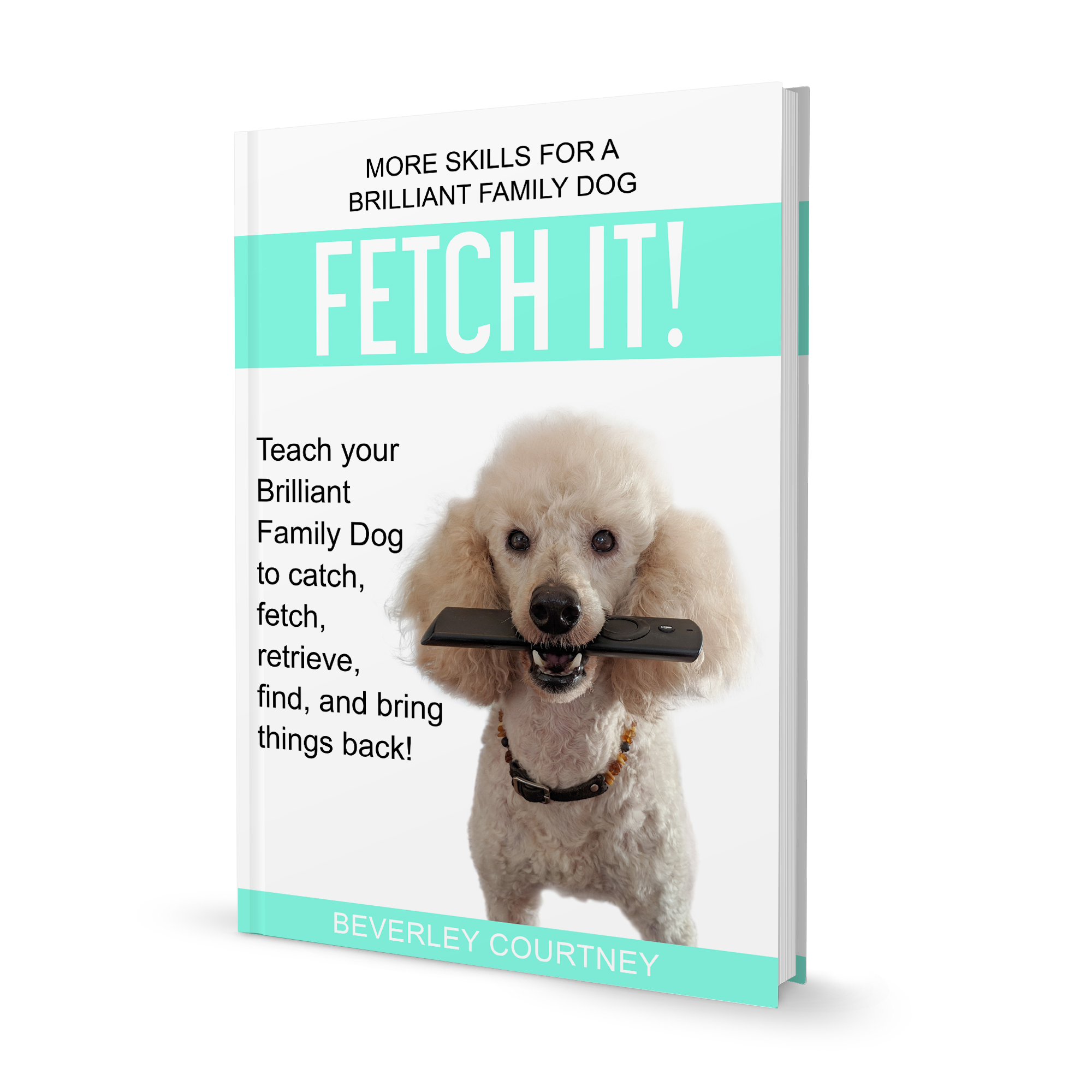
Want to turn your dog into a star retriever? Check Fetch it! Teach your Brilliant family Dog to catch fetch, retrieve, find and bring things back! and enjoy a new relationship with your dog.

Dog trainers and parents know the value of a playpen

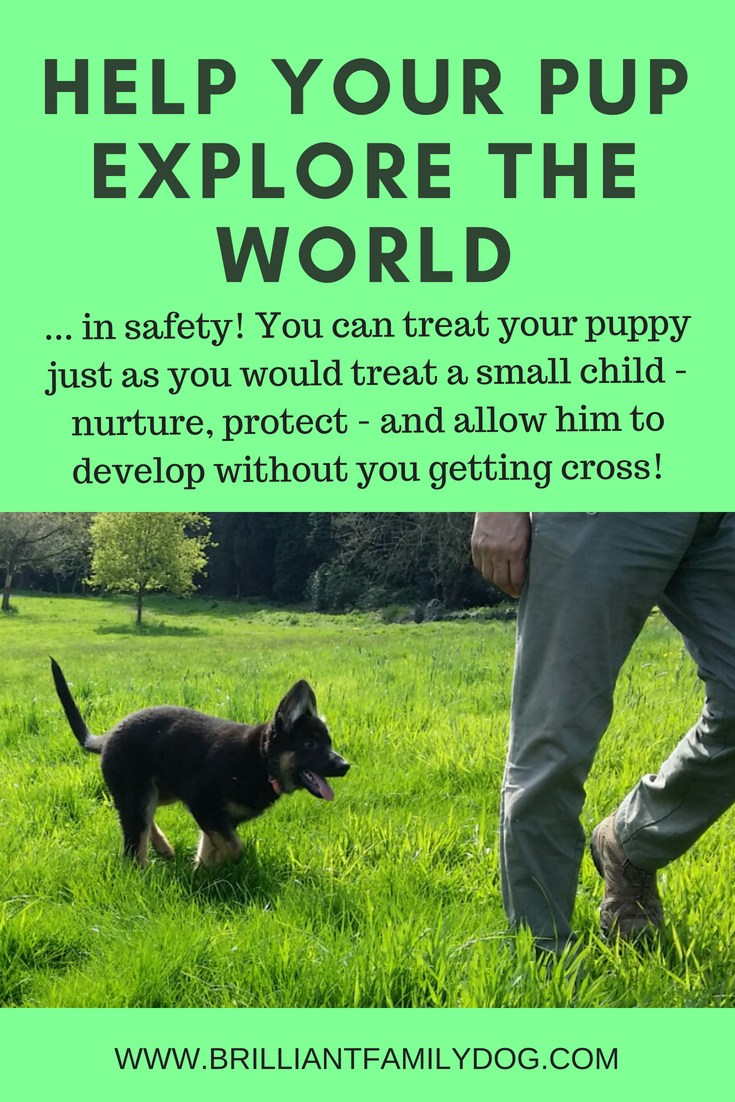
Dog trainers as well as parents know the value of keeping your new puppy safe - from electrical wires, other dogs in the house - and keeping them safe from your puppy! Along with children, cats, and grannies | FREE GUIDE | #newpuppy, #dogtraining, #…

Many parents will know the joys of being able to park their crawler in a playpen from time to time and know that they’ll stay safe.

Puppies need to be protected from many of the same dangers as babies. 

But there’s someone that needs to be protected from the puppy!  And that’s your older dog.

Your older dog didn’t choose to get a puppy - you did. 

His opinion hasn’t been asked. There he is, enjoying his peaceful home, when suddenly a ball of fluff and teeth arrives and he is expected to be an unpaid childminder.

Quite soon the pup is ruling the roost. Your faithful older dog is jumped on and chewed mercilessly whenever the pup is awake. If he tells the pup off he gets told off himself. He can’t win.

Don’t abandon your old friend!

Your first dog needs to know that he is still special and has his own life. And a great way to ensure this is by using the playpen.

When it’s time for the pup to wake up and emerge from her crate, you’ll be taking her to the garden, on her own. So once peeing is done, the dogs may like to have a quick game together. Interrupt it as soon as it starts getting rough (even after two minutes if necessary) and divert them to something else - a game with you, perhaps. 

A doggy playpen has endless uses, on holidays and visiting friends as well as at home: read the post to get some ideas of what kind of puppy playpen you want, and how to use it for your new puppy and older dogs | FREE GUIDE | #newpuppy, #dogtraining…

Now is a good time for the pup to go into her playpen, with loads of things to chew and interact with (cardboard boxes, food toy, soft toys, plastic bottles, chews, bones …) while you get on with your work and Dog no.1 gets a break. 

And perhaps some personal time with you.

Not just dogs

The cat is safe from molestation as well, and I don’t have to shriek or grab the puppy to prevent disaster. 

You can zigzag it and divide a whole room, as I have in the puppy pictures on this page. 

I found this most useful - my puppy could be loose in the kitchen with me, the adult dogs could enjoy the freedom of going out to the garden or into the house and into the living room, and could see and interact with me. 

Oh, and if you pop the puppy into her pen when she’s still very young, she’ll never realise that jumping out is an option!

A doggy playpen has endless uses, on holidays and visiting friends as well as at home: read the post to get some ideas of what kind of puppy playpen you want, and how to use it for your new puppy and older dogs | FREE GUIDE | #newpuppy, #dogtraining…

You can get great pet playpens cheaply. The one I use is tall enough to be stable if a taller pup stands up with her paws against it. It has a door. It can be any shape from a hexagon to a rectangle or more creative shapes to fit between or around your furniture. It can be used indoors and out. It doubles as a barrier at an open door.

My puppy playpen also does service as a “balcony” when we’re camping in the van, so I can have the doors wide open and know the dogs aren't going to fall off a cliff. 


Resistance

So it seems strange to me that some people should resist using a playpen for their pup. Some don’t want to spend the (small) money for something they think they’ll only use for a few months. But that is a false economy! It will save you so much bother and moaning at your puppy. Your relationship could be damaged, and for what? 

I’ve used my playpen extensively even though my youngest “pup” is now 4. It really has paid for itself over and over again.

Everyone happy! (Especially Squeak the Cat …)


Check out this article for more ideas on containment,
with a free guide to download. 


Make life easy for you and your dog!

How can you rear your new puppy without losing your cool? Use the force-free tools available to help your dog cope with the world without ever going wrong! | FULL ONLINE COURSE FOR YOUR NEW PUPPY!  | #newpuppy, #housetraining, #puppytraining, #dogbe…

“Why are you carrying that lump of a child the whole time?” the woman asked of my friend Jessica. “He must be two if he’s a day. Where’s his pushchair?”

Jessica blushed and struggled on, hoisting her well-built two-year-old son onto her hip. She didn’t want to have to answer this sensible question. She was exhausted carrying the wriggly heavy child for hours, but she was under the thumb of her partner, who had decreed that no child of his would be put in a pushchair, and that his mother had to carry him whenever he could not walk. Apart from wearing out his mother who had no free hands for anything else, this prevented the child from interacting with his world without parental pressure. It blocked the path of discovery, self-awareness, confidence. 

This madness extended to the home, where the boy was not allowed to sleep in a cot. 

The result? Midnight mayhem. Whenever he awoke, Basil would - naturally enough - slide out of bed and start wandering. Naps were impossible if Basil decided he wasn’t sleepy enough. Result: unrested and overtired child - and all parents freeze with apprehension at the thought of that!

It’s hard enough bringing up a toddler, without both hands being tied behind your back.

Most parents would consider these attitudes lunacy - the result of Jessica’s spouse’s bullying. 

So why do people do the exact same thing with their dog?!

You can rear your new puppy without EVER saying “NO”! Use the force-free tools available to help your dog cope with the world without ever going wrong! | FULL ONLINE COURSE FOR YOUR NEW PUPPY!  | #newpuppy, #housetraining, #puppytraining, #dogbehavi…

I’m always surprised when I come across resistance to using a crate for a dog. 

Using a crate for a dog is just the same as using a cot for a child.

There’s no question of punishment. The crate is his bed, his own space; it has plenty of toys and chews in it; all meals are fed in it; stuffed food toys are given in it. It’s a haven where he’s safe from other dogs, cats, children, the world. All he has to do in it is r-e-l-a-x. 

Here you see Coco Poodle relaxing in his much-loved crate. It even has a handle for him to pull to open it when he wants to go in for a break. 

You should always know exactly where your dog is. If you ask him to go in his crate when you go out, you’ll know that when you come back you’ll be greeted by a smiling, stretching, cool, rested puppy, with no chewed cables or furniture, no upturned bin, and no pee on the floor. Your pleasure at seeing each other will be genuine and untrammelled by recrimination, bad temper, and frustration. 

Leaving him loose to entertain himself in the house instead of getting his valuable shut-eye, will make you bad-tempered and cross, and your puppy will have NO idea what he’s done wrong - just that you don’t like him and you may be dangerous. This is not the way to create an unbreakable bond with your dog!

So why would you resist this simple solution to so many aggravations?

Don’t labour on like Jessica did, making housetraining, chewing, and life in general much, much harder. Use the tools that are available to you, just as most parents do with their small children. 

More info on how to crate-train happily here


And have a look at just how I train my own puppies! in this small but perfectly formed mini-course


Where are my spoons? Why your dog runs out of calmness

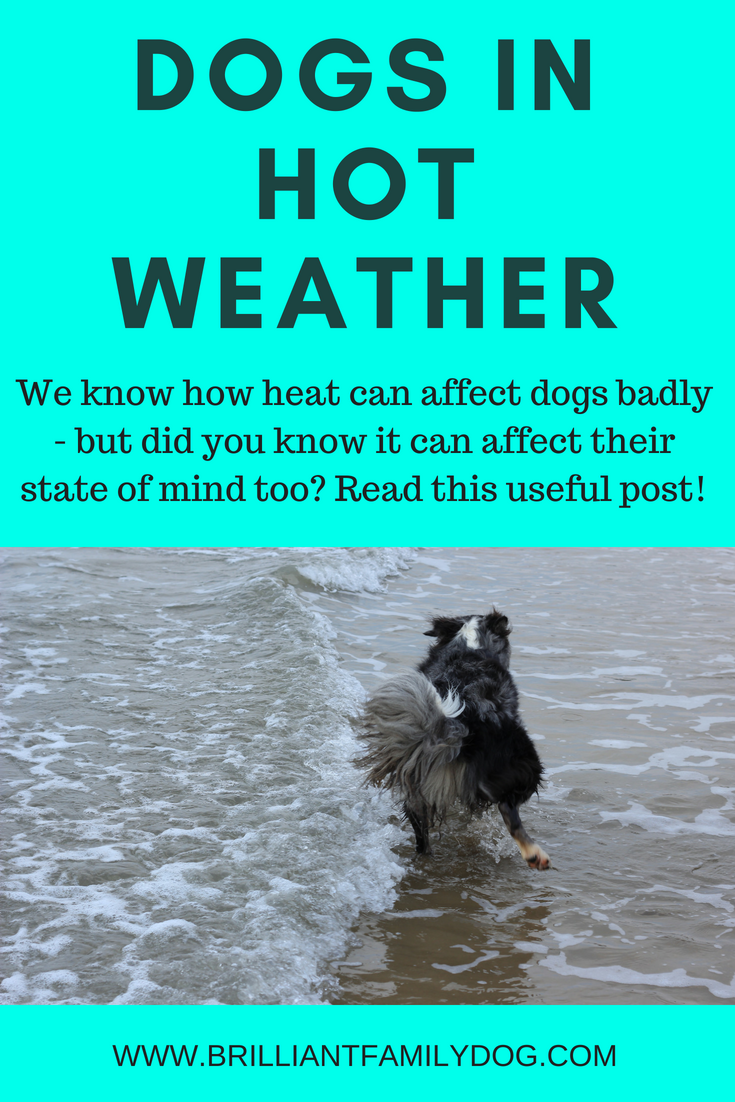
How does heat affect your dog? We all know not to leave a dog in a car - but have you thought how the heat can affect his psyche? Read this post for some eye-openers! | FREE VIDEO WORKSHOP | #anxiousdog #dogtraining, #newrescuedog, #puppytraining, #…

It’s a puzzle to so many people. Their dog is easygoing and tranquil, and out of nowhere he snarks at another dog - or snaps at a child - or even growls at you! 

Maybe your dog is not so easygoing and you have just learned to live with these “random” outbursts. You never know when he’s going to be in a good humour, and when he’s going to have a meltdown.

But you CAN know! 

If you’re aware of what’s using up your dog’s patience stores, you’ll be able to manage him so that he doesn’t run out entirely, and be left with no way to go except have an outburst.

What you need to learn about is known as Trigger Stacking. And at the moment we have a huge extra trigger that many people simply aren’t aware of.

Heatwave!

In the UK at the moment we are enjoying (or suffering!) extreme weather. Weeks of temperatures in the high 70s and 80s (that's the high 20s in new money) - we’re not used to it at all!

So spare a thought for your dog, who has to wear his full fur coat regardless of the weather. 

You doubtless know all the commonsense advice for dogs and hot weather: 

• Ensure plenty of fresh water is available

• Brush out the winter coat as far as possible, and trim and shear hairy beasties

• Cut back on walks - maybe none at all for a few days, and certainly only at the cool ends of the day

There’s more to keeping your dog cool in the summer than his physical comfort. It can also help with dog anxiety and general dog behavior. Read this post for some eye-openers! | FREE VIDEO WORKSHOP | #anxiousdog #dogtraining, #newrescuedog, #puppytr…

• Limit access to the garden UNLESS you have a paddling pool to entertain your dog, or unless he has enough sense to find a shady spot and stay there

• Check temperature of the ground with your hand. Have you seen people doing the hoppy dance on a hot beach when they have no shoes on? 

• Don’t leave your dog in a car, even with the windows open, without taking measures to keep it cool. This will include covering all the windows, ensuring a through draught, running an aircon, and - of course - parking in the shade.

• Consider a cooling mat for a double-coated breed, or a cooling shirt. A wet t-shirt will work well too, but you need to keep wetting it.

• Frozen food-toys may be popular

• Observe speed of panting and shape of tongue - a long spoon-shaped tongue means your dog is working hard to get rid of heat 


Heatstroke in dogs can be quick, and deadly. So please take the precautions above to ensure your dog is protected.

Hothead

But you also need to consider how this heat is impacting his mental state.

I’d like you to take a quick detour and bone up on Spoon Theory. This explains so well how limited stores of energy have to be farmed and managed carefully. The same applies for our dogs with their limited store of tolerance. 

Before you even step out of the door on a hot day, your dog is stressed. He’s already used up a boatload of spoons and may be running critically low. This could apply to the calmer dog as well as the “reactive” or growly dog.

You know how quickly you can get annoyed when you're uncomfortable - especially if you're not used to the heat? Think of airport rows and road rage in hot traffic jams.

There’s more to keeping your dog cool in the summer than his physical comfort. It can also help with dog anxiety and general dog behavior. Read this post for some eye-openers! | FREE VIDEO WORKSHOP | #anxiousdog #dogtraining, #newrescuedog, #puppytr…

Lots of people will be out and about in holiday mode, with dogs who are only walked on high days and holydays, and everyone will be hot and bothered.

So seek out quieter walks, shaded walks - if you can find a place for your dog to swim, so much the better! - and cut out the ball-throwing till the worst of this heat is over. It will be over soon enough, and all us Britishers can go back to talking about the weather in disparaging terms! 

And if you live in a permanently hot place, you’ll have worked out your own ways of keeping your home cool, and strategies to get about outside without boiling. A reader from Texas told me that she can only take her dog out for 20’ at 5 am - after that it’s into the hundreds and impossible. 


Triggers, and spoons

Armed with this knowledge, you can now look at your dog in a different way. Hopefully a more understanding and tolerant way. He’s not being difficult - he’s struggling in circumstances he finds hard at the best of times, and may now be finding impossible.

In the greater scheme of things, it really doesn’t matter if your dog doesn’t go for a walk for several days - or even weeks. And contrary to what you may be thinking, you may be surprised to find that your normally hyper dog in fact gets calmer and more manageable, the less he’s walked!

Help him by managing his day carefully when outside influences are making it harder for him. He’s relying on you! 


Start the change with your reactive, anxious, aggressive - Growly - dog with our free and premium courses packed with ideas and strategies, all force-free


How training your dog can help you train people

How can you protect your dog from well-meaning people who want to pet him? Here are some easy dog training techniques to kindly control your dog and train your visitor! FREE VIDEO WORKSHOP | #shydog, #dogtraining, #newrescuedog, #puppytraining, #dog…

Some people are good at greeting dogs. And some are … not. It’s not a skill we’re born with (think how long it takes to teach children how to greet people politely!), so we have to teach those who approach us how to greet our dog - or, indeed, whether they may greet her at all!

If your dog is like Greta Garbo, who famously said, “I want to be left alone,” then no greeting is required. This is where you’ll have to use your dog training skills to prevent a quick lunge from the visitor, now wailing “But dogs like me!” as they jump back alarmed from a snap.

You may have dogs who lurve people and want to jump all over them. Yapping NO at your dog, flapping your hands and yanking the lead is not going to cut it. You need to teach your ebullient dog how to greet strangers - and for this you need the stranger’s co-operation!

So how can you get the people you meet to comply?

You can use the same mantra we use for our dogs - 

Reward what you like
Ignore what you don’t like
Manage what can’t be ignored

This means that if your visitor does what you ask, they earn the reward of greeting your dog. If they do inappropriate things (in your dog’s eyes) then you ignore their efforts as you focus on directing them to what you do want, and manage the situation so they can’t interfere with your dog.

Let’s have a closer look at this.


The shy, anxious, or fearful dog

Evasion skills for your shy or worried dog

How can you protect your dog from well-meaning people who want to pet him? Here are some easy dog training techniques to kindly control your dog and train your visitor! FREE VIDEO WORKSHOP | #shydog, #dogtraining, #newrescuedog, #puppytraining, #dog…
  • Carwash - teach your dog to run behind you and appear peekaboo-style between your legs. Few strangers will grope between your legs to get at your dog

  • Get behind - lurking behind your legs may work better for very large or very shy dogs

  • Down - can get them out of arm’s reach of invasion

  • Muzzle - If your dog has a tendency to lunge and snap, teach her to be happy in her muzzle. This will relax you as you’re not worried about damage, and does tend to keep people away. They think this dog is dangerous - in fact she’s safer than an unmuzzled dog


Where you can help

  • Get between your dog and the kindly visitor intent on grabbing her

  • Use your body to block the path to your dog, and keep moving as necessary to stay in the way

  • Asking the would-be greeter questions and taking control of the meeting, will distract them from their “Hello doggy” plans

  • Maybe just keep walking! With a quick “Morning!” as you pass

  • Or use the tried and tested policeman STOP hand signal. This is immensely effective at stopping people in their tracks, giving you time to arrange your dog where you want her, and allowing you to compose a suitable sentence to keep the person at a comfortable distance. You don't have to make excuses for your dog. Just think of a quick way of getting the person to do what you want. Practice this at home with a friend, so you feel brave enough to do it!

  • Talk to your dog quietly and politely - this may impress your would-be greeter that you don’t have to yell and grab this particular dog


The over-exuberant dog

If a meeting is appropriate, give clear instructions on how to greet your dog. You’ll train your dog how to do his part, using friends to help you. This means he’ll know this “game” when you want to use it in the wild.

Bouncy Goldie pup Alfie shows how to greet people

Greeting skills for a bouncy dog

  • Hand touch (your hand to start with)

  • Release cue (“Go say hi”, only when dog is sitting and calm)

  • Timing of reward (when he’s turned back to you)


Your clear instructions should be brief and simple. For instance, “just hold your hand down by your side so he can sniff it”. This tends to stop people leaning over your dog and grabbing or patting, ruffling or thumping. It also stops your dog leaping up to nose-dot them as they can inspect their hand instead.

By the time your dog has sniffed the hand to gain all the information he needs about the person, he’s already back with you for his treat. Job done.

Crowd control

Unless you know for a fact that the person wanting to chat to you and your dog will listen to you, follow your instructions, and understand what you’re doing - don’t let them near enough to cause trouble.

All this work you’ve put in to understanding how your dog’s mind works and how to get the best from her? It’s just the same with people! You can take a quick overview of the situation, remember my mantra above, make rapid decisions about whether a greeting should or should not happen, and take control of the meeting.

This way you won’t be caught out by those who think they know more about your dog than you do, and avoid the embarrassment of muddy pawmarks on the person’s clothes … or worse.

Remember if your dog thinks she has to defend herself against this invasive person, she’ll be more alarmed about the next person you pass, and may even consider a pre-emptive strike (leap out and snap) to keep them away.


Is your dog throwing up more challenges than you anticipated? Check our free and premium courses and find how to change things fast!

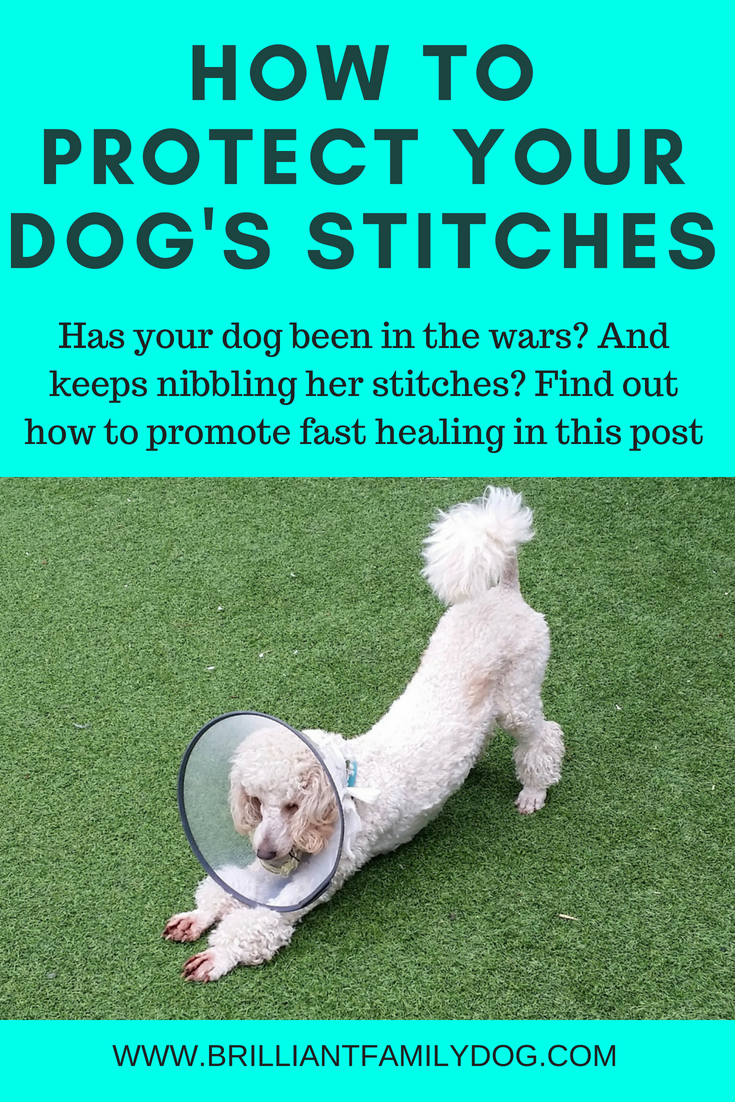
How to stop your dog damaging her stitches

Is your dog injured? And nibbling his stitches? You have to protect the wound to promote healing, but there are many ways to do this! | FREE EMAIL COURSE | dog training, dog health | #doghealth, #dogbehavior, #dogscratching | www.brilliantfamilydog.…

At some stage in his or her life, your dog will need stitches. Could be for neutering, a gash or tear, or something more serious.  

Some dogs will lick obsessively at a wound. This causes skin changes, it inhibits healing, and can introduce infection. So it’s essential that the wound is allowed to heal without being licked and nibbled at.

Many years ago one of my dogs came back from the vet wearing a modified wastepaper bin on his head. They’d cut the base out of it, leaving nasty ragged plastic edges. While protecting the wound they had made in surgery, it created sore patches and cuts all around his neck where it chafed. 

Vets now use a ready-made collar which comes packed flat. This is known as an “Elizabethan” or “Buster” collar to attach to your dog’s own collar. These are large lampshade-type constructions which will fit any size dog. 

They annoy mightily, but they don’t do any damage. Except when the dog catches it in a doorway and it digs into his neck. Or gets food all over the edges. Or is unable to get a drink without spilling the water bowl.

For indoor use only

If your dog needs this to protect the wound, then go for it. But if he’s well enough to go for a walk with you, please take it off! It crashes into things, its appearance will cause problems with other dogs, and it distorts your dog’s hearing so that when you call he’ll head off in the direction he’s facing - as that’s where the sound seems to be coming from! 

If your dog is busy running around, sniffing, and being a dog, he won’t be licking his wound.

There are alternatives. I haven’t tried one, but there are cushion-type collars that are supposed to prevent the dog turning his head round to reach the wound. I guess these could be very effective, depending on the position of the wound, and the elasticity of the dog. For dogs who are able to turn and meet themselves coming back, this probably wouldn't work.

A t-shirt that covers the area may be quite enough. Depending on the size of your dog, you can put a child’s or adult’s t-shirt on him. Tie all the excess material in a knot over his rump, so he can still pee without getting in a mess. 

If your dog can’t leave the wound alone, then obviously the bonnet stays firmly on. 

There are lots of crafty tips and tricks to help make life easy for you and your dog in my books. And what's more, you can get them direct from me, right on this site, and save yourself some money! www.brilliantfamilydog.com/books

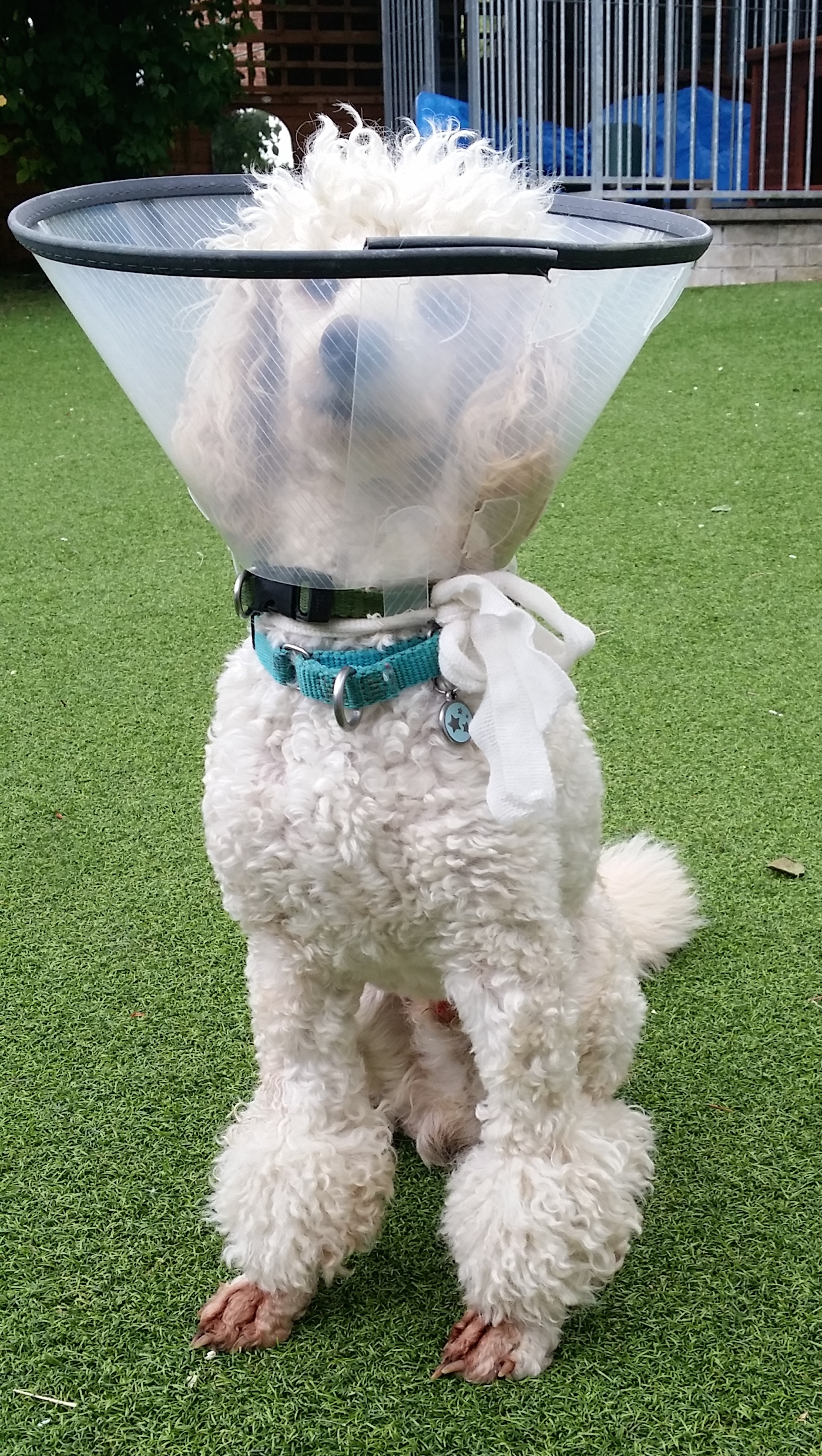
Coco looks like Buzz Lightyear in his bonnet! You have to protect the wound to promote healing, but there are many ways to do this | FREE EMAIL COURSE | dog training, dog health | #doghealth, #dogbehavior, #dogscratching | www.brilliantfamilydog.com

Not just licking!

Another time when it’s essential is when the wound is on the face or head. A quick scratch with a powerful hind leg can do untold damage in seconds. Dogs never seem to do the minimum scratching necessary to relieve the irritation - they scratch for what seems a pre-determined period, by which time the stitches may all be ripped out. Keep your hat on!

Here's Coco doing his Buzz Lightyear impression ...

But I’ve found that often nothing at all is needed. If I’m watching over my dog I can interrupt any interest in the wound site. The techniques good vets use these days mean that the incision is often tiny and can have minimal stitches or staples or glue to hold it together. So you don’t get the pulling and tweaking you can get with lots of stitches.

Years ago a surgeon told me that they had reduced healing time in his wards dramatically by making the bandages impossible for the patient to interfere with - thus letting the healing take place unhindered - and by having a lounge between the different-sex wards where patients could mingle. This added interest gave them something else to focus on! 

You can do the same by ensuring your dog can’t get at the wound, and by giving him lots of other things to amuse him, including walks, or play in your garden, if appropriate and advised by your vet. Otherwise you can stick to “brain games” - searching, chewing, unwrapping, etc, or just plain ole companionship.

So try relieving your dog of the burden of the dreadful bonnet! You may find it’s only needed occasionally if at all.


Want some ideas on dealing with everyday dog and puppy problems? Get your free email course and get some imaginative answers

THIS E-COURSE IS A BONUS FOR YOU WHEN YOU SIGN UP TO RECEIVE EDUCATIONAL EMAILS AND OCCASIONAL OFFERS FROM ME. YOU CAN UNSUBSCRIBE AT ANY TIME.
Privacy Policy


And here are some games that will help distract your dog from her stitches, at the same time building a terrific bond between you!