new puppy

Puppy Management!

Does your puppy chew everything? Here’s our checklist to ensure he only chews what you want him to chew.  Brilliant Family Dog

I hear all the time about puppies who’ve chewed up shoes; destroyed books; dug up plants; gnawed chair legs … you name it, somebody’s puppy has chewed it.

And my question is always the same:

“Where were you when your puppy was doing all this?”

You see, puppies, like children, are curious. They want to explore this wonderful new world they live in.

And to test anything, it goes in the mouth.

Now, IMAGINE your puppy is a toddler … There are things you wouldn’t let your toddler near!

And now imagine,

  • That shoe = naked electric cable

  • Chairleg = a fire

  • The flowerbeds are bottomless pits

  • The books are poisonous ..

Now, would you let your toddler touch them?

No?

So why do you let your puppy go near them?

If you didn’t want your toddler to get near these dangers, you’d take steps to make them unreachable.

Remove the object from the child’s reach, or remove the child from the area of the object!

❓ Would you leave your toddler to explore the kitchen while you watched tv in the living room?

❓ Would you leave your toddler unsupervised in the garden while you’re indoors on a zoom call?

If you REALLY didn’t want your puppy to destroy your possessions, you’d be serious about it!

How to prevent puppy chewing

The simplest way to prevent chewing is using some kind of containment. That could mean a crate or playpen when you are busy or otherwise unable to supervise.

🐶 Your puppy should always be in the same room/space as you, till trustworthy.

🐶 So he’s either with you - actively supervising - or he’s in his crate or playpen.

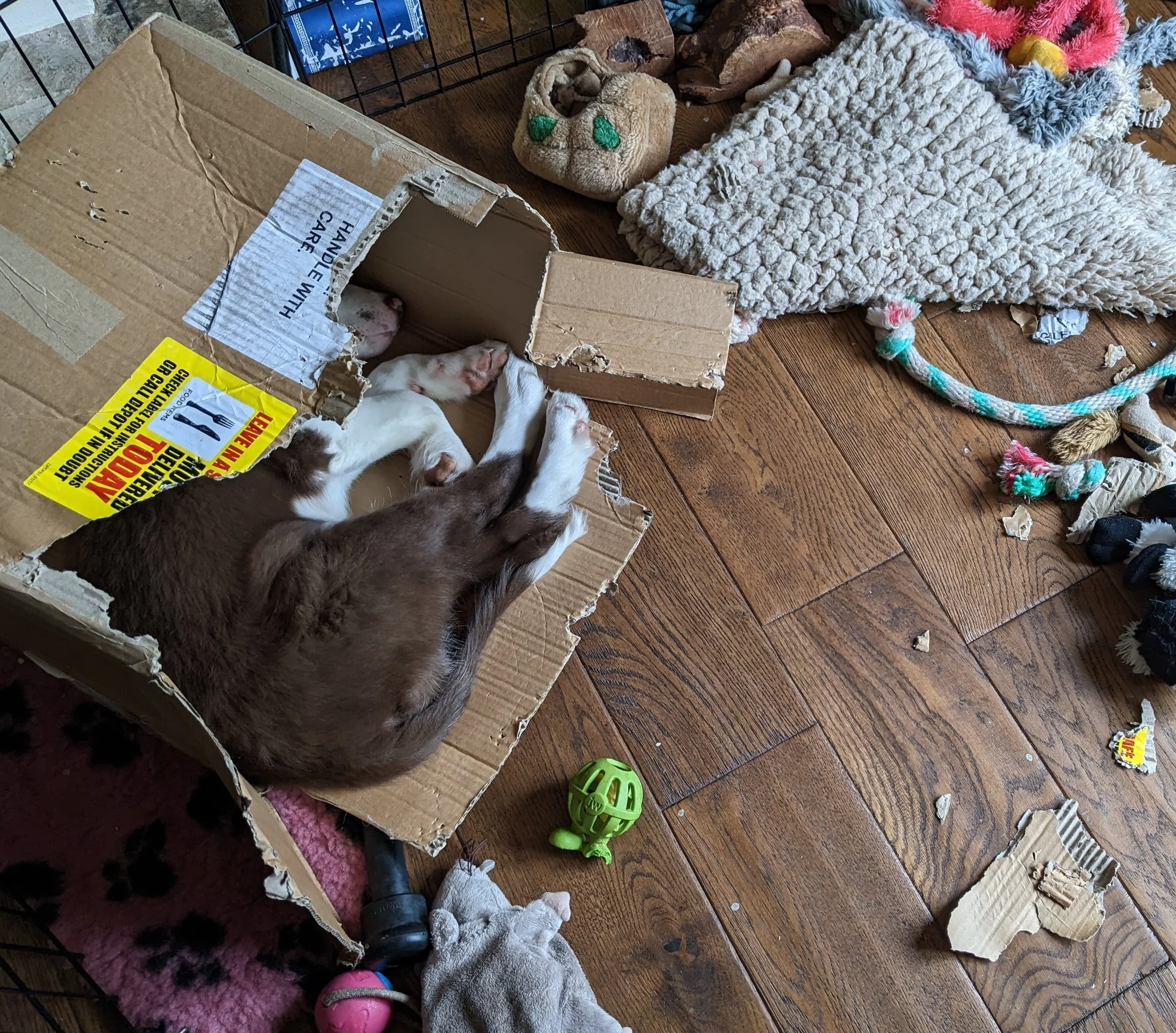
Happy Yannick asleep in the wreckage brilliant family dog

Baby Yannick sleeps peacefully amidst the wreckage in his playpen

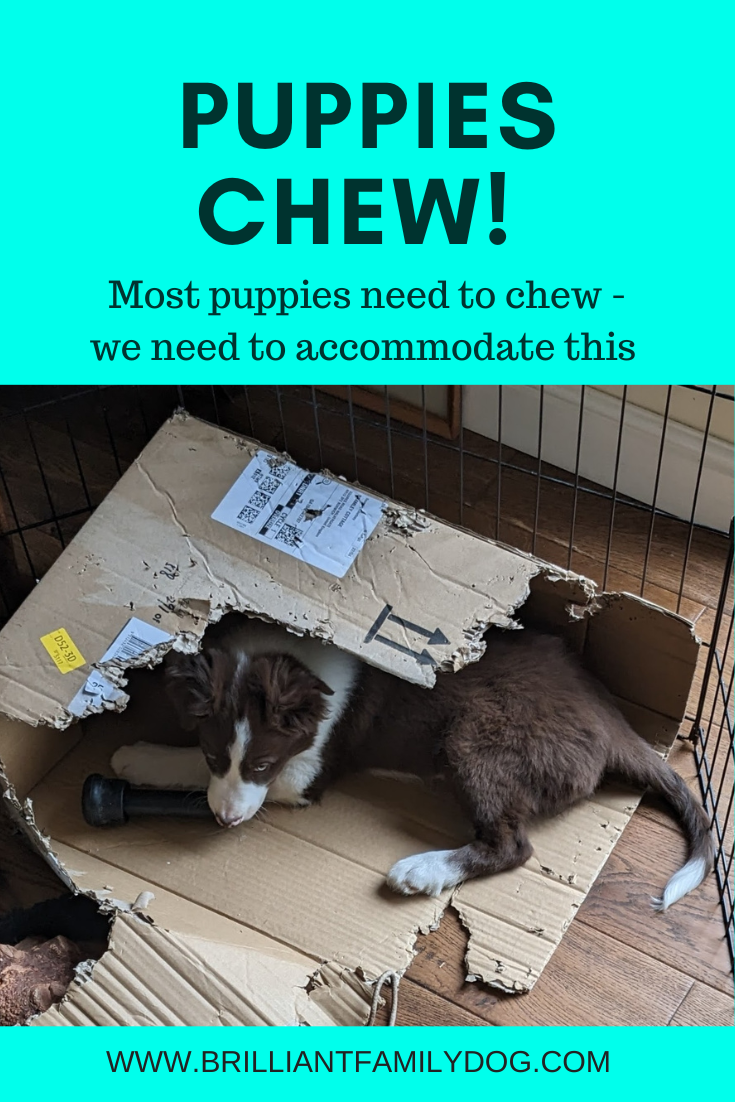
And if you have a chewy puppy (some puppies never chew things), be sure to give him plenty of things he can chew, in his playpen. Cardboard boxes are winners here. Raw meaty bones are great. Some dogs like antlers or coffee root.

Don’t use rawhide chews, which are industrial waste and can cause huge problems (aka huge vet bills).

If he wants to chew his bed - then, it’s his bed! Give him something disposable (and safe), like an old blanket. Remove shredded things so he doesn’t swallow them. Save the expensive bed you’re so proud of till he’s able to use it safely.

Babies and toddlers have cradles and cots which can accommodate all kinds of stomach mishaps! They don’t get a “grown-up bed” till they’re more reliable.

And all those expensive toys you bought him? Keep those for when he’s out of the chewing stage. Give him toys you don’t care about. If he needs to chew, then you must provide chewables!

Survive the chewing stage

Yannick never chews anything now!

If your puppy is a chewer, he just is! And you have to work through this stage with him with as little friction as possible. Telling him off will confuse him and raise your blood pressure.

There’s no need!

Just adapt your living arrangements to accommodate your chewer while you teach him to play nicely with your toys, which you put away after the game.

Don’t leave valuable things with your piranha fish!


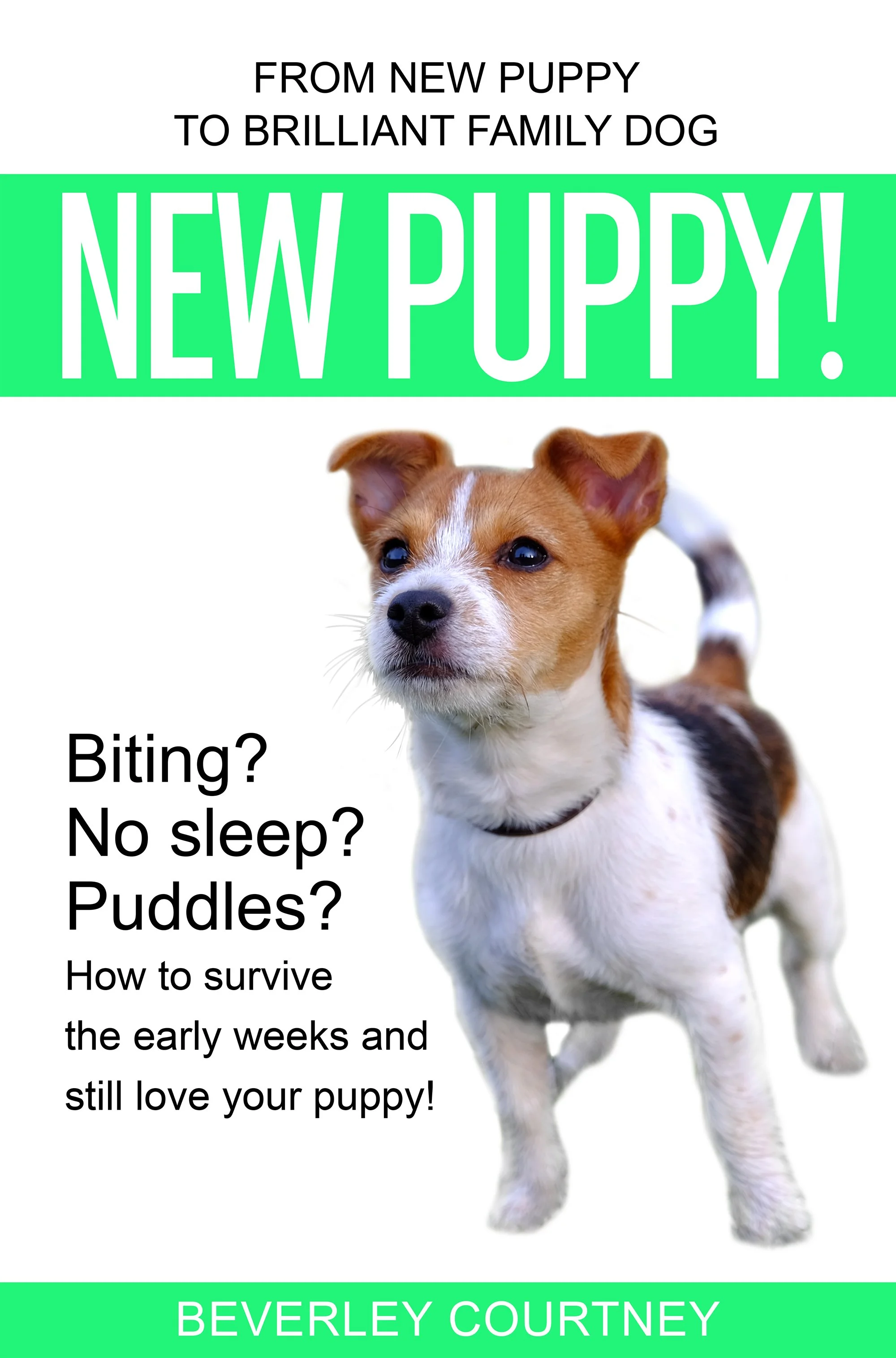
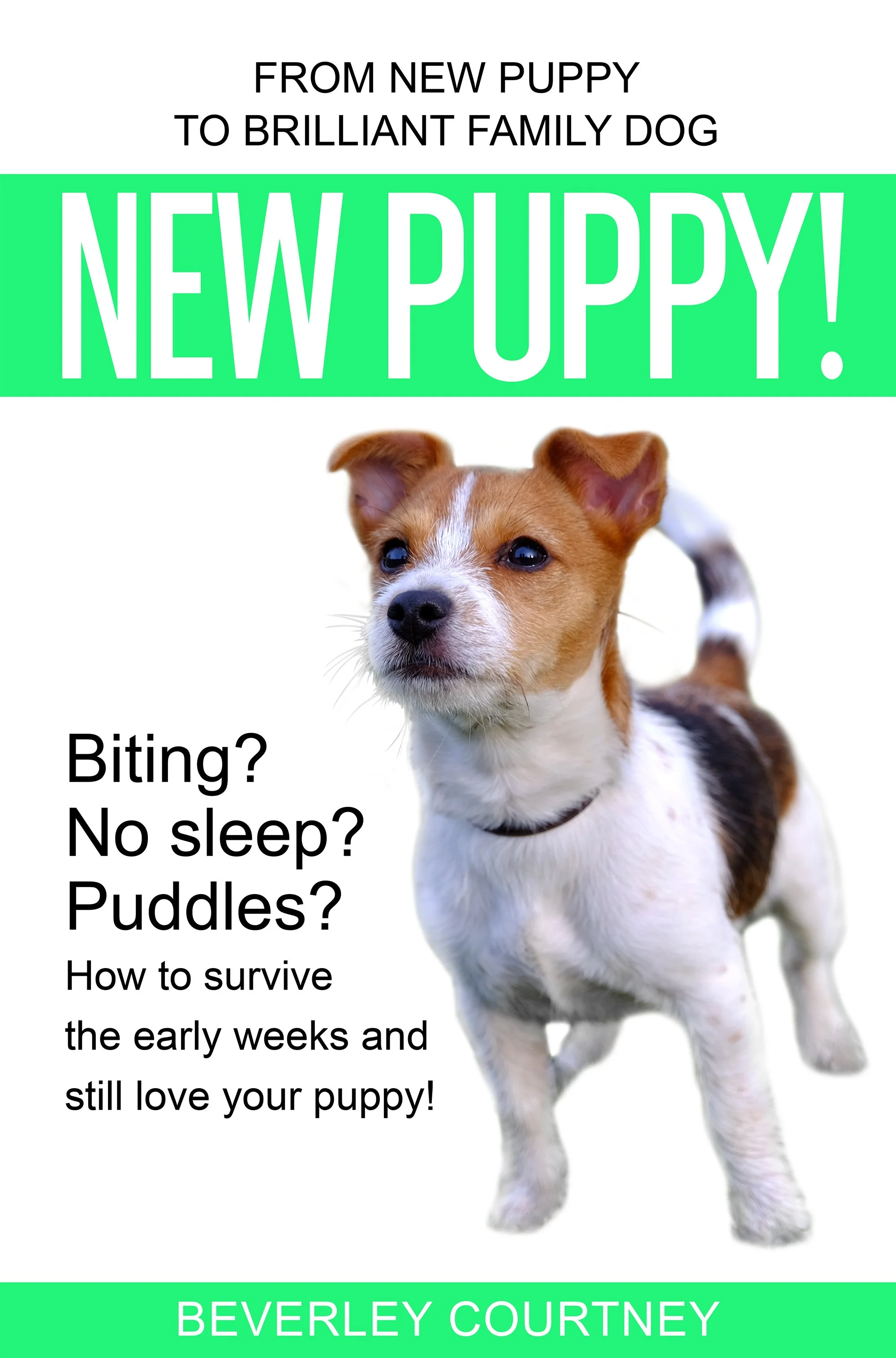
And for more down-to-earth ways to make the first few months with your puppy magical, Read New Puppy!


A new puppy PLUS a reactive dog: can it work?

I had this query from a reader recently, whose heart is clearly in the right place:


“I have a reactive/aggressive 8 year old I did not have from a puppy. As she has gotten older she has calmed down a bit however, we do not trust her around other dogs and do not even try to socialise her. She will cry, whine and sometimes growl which can be embarrassing.

I have longed for a dog that I can take everywhere with me and can get along with all dogs and people. I am considering getting another dog that is a little bit older than a young pup.

We do plan on introducing them slowly with the new dog being outside and our older dog inside watching through the window, then keeping them behind closed doors in the house etc.

One of my main worries is jealousy and the new dog picking up bad habits from the older dog. I also worry around the unfairness of walking them separately or is this something they will both quickly adjust to?

How do I make sure the new dog does not being aggressive also?”


Lots of questions here! And a few misconceptions too. Here was my reply to this caring owner:

“Well done on helping your dog get calmer - but don’t be embarrassed when your dog shows she’s uncomfortable! She’s giving you information. If others don’t understand, that’s not your problem - they will be impressed by your care.

New dog - I think you’d be better off with an 8wo pup. You’ll bring out the maternal instincts in your resident dog and she won’t see this baby as competition. Follow this article on introducing a puppy to a reactive dog to ensure a safe introduction and development.

Also, the young puppy will sleep so much that you’ll have plenty of time to give to your adult dog!

Walking separately is not unfair - most dogs prefer this undiluted time with their special person. I have four dogs and they all get their special times of solo walking with me.

There are a number of resources - from free to premium - on www.brilliantfamilydog.com/blog/how-best-can-you-help-your-dog-learn to help you. Do take advantage of them!”

As to how to introduce the older dog to the new puppy - and this goes for ANY older dog and puppy, not just a reactive dog - there is valuable information in that introduction article.

You can’t get a puppy and just chuck it into a multi-dog household and let it sink or swim. The outcomes are most unlikely to be what you’d like! There are plenty of parallels with children whose parents abdicate responsibility and the children rear themselves alongside their equally unguided peers. This can lead them down many unwanted paths . . .

So start as you mean to continue! Lots of 1-1 attention for each dog individually, and the puppy is reared more or less separately. After all, a puppy has a completely different physical timetable, with different requirements for training and exercising, so it makes sense.

Having a multi-dog household with the different characteristics of every dog within it is enchanting. They are so different!

And they need to be allowed to be. And not regarded as a pack.

Here’s a good place to start with your new pup:

Want a step-by-step guide to everything you need to know about your new puppy? Get New Puppy! here and start on the right paw!

Those early months are SOOOO important!

Let me know how you get on.


Do you hit your dog?

Read this post to see where you may unwittingly be demolishing your precious relationship with your dog!  Brilliant Family Dog is committed to improving the lives of dogs and their harassed owners through books and online learning, all force-free and

Of course you don’t hit your dog!

You wouldn’t be here in Brilliant Family Dog if you did!

But the thing is, you don’t need to actually hit someone for them to feel bad about you.

This is so for dogs as well as for people.


Different forms of punishment

So you may ignore your dog. Lots of “dog trainers” tell you to do that.

Now imagine how you’d feel if a loved one ignored you! Refused to speak to you!

🐕 Wouldn’t you creep and crawl inside?

🐕 Feel like a worm?

🐕 Wonder what you’ve done to upset them?

🐕 No idea how to put things right?

That’s just how your dog would feel!

I think that if I offended someone, I’d much rather they explained to me how I had done so, so that I could put it right in the future, and not repeat my mistake.

So you can do the exact same with your dog.

Just show him that what he did didn’t work. Ask him again, and when he gives the smallest hint of doing what you’d prefer, reward that - fast and fully!

Dogs are Doers. They are not Not-Doers.


Leaving your dog in a vacuum of silence will not help him understand one bit.


Old saws are not necessarily right!

There’s a saying: “Sticks and stones may break my bones, but words will never hurt me.”

I couldn’t disagree more!

How someone feels about you is so important to you! If someone is unkind to you, or unfair, doesn’t that hurt? With real pain?

If they say harsh things, wag a finger, shout in your face, isn’t that frightening?

Your dog is the same!


Punishment rewards the punisher

You see, punishment rewards the punisher.

The only person who benefits is the person doing the punishing, in whatever form - whether hitting, shouting, abusing, belittling - they are the ones who get a gratifying feeling. Some even get a visceral thrill.

While punishment does little good to the one being punished.

Yes - it may temporarily suppress behaviour (just long enough for the so-called trainer to cash your cheque) - in the presence of the punisher. But it’s not going to stop it, because there is no CHOICE involved on the part of the victim.

Giving your dog, or child, or friend, or colleague, a choice in how they respond is critical for them to learn and want to repeat that choice.


Losing your temper

Yep! I put my hand up, along with the rest of the universe! We can all lose our temper, get frustrated, reach the end of our tether.

But if you give in to the moment and - even just yell at your dog - how does it make you feel?

Do you feel proud of yourself?

Or do you realise that you have just taken a chunk out of your relationship with your dog, which will have to be restored double-quick?

And what if children were watching? What have they learnt, about you, about how to manage people, how to manage animals?

What if another adult was watching? What do they now think of you? Do you like what they’re thinking?

Looking at things from an outside point of view can help us see more clearly what we are doing!

Yes, we can all have uncharacteristic outbursts. But before you justify yourself to yourself by saying the dog was driving you mad, was not listening, was being deliberately difficult - keep in mind that your dog is from another species. He doesn’t understand verbal language (he associates sounds, sure, but not as we do).

We are honoured to be able to forge an unbreakable bond with the dog in our care.

We are blessed to have this learning every day - of working out why creatures (people or dogs) do what they do, and how we can get them to fit in with our plans without any coercion, force, or intimidation.


Gobbledygook!

And if this all sounds like outer gobbledygook, do watch my free Workshop here . It shows you what may possibly be a new way to relate to your dog.

As this correspondent says:


“Your teaching is a revelation! Honestly I’ve spent 40 years doing what I thought was right. Now, as soon as my new puppy chooses to do something I want she gets a reward. I hope - thanks to you - I’m getting it more right than I used to.” JP

And that dog-owner had learnt all that from my books! Want to see what you can learn too? Head over to this page. And we can both benefit from you buying direct from the author (that's me!)


Is your new dog not as easy as your old dog?

:  He’s a whole new person to welcome into your life, without neeing to compare him with your old dog. Brilliant Family Dog is committed to improving the lives of dogs and their harassed owners through books and online learning, all force-free and do


Got a new puppy?

Exciting!

All your hopes for the perfect dog rest in this wide-eyed little ball of fluff!

And as soon as you get started with him, he fails.

But how on earth can an 8-week-old puppy be failing? 😱

He wees everywhere, he chews everything, he pulls on the lead, he keeps you awake and barks the house down when you leave …

This may all be true (HINT: it needn’t be! Your new puppy can be sleeping through the night from Day 1, never chew anything you don’t want him to, walk nicely on the lead, and be comfortable in your absence - start the Brilliant Family Dog program by watching this free Workshop)

So - maybe it’s true. But the reason you think your little puppy is failing, being difficult, challenging, awkward, time-consuming, and all the rest - is because you are comparing him with your previous dog!

Your old dog

Your old dog was perfect in every way.

Fitted your household like an old slipper.

  • Never chewed anything

  • Always asked if he needed to go out

  • Walked nicely beside you and never ran off

  • Slept like a log and greeted you happily when you came home.

And this too may be true.

But your old dog was 14 (or 12 or 17) when he died. He’d spent his whole life learning how to rub along with you.

And you’ve TOTALLY forgotten the anguish and trouble of his puppyhood!

You are seeing your lovely old pet through rose-tinted spectacles.

 Of course he took time to housetrain!

Of course he chewed things (whether they were things you wanted him to chew or things he stole is entirely down to your supervision at the time)

Of course he hauled you about on the lead (until you taught him different)

Of course the baby cried when you left him, till he learnt to trust you.

This is a NEW puppy

This is a NEW puppy. A NEW person. Yes, he’s a dog, and he may even be the same breed as your previous dog, but he is an individual.

And he needs to be treated and loved as an individual.

Not continually compared with the paragon which was your last dog in his last years.

For me, this is the joy of having a new puppy! A new person to get to know - his fears, his foibles, his character - what he enjoys, what he loves.

Your old dog was wonderful and your new dog will be wonderful too.

Just cut him some slack and learn with him and here’s that free Workshop where you can begin your journey with your new puppy:

Here’s a free Workshop to

get you started.


“Pandemic puppies” are now coming home to roost


Who do you know who became a first-time dog owner during lockdowns? There are about a million in the UK alone, according to evidence being given to a Commons (British Government) Select Committee investigating pet welfare and abuse.

Sadly, the huge demand for dogs when people were feeling lonely in the pandemic led to massive growth in the shadier sides of dog supply, from puppy farming to feed the demand for fashionable “designer dogs” (and there have been some high-profile shockers exposed recently, even in the dog training world) to the wholesale importation of random street dogs from other countries.

In both of these cases, the dogs are the ones who suffered most.

In the puppy farms the bitches and dogs suffer abuse and mistreatment. Along with their puppies they endure a deprived existence. What damage this does to the pups’ state of mind! What hope for them to become a well-adjusted adult dog?

The mass importation of any street-dog that can be netted and caught, mostly from East European countries with a poor reputation for animal treatment, leads to predictable problems of acclimatisation. Dogs who have known only fear and privation do not become perfect British pet dogs overnight!


But now the new owners are suffering!

Many of these first-time dog purchasers had done no homework. They had no idea about dog and puppy developmental stages, dog socialisation and habituation, suitable ways to rear a “normal” dog, and specialist ways to rehabilitate an abused or deprived dog.

They bought into the image of the perfect companion, apparently totally unaware that a dog can take from 18 to 36 months to mature and become anything resembling the finished article.

Many of these folk didn’t do what they should have been doing for their new dog, and this has naturally resulted in problem behaviours in some dogs - anything from separation anxiety to aggressive behaviour, not to mention incomplete housetraining, inappropriate playbiting, hauling them about on the lead, and zero recall.

So it’s no surprise that now people have gone back to work and are no longer lonely, the shelters are bulging with abandoned dogs.


Get a vet check!

One of those giving evidence, Dr. Gaines of the RSPCA, advised “anyone who had seen sudden behaviour changes in their dog to go to a vet, who will be able to rule out any medical causes.

“If the dog gets a clean bill of health, the owner should then seek help from an animal behaviour specialist, preferably one that is a member of the Animal Behaviour and Training Council.” (I’m a member of the ABTC.)

Note that Dr. Gaines does not want you to get behaviour modification advice or training from your vet! Their skills lie elsewhere. It’s a qualified trainer you need!

One of the problems with these pandemic puppies is that prices sky-rocketed due to the headlong rush to grab a dog - any dog - so that as well as getting a poor specimen in many cases, people had no money left for veterinary care or learning how to get the best out of their life with their dog, aka dog training.


Shady practices

Dealing with these heartless people who view dogs as commodities, simply there to make them money for the least amount of effort, is gradually being addressed by the lawmakers.

Puppy farming is a loathsome practice, and results only in distress for the “products” (dogs) and the “consumers” (people).

Capturing feral dogs and transporting them in large numbers across Europe in the back of a van is equally as abhorrent. Many dog trainers earn a lot of their (usually modest) incomes from trying to rehabilitate these unfortunate victims of the demand for dogs.

Dogs can actually learn all through their lives - though the worse the start the harder the change can be to accomplish. But never give up hope! There are wonderful kind and dog-friendly ways to help your dog cope with our strange world.


So where can I get a dog?

You can go to a proper breeder and get a puppy that has been reared with knowledge and with love. This normally means someone who breeds only when they want to keep a puppy themselves. Not someone with sheds full of random bitches kept in the dark.

Remember that in the UK Lucy’s Law requires that the mother should be seen with the puppies. Lots of dog greeders will come up with any excuse for not doing this - along with many other tricks of the trade - and some will park any old dog with the pups in order to deceive. You really do need advice from an experienced dog-person! Here’s an article to help you weave your way through the maze.

The shelters are bulging with rejected dogs right now, and yes, many of them will be foreign imports, so if you’re desperate for some reason to adopt a street-dog or a so-called designer dog, you can still do so without encouraging this dodgy trade.

Need a bit of help?

And if you’re having trouble with your dog, whether a pandemic puppy or not, we can help you! There are over 300 articles here at www.brilliantfamilydog.com and we have free workshops, masterclasses, email courses, books, and guides, along with low-cost online programs and books. Have a look at the menu at the top of this page to see them all.

There’s no need to miss out on getting a great life with your chosen pet, however inauspicious the start!

Here’s a free Workshop to get you started.


Where should you get your dog advice?

It’s important to understand things like sleeping and feeding as soon as you can. We have lots of resources to help you with your precious new puppy.  Brilliant Family Dog is committed to improving the lives of dogs and their harassed owners through


I was distressed recently by a reader.

Now I have to say I love answering readers’ queries, and helping them get the best for their dog and themselves, in their particular circumstances. ❤️ ❤️ ❤️

If they’re asking it’s because they realise they don’t know the answer, and want help. But sometimes you get someone who doesn’t want to learn . . .

This person wanted to know why her 8-week-old medium-size puppy cried all its first night. I asked her a few questions while giving her resources. It seems this tiny puppy had been fed six hours before bedtime and was expected to last on this till the next morning.

No wonder it couldn’t sleep!

The poor puppy was starving!

At that age it should have been on 4-5 meals a day. I explained this to my correspondent, giving resources again.

And she replied that the vet had said this 8-week-old puppy should be fed half a cup of food twice a day only. For English readers, this would be about 3.5 oz of food in total - enough to keep a sparrow alive.

Clearly no proper vet would say such a daft thing! She simply must have misunderstood somehow.

It’s important to understand things like sleeping and feeding as soon as you can. We have lots of resources to help you with your precious new puppy.  Brilliant Family Dog is committed to improving the lives of dogs and their harassed owners through

To cheer you up in this tale of woe, here’s a nice full puppy sleeping!

By the way, for English readers, here’s a load of money off a super food I regularly use and here’s another where you can get a big discount using this link - they provide high-quality fishy treats and foods, which are firm favourites with my crew!

But it set me thinking …

In this case the vet was asked about feeding - something that should come squarely within the vet’s remit.

But so often people take behaviour advice from their breeder (that’s fine if it’s a real breeder and not a puppy farmer or designer-dog “greeder”), or their groomer, or their vet, or the milkman . . .

Behaviour advice should be taken from people who are trained in dog behaviour!


Simple as that!

😳 You wouldn’t ask your hairdresser about a skin disease - you’d go to the doctor.

😮 You wouldn’t ask your gardener why your house is falling down - you’d go to a builder or engineer.

So please - don’t take behaviour advice from anyone but a qualified dog trainer/behaviourist!

And if the advice you get makes no sense (who’d feed a small baby twice a day with a set amount of food?) don’t do it!


***


Footnote: What happened to that puppy? I have no idea. The owner told me my advice would only work for people who didn’t work, then unsubscribed. Presumably they leave the puppy alone all day while they’re out - afraid, lost, and starving. So upsetting . . .

I do what I can to change people’s approach to dogs. One dog at a time. This was one I couldn’t reach.


But hey! You’re reading this, so you understand and know just what I mean!

We have to keep spreading the word.


And if you know someone who’s just got a puppy and is struggling - send them here so they can start the right way!