Do you tidy up after your dog?

Here are some ideas for you to get your dog to help you in your daily life, by fetching, carrying, and tidying up!  Brilliant Family Dog is committed to improving the lives of dogs and their harassed owners through books and online learning, all forc

Do you tidy up after your dog?

Or does your dog tidy up after you?

A recent reviewer of one of my cozy mysteries (yes! I write cozy mysteries featuring dogs!) wanted to know how to have more than two dogs and keep her house clean! You see, the books feature a household of three dogs and a cat.

Great question!

Once you have a family - be it two-legged or four-legged - a certain level of housepride has to drop, to maintain your sanity. But this doesn’t mean you have to live in a pig-sty!

It’s important to remember that this is your dog’s home too, and you shouldn’t be spending your time trying to pretend that you have no dog.

My dogs have plenty of beds around the house, so they can use their own furniture instead of mine, and tidy themselves up out of the way of foot-traffic.

They also have a large toy basket. All toys get chucked into this every night, and they can spend happy times rooting through to pick out their favourites or a new toy the next day. They always have access to a large variety of toys, of all possible materials - cloth, wood, metal, plastic, rubber, silicone … things to chase, chew, or cuddle.

Meals are taken in their appointed dining places, and one of them collects the bowls afterward and stacks them for me.

Dogs doing the work

I can frequently be heard saying, “Pick that up for me,” when I drop things or can’t reach them. Sometimes this is from laziness on my part, sometimes because the dogs love to do it - but always because it provides an opportunity for a positive interaction. And is often very entertaining!

Even delicate or awkward things can be carefully retrieved for me, including the tv remote, or a metal spoon. Naturally I’d never ask them to pick up anything sharper than a butter knife!

So “Where’s my jumper?” gets an enthusiastic response as Lacy runs to locate it and bring it to me.

And “Where’s my shoe?” is always good value. Even little Coco can pick up my heavy clogs and bring them. The star of the show here would be Lacy, who - if she can’t see them downstairs, will run upstairs and bring down one shoe. “Where’s my other shoe?” causes a momentarily wrinkled brow before she turns and runs back up to find the pair.

My socks are passed to me when I’m getting dressed and I “drop” a sock. And as long as they’re not very tight-fitting, they can also be removed for me, as well as trousers on request, coat-sleeves (very useful if you have a shoulder injury and can’t reach behind you), and - the pièce de résistance - pulling the cover off a duvet!

These last are all a development from Tug - but with a controlled “hold” so they aren’t ripping things to bits.

A further development of this would be emptying the washing machine, or tidying up rubbish into the bin, or toys into the toybox.

16 Muddy paws?

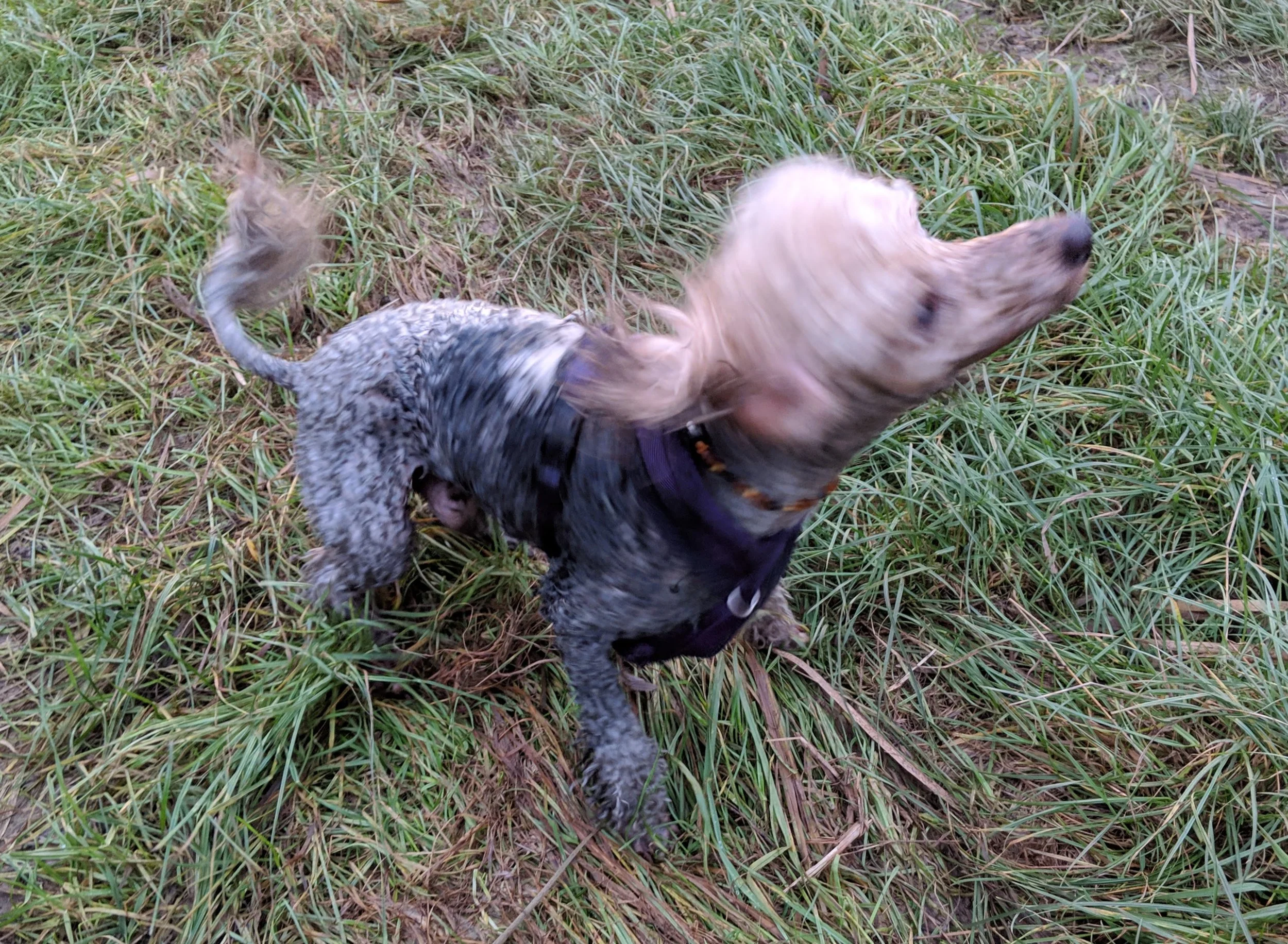
A towel at the back door is the simplest solution for this, along with an absorbent doormat. Teaching your puppy to have his paws dried is one of those essentials that can be overlooked if you are enjoying a hot dry summer (which this year we definitely are not, here in England!). So be in the habit of randomly “drying” your pup’s paws when he comes in, even when they’re not wet.

You can go a step further and teach your dog to wipe his feet. Some folk use a similar process to teach their dogs to file their own claws on a scratchboard. I have to say I can’t be bothered to supervise this foot-wiping with multiple dogs - easier to grab their paws with the towel. But, of course, I don’t “grab” them. They raise each paw for me in turn.
Here are some ideas for you to get your dog to help you in your daily life, by fetching, carrying, and tidying up!  Brilliant Family Dog is committed to improving the lives of dogs and their harassed owners through books and online learning, all forc

And, of course, restricting access to any sources of mud in the garden would be a good move.

Lastly, teach your puppies to enjoy hopping in the tub and having a shower from an early age: Coco needed more than a shake and a rub-down when he fell into a black dyke!

So how do I teach all this?

Most of these “tricks” can be learnt in Fetch it! Teach your Brilliant Family Dog to catch, fetch, retrieve, find, and bring things back

For fun and games, when you don’t care about the wellbeing of the object (e.g. their own toys) you can have an informal retrieve. For things where precision is needed - jumpers, shoes, electronics - you need the section on teaching a formal retrieve. It’s no use having a speedy find and pick-up if your item arrives back slobbery and in tatters!

And tidying toys up into a toy basket is simply an extension of the retrieve, but they deliver the item to the basket instead of your hand.

It’s certainly possible to have multiple dogs AND a clean and tidy house.

I’d love to hear what your dog does to help about the house! Comment below.


Don’t give up on your dog!

Your dog is an open book. And when you get him the pages are mostly blank! It’s up to you to teach him what you want him to learn, and keep going - don’t give up.  Brilliant Family Dog is committed to improving the lives of dogs and their harassed ow


I love tennis! And not just because of having a constant supply of tennis balls for the dogs …

** Actually I don’t make my dogs ball-mad - there are too many injuries associated with ball-throwing. See this post. I work with frisbees and hoops and tugs in the main - but I digress …**

Tennis … and aficionados will know that right now it’s time for the French Open, at Roland Garros. Roland Garros was not, in fact, a tennis-player, but a famous aviator. And this is what he said:


“Victory belongs to the most tenacious” - Roland Garros


This is emblazoned on the main stadium for all to see and constantly remember.

Now - it’s not just tennis-players who benefit from being tenacious!


Whatever it is you truly want to achieve requires tenacity.


🐾 Things will seldom go as you expected.

🐾Things will fall apart regularly.

🐾 Something you thought you had done will mysteriously become undone.

🐾 It all seems too difficult!


And nowhere is this more true than shaping your pet dog to become your Brilliant Family Dog.


A living being!

We are not dealing with an inanimate object, like a tennis racquet - we are working with a living, sentient, being who has his own ideas about how things should go!

Now it’s true that, as Susan Garrett says, dogs are always doing the best they can with the information they have in the situation they find themselves in.

They are obliging souls!

But they are not superhuman (supercanine yes, superhuman no). They cannot give you the right response without some clue as to what you want.

And with the things you thought you’d taught breaking down, and your dog producing new behaviour with each passing month as he grows and learns, you need to keep those clues coming!

Keep in mind that this dog you’re working with is not set in stone. He’s a changing, developing, person.


Development in the dog

It would be a mistake to think that your 8-week-old puppy is the finished article. He’ll go through many changes as he develops physically and mentally. Just like our own children, there’s a huge learning curve for them to travel before they reach 2.

But what are they learning?

Ha! This is where you come in. Just like our own children, they need constant guidance. You can’t just leave this pup alone and expect him to turn out as you’d like - as the perfect family dog.

This is where our friend Roland has it right!

It’s persistence, consistency, perseverance - all those hard words that you perhaps don’t want to hear - tenacity!

It’s formulating your training plan and sticking to it! That’s what will bring you the results you want.

I’m so pleased when I see people who do just that - stick to their plan - and succeed.

All teachers will be familiar with those who drift in, thinking that just having the idea of training your dog - perhaps enrolling in a course or studying some books - will be sufficient.

It is not.

You have to do the work!

And it’s YOU who has to do the work. Your dog just comes along for the ride. You’re the one with the input.


Commitment to your dog training

If you’re ready to commit to REALLY helping the animal in your care have the best life, and you to have the best life along with him, then I have some resources for you:

Start with this free Workshop, with its important and valuable lessons.

Then you can decide which suits you better - joining us in the vibrant Brilliant Family Dog Academy with video demos and full individual support, or working on your own through my series of books.

It’s all there for you.

The only thing I ask - as your dog can’t ask you - is that you STICK WITH IT!

Toffee is ready to learn!

Toffee is ready to learn!


Give your dog time!

Dogs process information more slowly than we do - a canny trainer builds in the time they need when teaching a new action or trick!  Brilliant Family Dog is committed to improving the lives of dogs and their harassed owners through books and online l

Give your dog time.

And by this I mean thinking time.

You see, dogs process information - in general - more slowly than we do.

I know that’s hard to fathom when your dog seems to be on a hair-trigger for reactivity, or rabbit-chasing - but that’s a gut reaction, not a considered one.

We may forget that there’s a big difference between a gut reaction and a thinking one, and mistakenly expect our dogs to respond at high speed every tiime.

Of course, with consistent, kind, teaching, you will get that knee-jerk reaction you want - a lightning recall, an instant drop. But this comes over time and with many repetitions.

Something new

So if we’re asking them to do something that involves thought, we must give them time to think it out!

This is particularly marked when we’re teaching something new.

Dogs need time to process what they’re being asked to do.

So SIT, SIT, SIT (which we so often hear from impatient owners) will only confuse. It’s not going to get the result you want!

SIT .. pause to see if that went in.. And if the dog is unsure, it may be followed by a ponderous sit.

So - most dogs are fairly quick at sitting in fact, but I give that as an example of the kind of time lag we may need to allow when a new thing is being asked.

Our expectations

Coco stacks cups: this level of skill takes a lot of thought from little Coco! You can see me holding back from “helping” him.

Our expectations can be so unrealistic, that we expect the dog to learn a new thing in a couple of moments!

It takes many repetitions for them to learn this new thing.

You’ve probably forgotten, but how many times did you have to be taught, as a 3 or 4 year old, how to read words, how to do sums? Many, many times! Until it became second nature to you.

And so it is with our dogs. However brainy they are, they’re not going to get much beyond a 3 or 4 year old human level. That’s not how they’re made.

The first mistake …

And one of the chief errors I see is people yelling their “command” and expecting their dog to magically understand it!

Until you’ve gone through this simple repetition process, rewarding the dog’s action whenever she does what you’re hoping for, you’re not yet ready to name this action. How you get the action you want is a secret you’ll learn in the Brilliant Family Dog Academy! You can find out about that here.

You’ll see that we teach in a different way to the traditional one. We get the dog to choose to sit, long before we ever mention that word!

Remember, we don’t add a vocal cue till what we want is pretty fluent.

Then we have to teach the thing all over again - or revise, if you like - with the cue in front. We’re saying, “That thing you’re doing, we call that a SIT.”

Softly, softly, step by step! Think of that toddler, struggling to understand us!

Eventually the vocal cue alone is enough. And by this time, you’ll have an instant response.

The second mistake …

And to keep it fast, keen, and enthusiastic - ALWAYS reward what it is you want your dog to do!

Now, before you complain, that doesn’t mean you always have to be stuffing your dog with treats.

Finding out what he finds rewarding, and then administering that reward - be it a run in the garden, a cuddle, genuine praise, another opportunity to earn a reward - is the mark of a skilful dog trainer.

Is that what you’d like to be?

Interspecies communication

All in all, the fact that this species can understand our human verbal language and act on it is - pretty astonishing!

Let’s keep that in mind, always.

Give them grace, and the time to work it all out.

And you’re not alone trying to figure this out! For a helping hand, check out our simple, step-by-step, dog training books!

Do you ask your dog’s permission for handling him?

It takes a little longer at the outset to establish a regime of mutual permission - and this makes all your dog care so much easier!  Brilliant Family Dog is committed to improving the lives of dogs and their harassed owners through books and online

There are things we have to do to our dog. Let’s make them into things we do with our dog!

There’s grooming, hunting for ticks and other beasties, claw-clipping and grinding, perhaps administering eye ointment, drying feet … there’s a lot we have to do to keep our dogs fit and healthy.

So it’s important that you don’t just grab your dog (like vets often do) and inflict “treatment” on them!

I appreciate that vets are always in a hurry. But there are some excellent ones who clear it with the dog first before touching them … and then there are the smash-and-grab ones, who can set up a lifelong fear of the vet in a couple of hasty and ill-considered seconds.

So to get this going smoothly, you need to get buy-in from the dog, and make it easier all-round.

Here’s an excerpt from one of my Growly Dog Books


Is it you that’s causing the pain?

The key here is that your dog will associate something with any pain or discomfort he’s feeling. That something he’s latched on to may be the approach of a person holding a broom. It may be entering the vet’s surgery. It may be being manhandled so you can reach his claws. So if you have to administer a treatment which may be uncomfortable, it’s a good idea to get him to associate something else with this pain, and not you!

There are various techniques about that focus on the dog giving you permission to treat him - having him become a party to his own treatment.

Picture this: you go to the dentist for your appointment. While you’re talking to the receptionist, the dentist creeps up on you, grabs your jaw and forces it open to poke instruments in. Horror! This is an assault! And yet isn’t this what people often do to their dogs?

A better scenario would be that you go into the dentist’s surgery. He indicates The Chair. Now when you get into that chair you are effectively giving the dentist permission to open your mouth and start poking about in there. It’s just as unpleasant as before - but this time you gave your consent.

So get your dog to give you consent by transferring the “this may hurt” feelings onto something else. Some people use a pot of treats on the floor. As long as the dog sits or lies still in front of that pot he’ll be given a treat. Gradually you can pick up a paw or start brushing a tail while you dish out the treats. If your dog leaps up and flees, let him. When he ventures back he can choose to station himself in front of the treat pot again. He’s saying, “Ok, you can brush me now”. You could also get out the implements he’s worried about - the nail clippers or the claw-grinder, and perhaps use a particular mat for him to sit on, which you only use for treatments. When he comes to you, you can reward him for his bravery. He knows what’s going to happen - you’re not going to jump him.

If you call your dog over for a cuddle then grab him and swing him over onto his back so you can check his tangles, how’s he going to feel next time you call him?

Choice, choice, choice! Think of that dentist and let your dog have a say in his own care.

📖 Read more here: www.brilliantfamilydog.com/growly-boxset📚

And here’s a video of my Border Collie Yannick being introduced to Chirag Patel’s excellent Bucket Game. Note that he is free to come and go and take whatever position he likes.

We moved on quickly after these sessions, and I’m now “allowed” to hold all Yannick’s paws and clip his nails without any of the fear he was showing previously.


Should you ignore your dog?

This is the question I received from a follower recently:

“Most trainers say that you should ignore your dog when you come home and they are happy to see you. Do you agree with this?”

It’s something I hear quite often, so I thought I’d address it here.

And I have to say it’s one of the battier things some so-called dog trainers promulgate.


When you arrive home, in the bosom of your family, and they greet you - the children running to clasp you round the knees, your partner calling out an offer of tea from the kitchen - would you ignore them? 

Would you walk past them, ignore them, see their faces crumpling with confusion? 

OF COURSE YOU WOULDN’T!

If you’re the slightest bit normal you are enchanted by this warm homecoming, and respond with delight and appreciation.

Same for dogs

Cricket is first in the queue for a hug after my trip away

So why on earth would you want to ignore your loving dog, who greets you with delight on your return?

I suspect some people get confused between love and discipline.

If you come home to find your possessions shredded, this is NOT your dog’s fault! He may have been lonely, distressed, bored. He may have smelt you on the object he chose to love to death and just wanted to be near you.

Whatever the reason: who left the dog with access to things you didn’t want him to have? 😳

This is simply a case of mismanagement. Fix that and there will never be any need for you to feel anything but delighted when you arrive home.

I have dogs because I love them, and their genuine pleasure at my return home is always important to me. 

Isn’t it for you too?

Comment below …

If you’re finding it difficult to establish the love and boundaries your dog needs so that you don’t need to worry about separation anxiety or dark deeds while you’re out, check out the books here: www.brilliantfamilydog.com/books 


Slow change works well for dogs

Change can come so slowly.

Too slowly for us rushers! We’re always in such a hurry to be in a hurry.

WHY? … But that’s for another day!

We try something once, then say “That doesn’t work!”

And sometimes things don’t seem to change at all. We seem to have been labouring over the same problems - for ever!

But if you look back - honestly look back - you’ll see there has been change.

“The only constant is change” As Heraclitus said, so long ago.  “Everything changes and nothing remains still; you cannot step twice into the same stream.”

Nothing stays the same - it’s always getting better or worse.

So.

This is where we have to take a dispassionate view.

Recordkeeping can be very helpful here. It’s undoubtedly useful, but few people stick to it. It doesn’t suit many people - too much navel-gazing!

But look what people who only see your dog occasionally say!

Perhaps they got all four paws in the stomach last time you met, and now your dog is sitting quietly.

They are impressed, and will tell you so.

Perhaps your dog was on full alert when you met last time, and is now able to mooch about and sniff.

So people feel more relaxed round you, and will let you know by stopping to chat.

Or maybe it was a full-on barking and lunging meltdown they witnessed, and now you have the sense to recognise trigger points and manage the situation so much better - so that your dog can pass this hornèd monster without reacting.

They smile and acknowledge you from a safe distance.


Compliments

I remember a lady I didn’t know passing me on the road one day, years ago, with my then challenging puppy who wanted to get everywhere at the speed of light.

“I’ve been watching you,” she said. “You’re doing so well!”

Wasn’t I pleased! And I’d had no idea of her existence while she watched me every day from her kitchen window.

People aren’t all judging us - as we may feel when our dog is acting up.

Most are actually sympathetic.

After all, who’s brought up children without a public tantrum in the supermarket?

Who’s not had to apologise to a neighbour for their small boy’s - shall we say “over-exuberance”? 😳

Who shall cast the first stone?


We’re all in the same boat

Relax!

You are doing the best you can.

Your dog is doing the best she can.

Your neighbours are doing the best they can.

It’s all just fine.

And really?

So much better than it was a year ago …

If your dog is of the Growly variety - barking, lunging, terrifying the neighbourhood and making you blush! - take a look at the Growly Dog books you’ll find here: www.brilliantfamilydog.com/books

You really can make a big difference!