Force-free dog training

Does your dog talk to you?

I knew from the start that my puppy Yannick was fearful. He found the world a challenging place, full of alarms and frights.

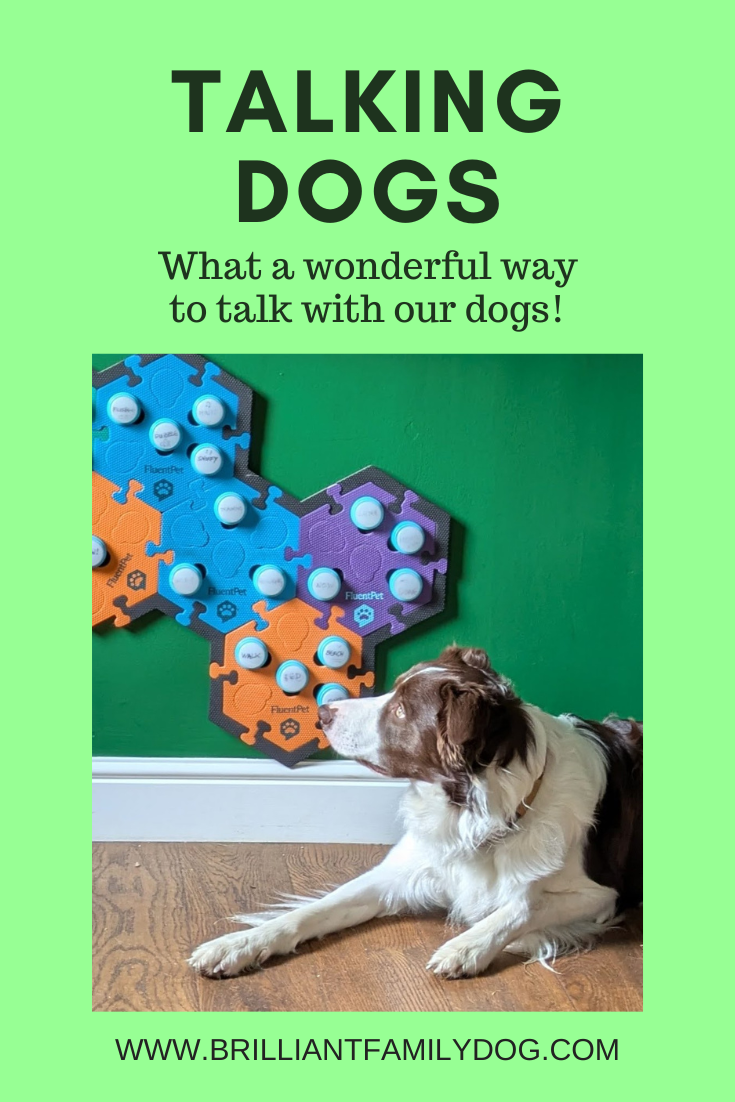
So when I learnt about these talking buttons - where dogs can actually communicate what they are thinking and feeling - I was excited to give them a try. 

They worked a treat!

I started with his favourite two things - PLAY and CUDDLES. Once he was able to ask for these, I gradually added more buttons. And as you can see, he has forty-four of them now, many of them used on a daily basis.
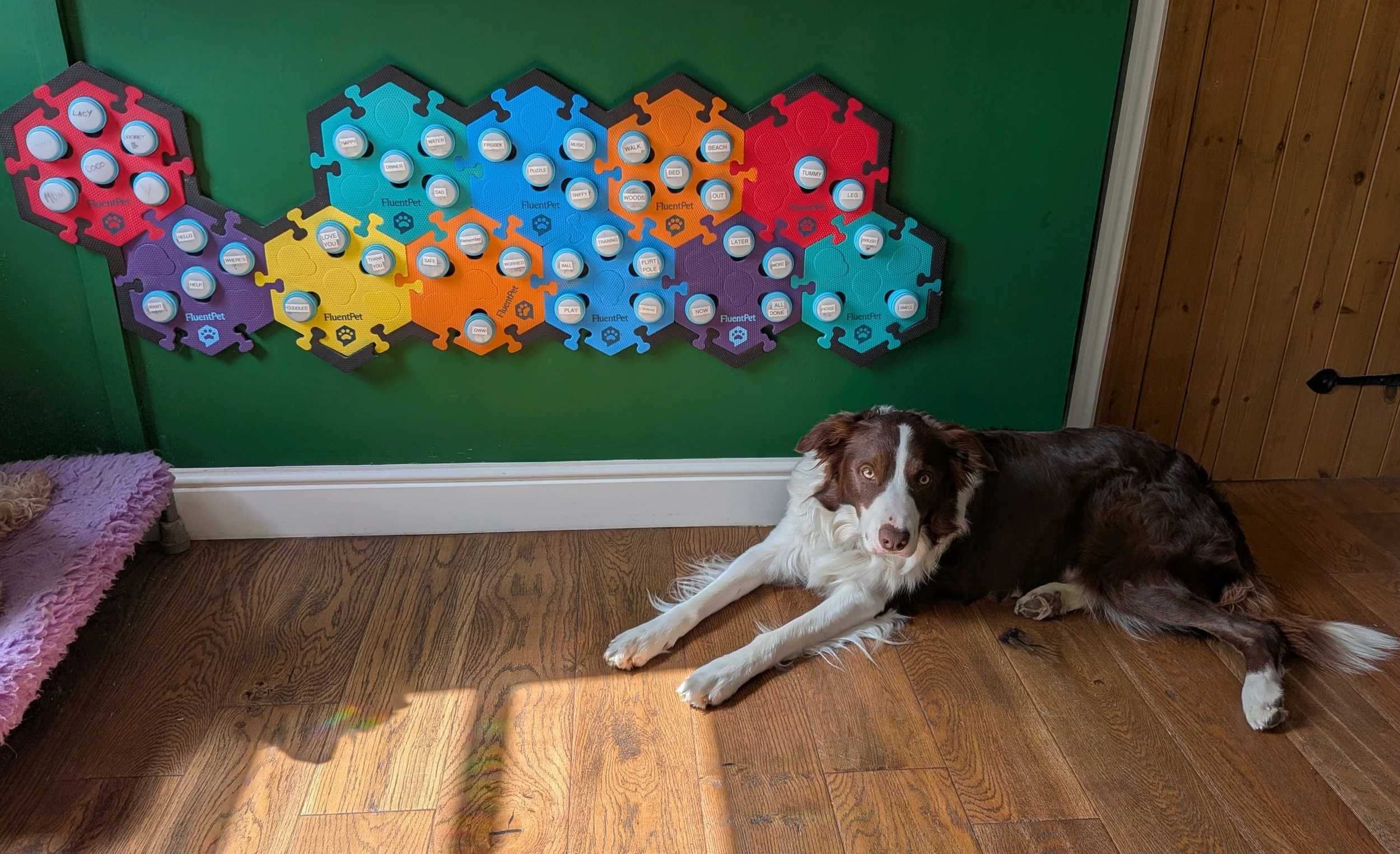
Now he’s able to tell me if he’s WORRIED, or he feels SAFE. He can tell me he loves me, or he loves something I’ve done (LOVE YOU). He can express HAPPY and SAD; he can ask for his favourite things - PUZZLE, BEACH WALK, CUDDLES (still!), FLIRT POLE … 

I’m going to show you some videos here of some exchanges between us. Usually I’m WORKING (unavailable) when we’re in his button room, so sometimes there are pauses while I finish a sentence.

▶️ Yannick asks me to sing!

▶️ Yannick notices the heating is noisy (to his sensitive ears)

▶️ Yannick talks through his buttons!

So you can see how my working sessions go! (And who wouldn’t be glad of such charming interruptions?)

I find it a delight that my anxious dog is able to express himself, make observations, and ask for what he wants.

A farewell to his old friend

One very moving episode, which sadly wasn’t captured on camera, was when I was kneeling on the floor ministering to our dying Cricket the Whippet - who Yannick loved dearly. He sat and watched me, then turned to his buttons and pressed SAD.

Now for the sceptics amongst you, maybe he was describing how I was sad. But I am quite sure that he was expressing his own sadness in seeing the gradual decline of his friend. 

Her name is still on his button board, and from time to time he talks about her - CRICKET LOVE YOU - especially if a picture of her appears on the television screensaver carousel.

Do you want to try these excellent buttons for your dog? 

If you’re now dying to unlock your dog’s deepest thoughts and feelings, you can use these buttons too! 

As a Fluentpet Guide I’m able to offer you a discount on any buttons or kits you purchase. It’s a great company, with masses of educational programs (nearly all free) and a thriving community hub. There is solid research going on behind all this. 

Here are some more stories, showing that cats and dogs are equally good at talking with their buttons. 

If this is something that interests you, I can show you how I introduce Yannick to a new button.

Let me know what you think of Yannick's chitchat! I’m dying to hear …

RESOURCES

How do buttons work?

Is there science behind Fluentpet buttons?

How can I teach my dog or cat to talk?

Do the ends justify the means for your dog?

My post Double standards for dog owners? last week provoked a lot of comment, on social media, some here, and in my inbox. Not surprising for a topic that polarises people.

But the apologists - who were vociferous in their sneering - seemed to overlook one principle. After saying all the nonsense about how these nasty gadgets don’t hurt ⚡️ 😵‍💫 they reckoned that the result justified whatever they did to get it.

The outcome from the use of punishment and punitive equipment is normally a shut-down dog - exhibiting the learned helplessness I referenced last week. Or it can result in far worse and unpredictable behaviour, when the dog’s tolerance is at an end, and the dog is destroyed.

Apart from the fact that both of these are horrible outcomes to inflict on any living creature, they are overlooking the fact that “the end justifies the means” is the cry that has been used by extremists of all kinds, down the centuries, to excuse oppression, torture, and wholesale slaughter.

It is not acceptable.

We, as civilised people, have moved forward in so many ways. Children are no longer beaten, women are not stoned to death, slavery is forbidden, corporal punishment in prisons and the services is no longer permitted.

And yet there are still plenty of people around who think it’s JUST FINE to do these things to animals.

It was no surprise to me to look at the social page of one of those who told me it was all perfect and hunky-dory, and see that they espouse extreme right-wing political views, especially on race and gun use.

It all fits.

Don’t put up with this!

If you believe we should treat animals as kindly as we would like to be treated ourselves, stand up and be counted!

The nonsensical claims from “The Dark Side” need to be countered. Commonsense needs to win the day.


Double standards for dog owners?

Here’s something to puzzle over. I had the unedifying experience of someone trying to explain to me that the use of pain-giving equipment on dogs was perfectly acceptable.

“I don’t use force, I only correct,” he said blithely, going on to explain how he used choke collars, prong collars and electric shock collars (which he calls ‘remote collars’ to make them sound ok):

“I make it a positive experience for the dog,” he went on, “It’s just a way of communicating with the animal that they understand.”

😱   😱   😱   🥵


Well - where to begin?!

There’s so much wrong here that it’s hard to know where to start.

What about this question: “How can pain ever be ‘a positive experience for the dog’?”

And how about this one: “Do you beat children too, and give them electric shocks?”

I did ask those questions - and they were, naturally, unanswered. I just got more flannel about how to “use correctly” these instruments of torture. And that “positive reinforcement makes dogs nervous”. 😮


My thoughts on this “way of communicating”

“It’s just a way of communicating with the animal that they understand,” he said.

Yes, I would understand if you stuck sharp metal things into my neck and exerted pressure.  

And yes, I would understand if you gave me an electric shock.

But what would I understand?

◆          I would understand that I was a victim.

◆          I would understand that apart from avoidance there was nothing I could do in the face of this barrage of pain.

◆          I would understand that you don’t like me, don’t understand me, and have no intention of learning about my feelings.


This all leads to learned helplessness, disengagement, and no learning beyond fear.

Is that how we want to live with another creature? A creature we’ve invited into our home to share our life? Is that how we treat our children, our work colleagues, our friends?

It’s true that in the very early days (long, long ago!) I tried choke chains, because that was the thing back then. But for the great majority of my life I’ve used nothing stronger than a soft collar, and usually only a properly-fitted harness.

I am happy to say that in all the many years I’ve been training dogs, I’ve never been bitten.

I’m proud of my dogs’ achievements, and even prouder of what my students have achieved. Dogs who were on the brink of being ‘rehomed’ are now loyal and much-loved companions.

“It was as if a light bulb had been turned on in my head.” - a happy client

What’s more, this way of treating the other creatures we live with spills over into better decisions at home and at work with them thar humans too!

Once you give someone - be it a child, a dog, or a spouse - a choice, you get willing engagement and active problem-solving.

And you can sleep at night.


Find out how to teach your dog without any need for punishment and nasty collars!

Here’s a FREE WORKSHOP to get you started.