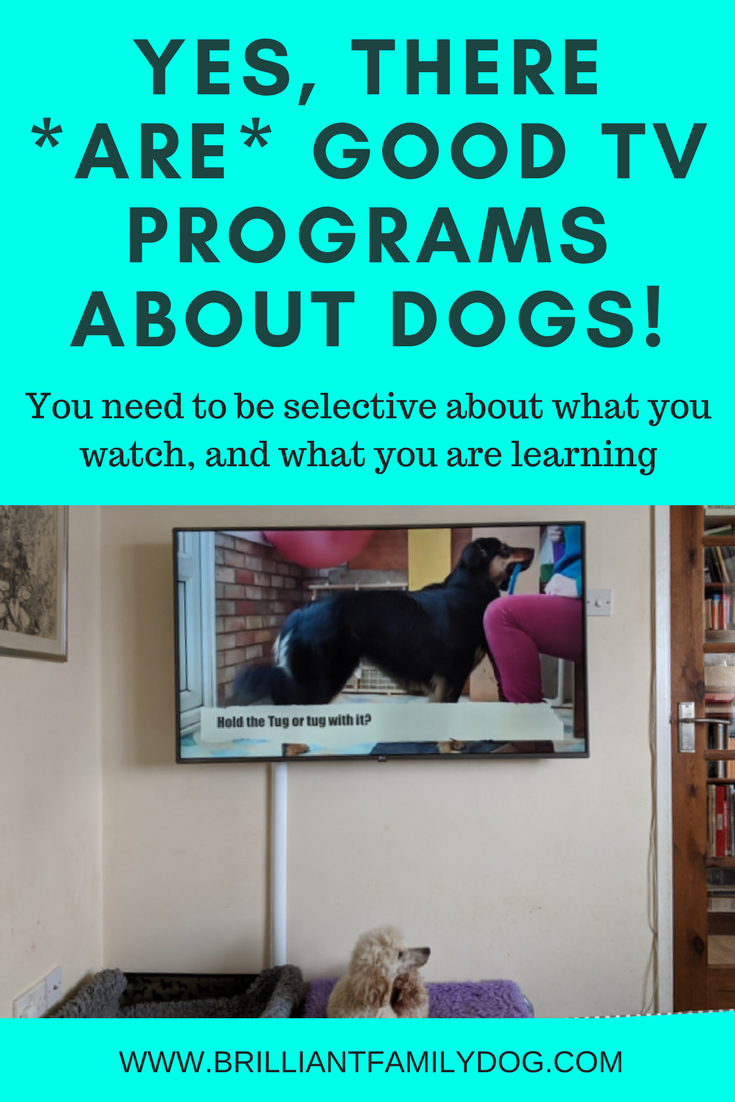
Yes, There can be good stuff on tv about dogs!

A problem dog learns the same way as any other dog. Be careful what you watch on tv so you feed your mind and your dog with the right ideas! The relationship will blossom and life will improve | FREE EMAIL COURSE | Reactive dog, problem dog, fearful…

A lot of television programmes about dogs are either mawkish and miserable - or actively misleading, giving bad advice.

The programme-makers are always looking for the sensational to attract audiences and sell their advertising space, hence the many shows about mistreatment and cruelty to animals, and the dramatic attacks seen in some “dog-training” series. These programmes are made with no reference to the huge scientific advances in the knowledge of how dogs’ brains work, and are responsible for a lot of misery and suffering - of dogs and their owners, who try to put the techniques into practice with disastrous results. 

It's so sad when clients come to me with a problem that has been made considerably worse after trying these inappropriate or downright barbaric methods.

A fresh breeze!

So it’s good to come across a show that I can actually wholeheartedly recommend! UK viewers had a treat recently when a couple of well-known force-free behaviourists (Chirag Patel and Sarah Fisher) and a like-minded vet got together to deal with some very difficult cases - from a variety of animals. As well as a couple of dogs, there were a cat, a rabbit, a pig, and a parrot. It did have a sensational title - Nightmare Pets SOS - but the rest of it was fine.

[This program is available for UK viewers at www.bbc.co.uk for a limited time. You may also find pirated copies on Youtube]

What interested me here was that the solution to the many diverse problems encountered with very different species was always the same: 

1. Remove pressure

2. Provide correct environment

3. Enrich the animal’s life

4. Teach an alternative behaviour

5. Use only Choice Training


So what this meant in effect, was that the terrier who pulled frantically on the lead should be given a slack lead; the “vicious” parrot who didn’t want to interact with its owner was allowed space; the cat who was not using his litter tray was given the correct size and number of trays, and privacy; the pig was taught to go to his mat instead of begging from the customers in the pub he lived in; and the biting rabbit was given peace, suitable housing, and could only be handled with its permission.

In addition to this, the animals were offered enrichment with toys and objects they could interact with so that their brains were stimulated into more acceptable activities. 

There was no need to have more control of the animal, more restraints, tighter boundaries, or "NOOOOO". 

The animals were offered a choice in their care. And their owners were surprised how quickly their recalcitrant pet changed once they stood back and allowed a moment’s reflection and a freely-given choice. 

Lacy plays Retrieve Games http://youtu.be/TM73EUsI7bk

Lacy plays Retrieve Games http://youtu.be/TM73EUsI7bk

And they were united in appreciating that this could all be done without confrontation, without more controls, without alienating their pet further. 

All the pets had a successful outcome in varying degrees. Why did the success vary? Because once the owners had been shown what to do, it was entirely down to them to accept the advice and follow through with the training! 

It was very rewarding - as it was for those trainers on the programme, and indeed anybody involved in this type of work - to see how some of the owners really did what they were asked, and got the results to prove it. Any who carped and complained and made excuses didn’t get so far. 


Does this ring a bell?

And where have you seen those five points before? 

Here! All over Brilliant Family Dog you’ll see this training in action.  It gives you workable solutions to so many problems.

And once you get into the swing of this way of interacting with your dog, you can work out for yourself alternative ways of changing other behaviours you are less than ecstatic about.


Get started with this free email course, which gives you new approaches to old problems:

THIS E-COURSE IS A BONUS FOR YOU WHEN YOU SIGN UP TO RECEIVE EDUCATIONAL EMAILS AND OCCASIONAL OFFERS FROM ME. YOU CAN UNSUBSCRIBE AT ANY TIME Privacy Policy

Want to turn your dog into a star retriever? Check Fetch it! Teach your Brilliant family Dog to catch fetch, retrieve, find and bring things back! and enjoy a new relationship with your dog.

When you change, your dog will change too

Reactive dog, aggressive dog, fearful dog, dog behavior | It’s not the dog that has to change! Change your own mindset and change your dog!  | FREE EMAIL COURSE | #aggressivedog, #reactivedog, #dogtraining, #growlydog | www.brilliantfamilydog.com

I wrote recently about how a small change in your own mindset can trigger a dramatic change in your dog’s behaviour - without any “dog training” at all!

And I wanted to revisit this as it’s such an important - and little understood - part of the puzzle.

While we say “My dog is this, my dog does that,” it’s all about the dog. The dog is perceived as the problem. But the fact is that it’s the perception that is wrong!

Once people change their way of thinking and talking about their dog, they get massive change without having to do a thing.

Not only dogs …

As a child I was curious, questioning, always challenging what I was served up as gospel truth. So naturally, teachers didn’t like this and saw me as a threat (yes, even aged three …). So I was labelled “difficult”. I was the naughty child. 

This “knowledge” about me was passed on in reports and staff meetings, so that all new teachers were instantly brought up to speed with this troublemaker, instead of forming their own opinions from facts. The other children began to look to me for a response in new situations: I had a reputation to live up to! 

So my entire school life was coloured by a few instances in kindergarten and junior school - perpetuated despite the fact that I grew and changed. I came to believe these opinions myself. And then had to work through adulthood to shed this nonsense and develop my true self. (I can tell you that making prize-winning drawings and writing bestselling books was definitely not something those teachers foresaw for me!)

Back to dogs again

We have a much shorter time with our dogs - they simply don’t live long enough for us to spend years labelling them and predicting their poor behaviour based on our wrong assumptions.

And these wrong assumptions can creep into every corner of our lives with our dogs. 

Whenever you say “She always does this,” or “She never does that,” you are placing a permanent label on your dog. You are fixing in your mind that she cannot change, that she’s hardwired to behave in a certain way. 

Back to children - there’s a big difference between “You are an untidy child,” and “Your room is in a mess.” Or “You are a bad boy,” and “Was that a good thing to do?”

Focussing on the doing rather than the doer takes blame and finger-pointing out of the picture, leaving the way clear to solutions and change.

And while we look at the behavior rather than the perpetrator, we see that nothing could be further from the truth than the belief that your dog is hardwired to behave in a set fashion. It doesn’t matter how long your dog has been doing a certain thing - you can change it! 

  • She’s afraid of things? You can make her environment less scary while you countercondition her to better responses.

  • She’s boisterous and impulsive? You can teach impulse control and show her that she can get what she wants when she does what you want. There’s no need for confrontation, ordering about, “commanding”, having a battle over anything.

  • She annoys you by barking noisily, chewing the furniture, messing up the house? Manage! Train! Once you realise that these things are just what the dog IS DOING, and not what the dog IS, you can change it all.

Reactive dog, aggressive dog, fearful dog, dog behavior | It’s not the dog that has to change! Change your own mindset and change your dog!  | FREE EMAIL COURSE | #aggressivedog, #reactivedog, #dogtraining, #growlydog | www.brilliantfamilydog.com

The secret of change is to focus all of your energy
Not on fighting the old
But on building the new


“Socrates” by Dan Millman


I learn a lot from my students, as well as from my dogs!

I’m delighted to watch my online students develop. The penny drops! They see where they have gone wrong in the past, not helped their dog. Sometimes they have unwittingly followed bad advice from the multitude of awful “trainers” and tv personalities out there, and actually made things worse.

But today is a new day! 

Tear off a new sheet!

Start from where you are and head forward!

It’s a joy seeing things improve for them without their needing extra gadgets, lockdown, extreme control.

They see that opposition is just as unhelpful in their relationship with their dog as it is in their relationship with a friend or spouse. Embracing their friend’s likes and dislikes is part of the friendship. Empathy for their fears and foibles is essential to a strong bond.

And a new life opens up for them with their dog, whom they can now view with different eyes. 


Check out this email course that will get you started on the change!

THIS E-COURSE IS A BONUS FOR YOU WHEN YOU SIGN UP TO RECEIVE EDUCATIONAL EMAILS AND OCCASIONAL OFFERS FROM ME. YOU CAN UNSUBSCRIBE AT ANY TIME.
Privacy Policy


Hooray for change for your dog! Discard the old labels

Reactive dog, aggressive dog, fearful dog, dog behavior | It’s not the dog that has to change! Change your own mindset and change your dog!  | FREE EMAIL COURSE | #aggressivedog, #reactivedog, #dogtraining, #growlydog | www.brilliantfamilydog.com

I just had the amazing experience of working with over a thousand people in my Free Masterclass Workshop for Growly Dogs

And as ever, I learnt as much as my students did! Only perhaps in different ways. 

These were people who had got a dog in the hope of having a companion they could take anywhere - on country walks, visits to friends and cafes, perhaps as an agility star - and what they got was something very different.

They found themselves dealing with a dog who was naturally shy and fearful, or who had had bad learning experiences which coloured his reactions to anything new or different. These dogs continually perplexed their devoted owners, who were doing their best in trying circumstances.
So I was happy to be able to give them some practical advice, along with some thoughts on changing their mindset to help them.

What I learnt was that these people were selfless in their dedication to helping the dog that they got. Not perhaps the dog they had anticipated. But they set themselves to the task of helping this new person in their life with admirable tenacity, continually searching for better answers. And these better answers were what I aimed to give them!


Want to make a start on this change?

Join our free Masterclass and change your dog by changing your mindset!


How will changing my mindset change my reactive dog?

For many, just changing how they thought of their dog made a huge difference in their dog’s behaviour! 

Crazy, eh? But true. 

If you continually refer to your dog as a rescue dog, a problem dog, a difficult dog, trouble, a nuisance, stubborn, you are giving yourself an excuse to fail.

Once you accept that this dog’s history is just that - history, and that he is now your dog, you have to take responsibility for the situation and make some change happen!

The renowned Veterinary Behaviourist Karen Overall says: 

“What we call something matters
because it shapes how we think of it.”

That is SO true! And it’s what many of the Workshoppers found! Changing how they described their dog changed their own perception - and produced some surprising results. 

I’d add to this my own saw:

What you expect is what you get

If you call your dog difficult, annoying, troublesome, a rescue .. You are expecting her to behave in that way. And guess what? She will. Once these students changed their way of seeing their dog, the dog miraculously improved!

Of course this goes for children, spouses and work colleagues too. We are very quick to attribute thoughts and motives to other people. Slow down and question that! And get rid of those labels!

How many of us grew up thinking we were “no good at maths” - or art, or music - because of the careless remark of a teacher in infant school? Perhaps we’ve spent our whole life believing an opinion made in a moment when we were 5 years old! Once we get a label we find it hard to see past it, whether it's on ourselves or someone or thing that we’ve labelled. 

And this applies to your dog just as much as to you. If you think you’re no good at maths because someone once said this, then saying “We can’t walk past another dog without an outburst” is going to result in … yes! an outburst, every time!

It’s not about the dog

Reactive dog, aggressive dog, fearful dog, dog behavior | It’s not the dog that has to change! Change your own mindset and change your dog!  | FREE EMAIL COURSE | #aggressivedog, #reactivedog, #dogtraining, #growlydog | www.brilliantfamilydog.com

So many of the students in the Workshop had positive results, and were proudly posting of their successes, that I realised that this is a big hole in the approach that many people take to dog training. 

They think it’s about making the dog change.

Whereas, in fact, it’s you that has to change!

The added bonus here is that as you remove the labels from your dog, you begin to see her in a new light. You start with a clean slate - just you and your dog. Now you can build that bond so that you know just where you are together - no doubts, no misgivings, no apologies, no blame.

Try it. 

Spend today blitzing your mind for those labels and removing them. Speak and think of your dog as … your dog. Think of the good things that she does, the moments of joy she gives you, and describe her as those instead. 

Expect only the best from her, and you’ll start to get it.


Start the change with your reactive, anxious, aggressive - Growly - dog with our free Masterclass packed with ideas and strategies, all force-free

Free Live 5 Day Workshop for your *Growly* but Brilliant Family Dog

Reactive dog, dog afraid of tv, aggressive dog, fearful dog, dog behavior | How to enjoy watching animal programs on tv without your dog going ballistic! | FREE LIVE WORKSHOP | #aggressivedog, #reactivedog, #dogtraining, #growlydog, #fearfuldog | ww…

I can honestly say I’m blown away by the response to my invitation to a free Live 5 Day Workshop for your Growly but Brilliant Family Dog. 

Well over a thousand people have registered, and most of them are busy introducing themselves and making friends in the private forum.

I decided to offer this week of free training because I see so many people struggling with difficult dogs. They love their dog and they often have no idea why she’s acting so awkward when out and about.

This isn’t helped when it’s a rescue dog with little back-up from the people who homed the dog with them. If you’re new to owning a dog, a rescue dog with a traumatic past is not necessarily the best introduction to this exciting and privileged new world of interacting with another species! 

There is so much misinformation about - from describing the dog as “dominant”, “stubborn”, “obstinate”, or even “he’s doing it to annoy you”. There are many self-proclaimed experts about who say “he just needs to learn his place”, “you need to be harder on him”, or “you need to use this or that (nasty) gadget to get results,” showing you something that wouldn’t have found house-room in The Inquisition.

So don’t flounder about wondering who to listen to.

Listen to your own instincts.

If it’s suggested you do something nasty to the dog in your care - whom you love! - follow your heart and firmly say “No”. We don’t need to beat or punish our children, and we don’t need to do it to the animals we choose to give a home to either. 

But he does seem stubborn!

Want to know what your dog really thinks? He’s not stubborn - he’s afraid. Afraid to go forwards, afraid to incur your displeasure, afraid of the world. But it’s fear, not stubbornness. Or dominance, or any of that other nonsense put about by people who are talking through their hats.

This post may help you with all of that.

If you feel tempted to describe your dog in a negative way, try looking at it from another angle. Instead of labelling him as difficult, stubborn, whatever ... try fears, is anxious, worries ...

And you may be surprised to know that it’s not so much months of hands-on training that will change your shy, reactive, anxious, aggressive - growly - dog into the companion you want. A lot of it is in your own head!

Have a look at this recent email from a reader:

“Firstly thank you for your wonderful book, it has really helped me understand the reason why my little girl Bess reacts the way she does.

Just by reading your first growly dog book, I have realised that she is terrified of strangers. We are working on the steps and I am slowly seeing huge improvement.”

Now it was Bess’s owner who changed her view and got success. Bess didn’t have to change at all!

A simple change in your own outlook and behaviour can have marvellous results in the way your dog responds.

And that’s what people are learning in this Workshop!

As Karen said:

"One of the best things I have done, the workshop taught me so much."

How do I get in on this?

Come and join our free 5 Day Video Workshop and learn. There were well over a thousand people from all round the world already happily meeting, encouraging and enthusing each other in the private group. Friendships were made that will last. 

What do they have in common? A desire to make life with their difficult dog better without doing anything nasty. At all. They all understand how alone you can be, and people are already feeling less isolated with their dog.

While the Workshop is specifically geared for those of you with reactive, anxious, fearful, aggressive - Growly! - dogs, in fact anyone will learn a lot about how to build a relationship with their dog. And they’ll also have a lot more empathy for the Growly Dog owner who they may have disdained previously as being inadequate and unable to control their dog.

As you’ll discover, it’s not about control!


Start the change with your reactive, anxious, aggressive - Growly - dog with our free Masterclass packed with ideas and strategies, all force-free


UPDATE:

This Workshop is now over, but look! Here’s a free Masterclass for you to enjoy - plenty of lessons to get started with straight away ...

Yes, you and your dog can now watch animals on tv!

Reactive dog, dog afraid of tv, aggressive dog, fearful dog, dog behavior | How to enjoy watching animal programs on tv without your dog going ballistic! | FREE LIVE WORKSHOP | #aggressivedog, #reactivedog, #dogtraining, #growlydog, #fearfuldog | ww…

Time for an update on Coco and his animals-on-tv fear obsession!

Two years ago I wrote a post here called "I'd like to watch animals on tv in peace!" explaining how we were working on Coco’s tv fears. He’d come a long way at that stage, but still needed help to cope.

Now look at today’s photo! He’s watching Flyball from Crufts. 

Those of you familiar with Flyball competition will know that this fast and frantic - but highly-skilled - activity involves dogs flying at speed over jumps, catching a ball and racing back with it, all accompanied by people screaming and frenetic barking. Earplugs needed. 

Coco was able to lie completely relaxed on my lap and watch the programme. The difference between now and two years ago is that he needed no input from me to achieve this calm and curious state. He no longer needs training or help in this area - he can cope entirely by himself. He has learned that he has no need to be afraid of the beasties on the screen, even when they're growling and coming towards him.

It’s a great example of how you can change so many things your dog annoys you with. No need to put up with something you don’t like! And, of course, in this case Coco was seriously afraid, so we had to help him.

If you’re prepared to put the time in you can change almost anything

Most people will make a half-hearted effort, possibly doing the wrong thing anyway by chastising the dog, and then give up. You need to know what you’re doing, how to do it, when to do it, and work out a program to achieve the results you want.

Reactive dog, dog afraid of tv, aggressive dog, fearful dog, dog behavior | How to enjoy watching animal programs on tv without your dog going ballistic! | FREE LIVE WORKSHOP | #aggressivedog, #reactivedog, #dogtraining, #growlydog, #fearfuldog | ww…

And there are lots of grades of result that may suit you. You may like the dog to take himself out of the room. So you teach him that as soon as an animal appears on tv, he heads through the door for a treat. (You can start by just chucking some hard treats clattering through the doorway.) You may like him to lie in a certain bed which prevents him seeing the screen: problem avoided! Or you may like him to stay calm and enjoy the program with you.

First deal with the fear

The first thing you have to address, however, is the fear! No-one can learn anything while they’re afraid. I used Desensitisation and Counter-Conditioning (DS/CC) and it slowly but surely worked. 

Want to know how to do this? Come and join our free Masterclass and learn. Well over a thousand people from all around the world already joined the first Workshop, happily meeting, encouraging and enthusing each other in the private group. Friendships were made that will last. 

While the Workshop is specifically geared for those of you with reactive, anxious, fearful, aggressive - Growly! - dogs, in fact anyone will learn a lot about how to build a relationship with their dog.

Head over to the registration page and join us!


Is your dog throwing up more challenges than you anticipated? Watch our free Masterclass and find how to change things fast!

Here’s another blog that you might want to read:

I’d like to watch animals on TV in peace!

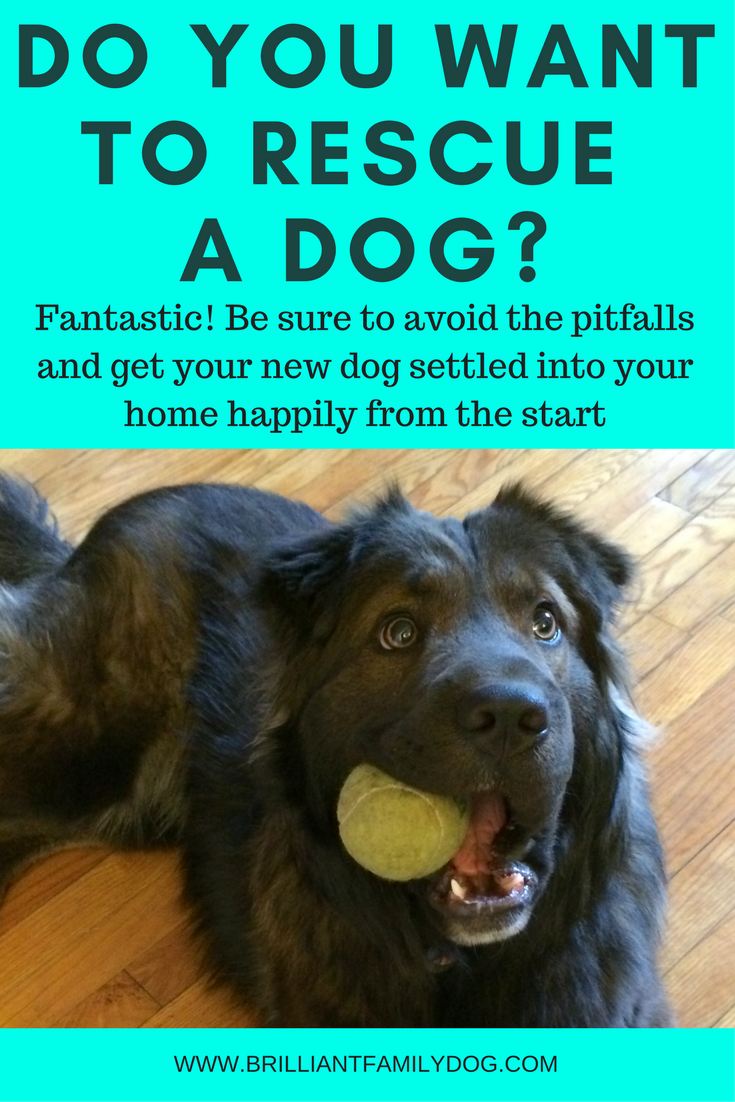
So you want to rescue a dog? Read this first!

Reactive dog, rescue dog, aggressive dog, fearful dog, dog behavior | Has your rescue dog become very difficult when out? Read here how to get things running smoothly for both of you | FREE EMAIL COURSE | #aggressivedog, #reactivedog, #dogtraining, …

You want to rescue a dog - give a home to a poor neglected beastie who’s had a bad start in life? Good for you! 

There are so many stories of spectacularly successful adoptions, where the dog fitted easily into her new home from Day 1, had few issues and was easy to train. 

But this isn’t by any means always the way it goes. So you need to go into this with your eyes open.

Different dogs, different folks ...

Is your new dog struggling with the outside world? Get our free e-course here and get started!

THIS E-COURSE IS A BONUS FOR YOU WHEN YOU SIGN UP TO RECEIVE EDUCATIONAL EMAILS AND OCCASIONAL OFFERS FROM ME. YOU CAN UNSUBSCRIBE AT ANY TIME.
Privacy Policy

Do not allow sentiment to cloud your judgment! Most dogs up for rehoming (unless they’re very young puppies) come with baggage - of some sort or another. We all have baggage - life experiences that have formed our worldview - some good, some not so good. 

And not every dog is the perfect match for your life. Some will have been neglected; some will have been abused; some have lost an adoring owner through death or other catastrophe; some were just not given the right care. 

But they all have a history, good or bad. 

Same as you would, if suddenly transported to a new home where people do things differently. There’s scope for a lot of misunderstanding and confusion here - even which way you hold your knife and fork, or how to make coffee! So imagine how hard it can be for a dog to adapt to such a major change in his life.

Sometimes the dog settles into his new home seamlessly and easily, but sometimes this baggage takes a lot of work, some expense, and much dedication, to unpack. 

Love alone is not enough.

Backstory

Any reputable rehoming shelter will tell you the truth about your chosen pet. But sometimes they don’t know the truth themselves! If the dog was found straying there is no history attached. And a dog in even the best and kindest rescue centre can be completely shut down and depressed - or continually hyper and mad. Neither of these states will reveal the true dog. Only once your new dog has been in your home for as long as two or three months will you know what he’s really like, and what issues he may have. 

If I moved into your house, for example, at first I’d be saying “Is it alright if I sit here?” and “Where does this cup go?”. After a couple of months I’d be feeling at home and sitting where I liked and leaving cups any-old-where! This is when you’d see the natural me. So it is with your new dog!

“My dog was so quiet and easy, and now, two months on, he’s starting to steal things, bark, dig up the garden … what am I doing wrong?”

That's a fairly common question. My answer?

“Nothing! You’re doing it all right and your dog is making himself at home and behaving in a relaxed and natural manner and being a dog. Now the training begins in earnest.”

By the way, not all shelters are created equal. If you arrive at a place and it’s noisy, the dogs are all racing about their pens barking, showing repetitive behaviours like circling or jumping off the wall, and some dogs are lying deathly still and have completely opted out, then you will struggle to see what your selected dog is actually like in reality. Stress has taken over and made the original dog unrecognisable. It can take many weeks for this dog to unwind.

Think of those poor children in camps in war-torn countries: we would absolutely expect them to have substantial damage which would take many, many years to repair. Why do we assume a dog will just be fixed in an instant?

There are shelters with enlightened policies of taking in fewer dogs (though successfully rehoming more!), giving all dogs more space and distance, keeping things calm and quiet, not allowing public access to all the dogs - only the ones they select to offer a particular family. 

Check out these resources to locate a shelter which follows the latest guidance for giving rehomes the greatest chance of success:

www.nawt.org.uk/open-paw

You may be working against a difficult history

Reactive dog, rescue dog, aggressive dog, fearful dog, dog behavior | Has your rescue dog become very difficult when out? Read here how to get things running smoothly for both of you | FREE EMAIL COURSE | #aggressivedog, #reactivedog, #dogtraining, …

Keep in mind that if this dog were no trouble he may not have been abandoned by his owners. That’s not exonerating those owners - they should have thought before even getting a dog in the first place. Giving up on an animal through their own neglect and idleness is utterly wrong, and unfair. 

He may have developed habits through lack of adequate care or training, that caused his first owners to get rid of him.

•  Maybe he’d developed a habit of running off, because he was never taught a recall.  

•  Maybe he was left alone all day and chewed up the furniture. Not his fault, but this could be the reason he was thrown out. Or rehomed. So now you have to train recall and staying alone from scratch. Check out the articles here at brilliantfamilydog.com, the free e-course, and you can get started with this mini-course:

• Maybe he was never properly socialised as a puppy, and has a distorted view of strange dogs and people and things as a result. Here you’ll have an ongoing task - to help him cope with our world. And this is the one which may cost a lot of money and a lot of time, but which will repay you many times over in watching your dog change and develop and gain in confidence. Check out the resources for Growly Dogs, the free course and premium course

Love alone just isn’t enough

Love and nurturing will do a lot of healing, of course. But to deal with any difficult issues - such as inability to cope with the presence of other dogs on the planet without lunging, barking, or screaming, threatening to bite if approached, stealing and guarding stolen items ferociously - you need professional help. There’s no need to struggle on for months while the situation gets worse and worse and you regret your decision to get your dog! Get the help you need straight away. Once you understand why your dog is acting as he is, changing it becomes straightforward.

Finding a true force-free trainer is essential. Any aversive or coercive methods (shouting, throwing things, yanking the lead etc) will only compound the situation and make it far worse in the long run. You’ll find a list of useful organisations at the foot of this previous article

There are plenty of rehomed dogs who have turned into Brilliant Family Dogs! This may be by luck or by judgment, but is a great outcome. In my line of work I naturally tend to meet a lot of the rehomes that cause problems.

And I’m happy to be able to say that the situation can always be vastly improved. It’s a joy to see the dedication of the new owners as they work to rebuild their new dog’s shattered confidence.

Cast off the rose-tinted spectacles!

Matching a dog to your family is a delicate and difficult task. Be sure to remove your rose-tinted glasses before you make any decision. You and your family will be living with this dog for anything up to the next 15 years or so. The placement must be right for you and your dog, but also your children and your spouse too, not to mention your cat.

While you’re still looking for your perfect companion, do a bit of research into what you’ll need. Here’s your Action Step: While you can’t purchase a crate until you know your new dog’s size, you can certainly do your homework and narrow down the choice so you’re ready to get one as soon as you expect your dog to arrive with you. Don’t cut corners - go for the best and most robust that fits your budget. This crate is not for confining your dog to keep him under control - it’s to give him a safe haven where he gets all his meals and toys, which he’ll love, and which will help enormously with separation - both night-time and daytime absences. 

And don’t forget the essential training! You can’t expect your new dog - who may be very confused about what people want of him - to just know what you want. You have to teach him, step by step. And while some of those steps may feel uphill, most will be successful - if you follow a force-free training program. There are some excellent dog training classes around the world where the instructor is firmly grounded in force-free training, treating each animal as an individual (refer to that list above for umbrella organisations).

But if you’re in a force-free “black hole” and there’s no class around that you would countenance taking a dog flea to, never mind your precious new dog, take a look at the articles here at www.brilliantfamilydog.com

They follow the same style of teaching as my books, which have received over 150 5-star reviews from pet-owners, who enjoy their directness, simplicity, and effectiveness (and humour!). You may have a challenging new dog - but with a little help and support you can turn him into your perfect pet.

Happy hunting for your new companion, and may you be one of the great rehoming success stories! 


Want to get off to a flying start? Get our free e-course here and get started!

THIS E-COURSE IS A BONUS FOR YOU WHEN YOU SIGN UP TO RECEIVE EDUCATIONAL EMAILS AND OCCASIONAL OFFERS FROM ME. YOU CAN UNSUBSCRIBE AT ANY TIME.
Privacy Policy


>