THE FRUSTRATION OF THE GROWLY DOG OWNER: IT’S NOT OTHER FOLKS’ FAULT THAT THEY DON’T UNDERSTAND

The reactive dog owner needs extra patience: you have to manage your own fearful dog, and deal with incoming “friendlies”!  Learn what to do here, whether you have the Growly or the Friendly dog. Brilliant Family Dog is committed to improving the li…

First published on positively.com and reprinted here with permission

“Could he not SEE that my dog was upset?”

“My dog was on lead and under control - it was his dog that was out of control!”

“Why, oh why, do people let their ‘friendly’ dogs invade the space of my fearful, reactive dog, and then blame me for being a useless dog-owner with a nasty dog?”

Anyone who works with Growly Dog owners - owners of shy, anxious, reactive, or aggressive, dogs - is familiar with these cries! 

Yes - it’s so frustrating when you’re doing everything right for your dog: keeping him calm; keeping your distance from things he fears; keeping out of the way of other dogs, or bikes, or people … and another person lets their dog rampage up to your on-lead dog!

At first, you may not be sure whether this is an exuberant, over-friendly, approach - or something more sinister. Is this dog going to attack mine? How can I get away? Oh no!

Your heart is now racing, your dog is now lunging and barking - the whole thing is a sorry mess! And what does the other person do?

Well, usually, nothing. (They have no recall, so they’re not going to follow your plea to “Call your dog please!” and demonstrate how useless they are!)

If you’re lucky you won’t get abused or reviled. But sometimes they can’t stop themselves!

“You ought to control that dog.”

“That dog is nasty - you should muzzle him before he attacks someone.”

“My dog is friendly - it’s your dog that’s the problem.”

And so on, they go.

It’s enough to make you cry. And often that’s exactly what happens. No-one likes their dog to “show them up”, and no-one likes being sneered at, talked down to, or threatened. I absolutely sympathise if this has brought you to tears.

Is there a danger of dog owners dividing into camps of “them” and “us”?

But let’s have a look at what’s going on here.

You can help your fellow dogwalkers enormously by keeping your bouncy dog away from their shy one.  Learn what to do here, whether you have the Growly or the Friendly dog. Brilliant Family Dog is committed to improving the lives of dogs and their ha…

Many people, and that includes many dog-owners, have no conception that dogs have feelings too. They seem to think that all dogs will get along with each other, and that their dog barging in to play with another dog is totally ok.

Supposing they were having a family picnic. How would they feel if some strange children landed in the middle of it, kicking over the food and drinks, and snatching the bats and balls and playing with them themselves? I don’t think they’d be best pleased, and may well express their feelings to the other children’s parents.

So why do these same people think it’s absolutely ok for their dog to rampage about and approach other dogs uninvited?

I think they simply don’t realise. But some education needs to happen. These same people whose dogs are flying about annoying others could well be pillars of society once they leave the dog park. They could be considerate, allowing diversity of thoughts and opinions, concerned to let children fit in and express themselves as they are. But sadly they don’t afford the same consideration to dogs.

I guess they think that all dogs are the same.

Or that all dogs should be the same.

They don’t understand that gentle, loving, affectionate dogs can be forced to show aggression and panic when confronted by their tearaway.

It’s up to the Growly Dog owner to do his best to protect his dog from unwelcome advances, and it’s up to the “friendly” dog owner to teach his dog some manners and restraint.

So for the Growly Dog owner

  1. Keep your distance.

  2. Seek out quiet places and times to walk your dog where you’re unlikely to meet other dogs.

  3. Give your dog a break from stressful walks - only walk her when you’re confident of a calm time.

  4. Understand that it’s not the fault of the other owner if they don’t understand what you’re going through. We often don’t understand something until we go through it ourselves. Maybe they will never understand until they get a shy, anxious, reactive dog themselves - then the light will dawn!

  5. Be patient with them when they don’t respond to your cries of “Please put your dog on a lead, my dog is afraid!” You need all your presence of mind to help your dog.

And for the “My dog is friendly” owner

Spare a thought for the other dog’s feelings when your dog wants to dive in and play. Learn what to do here, whether you have the Growly or the Friendly dog. Brilliant Family Dog is committed to improving the lives of dogs and their harassed owners …
  1. Respect the space of other dogs and their owners.

  2. If another owner is struggling to restrain his leashed dog while your unleashed dog dances around them - please race in to collect your dog!

  3. In fact, when you are approaching a dog on lead, put yours on lead too.

  4. Put your phone away and focus on what your dog is doing.

  5. Always keep your dog within a few yards of you so that you can practice your recalls.

  6. Notice how other dogs behave, and rejoice in the individuality and diversity of our best friends.

Meanwhile, both the boisterous dog and the shy dog could do with a bit of help!


Get your free email course which gives you information and strategies about how to improve walks with your dog - whatever his personality.

THIS E-COURSE IS A BONUS FOR YOU WHEN YOU SIGN UP TO RECEIVE EDUCATIONAL EMAILS AND OCCASIONAL OFFERS FROM ME. YOU CAN UNSUBSCRIBE AT ANY TIME.
Privacy Policy

Dogs and cats - why not have both?

It’s possible to have a harmonious home with cats AND dogs - here are some methods to make sure it works well for everybody. Brilliant Family Dog is committed to improving the lives of dogs and their harassed owners through books and online learning…

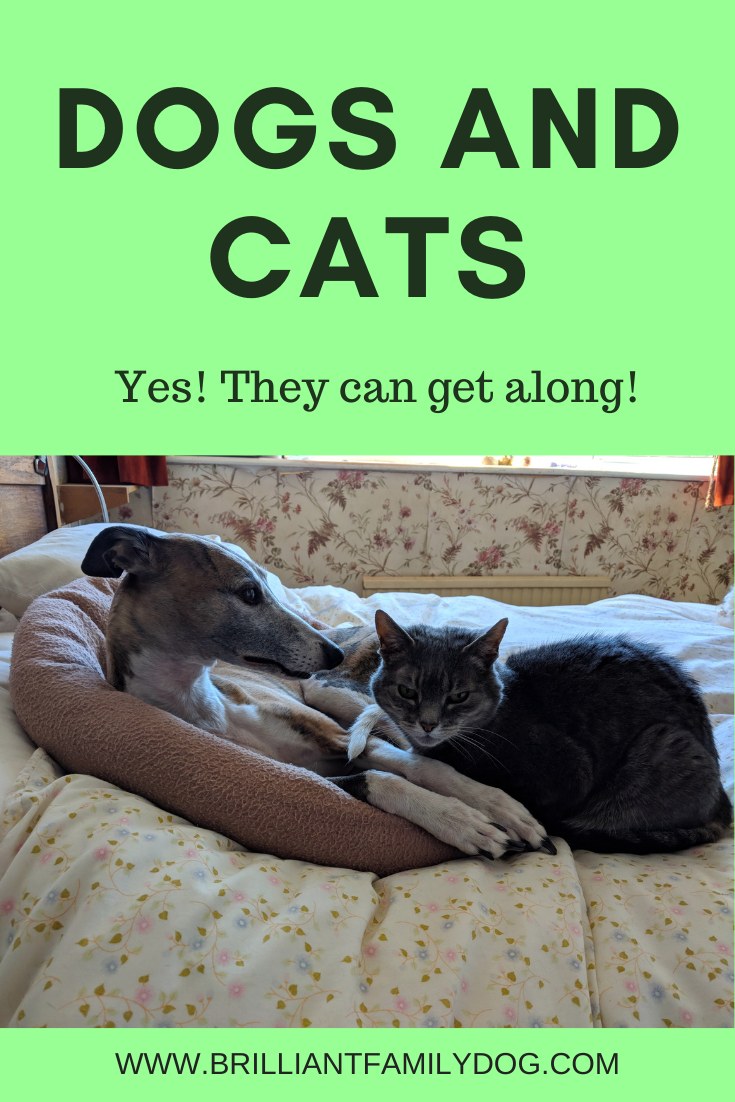
Dogs and cats are traditionally seen as arch-enemies: think of all those cartoons featuring frenetic cat-chases! But I've found that once introduced with care, my dogs and cats get along really well together. You can see Cricket and Squeak sharing a bed here, a common sight as they enjoy each other’s company - and body-heat. And Cricket is a sighthound - bred to chase and kill small fluffies.

It all depends on how you introduce the dogs and cats in the first place. If you're starting with a puppy, and using the methods in this post, the dog and cat situation will always be under your control as the pup will be in his crate, out of harm's way, whenever you're not there.

So you can let the cat discover the puppy in a casual way - very often simply appearing to ignore what's going on is the best policy. Let both dog and cat know that they don't need to be jealous of one another. Feeding and fussing over the older animal first is a good way to reassure him. In any case, an early scratch on the puppy's nose from the cat will probably ensure that she lives a peaceful life from then on!

It’s possible to have a harmonious home with cats AND dogs - here are some methods to make sure it works well for everybody. Brilliant Family Dog is committed to improving the lives of dogs and their harassed owners through books and online learning…

Here baby Tip has a game with Christmas the cat, who is delighted with this new arrival! Dogs and cats are usually fascinated by any newcomer to the household, and they're ready to play as soon as they get the chance. Of course you have to supervise any play between dogs and cats while either is tiny.

It’s possible to have a harmonious home with cats AND dogs - here are some methods to make sure it works well for everybody. Brilliant Family Dog is committed to improving the lives of dogs and their harassed owners through books and online learning…

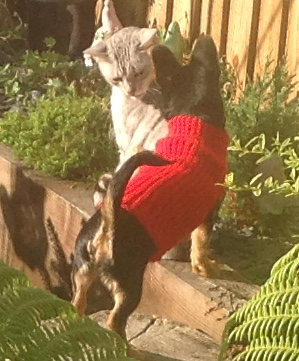
Kalamazoo’s owner was worried that when puppy Bobbi arrived, fur would fly. But just using what I suggest here worked wonders. You can see them both enjoying a little winter sun together in the garden

A new kitten, an older dog

Then to introduce a kitten to an adult dog - just reverse the process! Put the kitten, with her bed and litter-tray, in your dog's old crate. The kitten is now protected from any unwanted attention when you're not around. Once the novelty of the new arrival has worn off, you'll be able to let both dogs and cats mosey along together.

If you have taught your dog that you decide the House Rules, he'll be happy to go along with your wishes - and your wishes will clearly state that Cat is not on the menu.

The last kitten to arrive here (don't they just drift in, shortly after you've decided on NO MORE cats?) was the one to initiate most of the rough-and-tumbles with the dog she selected as her special friend. Indeed she still does.

The play between dogs and cats can get quite rough at times, and we have regular chases through the house, but it's all well-meant, and no-one ever gets damaged. If this kind of dogs and cats rough-and-tumble happens often, you may just want to move the more delicate family heirlooms to a higher shelf . . .

I've had several cats that like to come on walks with us, and one who will intercept me on the road, ambushing the dogs from behind a tree or wall. Then she'll stand in the middle of the pavement, barring our way and sniffing the dogs' noses. This always astonishes passers-by, who don't realise it's our cat!

One of the terrific advantages of bringing up dogs and cats together is that I never have to fear for my dogs' behaviour if we visit a friend who has cats, and there's less chance of my cats getting chased under a car by a neighbour's dog.

Older dog, older cat

It’s possible to have a harmonious home with cats AND dogs - here are some methods to make sure it works well for everybody. Brilliant Family Dog is committed to improving the lives of dogs and their harassed owners through books and online learning…

What about introducing an older dog into a household with a resident cat? This happens a lot when people rescue a dog. The shelter may say the dog is ok with cats, but it’s honestly very hard for them to judge any dog’s behaviour in the artificial shelter set-up.

The first thing to do is ensure safety for the cat, while you assess the level of risk from the dog. Keeping them safely apart most of the time to begin with, you can gradually countercondition your dog to the existence of the cat.

The key to making this all work is to change your dog’s emotional response to the cat, rather than trying to reason with him and tell him off. We go into detail on these methods of counter-conditioning in our online courses.

Here’s an explanation of how and why counter-conditioning works

It isn’t limited to fearful responses, it works on any emotion.

Baby gates and playpens are terrific for containing your new dog in an area. And always ensure your cat not only has access to higher ground and can get out of trouble fast, but also have a separate cat-entry for the house. A cat flap or window will do nicely.

Up till she was 17 Squeak the cat would do some serious mountaineering to clamber over the shed and garage, hop onto the conservatory roof then scramble up 12 inches to get through my bedroom window, and if it was raining, drop in a soggy heap onto my bed. Now we’ve moved we have a fully-operational cat flap, so the 19-year-old can get in and out rather more easily.

I have seen wonderful cat cities “in the sky” which people have built in their homes - a series of ladders, platforms, tunnels and walkways that only the cat can reach. They don’t take up a lot of space as they use the upper area of an otherwise blank wall. It certainly makes a change from generic wall-art!

When he was very young, my son made “Cat Flats” - a series of interlinking cardboard boxes with small doors and tunnels. His cat Rosemary loved it!

The More Dogs and Cats, the Merrier

It’s possible to have a harmonious home with cats AND dogs - here are some methods to make sure it works well for everybody. Brilliant Family Dog is committed to improving the lives of dogs and their harassed owners through books and online learning…

Lacy is the Cat Monitor here. I never have to worry about where the old - now deaf - cat is, as Lacy Always Knows. Here she’s checking the cat out first thing in the morning. A quick sniff and on her way again.

All in all, having dogs and cats in the household makes life more fun. Having at one stage had four dogs and six cats, I know that to be so. The same can be said for chickens, goats, budgerigars . . .

There's no reason why dogs and cats can't get on as they do with any other inmates of the house. But if you are really in fear for your cat's life when you get a new dog, then get some professional help from a qualified force-free animal trainer or behaviourist. That's so worth doing - you will find your life improves immeasurably once you have a dog you can trust, and you and your poor cat’s anxiety levels can go down.

And if you’re wondering about what to do when your dog wants to chase other cats, outside, check out this post about growly and reactive dogs, and its associated guidance.

It’s possible to have a harmonious home with cats AND dogs - here are some methods to make sure it works well for everybody. Brilliant Family Dog is committed to improving the lives of dogs and their harassed owners through books and online learning…

Some dogs have a very strong prey drive. Cricket the Whippet is one, naturally. But she knows that cat is not the same as rabbit, small dog is not the same as small deer. There’s no problem.

If you re-home a dog who has been trained already to chase and kill small things, like an ex-racing greyhound, or a working farm terrier, you may or may not succeed in making the new dog safe around your cats. Read this article about the reassurance of a muzzle.

and link it

If you have cats already, an ex-racer or working ratter may not be the dog for you. Though I do know people who have decided to spend the necessary time, and are prepared to live with the restrictions, to make it work.

Want some help getting this right?

Watch our free workshop and teach your dog to listen!

Do-based training for you and your dog

You’re on your way to only rewarding and never punishing your dog. How about applying the same principle to yourself and cutting yourself a little slack? Brilliant Family Dog is committed to improving the lives of dogs and their harassed owners thro…

I was thinking about Don’t-based training in this post a few weeks ago. And on reflection, I thought how much this applies to us as well as to those we interact with - dogs, colleagues, children, partner …

We say DON’T to ourselves every bit as much as we say it to our dogs and possibly our children - and often more!

Time to find a better way!

No blame, no shame

We turn straight to fault-finding, blame - shame! This happens with us as well as with our dogs.

“I’m no good at this,” we cry. “I can never make this work,” “Who, me??”

How often do you find yourself saying this type of thing? Doing yourself down? Why are we so intent on finding fault, beating ourselves up?

Could these feelings of unworthiness have been instilled at an early age, and we accept them as fact?

We’d never speak as harshly to another person - and I hope, our dogs! - as we speak to ourselves.

Imagine your friend saying, “I want to start this new project,” and you saying, “You? Some hope! You’re useless - it’ll never work. Why even bother?”

Of course you wouldn’t! You would be kind, supportive, encouraging. Even if you thought the venture foolhardy you’d step carefully round the subject, tease out some answers, and NOT judge your friend.

Would you say to your dog who is struggling to understand you, “You’re stupid. Why did I ever get you? You can’t learn anything.”

Of course you wouldn’t! You would be kind, thoughtful, gentle. You’d seek to find where your dog’s problem is, and how you can adjust things to make life easier for you both.

So why do you say it to yourself?

Dog training aka people training

You can use the positive reinforcement, dog-friendly methods I teach you for your dog, and apply them equally to yourself! Brilliant Family Dog is committed to improving the lives of dogs and their harassed owners through books and online learning |…

You can use what you know from the way I show you to train your dog.

  • You focus on what you want

  • You start from where you are

  • You take baby steps

  • You celebrate small successes

  • You are proud of what you achieve!

Start with the science-backed method that works:

Reward.

Not a “carrot” or a “stick”, but a reward. A word, a treat (we can have treats too!), a touch. Something that shows you understand. Something that shows you appreciate the effort being made.

It’s been proven beyond a shadow of a doubt, with species as diverse as killer whales, dogs, pigeons, and dare I add - children!

If you reward what you like you’ll get more of it

And in this case the reward is in focussing on what it is you like. The more you think of what you can’t do, your insufficiencies, your perceived failures, the more of that you’ll get!

So the message is clear:


Focus on what you want and go for it.


Whether that’s the new trick you want to teach your dog, or the new course you want to chart for your life. No more beating yourself up!

Decisions, decisions

People find decision-making hard. We’re trying to break away from possible directions and choose just one. Sometimes we want to make a b-i-i-i-i-g life decision. Sometimes we can’t decide what to have for supper.

But decision-making is a habit. And you can build this up with practice. So practice making small decisions and then putting the subject out of your mind - no longer open for debate.

Don’t second guess yourself. Once it’s decided it’s DONE.

Do this with something small - like that question of what to have for supper - and enjoy the feeling of success and relief, once you’ve stopped going round in circles in your mind. Make your decision, and stick with it!

Soon you’ll be saying, “I’m going to schedule three training sessions with my dog this week, and get started on Loose Lead Walking working for me.” And you’ll STICK to it! Because you made that decision.


Looking for new things to teach your dog? Check out our free 8-lesson email course, packed full of recipes and new methods to explore

THIS FREE ECOURSE IS A BONUS FOR YOU WHEN YOU SIGN UP TO RECEIVE EDUCATIONAL EMAILS AND OCCASIONAL OFFERS FROM ME. YOU CAN UNSUBSCRIBE AT ANY TIME.
Privacy Policy

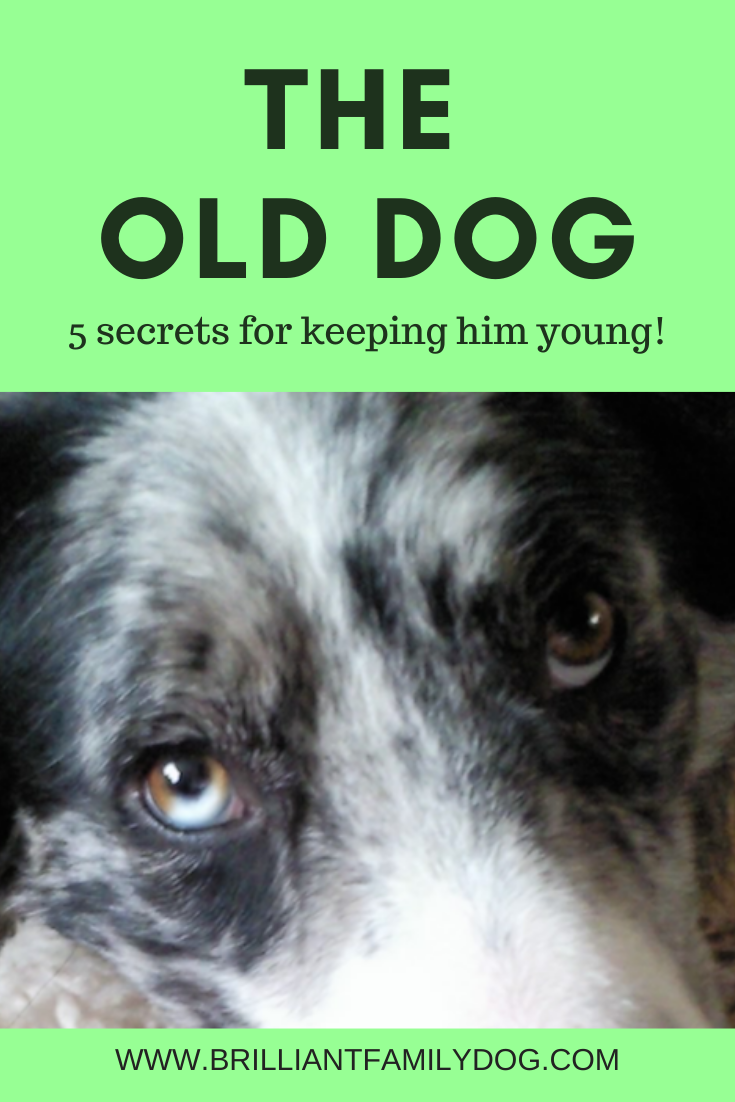
The Old Dog: 5 secrets for keeping him young

A life well spent playing with you can become a delightful old age with your old friend. Follow these 5 tips here to ensure a healthy life for your dog - well into his later years! Brilliant Family Dog is committed to improving the lives of dogs and…

I write with my old dog at my feet. Tired out after his hour's free running - and he still does run! Border Collies will run till they drop if you let them - he sleeps peacefully near me. He still prefers the hard floor to any of the comfy beds scattered about the house - a hard Border Collie, he! Rollo doesn't see so well now, and he doesn't hear as sharply, but as long as he jumps up - ready to go - when I move, I know he's well.

It's so easy to look after him after our long life together. It's never a chore to take extra time for my old dog, to hold the kitchen door open a bit longer, help him up the stairs, lift him into the van - it's not a task, it's a pleasure. It's a small Thank you for all the love and fun he's given me over the last thirteen years together.

We still enjoy our conversations at the end of the day, Rollo with his head on my knee, gazing at me with devotion, me twiddling his ears and smoothing his brow.

Dogs don't live as long as we do - some stiff questions will need to be answered in the afterlife! - but they pack an enormous amount into their few years.

A sheepdog runs maybe 30,000 miles in his lifetime, much of it over rough terrain and in all weathers. Gundogs also clock up huge mileage, and even the busy little terrier covers an awful lot of ground during the course of an active day. Sighthounds are professional sleepers, but can operate for short periods at phenomenal speeds, crashing through undergrowth as they race. All this activity causes a lot of wear and tear on the skeleton and soft tissues as your young tearaway becomes an old dog.


The Secret of Keeping an Old Dog Young

There are steps we can take to keep our old friend active and content for as long as possible. 

1. Physical fitness

Jake is 14 years old in this photo, leaping joyfully for his frisbee! Keeping your old dog’s fitness up to scratch is one of the secrets for a healthy (and vet-free) old age for our companion dog. Brilliant Family Dog is committed to improving the l…

The most important is to keep him physically fit. If you’ve always paid attention to this, this won’t be difficult. You can’t suddenly start a fitness regime with an old, portly, dog without care and possibly help from an expert.

See an old dog in action here! Jake was 14 in this photo of him catching his frisbee. 

2. The right food

"You are what you eat," as the old saw goes, and the right nutrition is so important.

How would your teeth be in old age if you only ate soggy biscuits all your life? How could your body function correctly if you had been bred for thousands of years to tear into raw meat, guts and bones, yet were only allowed to eat grain? And what would your muscle tone be like if you were served mushy food in your armchair everyday, instead of having to find and prepare fresh food for yourself?

This is how it is for millions of dogs worldwide, caught up in the fashion for fast food. Check out this post now, to see how to feed your dog healthily, appropriately, and ... very cheaply!

To keep your old dog fit and happy, it's essential to keep the weight off! It's so sad to see huge, obese dogs waddling around, and it's usually pure self-indulgence on the part of their owners. So much easier to stuff the dog with unsuitable food and then blame her for not wanting to exercise!

Did you know that giving a small dog a biscuit is the equivalent of us eating a beefburger! Please think before giving your dog - of whatever age - unsuitable food. If you must, then break off a tiny morsel of biscuit - that will carry the same message of devotion. And it’s never too late to teach your dog that begging doesn’t work! Check out Leave It! and change your life.

How can you tell if your dog is carrying too much weight? Checking your dog over regularly with your hands will tell you - and will also pick up any sores, ticks, cuts, lumps, mats, rashes, and whatnot.

The back of the neck should have soft folds of skin you can lift easily: no rolls of hard fat. You want to be able to feel all the ribs - but you don’t want to cut yourself on them! You should easily be able to locate the pin bones at the top of the pelvis, and the belly area should be soft and hollow most of the time. A tight beer-belly shape means you have work to do.

If you choose to feed a raw natural diet, this problem never seems to arise. It's hard work chomping your way through meaty bones, and this is beneficial for teeth, muscles and therefore the skeleton. The whole dog gets involved in ripping meat off a bone - see them use their legs and shoulders and really put their backs into it!

But if that’s not for you, at least make sure the diet is highly nutritious, and you provide plenty of chewing possibilities and monitor exercise.

3. Dry him off

My next tip comes from that redoubtable English Border Collie breeder and trainer, Bing Bellamy (Sealight Border Collies). "Never leave an old dog wet!" she admonished. Some of you rejoice in warm weather year-round, so this may not apply to you. But for those of us languishing in the temperate zones or worse, it's good advice. It's easy enough to ensure your house-dwelling old dog is clean and dry after a walk, but remember your kennel dogs need even more care - dry bedding, no draughts, no damp, heating where appropriate.

Rollo would like to spend his day in the garden, lying in the wet grass, getting covered in a blanket of snow, or just drenched with rain. But I won’t let him! His killjoy mother doesn’t allow it.

Despite all your efforts, your old dog may suffer from arthritis, old soft-tissue injuries, and sundry joint problems. All those miles clock up! There's lots of help you can get, from over-the-counter remedies to working with a Canine Massage Therapist (you’ll need a vet referral) - don't leave your friend suffering!


4. Give him comfort

Give your old dog a warm, comfy bed. Many dogs have made a warm, comfy bed a requirement from an early age - for Cricket the Whippet it's a priority! But even those who spend their life spurning the lovely bed you bought them in favour of a cool tiled floor will benefit from a soft bed as they get older.

Be sure that it's an easy-care bed, as one of the problems you may encounter in your old dog is urinary incontinence. This is more common in a spayed bitch, as the hormones needed to keep the tissues plump are no longer available. It's simply cured though. Your vet will have hormone tablets that you can administer in remarkably small doses that I have found fix the problem completely.

5. Eyes and Ears

Just like us, your old dog is gradually going to suffer from diminished function of eyes and ears.

Early training will mitigate the effects of increasing deafness in your old dog. If he knows always to check in with you on a walk, he’ll continue to do that. So brushing up on your recall while your dog can still hear you will pay off! Brilliant Fa…

Loss of hearing can be dangerous for your dog - unless you are prepared to keep him on a lead rather more. My old dog Poppy was so deaf towards the end of her sixteen years that I attached a bell to her collar. At least I knew where she was in our garden or in the fields we walked, even if she didn't know where I was.

Once I’d discovered this trick, it's now standard practice for us to add a bell to the collar of our old dogs when we go out. And the bell also keeps bears away - not a huge advantage in the Norfolk countryside, but perhaps more helpful where you live!

It's an ill wind that blows nobody any good, though, and an unexpected benefit of hearing loss was that once she got to fourteen or so, Tip, another of my collies, was no longer terrorised by fireworks for the month leading up to Guy Fawkes Night (though now they can happen any time …). So your anxious dog has this relief to look forward to!

You'll know when your old dog's eyesight is getting worse as he starts to knock into doorways, miss catching his ball or frisbee, and peer in your general direction when you speak to him, instead of straight at you.

Rollo used to be famous for catching. Nothing got past him, however cannily we tried to trick him! Sadly, he can’t catch anything at all now. But careful throwing can still give him a game of chase, with the frisbee landing in front of him so he can scoop it up. And quite often, one or two dashes is enough. So after handing the toy back to me to throw again a couple of times, he’ll keep away with his frisbee and watch the younger dogs flying about.

As time goes by your older dog will stick close to you a lot of the time. Unless there's a danger to the dog, or he is seriously injuring himself, he can usually be accommodated pretty easily.

His eyes may weep, so you'll need to clean his face for him. You'll also need to clean him the other end on occasion, especially if he has a long coat, as he finds it harder to reach that far to clean himself. A long-coated dog could also benefit from having his "trousers" and underside clipped shorter. This will ensure that there are no mats that can become smelly.


Tough Decision Time

Some dogs will slide gracefully and uneventfully into old age, like my Battersea special Poppy, and will die peacefully at home. Up to age 16, she still came for occasional walks and was content to potter about the house and garden, having no difficulty getting up. If she didn’t want to come, she would turn her head away when I got her lead: it was always her choice.

But there may come a time when your old dog is suffering pain, is unhappy, and you need to intervene to end his life.

Unlike us, a dog can't curl up with a good book. If he can't "be a dog", and run or just walk about, snuffling at things and enjoying life; if he's no longer excited at the sight of the lead and cry of "Walk!" then maybe it's time to let him go. Don't agonise for too long over this. You'll know when the time is right, so just do it. And you’ll know afterwards when you experience the flood of relief that your old friend is no longer suffering that you did the right thing.

I’m happy to pay a bit extra for the vet to come to the house to do the deed. My last dog to go was lying on his bed being handfed fish and chips while the nice visitor stroked him and he slid away.

I shall have to dodge the brickbats now, but I could never bring myself to put a dog's back end into nappies and onto a pair of wheels. My criterion in the event of an accident has always been "Can he be a dog?" Getting about on three legs will still allow him to be a dog. Two legs and two wheels will not. Though I must emphasise that this is my own personal choice. I know people who have kitted out their dog with wheels and had success. There's a lot you'd need to take into account to choose the best outcome for your family and your dog.


Old dogs are a delight

Enjoy them and give them the time they deserve. We only have one life, as do they. Let’s make it the best for both of us!

If you’re struggling to come to terms with any of this, you may find help here: www.beverleycourtney.com

Consistency vs unpredictability in dog training

This is the look of understanding you want to find on the face of your dog when you’re teaching her! Brilliant Family Dog is committed to improving the lives of dogs and their harassed owners through books and online learning | FREE E-COURSE | #newp…

I was talking about being unpredictable in your dog training here recently. And yet I also talk a lot about being consistent!

It’s a fine line we need to tread. Between boring the proverbial pants off our dog and retaining some semblance of knowing what we’re doing.

And it’s not only in your life with your dog that you need to keep this in mind … more below.

Predictability

In your training you need to be predictable. Your dog has to KNOW without a doubt when she’s got something right.

So this is why using your marker at the right moment is so important.

“Marker?” you ask? This is what you do when your dog does something you like. Some folk like to use a clicker, but most will get along very nicely with a word. I use YES. Quick, clear, to the point. Whatever my dog was doing when I say YES is something she’ll consider worth repeating.

Why? Because YES is always followed with a reward.

Always. No exceptions.

This is where the clarity and consistency come in.

So if you’re woolly over your timing, your dog’s response is going to be equally woolly.

I often say Lacy wears her heart on her tail! Because I know EXACTLY when she’s GOT the new thing she’s learning, as her tail starts to swish as soon as she does the required action.

This is great feedback for me!

Your dog may give a clear signal like that. Or you may have to depend on

🐾 sparkly eyes,

🐾 slightly parted mouth,

🐾 eager stance …

See the image at the top for a demo of this. By the way, Lacy hadn’t just eaten a cat - I was wearing a red jumper and it reflected back on to her pearly whites!

You’ll get to know exactly what your dog does when she gets it. This is wonderfully rewarding for us, too.

Unpredictability

But there’s also a place for being UNPREDICTABLE!

You need a careful mix of consistency and unpredictability in order to get the best from your dog. Brilliant Family Dog is committed to improving the lives of dogs and their harassed owners through books and online learning | FREE E-COURSE | #newpup…

Don’t be a clockwork dog owner - keep your dog guessing!

🐾 Do you usually train in the kitchen?

✔️ Train in the bedroom.

🐾 Do you usually sit in a particular chair?

✔️ Choose another.

🐾 Do you usually train your dog at a certain time - or place?

✔️ Mix it up.

Get the idea?

And if your dog is doing something you’re not mad about, follow this simple recipe:

1. Your dog is doing something.

2. Decide what you’d like instead.

3. Teach the new thing.

4. Be consistent.

Please don’t expect your dog to somehow know - not only what aspect of her behaviour is troubling you, but what you want her to do instead!

Dogs are remarkably sensitive and observant, but they don’t have a crystal ball.

Not only with our dog . . .

For some ideas of how to go about this with ease, check out our free email course

  THIS FREE ECOURSE IS A BONUS FOR YOU WHEN YOU SIGN UP TO RECEIVE EDUCATIONAL EMAILS AND OCCASIONAL OFFERS FROM ME. YOU CAN UNSUBSCRIBE AT ANY TIME.
Privacy Policy

And it’s not only with our dog we need to combine unpredictability and consistency. If you’ve done the same things, day in, day out, since forever . . . you’re going to get the same results as you’ve always got. Stands to reason!

So to get the change we all need - to move forward in our lives and fulfil our true potential - something has got to change. We can’t stay stuck in childhood our whole life.

Change things up, be unpredictable! This is the ultimate sign of a flexible mind.

Choose new thoughts, new feelings, new things you can do.

While, at the same time, being consistent!

Always stay true to your values and your core beliefs.

That’s a puzzle for you to work out. Have fun!

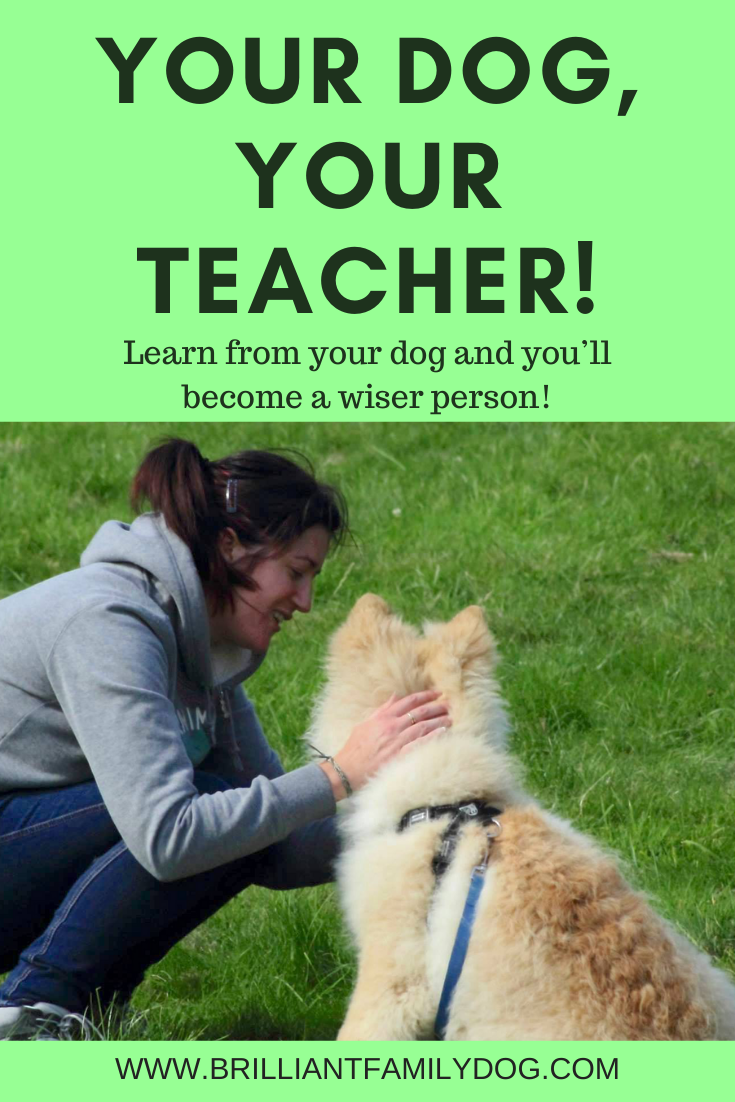
Your dog may be your greatest teacher!

Your dog may be your greatest teacher - if you will only listen to the lessons she’s giving you! Brilliant Family Dog is committed to improving the lives of dogs and their harassed owners through books and online learning | FREE MASTERCLASS | #dogtr…

I am firmly of the belief that we are sent the dog we need. The dog who needs to teach us.

And if your dogs all seem to misbehave in the same way, it’s because you haven’t yet learnt the lesson the first dog was trying to teach you! So you get the “same dog” over and over again.

This is not confined to dogs, by the way. We all know people who keep having failed relationships with the “same person”. And folk who persist in the same way of communicating or working which always results in the same disappointment and frustration.


Check out our Free Courses here

Who is your best teacher?

It may have been an actual, official, teacher. Or your mother, your grandfather, the man in the corner shop, trees, a child, the sky, yourself.

And the lessons may not be the lessons you expected! You are being shown what works, and what doesn’t work.

As James Wedmore puts it,

You either get the result you want, or the lesson you need to learn.

There is no failure, in other words. You always get a result - but it may be a surprise to you . . .

Is your best teacher your dog?

Let’s look at your dog again.

If your dog is ruling the roost it’s because he’s teaching you better than you’re teaching him!

Your dog may be your greatest teacher - if you will only listen to the lessons she’s giving you! Brilliant Family Dog is committed to improving the lives of dogs and their harassed owners through books and online learning | FREE MASTERCLASS | #dogtr…

I’m perplexed when I see how people mistakenly treat their 8-week-old puppy as if he has the knowledge and wisdom of the ages.

He doesn’t!

He knows nothing!

I know they’re not nasty people - they have been misled into this way of thinking, by tv personalities who claim to be dog trainers, and by popular perception and old wives’ tales..

But expecting him to “know”, or to “behave”, is as unreasonable as expecting the same of an 8-week-old baby.

In every interaction, one participant is shaping the other.

That is to say, one is calling the shots and the other is complying. This never has to be nasty - imagine you’re dealing with that small baby. There is no assumption of right or wrong, no blame, no shame - just getting things working well, for both of you.

I never want to enforce obedience. I would far rather manage my dogs so that they choose to do what I would like them to do.

And it’s entirely possible!

Though you may need to make some mental adjustments yourself:

🐾 Ditch the concept that you are superior to your dog.

🐾 Ditch the idea that others must obey your “commands”.

🐾 Scrap the thought that failure to comply is outright rebellion and must be quashed! 

Have a look at what this Brilliant Family Dog Academy student had to say, two months into her program:

I’m delighted and love that the dogs seem to be deciding what it’s best to do, so that life is calmer and simpler, and a proper partnership. Thank you, Beverley. MC

Want to know how she achieved this?

Watch our free Workshop to get your dog to listen, and find out just how much of the learning is for you!

Once you change what you’re doing, your dog will automatically change. Exciting!

And when you reflect on all of this, you may find you could do with a bit of help and healing in order to change where you are in all aspects of your life.

Drop me a message and we can have a conversation about how you can achieve what it is you truly want in this one precious life of yours!