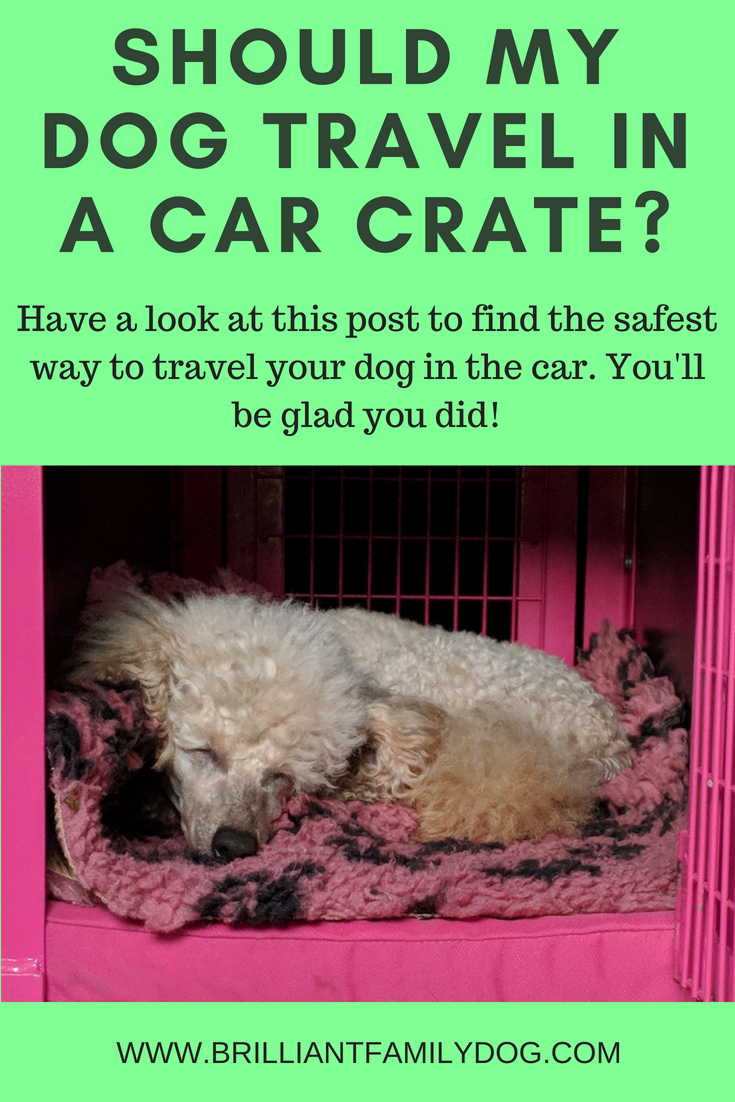
Dogs in cars: what's the safest way to travel?

How can I make sure my dog is safe in the car?  Read the post to find out what’s best, and why! | FREE EMAIL COURSE | Dog car travel, puppy car travel, dog behavior | #dogtraining, #newpuppy, #newrescuedog, #puppytraining, #dogbehavior | www.brillia…

I’m often asked to advise on the best way to travel a dog in the car. Now I’m no lawyer, so you’ll have to check any legal fine print yourself, but I do have some ideas and I’m going to put them forward here. And I’m going to break them down into these main categories

1. Safety of dog
    
2. Safety of others


Dogs and the law

First of all, what are the legal requirements? These will vary from country to country, but I’m hoping that most civilised countries have something similar to what we have in the UK - or, indeed, something better!

In the UK this subject is covered principally by these acts:

  • Control of Dogs Act 1992

  • Animal Welfare Act 2006

  • Road Traffic Act 1988

And if you're not familiar with Rule 57 of the Highway Code, now's the time to brush up. It states that drivers are responsible for making sure dogs (or other animals) are suitably restrained in a vehicle so they can't distract or injure you - or themselves - during an emergency stop: “When in a vehicle make sure dogs or other animals are suitably restrained so they cannot distract you while you are driving or injure you, or themselves, if you stop quickly. A seat belt harness, pet carrier, dog cage or dog guard are ways of restraining animals in cars.”

What you use is up to you - but you must use something! Your dog must be restrained while travelling in a car. It’s commonsense, and furthermore, your insurance company may find a loose dog in the car the perfect excuse to refuse to pay out on your policy. This could be very, very expensive.

I’ll look at the different types of restraint mentioned here further in this article. I’m not going to compare brands or models, as there’s such variation around the world. 

For more advice on car protocols for dogs, get our free email course here!


1. Safety of the Dog

Safety first. A loose dog is considered an unrestrained load, and as a projectile could do a lot of damage to driver and passengers in the event of a crash. You need to restrain your dog so that any impact from a collision is minimised. A dog doing pirouettes on the end of a car harness is not a good idea.

Your insurers may be happy to negate your insurance if the dog could be presumed to have interfered with car safety.

Your dog needs to be able to shelter from direct sunlight, or to keep warm in a cold car. Having a crate you can cover with cloths also prevents the dog seeing out and becoming motion-sick as a result, and may minimise car-barking.

A tethered dog would be easy to see in a car, and easy to steal as you’ve obligingly put him on a lead already. Basically - don’t leave a dog tethered. The risk of getting tangled, breaking a leg, or being strangled is too great. 

When you arrive at your destination, you need to be able to get your dog out of the car in an orderly fashion. So your dog will learn to wait till the lead is fixed to his harness before being allowed to jump out of the car.


2. Safety of others

Dogs travelling in cars - what’s the safest way? Read the post to find out what, and why! | FREE EMAIL COURSE | Dog car travel, puppy car travel, dog behavior | #dogtraining, #newpuppy, #newrescuedog, #puppytraining, #dogbehavior | www.brilliantfami…

The driver needs to focus on the road, not be distracted by a dog licking his ear, or hanging out of the window, or be worried about whether the puppy has got his paw caught in the strap again …

In the event of an accident, rescuers need to be able to help the people in the car, and the dog too. Not easy with a loose - or tethered - terrified, injured dog.

There is also the danger of the dog escaping from the car in an accident. Dogs have been lost for ever this way.

Now to the types of restraint you can use. You have to balance safety, convenience, and budget. But will the convenience and the money-saving be worth it if something bad happens? You'll see that all these methods specifically exclude dog-on-lap, dog bouncing from front to back of the car, dog on parcel shelf, dog hanging out of window, and so on.

Car crate

  • Crates must be restrained or fixed in some way

  • Crates can be removed to free up space when you’re transporting other things - even people, perhaps!

  • Much better for carsick dogs as the mess stays in the crate

  • Reduced danger of injury

  • No need to release dog when you leave the car

  • Easier to allow proper ventilation and protection from heat/cold

  • You can partially cover the crate so your dog can’t see out of the windows: perfect way to stop your dog barking at everything he sees while you drive!

  • If your dog has never been in a crate, you must teach him first in the house. Here’s a good method

Loose crate

  • An airline crate is good and well-ventilated

  • Metal crates for the home are usually too rattly, and too flimsy to give any protection

  • Fabric crates - dogs can overheat in these. And your dog must be acclimatised to a fabric crate out of the car first. Not suitable for puppies.

Custom car crate

  • Best solution

  • Shouldn’t rattle

  • Will have escape hatch to the inside of the car in case you're rear-ended

  • You can have a hole to pass the lead through.

  • Can fit your car exactly without wasted space, possibly with storage space below or above

Tethering

  • Car harness - not suitable for puppies or wriggly, excitable, dogs

  • Don’t tether to a collar: this will cause stress and possibly injury

  • Tethering anywhere in the car: ensure dog can’t leap out and hang himself.

  • Always disconnect the dog when leaving him in the car: serious risk of injury

  • A car-sick dog will make an awful mess of your upholstery …

Dog Guard

  • The dog is restrained in one area of the car and can’t interfere with the driver.

  • If the dog is small and the boot large, they have too much space to race and jump about.

  • Nothing to prevent them leaping out into the road as you raise the boot, though you can work out a tethering system you work from inside the rear passenger seat.

Dogbox fixed to the towbar

  • The mind boggles at what will happen to your dog in the event of a car running into the back of yours …


As you can see, a custom crate is my preferred solution. Yes, they cost money. But so did my dogs. And the amount of love, care, and money that has gone into them since they arrived is massive. So what’s another few bob to keep them safe?

But who cares about the money? I want my dogs to be as safe as possible when I ask them to travel in my car. I provide approved protection for my human passengers, the least I can do is provide appropriate protection for my precious dogs!


My dog wants to be everyone's friend! 5 Ways to make walks easier

Edited and reprinted from positively.com with permission. This post hit the spot with thousands of readers when first published, so I thought you might enjoy it.

My Dog wants to be everyone’s friend! 5 ways to reduce frustration on walks | FREE EMAIL COURSE | Reactive dog, problem dog, fearful dog, dog behavior | #dogtraining, #reactivedog, #dogtraining, #growlydog | www.brilliantfamilydog.com


I’ve come across a few instances lately of people actually being pulled off their feet - and in one case rendered unconscious! - when their dog saw another dog approaching and decided he either wanted to play with it, or to dive forwards barking to make it go away.

Whether this poor behaviour is from a fear reaction or an over-friendly one, the upshot is much the same. Broken noses are no fun. So, unsurprisingly, the treatment is also similar.

I have given you some techniques in It's Not the Dog, It's You to help specifically with fearful dogs. A lot of that information is useful for absolutely any dog, including those who don’t appear fearful. 

So, keeping those methods in mind, let’s focus here on the super-friendly, over-ebullient dog who is determined to have a party with every dog or person he sees.

Picture the scene: owner is happily walking along the road, with dog on lead. Dog spots another dog! Hallelujah! Dog stands up on hind legs squealing with excitement before plunging forward with shrieks and barks towards the other dog.

Already got a Growly Dog? A reactive, shy, aggressive dog? Watch our free Masterclass and learn new strategies to change your lives for the better!

It’s no use waiting till this is happening to try and change things. A knee-jerk response is not likely to do anything at all to help. Everything that needs to be changed has to be done beforehand, at home, in your kitchen, just you and your dog.

So let’s have a look now at what we can do to change this, before any more bones are broken.

1. What the Well-Dressed Dog is Wearing

If your dog is wearing a collar, then this is giving him terrific power to haul you along. Think where the collar goes on a horse in harness - right over the shoulders. Using the strongest part of a quadruped’s body - the rear legs and haunches - the horse or the dog can get great traction, to shift that heavy cart, or to pull you face down on the road.

Does your dog want to play with every dog he sees? Find out 5 ways to change this, for happier walks all round | FREE EMAIL COURSE | Reactive dog, problem dog, fearful dog, dog behavior | #dogtraining, #reactivedog, #dogtraining, #growlydog | www.br…

When a dog is straining into a collar and tight lead, his body language is distorted. His eagerness can appear aggressive - this sends the wrong message to the object of his attentions.

The stress on the throat can also cause physical damage - and in the first place it'll serve only to wind your dog up more!

Pulling backwards against this power is fruitless. At best you’ll have an undignified retreat with you hauling your dog backwards, screaming. The dog will be screaming - but you may be too by this stage!

You need to teach your dog to respond to the lead, and turn of his own volition. Instead of a ten-ton block of frantic barking and scrabbling paws, you get a quizzical look from your dog as he turns and trots towards you. Really!

So the first move would be to investigate a no-pull harness. This is the one that I recommend.**  

One that attaches front and back will be the most effective. Good ones have an almost magical effect on even the most determined pullers. The harness needs to be comfortable to wear.

I would not use a headcollar for a “frustrated greeter” which is who we’re talking about here. If your dog is fighting to get the thing off his nose (most dogs hate them, unless slowly and carefully acclimatised) this is going to increase his level of frustration till he may possibly lash out (“redirect”) onto the nearest leg or hand. That would be your leg or hand. Ouch.

2. Loose Lead Walking, if taught well, is a trick

For your dog to walk close to you, keeping his nose level with your leg, he has to focus and concentrate. It’s not something that your dog will learn overnight - it runs counter to his natural desire to weave and run all over the place. 

The best force-free trainers make this exercise a game which the dog enjoys playing. Trying to frogmarch your dog along on a tight lead while yapping commands at him is not fun at all, for either of you!

The key is to have the lead loose, so that your dog can make a free choice where to walk. This may seem counter-intuitive to you, but it really does work very well when you’re in partnership with your dog as opposed to being his prison guard.

Once you have this skill, you can ask for this circus trick of trotting beside you, looking at you, when you need to distract your dog. If your history of rewarding him is great enough, he’ll be happy to oblige.

3. Impulse Control

We all have to learn impulse control. As children we have to learn to fit into society by containing our impulses and being able to wait patiently. This ability to delay gratification has been proven to be an indicator of a high achiever.

Your dog can be a high achiever too!

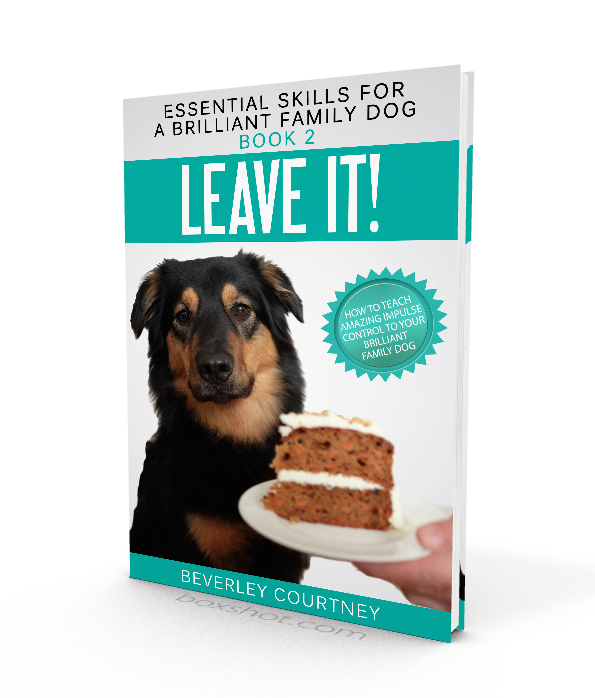
See Leave It! How to teach Amazing Impulse Control to your Brilliant Family Dog for a teaching method. Once he understands this skill, waiting politely should become his default behaviour - there’s no need to keep telling him to “leave it”.

And though the quickest way to teach this is with food, it isn’t just about leaving food. It’s about exercising self-control in the face of any temptation - bolting through the door, leaping out of the car, snatching something he wants ....

4. You Scratch My Back and I’ll Scratch Yours

If you do this for me, then I’ll do that for you, aka the Premack Principle. If, as a child, I demanded something I wanted, The Adult would say “What’s the magic word?” Asking for it again, but adding “please” this time, had the desired effect.

Your dog’s equivalent of the magic word can be a Sit, or Eye Contact, or just plain Silence! So when he starts agitating about something he wants, you can ask him “What do you think you should do now?” Wait for him to stop belly-aching and give you a sit, or look at you, or stop whingeing, then you can give him what he wants.

Don’t tell him what to do - let him work it out!

You probably already do this when you offer a treat - your dog may only get it if he sits. So extend it now - to everything your dog wants!

  • Your dog pulls towards the verge: “You want to sniff that grass?” Wait for a polite response then you can say, “Go sniff!”

  • He scrabbles at your knee: “You want to sit on my lap?” When he sits and gazes meaningfully at you, you can say “Hup!”

  • He wails with excitement when he sees a friend: “You want to say hello to this person?” When he gives you his attention for a moment you can say, “Go say hi!”

Before long, seeing the person or dog in the street will be a cue to your dog to focus on you to ask for permission to greet. You may or may not give this permission, of course, but you can certainly reward his polite asking.

5. Distance is Your Friend

Never forget Distance! If he’s unable to stop squealing and diving, get further away and ask him again: “You want to say hello to that person?”

How much further away? 20 yards? 40 yards? 100 yards? Whatever it takes! When he’s able to focus and engage in rational conversation with you, then maybe - just maybe - he’ll be able to hold it all together while he gets closer to the object of his desire.

He can’t? Then he doesn’t get any closer.

Get Frustration out of the Picture

You can see that these five suggestions have a common thread: giving control back to your dog.

I don’t want to spend the rest of my days trying to control my dogs (or my children): I want them to control themselves!

Nothing is as frustrating as feeling you are a helpless victim who is not heard or heeded. 

Empowering your dog by giving him strategies to get what he wants leads to a happy co-existence which you can both enjoy.


 Have you got an over-friendly dog? A dog who struggles with impulse control and over-exuberance? A reactive, shy, aggressive dog? Watch our free Masterclass and learn new strategies to change your lives for the better!


Resources

** Harnesses: 
www.brilliantfamilydog.com/harnesses I supply the Wiggles Wags and Whiskers Freedom Harness in the UK. If you buy from me I will benefit, but you won’t pay any more!

2houndsdesign.com for the rest of the world.

Leave It! How to teach Amazing Impulse Control to your Brilliant Family Dog

Let’s Go! Enjoy Companionable Walks with your Brilliant Family Dog

It’s Not the Dog, It’s You!


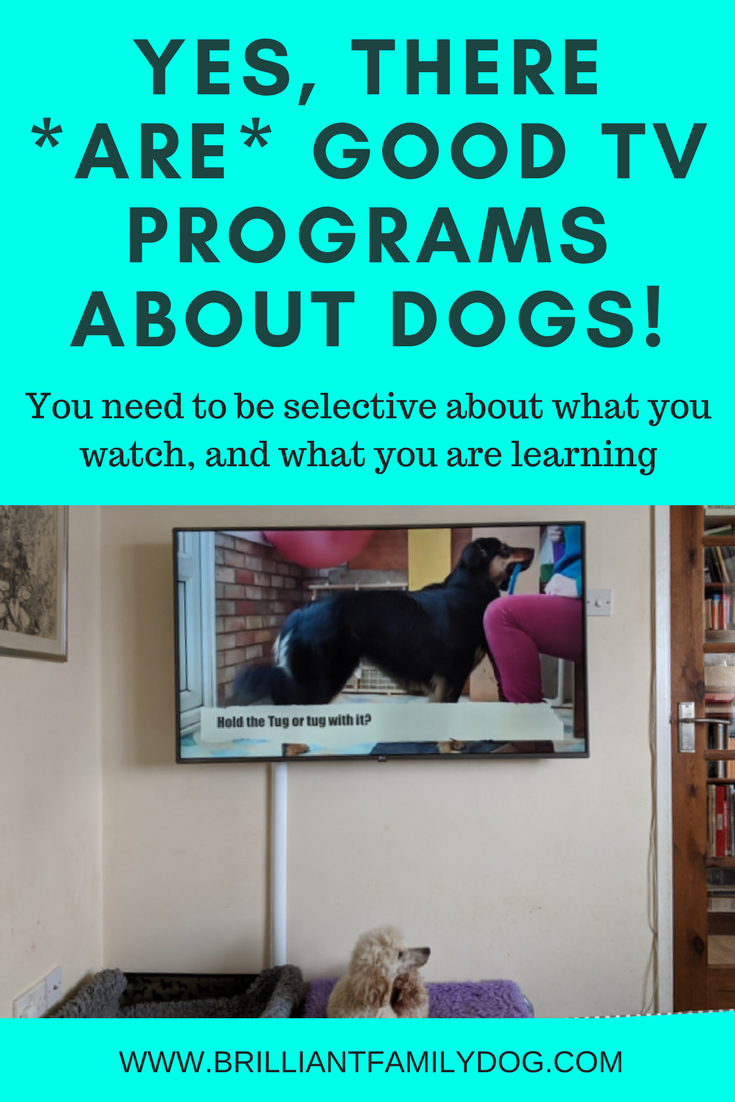
Yes, There can be good stuff on tv about dogs!

A problem dog learns the same way as any other dog. Be careful what you watch on tv so you feed your mind and your dog with the right ideas! The relationship will blossom and life will improve | FREE EMAIL COURSE | Reactive dog, problem dog, fearful…

A lot of television programmes about dogs are either mawkish and miserable - or actively misleading, giving bad advice.

The programme-makers are always looking for the sensational to attract audiences and sell their advertising space, hence the many shows about mistreatment and cruelty to animals, and the dramatic attacks seen in some “dog-training” series. These programmes are made with no reference to the huge scientific advances in the knowledge of how dogs’ brains work, and are responsible for a lot of misery and suffering - of dogs and their owners, who try to put the techniques into practice with disastrous results. 

It's so sad when clients come to me with a problem that has been made considerably worse after trying these inappropriate or downright barbaric methods.

A fresh breeze!

So it’s good to come across a show that I can actually wholeheartedly recommend! UK viewers had a treat recently when a couple of well-known force-free behaviourists (Chirag Patel and Sarah Fisher) and a like-minded vet got together to deal with some very difficult cases - from a variety of animals. As well as a couple of dogs, there were a cat, a rabbit, a pig, and a parrot. It did have a sensational title - Nightmare Pets SOS - but the rest of it was fine.

[This program is available for UK viewers at www.bbc.co.uk for a limited time. You may also find pirated copies on Youtube]

What interested me here was that the solution to the many diverse problems encountered with very different species was always the same: 

1. Remove pressure

2. Provide correct environment

3. Enrich the animal’s life

4. Teach an alternative behaviour

5. Use only Choice Training


So what this meant in effect, was that the terrier who pulled frantically on the lead should be given a slack lead; the “vicious” parrot who didn’t want to interact with its owner was allowed space; the cat who was not using his litter tray was given the correct size and number of trays, and privacy; the pig was taught to go to his mat instead of begging from the customers in the pub he lived in; and the biting rabbit was given peace, suitable housing, and could only be handled with its permission.

In addition to this, the animals were offered enrichment with toys and objects they could interact with so that their brains were stimulated into more acceptable activities. 

There was no need to have more control of the animal, more restraints, tighter boundaries, or "NOOOOO". 

The animals were offered a choice in their care. And their owners were surprised how quickly their recalcitrant pet changed once they stood back and allowed a moment’s reflection and a freely-given choice. 

Lacy plays Retrieve Games http://youtu.be/TM73EUsI7bk

Lacy plays Retrieve Games http://youtu.be/TM73EUsI7bk

And they were united in appreciating that this could all be done without confrontation, without more controls, without alienating their pet further. 

All the pets had a successful outcome in varying degrees. Why did the success vary? Because once the owners had been shown what to do, it was entirely down to them to accept the advice and follow through with the training! 

It was very rewarding - as it was for those trainers on the programme, and indeed anybody involved in this type of work - to see how some of the owners really did what they were asked, and got the results to prove it. Any who carped and complained and made excuses didn’t get so far. 


Does this ring a bell?

And where have you seen those five points before? 

Here! All over Brilliant Family Dog you’ll see this training in action.  It gives you workable solutions to so many problems.

And once you get into the swing of this way of interacting with your dog, you can work out for yourself alternative ways of changing other behaviours you are less than ecstatic about.


Get started with this free email course, which gives you new approaches to old problems:

THIS E-COURSE IS A BONUS FOR YOU WHEN YOU SIGN UP TO RECEIVE EDUCATIONAL EMAILS AND OCCASIONAL OFFERS FROM ME. YOU CAN UNSUBSCRIBE AT ANY TIME Privacy Policy

Want to turn your dog into a star retriever? Check Fetch it! Teach your Brilliant family Dog to catch fetch, retrieve, find and bring things back! and enjoy a new relationship with your dog.

The tone of your voice can make or break your dog’s recall!

Teach your dog to come back on one call - every time - by changing the way you call her! | FREE GUIDE | Dog training, new puppy, puppy training, dog recall training | #newpuppy, #dogtraining, #newrescuedog, #puppytraining, #dogbehavior | www.brillia…

"I try and get Missy to do as asked in the quietest and gentlest voice I can use - I will raise my voice slightly with distance and this seems to work well. The only time I will use a loud voice or shout is if it involves safety or urgency but poor Missy gets upset even though she does as asked. She cowers and skulks when she comes back to me. She gets lots of praise and top value treats but still takes a bit of time to become the happy pup again. Any suggestions for a less scary way to get her back in those circumstances?"

This is a good question from a reader!

In the heat of the moment, fearing for our dog’s safety, we run the risk of sounding harsh and worrying. In our efforts to get our dog back as fast as possible, we let our anxiety come through and bark sharp commands at the dog. Your dog - used to your lovely, kindly, friendly, calls - is nonplussed and worried, and will actually return much more slowly, if at all. 

Dogs are sensitive to the nuances in sounds. And some are super-sensitive. 

As this question comes from a man, the first thing I’ll say is: try and connect with your inner girl! Men tend to have deeper voices, can be more abrupt or gruff, and less melodic in their speech. (Yes, I know that’s a generalisation!) 

So you may need to lighten up, lift your voice. Think of a mother talking to her baby and make those sort of singsong sounds. 

Our questioner says he raises his voice slightly, which works - and only shouts when it’s urgent. He’s on to something here. Projecting your voice, as singers do, is a skill. You need to be able to project the sound, with the same expression - and without shouting or yelling. This may take practice. 

One way to develop this is to picture a spot some distance away - a tree, perhaps - and see if you can get the tree to hear you and your message, without distortion. It’s an old singing trick to pick a listener at the back of the hall and sing to them. It helps you get the sound a long way without changing the tone.

So practicing that would be a good first step.

Keep your anxiety to yourself!

And then you have to know how to react when something worries you. Your dog is racing towards a road - you’re likely to panic and yell urgently. And this is what’s upsetting gentle Missy. 

So take a second, take a good breath, think of how you usually call your dog, and project your voice as you did to the tree. This way your dog will hear you calling in your usual friendly way without the anxious tension.

You’ll need to think of the sound of your call. Perhaps you usually call Missy in a tuneful, singsong way, “Miss-eeeee!” She knows this sound and races back. In your anxiety you may bark “MISSY!!”, which evidently worries her. 

I’m just as guilty as you! I have called my dogs abruptly when there’s a safety issue, and ... it doesn’t work. Once I pause and think and produce the right tone ... it works perfectly!

Missy’s cowering and skulking, by the way, are calming signals to you. She’s showing that she’s no threat by creeping around you, probably also blinking, looking away, maybe licking her lips, yawning, wiggling, and a host of other body language from the dog’s extensive repertoire.

Recall is a fine art

This puppy is loving chasing after his young owner | FREE GUIDE | Dog training, new puppy, puppy training, dog recall training | #newpuppy, #dogtraining, #newrescuedog, #puppytraining, #dogbehavior | www.brilliantfamilydog.com

It sounds as if you have a good recall, and you always reward your dog well for returning to you, which is great. You want to practice these recalls as games, frequently. It’s a mistake to only use a recall - however many rewards your dog gets - in the heat of the moment. 

Recalls need to be a game you play regularly. Sometimes the reward is food, sometimes it’s catching you running away, sometimes it’s hurtling after a toy. Keep your dog guessing with your rewards - never be predictable!

Once your dog will spin on a sixpence and hurtle back to you at the same speed as she departs, you need to “bottle” that and bring it out for every occasion - urgent or otherwise.

Of course, if your dog is not 100% on her recall, you need to manage the situation and ensure that she’s always safe. This may mean keeping her on a long line if near a road, or if deer or bunnies are likely to hop out to tease her.


Here Boy!

Want a bit of help with this? My book Here Boy! Step-by-step to a Stunning Recall from your Brilliant Family Dog will get you going. And if you are the sort of person who needs to see the games demonstrated, you’ll love Brilliant Family Dog Academy - an online course with over 50 daily videos so you can get it right from the start!


Meanwhile, Get your free Rules for a Perfect Recall here

When you change, your dog will change too

Reactive dog, aggressive dog, fearful dog, dog behavior | It’s not the dog that has to change! Change your own mindset and change your dog!  | FREE EMAIL COURSE | #aggressivedog, #reactivedog, #dogtraining, #growlydog | www.brilliantfamilydog.com

I wrote recently about how a small change in your own mindset can trigger a dramatic change in your dog’s behaviour - without any “dog training” at all!

And I wanted to revisit this as it’s such an important - and little understood - part of the puzzle.

While we say “My dog is this, my dog does that,” it’s all about the dog. The dog is perceived as the problem. But the fact is that it’s the perception that is wrong!

Once people change their way of thinking and talking about their dog, they get massive change without having to do a thing.

Not only dogs …

As a child I was curious, questioning, always challenging what I was served up as gospel truth. So naturally, teachers didn’t like this and saw me as a threat (yes, even aged three …). So I was labelled “difficult”. I was the naughty child. 

This “knowledge” about me was passed on in reports and staff meetings, so that all new teachers were instantly brought up to speed with this troublemaker, instead of forming their own opinions from facts. The other children began to look to me for a response in new situations: I had a reputation to live up to! 

So my entire school life was coloured by a few instances in kindergarten and junior school - perpetuated despite the fact that I grew and changed. I came to believe these opinions myself. And then had to work through adulthood to shed this nonsense and develop my true self. (I can tell you that making prize-winning drawings and writing bestselling books was definitely not something those teachers foresaw for me!)

Back to dogs again

We have a much shorter time with our dogs - they simply don’t live long enough for us to spend years labelling them and predicting their poor behaviour based on our wrong assumptions.

And these wrong assumptions can creep into every corner of our lives with our dogs. 

Whenever you say “She always does this,” or “She never does that,” you are placing a permanent label on your dog. You are fixing in your mind that she cannot change, that she’s hardwired to behave in a certain way. 

Back to children - there’s a big difference between “You are an untidy child,” and “Your room is in a mess.” Or “You are a bad boy,” and “Was that a good thing to do?”

Focussing on the doing rather than the doer takes blame and finger-pointing out of the picture, leaving the way clear to solutions and change.

And while we look at the behavior rather than the perpetrator, we see that nothing could be further from the truth than the belief that your dog is hardwired to behave in a set fashion. It doesn’t matter how long your dog has been doing a certain thing - you can change it! 

  • She’s afraid of things? You can make her environment less scary while you countercondition her to better responses.

  • She’s boisterous and impulsive? You can teach impulse control and show her that she can get what she wants when she does what you want. There’s no need for confrontation, ordering about, “commanding”, having a battle over anything.

  • She annoys you by barking noisily, chewing the furniture, messing up the house? Manage! Train! Once you realise that these things are just what the dog IS DOING, and not what the dog IS, you can change it all.

Reactive dog, aggressive dog, fearful dog, dog behavior | It’s not the dog that has to change! Change your own mindset and change your dog!  | FREE EMAIL COURSE | #aggressivedog, #reactivedog, #dogtraining, #growlydog | www.brilliantfamilydog.com

The secret of change is to focus all of your energy
Not on fighting the old
But on building the new


“Socrates” by Dan Millman


I learn a lot from my students, as well as from my dogs!

I’m delighted to watch my online students develop. The penny drops! They see where they have gone wrong in the past, not helped their dog. Sometimes they have unwittingly followed bad advice from the multitude of awful “trainers” and tv personalities out there, and actually made things worse.

But today is a new day! 

Tear off a new sheet!

Start from where you are and head forward!

It’s a joy seeing things improve for them without their needing extra gadgets, lockdown, extreme control.

They see that opposition is just as unhelpful in their relationship with their dog as it is in their relationship with a friend or spouse. Embracing their friend’s likes and dislikes is part of the friendship. Empathy for their fears and foibles is essential to a strong bond.

And a new life opens up for them with their dog, whom they can now view with different eyes. 


Check out this email course that will get you started on the change!

THIS E-COURSE IS A BONUS FOR YOU WHEN YOU SIGN UP TO RECEIVE EDUCATIONAL EMAILS AND OCCASIONAL OFFERS FROM ME. YOU CAN UNSUBSCRIBE AT ANY TIME.
Privacy Policy


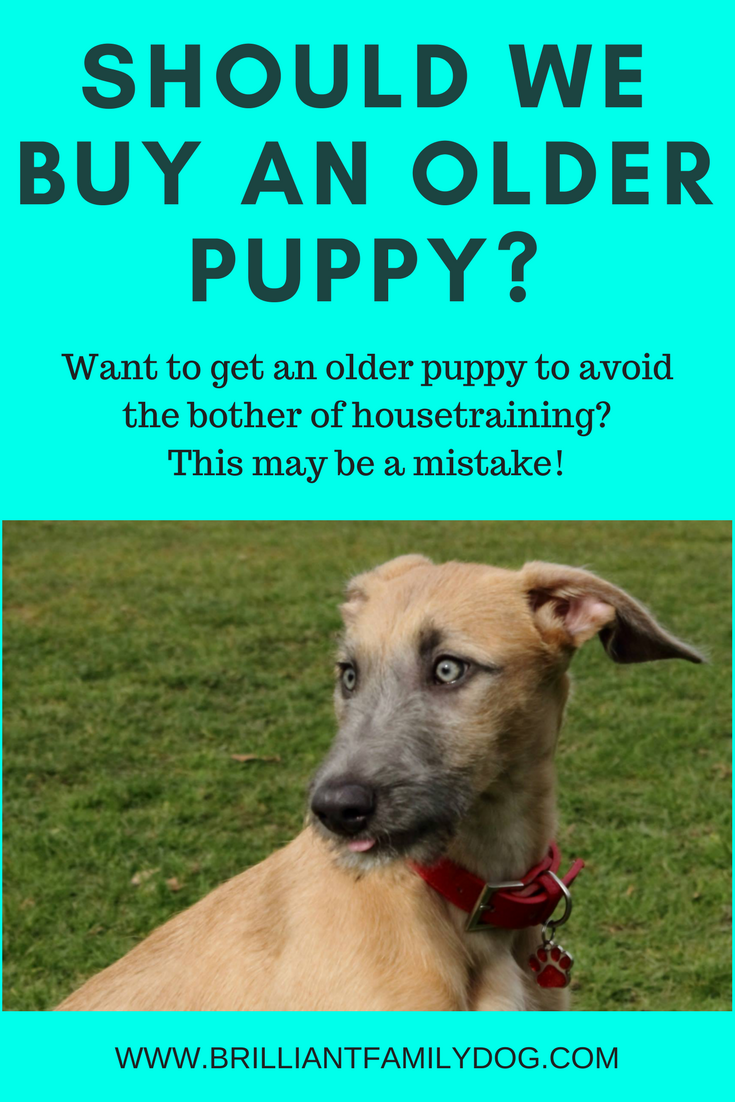
Should I get an older puppy?

Dog training, new puppy, puppy training | Should you get an older puppy? You may think you’re avoiding problems, but you may be making more for yourself!  | FREE GUIDE | #newpuppy, #housetraining,  #puppytraining, #dogbehavior | www.brilliantfamilyd…

“We don’t want to be bothered with housetraining, so we’ll get an older puppy,” she said, talking about getting her first dog.

“Oh, please don’t!” was my reply.

Housetraining is very simple if you know what you’re doing. 

So don’t let fears about that put you off. Your house won’t be ruined, there won’t be poo everywhere. 

If you follow this Guide to Errorless Housetraining closely your 8-week-old puppy will be clean and dry by 10-15 weeks of age at the latest. Just a few weeks in a lifetime with your dog. It’s a very short time and you’ll be building a bond with your puppy as you go (because there’s no crossness or telling-off in this method). 

Get your free guide to Errorless Housetraining and have it all done in a week or two!

This guide is a bonus for you when you choose to receive educational emails and occasional offers from me. You can unsubscribe at any time.


You should know three things

1. Poor-quality breeders (or greeders, as I prefer to call them) will have puppies left over long after they should have gone to their new home. 8 weeks is the correct age for that. So these pups - who could be any age, really - have been kept in a bare shed with a gang of other pups for months on end. They have had no socialisation (and no housetraining either!) and they may find it very difficult to adjust to a normal family life. Unwitting buyers may be told the pup is months younger than he actually is. Read up on how to recognise a puppy farm/puppy mill and don’t get caught by these chancers. Do you really want to take on this unsocialised, mentally neglected, pup?

2. Some competitive breeders produce litter after litter in their big operation, and pick pups to “run on” to see if they’ll shape up as potential prizewinners. Once these pups have got to six months or so they decide which one to keep and sell the rest - usually to ill-prepared purchasers who responded to an advert for a “puppy”. These dogs may have lived only with one breed of dog, kennelled in a big run of kennels. Some of the worst cases of fear or aggression I have to work with have come this route. Do you really want to take on a ticking time bomb?

3. Adolescence (5-14 months roughly) is the commonest age for dogs to be dumped in rescue shelters. (Don’t worry, I know that some dogs end up in shelters through absolutely no behavioural fault of their own.) So you have to be prepared that your chosen dog may need a lot of work to repair. People got a fluffy puppy. They may have housetrained it, who knows? They certainly didn’t do anything else they should, because now they’re abandoning their pet because … he’s unruly, he’s too strong on the lead, he runs off, he barks at other dogs, whatever. This is all because of their neglect in rearing and training their puppy properly. While giving a home to an abandoned dog is a laudable and kind thing to do, you owe it to your family to get the most suitable pet possible. Is this mixed-up, neglected, confused dog really right for your home?

Tell me, (apart from exceptional cases where perhaps the caring owner died) where will you get a puppy who has been carefully and sensitively housetrained, is now six months old, lovingly trained and socialised - and yet someone wants to get rid of him?

I know some of you will write to tell me just that. And you struck lucky! I’m delighted to hear your happy story.

Dog training, new puppy, puppy training | Should you get an older puppy? You may think you’re avoiding problems, but you may be making more for yourself!  | FREE GUIDE | #newpuppy, #housetraining,  #puppytraining, #dogbehavior | www.brilliantfamilyd…

Possibly there was a genuine reason for the owner parting with the dog, or possibly you found a breeder who genuinely loves dogs (I know that sounds crazy) and who did all the work necessary to produce a sound and confident young dog.

Housetraining is a brief interlude, quickly done, soon passed. If you choose to skip it and get an older puppy there is a possibility you could be dealing with its other problems long after the housetraining period is over.

Watch our free Workshop to get your dog to listen, and find out just how much of the learning is for you!

Once you change what you’re doing, your dog will automatically change. Exciting!