It’s ok to punish a dog to get what we want

Do we have to punish dogs to get what we want? Absolutely not! The reverse is true. Reward what you like and your dog will learn much faster | FREE EMAIL COURSE | #newpuppy, #dogtraining, #newrescuedog, #puppytraining, #dogbehavior, #reactivedog, #e…

It’s not all that long ago that children were sent up chimneys to clean them, and young children are still being used as slave labour.

These children are seen as possessions. Things to use and abuse as their “owners” see fit.

But in civilised countries we just don’t think that any more! Hooray!

Another thing that’s changed is our approach to animals. More and more countries are building animal protection into their law books. For wild animals, farm animals, and for our pets.

Dog or Puppy problems? Get your free 8-lesson email course and solve them all painlessly!

THIS FREE ECOURSE IS A BONUS FOR YOU WHEN YOU SIGN UP TO RECEIVE EDUCATIONAL EMAILS AND OCCASIONAL OFFERS FROM ME. YOU CAN UNSUBSCRIBE AT ANY TIME.
Privacy Policy

But there’s one place where people have a blind spot

And that’s aversive equipment.

Equipment designed to inflict pain.

You can save as many whales as you like, but if you still think it’s ok to put an electric shock collar on a dog (or force a 5-year-old child to work in a factory), you’re barking up the wrong tree!

I understand why you may think that shock collars, prong collars, choke chains and the like are ok to use on your dog. There are a lot of people - some of them calling themselves “dog trainers” - who are heavily invested in using these instruments of torture.

Why? The answer is simple but shocking.

Because they don’t know any better.

The only way they know to get results is by punishing the animal in their care. Whether the dog understands why it’s being punished doesn’t seem to cross their mind.

The fallout of using pain and intimidation to get quick results is a closed book to them. They don’t even bother to look at what happens later.

Using inhumane equipment to reach their ends is making them inhuman.

You wouldn’t want to be a part of that, would you?

The science of getting the results you want in animal training, without lifting a finger to harm the dog, or even ever saying NO, has been proven for almost a hundred years.

We are so behind!  

Do we have to punish dogs to get what we want? Absolutely not! The reverse is true. Reward what you like and your dog will learn much faster | FREE EMAIL COURSE | #newpuppy, #dogtraining, #newrescuedog, #puppytraining, #dogbehavior, #reactivedog, #e…

What’s good?

The good news is that more and more countries are changing their laws and BANNING these awful devices. I’m fortunate to live in one of those countries that has seen the light. **

Tell me, would you punish a child for doing something you don’t like?

Or would you rather TEACH him how to do what you DO like?

Would you give your child an electric shock if he didn’t answer you immediately?

The very thought sends shivers down my spine.

And I get those same shivers when I see that people are brainwashed into thinking it’s actually ok to administer pain to an animal.

The fact (and that’s proven scientifically) is that “training” done via methods of punishment does not last. And has many side-effects that make everything worse.

The child who’s punished for stealing a biscuit is not going to know why it’s wrong to steal. He’s just going to make sure he doesn’t get caught in the future!

The dog who’s punished for being afraid of something is now going to be afraid of his owner as well. His first fear is now superseded by the more immediate fear of the person holding the lead, or the electric transmitter. (They actually call it a “controller”. I rest my case.)

Rhyme and reason go out the window.

In both cases, you’re just teaching avoidant behaviour, not resolving the issue.

The future is bright!

Do you want to learn a way to actually communicate with your dog, and - miracle! - get HER to make good decisions without you even having to tell her?

The way forward is open for you to choose to do things with your dog and stop doing things to your dog.


It's ok to hurt a dog to get what we want

** Countries that have banned electric shock collars now include:

  • England

  • Scotland

  • Wales

  • Denmark

  • Norway

  • Sweden

  • Austria

  • Switzerland

  • Slovenia

  • Germany

  • Canada

  • Australia

Dog or Puppy problems? Get your free 8-lesson email course and solve them all painlessly!

THIS FREE ECOURSE IS A BONUS FOR YOU WHEN YOU SIGN UP TO RECEIVE EDUCATIONAL EMAILS AND OCCASIONAL OFFERS FROM ME. YOU CAN UNSUBSCRIBE AT ANY TIME.
Privacy Policy

Shouldn’t my dog come when I call him?

Teach your dog to come back on one call - every time - by changing the way you call her! | FREE GUIDE | #newpuppy, #dogtraining, #newrescuedog, #puppytraining, #dogbehavior | www.brilliantfamilydog.com

Many people believe that dogs arrive with us with a perfect recall - fully operational.

How wrong can we be?!

People think that as their dog SHOULD listen to them and come when called, then he WILL.

So they sit astride their high horse of SHOULDs and OUGHT-TOs and watch their dog disappearing into the distance without even a flick of his ear.

We expect to spend years - many years - teaching our children what we want them to learn.

So why on earth do people think that they don’t need to TEACH their dog to come when called?

Yet more answers for you in this free 8-lesson email course for changing your life with your dog!

THIS FREE ECOURSE IS A BONUS FOR YOU WHEN YOU SIGN UP TO RECEIVE EDUCATIONAL EMAILS AND OCCASIONAL OFFERS FROM ME. YOU CAN UNSUBSCRIBE AT ANY TIME.
Privacy Policy

What actually happens is that your tiny new puppy arrives with what you THINK is a recall. But in fact it’s just his infant clinginess and need to stay “close to Mum”. He has an instinctive need to stay close to the mother-ship and be protected.

As time goes by, your pup gets BOLDER and more venturesome. As he moves into adolescence, he gets further and further away from you (and further and further into possible trouble) and you find that your previously-dependable recall is no longer there.

lab pup racing away.pngTeach your dog to come back on one call - every time - by changing the way you call her! | FREE GUIDE | #newpuppy, #dogtraining, #newrescuedog, #puppytraining, #dogbehavior | www.brilliantfamilydog.com

Suddenly you have a “bad dog”, a “stubborn dog”, a dog who “never listens”, a dog who winds you up “on purpose”.

And this is the most common age when dogs are surrendered to a shelter for someone else to deal with. How tragic is that?

And if you’ve started with one of those dogs handed in to a shelter - who you’ve fallen in love with and have given a home to - then YOU have the task of undoing an awful lot of early learning from his puppyhood!

But it’s quite possible!

Even famously “deaf” breeds - who get on a scent and become totally immersed in it, or who spot a tiny movement in the undergrowth in the distance and barrel after it at high speed (that would be my Cricket the Whippet!) can learn to pay attention to you and demonstrate a stunning, instant, fast, spin-on-a-sixpence, recall.

Imagine how life with your dog will change when you’re able to say his name quietly and he’s right there beside you?

Imagine how it will be when you see your dog disappearing after a rabbit and you can call, just the once, and have him hurtle back to you?

Teach your dog to come fast when you call - every time - by teaching her what you want! | FREE GUIDE | #newpuppy, #dogtraining, #newrescuedog, #puppytraining, #dogbehavior | www.brilliantfamilydog.com

You’ll be glad to know you never have to treat your dog any differently than you’d treat your small child! There’s never any need for nasty gadgets, tellings-off, yanking the collar, and so on

And I can show you lots of kind methods that really work.

AND it will transform your relationship with your dog, and your enjoyment of him. After all, that’s why you got your dog in the first place, isn’t it?

Come and join us in our free Workshop on getting your dog to LISTEN!

There's something there for you that will transform your recalls for EVER!

I look forward to seeing you there, ready to learn ...

Meanwhile, check out my book with loads of games and ways to get on the road to getting that recall re-installed and fully functional.


Yet more answers for you in this free 8-lesson email course for changing your life with your dog!

THIS FREE ECOURSE IS A BONUS FOR YOU WHEN YOU SIGN UP TO RECEIVE EDUCATIONAL EMAILS AND OCCASIONAL OFFERS FROM ME. YOU CAN UNSUBSCRIBE AT ANY TIME.
Privacy Policy

Shouldn’t my dog come when I call him?


FETCH IT! teach your dog to retrieve anything

Teach your dog to retrieve, fetch, catch, and bring things back | FREE EMAIL COURSE | #newpuppy, #dogtraining, #newrescuedog, #puppytraining, #dogbehavior #dogretrievetraining | www.brilliantfamilydog.com

  • Does your dog like chasing toys … but expect you to go out and fetch them?

  • Or does she remove your fingers when you offer her a toy?

  • Perhaps she just thinks toys are to be taken to her bed and buried …

Not any more!


The latest in the popular series of how-to books from Brilliant Family Dog (currently with 3,000 reviews at Amazon) has arrived!

Fetch It! Teach your Brilliant Family Dog to catch, fetch, retrieve, find, and bring things back!

takes you step-by-step from a reluctant retriever to a fetching fanatic! It’s suitable for people who want to play with their dog in the garden and on walks, folk who compete with their dog, and those who just want their dog to clear up her own toys, fetch your shoes, and find your car keys!

Teach your dog to retrieve, fetch, catch, and bring things back | FREE EMAIL COURSE | #newpuppy, #dogtraining, #newrescuedog, #puppytraining, #dogbehavior #dogretrievetraining | www.brilliantfamilydog.com

It’s such fun to be able to play fetch and catch games with your dog. And provided you keep an eye on the temperature of the weather, you can get an awful lot of running done without too much effort on your part! There’s guidance in the book on safety so you won’t make any mistakes.

Can you imagine how your dog’s stock will go up with your family and friends, once he becomes a genuinely useful member of the family (apart from being cuddly and adorable, of course, which is his default setting)?

From fetching the post delicately off a hard flat floor without damaging your mail, to bringing her lead, fetching the phone, or finding your jumper, there are lessons here to teach your dog to become a retrieving wizard. And she will LOVE it!

What’s in the book?

  • What sort of retrieves are there?

  • How can I reward my dog? - super-important!

  • Retrieve articles - what will help you, and what to avoid

  • Teach your dog to catch - super fun chapter, this!

  • Step-by-step to a reliable Play retrieve

  • Playing Tug for impulse control

  • Step-by-step Formal retrieve, for competition and assistance dogs

  • Adding the vocal cue - how to ask politely!

  • Fun - this chapter includes, amongst others,

Fetch my shoes, Where’s my jumper, Fetch the post, Where’s your lead, Stack the dinner bowls, Fetch the tv remote, Find my keys, and how to teach Search


“I just have to let you know how thrilled I am. Dodger and I have been playing in the garden and I’ve been throwing his ball. He’s been running after it and then bringing it back. So I’m really chuffed!”

Avril and Dodger, her previously non-retrieving Staffie

5* Amazon review 

My dog is lovely but quite excitable, which made some things really tricky ... The advice in Beverley's books is clear and simple to follow, and best of all it teaches your dog to think for itself and make good choices without any commands. Seriously, if you want a nicer, better-behaved and calmer dog, read these books and follow her steps.


Go and check out this page now where you can choose ebook or paperback. And if you live in an Amazon-free zone (they do exist, I’m told!) you can ask your local bookshop to order it. It’s currently at a super-reasonable introductory price.

Plenty of ideas in this free 8-lesson email course for changing your life with your dog!


  THIS FREE ECOURSE IS A BONUS FOR YOU WHEN YOU SIGN UP TO RECEIVE EDUCATIONAL EMAILS AND OCCASIONAL OFFERS FROM ME. YOU CAN UNSUBSCRIBE AT ANY TIME.
Privacy Policy

 
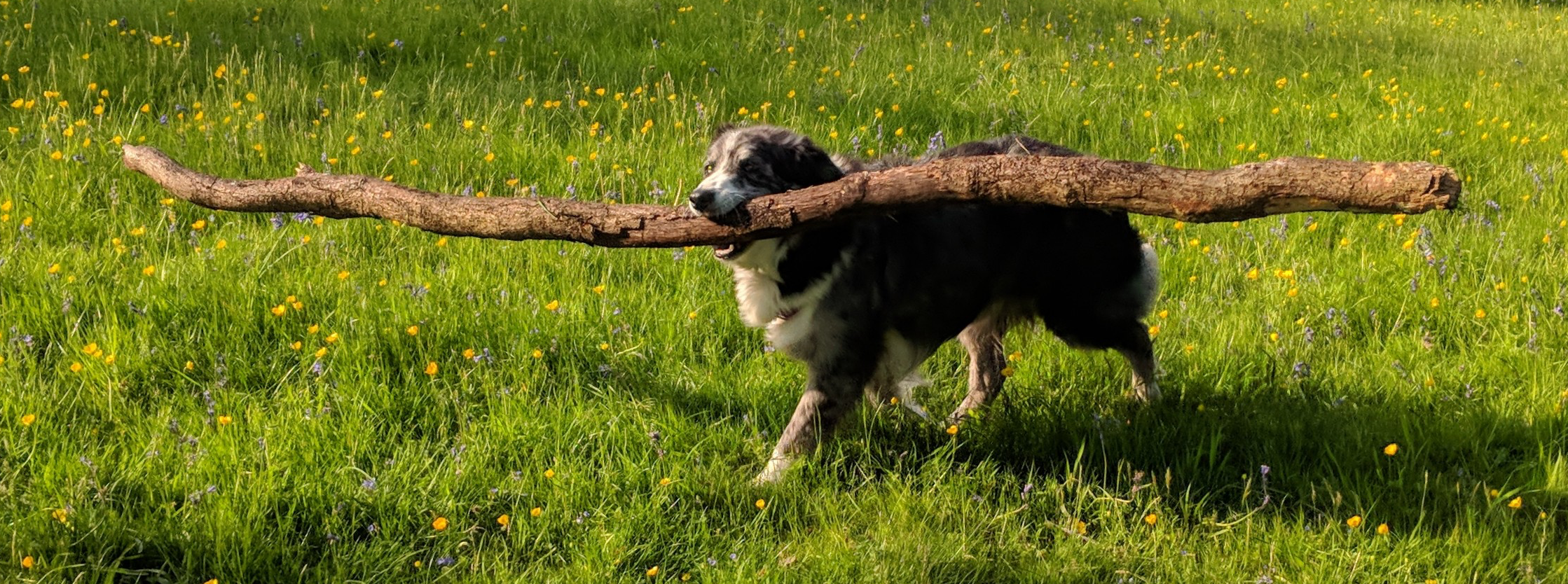
6 Rollo big stick closer.png

Your dog wasn’t born knowing this! You have to teach her

There's no need to be hauled about by your enthusiastic dog! Follow this proven step-by-step system and enjoy relaxed walks, your dog by your side | FREE EMAIL COURSE | #newpuppy, #dogtraining, #newrescuedog, #leaveit, #dogbehavior, #looseleashwalki…

I hear this so often:

  • “My dog pulls me all over the place on the lead”

  • “My dog criss-crosses in front of me so I trip”

  • “My dog has pulled me over in the road!”

  • “My dog is always ahead of/dragging behind me”

as if it’s the dog’s fault!

How can your dog comply with wishes that are never expressed?

How can he understand if you don’t explain to him?

How can he know what you want him to do if you never teach him!

It really is no use complaining to others what your dog does on a walk, if that’s what you allow him to do.

And if you don’t take active steps to change this, that’s what you’re doing. By “active steps” I don’t mean moaning and crying and yelling “get back” or “stop!” or “*$**&** dog!”

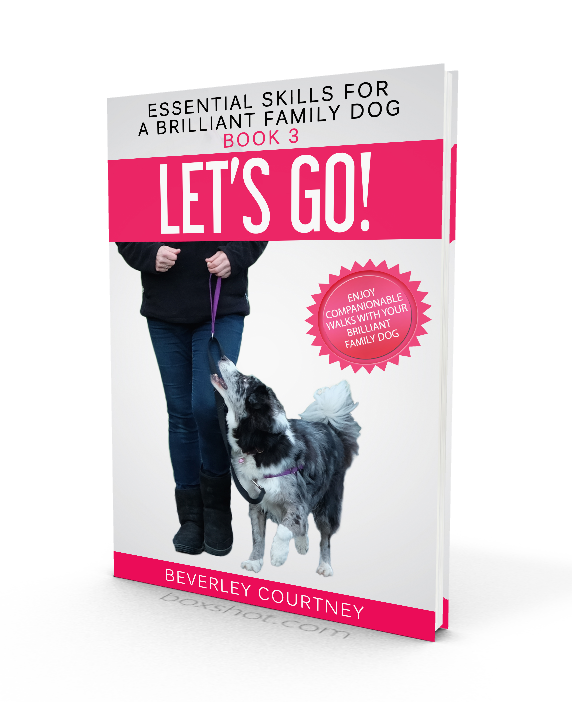
What I mean is a proper program of Loose Lead Walking. There are plenty of them about. Mine is here - Let’s Go! Enjoy companionable walks with your Brilliant Family Dog:

Students of Brilliant Family Dog Academy and From Challenging Dog to Brilliant Family Dog also get the benefit of this full program, along with step-by-step videos so they can get it right fast!

There are others, of course. And as long as you’re not using nasty gadgets, horrid collars, slip leads, retractable leads, tightening harnesses, tightening head collars - or any other aversive nasty, you should be ok.

And the system you choose needs to be proactive - that is to say you teach the dog what it is you want, rather than continually correct him for what you don’t want.

Continually punishing someone for doing something they had no idea was wrong is … WRONG! It’s also counter-productive. Your dog will think, “I’d rather have the sustained pain of choking into my collar than be told off the whole time and I don’t know why.”

Yes, that’s quite a lot of thought to impute to the humble dog. But I think you get the gist.

If you can teach your dog what you want and give him a choice in the matter, you’ll find things go much more smoothly! AND get the result you want. 

Not just walking nicely on the lead

And it’s not just Loose Lead Walking where you need to give your dog an inkling of what you want, not expect him somehow to divine your desires magically.

It applies to anything you’d like him to do - sleep in his bed and not yours, sit at the kerb before crossing the road, travel calmly and quietly in the car, greet visitors politely, leave your food alone on the kitchen worktop …

I’m not saying you have to do all those things - they’re just examples of what you may like to actually teach your dog, rather than expect him somehow to know.

And none of these things include yelling “Gerroff! Stop! LEAVE IT!”

Once you follow a proven program and teach your dog what you want, you have peace and harmony in the home. You can trust your dog to do what you would like him to do, and he can trust you not to tell him off for breaking secret rules.

You can ask him to do things, not command him. How often do you command your house-mate or spouse? “Make me a coffee. I said make me a coffee! Make it now!

Of course you don’t do that! You ask, politely, courteously, and ready to hear and respect the response you get. “I can’t right now, I’m in the bath,” doesn’t lead you to a meltdown, any more than “I can’t sit right now, there’s a dog staring at me over there,” should.

When it comes to it, we all want a peaceful and loving life with our dog - isn’t that why we got a dog in the first place?

Owning a dog is definitely a two-way street. You have to make sure your side of the street is open and has readily-understandable messages flowing down it. Then you’ll be able to hear your dog’s messages and come to an understanding with him.

“When the long line is on your harness you can wander about. When the short lead is connected, you walk beside me. Deal?”

Be sure you’re in conversation with your dog, not being a drill sergeant!


Plenty of ideas in this free 8-lesson email course for changing your life with your dog!


  THIS FREE ECOURSE IS A BONUS FOR YOU WHEN YOU SIGN UP TO RECEIVE EDUCATIONAL EMAILS AND OCCASIONAL OFFERS FROM ME. YOU CAN UNSUBSCRIBE AT ANY TIME.
Privacy Policy

Are you thinking of neutering your dog?

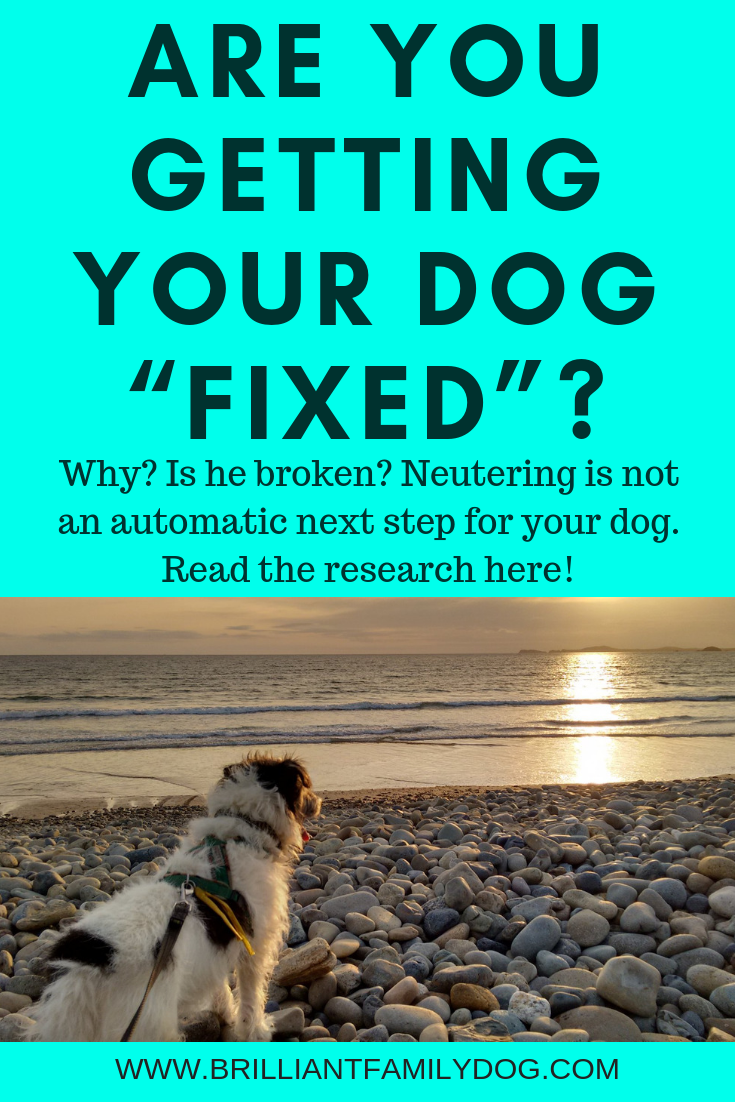
Do you plan to neuter your dog as the automatic next step? Think again! Neutering can have a lot of unwanted effects on your pet. | FREE EMAIL COURSE | #aggressivedog, #reactivedog, #dogtraining, #growlydog, #doghealth, #dogneutering, #dogspaying | …

There’s a lot more to neutering than just preventing procreation. A huge lot more. But people seldom consider these side-effects in their dogs when deciding to get them “fixed”.

I actually hate that term “fixed”. It suggests that the dog arrived in some way faulty and has to have his or her insides rearranged to make him or her acceptable. This is crazy!

The dog arrives in a perfect state. If we want to alter our dog to suit ourselves, we should be prepared to admit this to ourselves and not in some way blame the dog for being wrong.

There are times when neutering is a good idea and times when it is a very, very bad idea. I’ll break these down for you, in terms of the effects.

How will neutering affect my dog’s body?

There are some medical issues where neutering is the wisest or only course to keep the dog healthy - or just alive. Infection of the uterus in a bitch, and an undescended testicle in a dog would be two of these. One is acute, the other chronic.

There are arguments that this or that cancer or condition is more likely in an unneutered dog. But there are arguments of equal weight which say that this or that other cancer or condition is more likely in a neutered dog. The percentages are tiny in either case.

The other thing to consider here is how removal of the sex hormones affect the physical development of the dog’s skeleton. The growth plates close with sexual maturity, somewhere around 9-18 months of age. So the effect of early neutering - before this age - can be relative elongation of the long bones and consequent disruption of articulation in the joints. The net result can be less efficient movement (no good if you got your dog for working or performance) and then joint problems in later years (no good for anyone).


For this reason alone I think that neutering of either sex shouldn’t be contemplated till the dog is sexually mature. For bitches that would mean a few months after the first season at the earliest. Dogs would need to be 10 months to 3 years, depending largely on the size of the breed. The larger the dog, the longer it takes to mature.

I have now reached the limit of my medical knowledge, so I’ll move on to an area where I’m more comfortable!

How will neutering affect my dog’s mind?

The key thing for me is the effects neutering can have on how your dog is, on a day-to-day basis.

Many people believe that neutering their dog will calm them down. In fact, studies have shown that the opposite is true! Your neutered dog or bitch is likely to be more excitable than an intact dog. So please kick that one to the kerb.

Is neutering your dog the automatic next step? Think again! Neutering can have a lot of unwanted effects on your pet, many of which you may not know about! | FREE EMAIL COURSE | #aggressivedog, #reactivedog, #dogtraining, #growlydog, #doghealth, #do…

There has been a lot of scientific research over recent years. Studies have to cover a lot of dogs for a lot of years to be of any use, so they take a long time to emerge. I list a load of them in the Resources below. 

My main interest is how neutering can affect reactivity. As you’ll see from some of these studies, neutering can have a big impact on this!

“It has been shown, in a number of recent scientific studies, that neutering - especially early neutering - will increase sound sensitivity, touch sensitivity, fears, and aggression, in both males and females. In some cases that increase is “significant” or “highly significant”. People-directed aggression in females, for instance, was significantly elevated in the neutered bitches studied. (See the Resources Section for chapter and verse on this.) That’s what those studies found. A lot more research is needed to get more answers, and these studies can take years to produce reliable results.

These unfortunate outcomes are - of course - not guaranteed to happen if you neuter your dog! But it’s important to be aware that they just may happen. And if they complicate an already complicated situation, that’s not helpful.

Neutering has the potential to make your dog worse.”

Essential Skills for your Growly but Brilliant Family Dog

In brief, neutering a dog when he is experiencing fear of anything in the world around him (i.e. he responds to novelty or movement with barking, lunging, trembling, hiding … any action that does not demonstrate confidence) has the potential to make him MORE fearful.

And neutering a female who is already showing fear of other dogs has the potential to make her reactive to people as well after spaying.

You’ll see the facts and figures in the studies below.

If you’ve already neutered your pet, that’s water under the bridge. You can’t change it now.

BUT if you’re happily planning to neuter your dog simply because you think society expects it of you, or your vet suggests it as the automatic next step, please think again.

Once it’s done, it’s done. And if it changes your beloved dog’s nature and makes life harder for both of you, then you’re up the creek without a paddle.

But you have to neuter your dog, don’t you?

And what about the chief reason usually given for choosing to neuter? It’s to do with reproduction. Preventing unwanted puppies. It could also be to prevent bitching, wandering, fighting in males. But responsible management will do this for you! If you’re reading this post, it’s unlikely that your dog is wandering abroad without you knowing where he or she is.

Since neutering became the big thing - the answer to the stray dog problem - has anyone noticed the shelters getting empty? Irresponsible dog-owners will neither neuter their dogs nor contain them. I’m afraid there’s a lot of “preaching to the choir” here. And the fallout is that a lot of dogs’ lives have been unnecessarily altered for the worse, because of only partial education.

A little knowledge is a dangerous thing

You need to see the whole picture before making what is essentially a fundamental and momentous decision about the future of the dog in your care.

I’m suggesting that you need to change your mindset from neutering being an automatic next step for your puppy to seeing that you have a choice in this.

In some European countries it is considered barbaric to mutilate dogs, and neutering of either sex is usually only done for medical reasons. At the other extreme we have cultures where people are vociferous in declaring that all dogs should be neutered and it is our duty as a citizen to do this. I’ve had people writing to me from these countries asking if that’s a thing? You can actually NOT neuter your dog? Unheard-of.

In case you think I am on a mission to ban neutering, I can tell you that only one of my four dogs is entire at the time of writing. You have to decide what is right for your situation. I just want you to realise that there’s more to this than meets the eye, and you do have a choice.


RESOURCES

The effects of neutering on health and behaviour: a summary

Neutering Causes Behavior Problems in Male Dogs

Neutering bitches trebles the risk of urinary incontinence

Royal Veterinary College research, also shows which breeds are most at risk

Behavioral and Physical Effects of Spaying and Neutering Domestic Dogs (Canis familiaris)

Summary of findings detailed in a Masters thesis submitted to and accepted by Hunter College by Parvene Farhoody in May, 2010


Evaluation of the risk and age of onset of cancer and behavioral disorders in gonadectomized Vizslas

AVMA, Vol 244, No. 3, February 1, 2014

M. Christine Zink DVM PhD, Parvene Farhoody MA, Samra E. Elser BS, Lynda D. Ruffini, Tom A. Gibbons MS, Randall H. Rieger PhD

Non-reproductive Effects of Spaying and Neutering on Behavior in Dogs

Deborah L. Duffy PhD, and James A. Serpell PhD

Center for the Interaction of Animals and Society, School of Veterinary Medicine, University of Pennsylvania

Joint Disorders, Cancers, and Urinary Incontinence associated with age at neutering

Benjamin L. Hart, Lynette A. Hart, Abigail P. Thigpen, and Neil H. Willits, July 2020

School of Veterinary Medicine and Department of Statistics, University of California, Davis, California

For help with your reactive, anxious, aggressive, “growly” dog, get our free email course here.

  THIS FREE ECOURSE IS A BONUS FOR YOU WHEN YOU SIGN UP TO RECEIVE EDUCATIONAL EMAILS AND OCCASIONAL OFFERS FROM ME. YOU CAN UNSUBSCRIBE AT ANY TIME.
Privacy Policy


My dog has taken over my bed - how can I change this?

Does your dog sleep on your bed? That’s fine, if you like it! If you don’t, learn here how to change things without anyone getting upset.  | FREE EMAIL COURSE TOO | #puppytraining, #dogtraining, #newrescuedog, #dogbed, #dogbehavior  | www.brilliantf…

I had a recent query from a reader:

“Hi Beverley, Thanks for your informative emails. My puppy is now 8 months old and has been a joy (mainly) but I made the mistake of letting her sleep on my bed and now she is getting bigger. She’s only a small dog but still takes up a lot of room in the bed! Can you give me some tips how I can train her to sleep in her bed?”

This is an interesting question, and I expect many people are saying right now “Yeah, me too!”

Plenty of ideas in this free 8-lesson email course for changing your life with your dog!


  THIS FREE ECOURSE IS A BONUS FOR YOU WHEN YOU SIGN UP TO RECEIVE EDUCATIONAL EMAILS AND OCCASIONAL OFFERS FROM ME. YOU CAN UNSUBSCRIBE AT ANY TIME.
Privacy Policy


Cute puppies can develop all sorts of habits that you let pass, but as the cute puppy becomes a hairier, muddier, larger person, there may be some things you wish you hadn’t allowed in the first place!

This type of question pre-supposes that an established behaviour can’t be changed without difficulty.

Behaviour is just that - behaviour. It’s something your dog does. (Or something we do, of course, but we’ll stick with dogs for now.) So changing that behaviour to something else is just the same as for any other change you want to make.

It’s not a “mistake”. It just is.

So approach this as you would any new thing you want to teach your dog.

1. Your dog is doing something.

2. Decide what you’d like instead.

3. Teach the new thing.

And, of course, be consistent with the new thing. If it’s no bed, then it’s no bed. Ever.

There’s no absolute right or wrong here. If you like your dog doing something that another person disapproves of - then that’s that person’s problem, not yours. We have enough to deal with in life without taking on other people’s disapproval!

You may have been told by some misguided person that this is the thin end of the wedge and that you have to “be the boss” or the dog will take over your house. This is outdated “pack” nonsense. (And as long as the dogs take over the bills too, that’s ok with me …)

Back to the bed question

And it may be that you’re attaching emotion to this bed question. You may be thinking that you’re spurning your dog if you no longer share your bed with her. But your dog is not attaching emotion to the bed - it’s just comfy! And up to now it has been your preferred sleeping place for her.

I’m assuming that there isn’t a resource guarding element to this question, as it isn’t mentioned at all. If your dog doesn’t want to relinquish her place on your bed, and underlines her wishes with wrinkly lips, immobility, or growling, then you have an entirely different issue. Check out this post for help with that. 

Back to the bed … Many people have their newborn baby in their bedroom, and over time move him to another room. As I mentioned in last week’s post about puppies, things change and evolve naturally.

So time for your pup to move to a “grown-up bed” of her own!

A new bed

Make the new bed very inviting and comfy. Depending on your dog’s breed or type, you may want a flat bed she can stretch out on, or if a whippet, terrier, or other tunnelling breed, a tunnel bed or folded duvet to bundle herself up in will go down well.

Using the matwork from Calm Down!  you can quickly teach “go to bed”. Then you can play the game of:

your bed —> her bed

her bed —> your bed

all on vocal cue.

You may need to be persistent, depending on the comfort level and suitability of the new bed!

And you may find that your dog starts the night happily in her new super-comfy bed, but somehow has snuck onto your bed when you wake in the morning. You’ll just have to be vigilant and ask her to go back to her own bed as soon as you feel the bump and hear the sigh.

My own dogs have individual sleeping arrangements. Cricket the Whippet loves wrapping herself in her duvet, and Coco Poodle has a raised bed which he hops onto at night and remains there till invited off in the morning once I’m up. The others can sleep where they like - though they do have beds provided.

So even in the same household - the same bedroom - you can have different behaviours from the different dogs. As long as their needs are catered for, they’re happy.

There are 6 dogs happily hidden in these beds!

There are 6 dogs happily hidden in these beds!