Do you command your dog, or ask him?

And I suppose I can add - do you command your friends, or ask them?

I guess the idea of issuing commands to dogs comes from when the only trainers were policemen, soldiers, gamekeepers, and the like.

They were used to issuing orders to their underlings, so naturally they would do the same with their dogs.

But like so much of what was developed in the last couple of centuries, these methods are now outdated. Much better methods have been discovered and devised, and what’s more - they work!

Issuing a command goes hand in hand with the idea of punishment if the command is not immediately obeyed. People tell me their dogs are disobedient if they don’t respond immediately to a command. How many of these people live with folk who need repeated requests to get anything done?!

Why do they expect a higher standard from their dog?

Thing is - life goes much better when we’re in a partnership with those around us.

We ask them to do things, and they have a choice whether to do them or not.

And that’s exactly how I like to exist with my dogs.

My dogs ALWAYS have a choice!

“But my dog will never make a good choice!” people will wail!

Master and Slave?

Basing your relationship with anyone on a master-slave approach will only ever get grudging compliance at best.

Basing it on a friend-friend approach will get you the outcome you want!

Now in response to the suggestion that dogs will never make a good choice - it’s up to me to set things up so my dogs make the choice I’d like them to make.

And that’s what I mean by “training”.

It isn’t about getting instant obedience because the dog fears my fury or punishment if they don’t do it right.

It’s about bowling along together in harmony, both wanting the same result.

Isn’t that much more appealing?

If you work this right, your dog will anticipate your requests and actually do what you want automatically!

Think on that!

Tell me in the comments, where do you think you can make some changes that will lead to this happy outcome?
 

If you need some ideas, explore our free and premium courses on teaching your dog to listen. You'll find plenty of practical, force-free lessons to help you and your dog get off to a great start.

What’s your favourite dog walk?

For a dog walk to be a resounding success, it has to be enjoyable for you and your dog!

It also has to be safe, of course, and it needs to serve a purpose.

For you this may be to relax after a long day’s work; to get that body moving after being chained to your computer or the stove all day; to free your mind of all the “have-to’s” and go somewhere you can’t do any of them!

And for you dog, it could be any number of things, depending on your dog’s age, fitness, and personality.

What's your dog's favourite walk?

Is it

🐶 Sniffy?

🐶 Hurtling?

🐶 Hunting?

🐶 Chasing?

🐶 Playing with you?

🐶 Playing with other dogs?

🐶 Slow and steady?


Whichever it is, you need to be ensuring your dog finds his walks satisfying too!

While you admire the scenery and the sunset, your dog can be sniffing and exploring. 

While you stride out over moor and mountain, your dog can be racing around with glorious freedom.

And while you chat with a friend, your dogs can be enjoying a runaround together.

Or maybe both you and your dog prefer solitude, and are happy to walk for miles without meeting a soul.

Group Dog Walks

If you can find a well-organised group walk, where the organiser knows what they’re doing and can manage the situation safely, that can be a joy for puppies and sociable dogs.

But be wary! A lot of damage can be done if the organiser has little knowledge or authority. Ask to go on a walk without your dog first time round, so you are able to assess how suitable it will be for your dog.

Town Dog Walks

Town dog walks can be entertaining too - possibly including a pleasant coffee-stop at a cafe! - as long as your dog can handle the sights and sounds of busy streets and pavements without freaking out through fear or over-excitement.

If your dog is not 100% keen on this type of thing, you can save up your walks and go a couple of times a week to a calmer open space.

Dogs don’t have to be walked every day!

This is a misunderstanding prevalent amongst new dog-owners. 

It’s important to remember the purpose of the walk - it can be for socialisation and training, or for exercise and R & R. 

The ASPCA puts it like this: 

Freedom to Express Normal Behavior: by providing sufficient space, proper facilities and company of the animal’s own kind 

And it’s enshrined in UK law that animals should have the opportunity to express themselves as is appropriate for their species. That means free running for dogs! 

HINT: a reactive dog does NOT need to run the gauntlet of everything he fears every time he puts his nose out of the door. This dog would be a candidate for fewer but better-chosen walks. Perhaps a trip out of town to a quiet footpath, or even renting space in a field. 

Keeping your dog’s preferences in mind, along with your own, will lead you to finding a happy medium between the right amount of exercise and the right amount of stimulation.

So what’s your favourite dog walk? 

Do comment below and tell us where your favourite dog walks are, and whether you are fortunate enough to be able to access them easily and often - or whether they are special occasions you plan and look forward to!

And if you’re struggling with handling your dog on the lead at all, check out our free Workshop on getting your Dog to LISTEN! And for our lovely sensitive souls - our free Masterclass for Growly Dogs.


Want a quick fix for your dog?

Well, I hate to disappoint you, but there are no quick fixes.

There are certainly quick ways to get what you want with your dog - if you know how to do them!

But the idea that you can hand off your dog to someone else to “fix” is pie in the sky.

Not only is it unrealistic, but it’s wrong too.

It takes two to tango

The thing is that you and your dog are an entity. You are a combined relationship. What you do affects her, and what she does affects you.

So trying to get someone else to solve your problems, without including this vital synthesis, is doomed to failure!

There are lots of ethical reasons why you don’t want to “send the dog away for training”. How will you know what’s going on? 

This was evidenced by a recent correspondent who found out too late that the promised transformation was achieved by using nasty methods. What’s more, the transformation only worked when the people who originally tortured the dog were holding the lead. As soon as the kind and gentle owner had her dog back, the change evaporated. Why? The dog had been “taught” through fear, and was now no longer afraid! 

After telling her “the problem was her, not the dog” the ‘trainers’ handed the damaged dog back. The owner felt guilty that it was all her fault, and the problem was still the same. Then she realised that aversive means must have been used, as her dog “did not want to return to the trainers on the second day and was difficult to get out of the car.” Fortunately she saw the light and said, “I’ve not been back since.”

She’ll be teaching her dog herself in future! 

You’re a team!

Fact is, if you learn together, you can develop as you go on. If you understand the principles involved in getting your dog to do what you’d like, then you can teach anything! 

There’s no magic wand.

There’s just understanding, love, and a desire to do the best for the animal in our care. 

Here’s someone who’s just joined the Brilliant Family Dog Academy with her new puppy. She originally came to classes with me with her previous dog - 10 years ago - she knows this stuff works! 

“Out of everything Teal learnt as a pup, it was what he learnt with you that stuck and really worked for him.” SS 

And part of the reason it stuck (apart from the genius teaching, of course 😊) was that she and her puppy learned together. And having learnt from me, she was able to carry on reinforcing what she liked for ten happy years. 


Do you want this kind of life with your dog?

Watch our free Workshop here

and get your first lessons in Choice Training - on me!


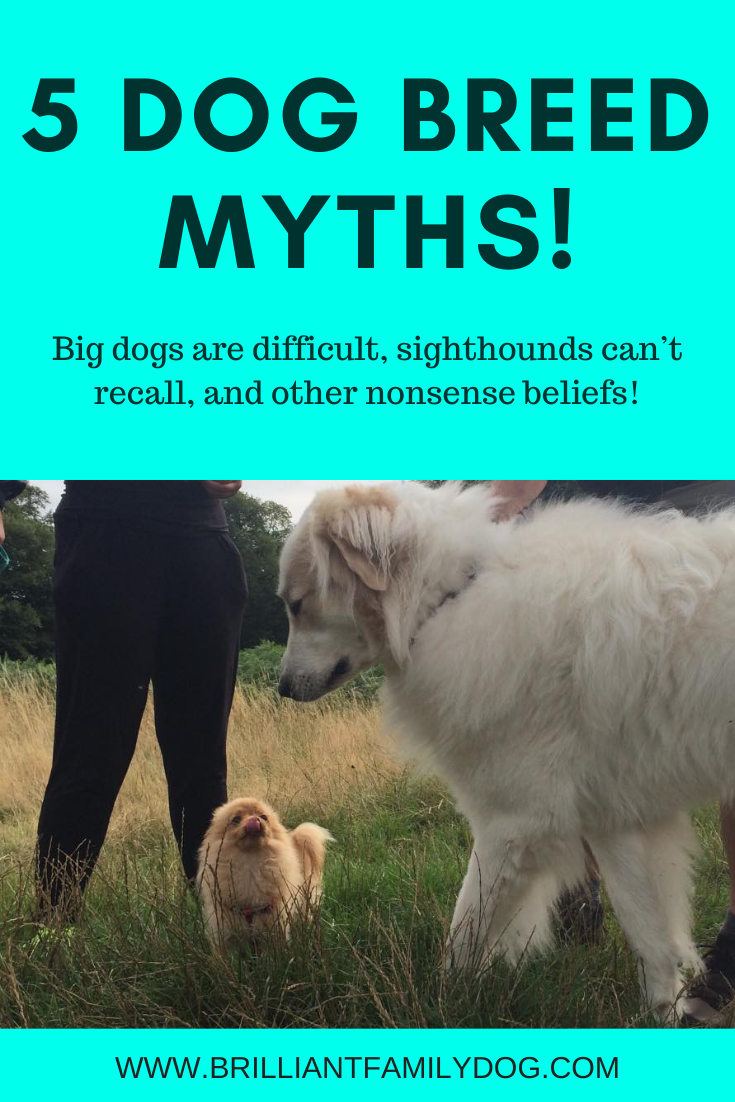
5 Dog Breed Myths


  1. Big dogs are hard to handle

  2. All small fluffy dogs are cute

  3. Rescues are better than pedigrees (or vice versa)

  4. Doodles don't shed

  5. Sighthounds can't recall


Well - you could call them “myths” - but I prefer to call them “excuses”! 

Because these things usually come out of the mouths of people whose dogs are in some way challenging them, so they have to produce a reason which doesn’t include the fact that they forgot to train their dog … or they have deluded themselves into getting the wrong dog for their home because of a misconception. 

Let’s take a look:

1. Big dogs are hard to handle

Back in my Working Trials days I didn’t do PD (Police Dog), but competed at plenty of trials where PD was being tested, so I got to know a fair few of the top handlers. The dogs are tested for their resilience, their tenacity, their instant responses, and their ability to bring down a criminal (without damaging him). 

I learnt a saying there when talking to a trainer whose Champion was quite a small collie, which applies to all animals - including people! Note that ‘fight’ here refers to the conflict or spirit - it’s nothing to do with dogs fighting.

“It’s not the size of the dog in the fight, it’s the size of the fight in the dog.”

People can manage horses. People can manage elephants. People can manage all kinds of large animals. Big dogs can be handled just as easily. 

And a lot of people struggle to manage quite small dogs!

It’s all a question of switching things round from the concept of control, of dominance, to the fact that it’s all very easy if the dog wants to do what you ask.

This is the essence of Choice Training, and is what I teach throughout Brilliant Family Dog and all its books and programs.


2. All small fluffy dogs are cute

This is a nonsense put about by the ghastly puppy farms and ‘greeders’ who cater for the desire to have a fashionable fluffy to show off. 

These “designer dogs” are … dogs! And if they’ve had a poor start, as suggested in my sentence above, they’re going to be more difficult than they need to be.

Dogs come in all shapes, sizes, temperaments, and characters. It’s essential to work with the dog that’s in front of you, rather than the dog you wish you had.

“Cute is as cute does” as my mother would most certainly have said (if she’d ever used the word ‘cute’!). 

And yes, small fluffies can be cute. But so can big smoothcoats. And both have the potential to be less than cute. It’s all in how we teach them.

Back to Choice Training again!


3. Rescues are better than pedigrees (or vice versa)


This one’s just plain silly. A dog is a dog is a dog. He has no idea how he came to be on the planet. He just is!

And all dogs have a right to a good home and a good life. 

Choosing a dog of known breeding can certainly help if you want that dog for a specific purpose, and need evidence that the dog will be fit for that purpose both physically and mentally. But there are no guarantees! 

And it’s true to say that there is more variation between individuals than between breeds.

In other words - there’s an element of pot luck in choosing any dog! The only thing we can be sure of is how we treat that dog when he arrives.

Choice Training, anyone?


4. Poodle crosses don’t shed

More nonsense, I’m afraid. If you cross two animals, you’re going to get genes from both. Which genes are recessive and which dominant is in the lap of the gods.

You’ve only got to look at children in the same family - blue eyes / brown eyes, blonde hair / dark hair … 

So you can get a poodle cross that has no sign of poodle coat, and one which is very poodly. And all dogs lose hairs. So if you have a health reason for not wanting dog hairs in your home, a poodle cross is no guarantee.


5. Sighthounds don’t recall


I’ll let Cricket the Whippet answer this one for you in this brief video.

You can see the moment she clocks the rabbit and takes off - and you can see the enthusiasm with which she hurtles back!

And here’s another for you, where there’s no rabbit, but she really really hoped there would be, as there often are up this path - and she was alert and attentive in the hunt! 

Want to learn more about Choice Training?

Check out our free Workshop here, on getting your dog to LISTEN!


Dog Tricks! Fun for all of us

Teaching your dog tricks will raise your relationship to an entirely new level - and is such fun for both of you. Brilliant Family Dog is committed to improving the lives of dogs and their harassed owners through books and online learning, all force…

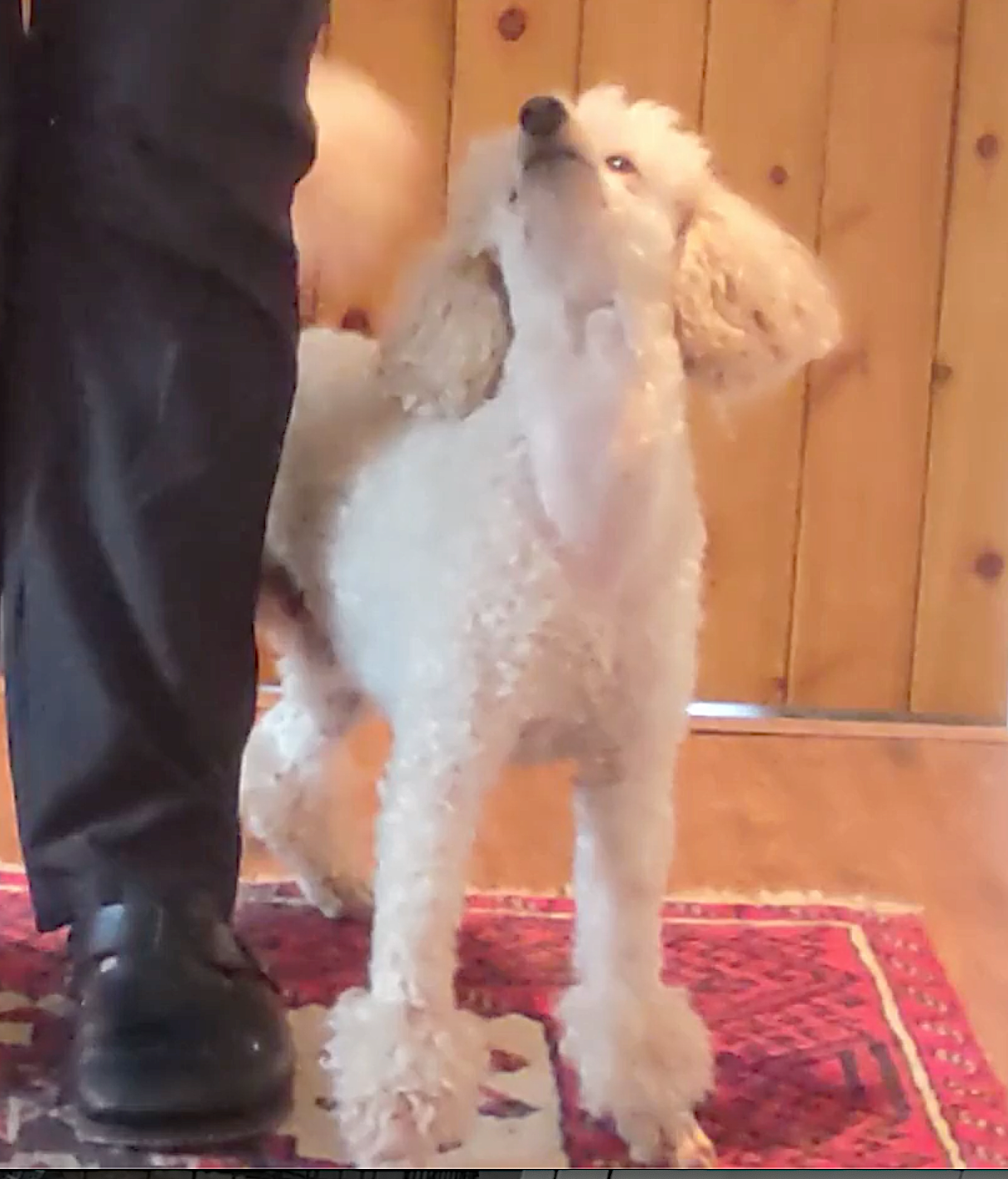
Coco Poodle has an announcement for you! 

He now has to be greeted with a touch of the cap and a bend of the knee. . . .

He has become TDCh Coco NTD ITD ATD ETD!

That’s to say he’s qualified as a Trick Dog Champion! The other alphabet (for he nearly has as many letters after his name as I do!) are Novice Trick Dog, Intermediate Trick Dog, Advanced Trick Dog, Expert Trick Dog.

I’m proud of my little poodle! He has always been a challenge with his hair-trigger responses and his reactivity, but those are part of who he is, and a contributing factor to how he learned so many tricks so fast.

He had to perform over 50 tricks to satisfy the examiners. Some of them we’ve been doing for years, and some were learnt specially for the occasion.

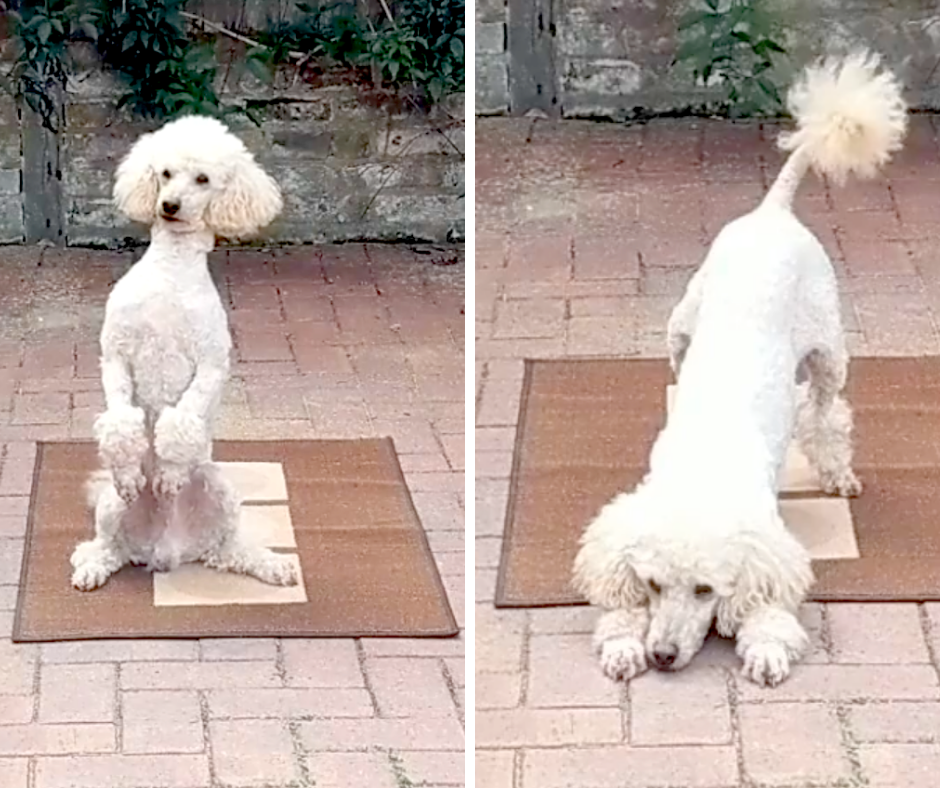
Here are a couple of old favourites: Sit Pretty and Take a Bow

COCO.png


Tricks are FUN!

I firmly believe everyone should teach their dog some tricks. That’s why they’re included in my Brilliant Family Dog Academy.

And remember, it’s all “tricks” to them! Sit is a trick, Wait is a trick, Stand still to have your harness put on is a trick, Picking up my dropped glove is a trick - but how useful!

So teaching a few tricks can contribute greatly to the harmony of your life with your dog. And you’ll certainly impress the socks off your visitors when you can mount a little performance of your tricks routine - always ending with Take a bow, of course!

People who see you having to managing your reactive dog on walks, will be delighted if your dog can give you a Sit Pretty, or a Paw Wave as you move off. You’ll become the star attraction of the neighbourhood, rather than its scourge!

And working in the non-pressured environment of teaching a trick - as long as you are endlessly patient - can do wonders for your own relationship with your dog. The trick can always be adapted to what you want: there’s no hard-and-fast rule of what a trick is. If it’s just for your pleasure, rather than competition, you do your thing!

Start teaching your puppy as soon as he arrives with you. Brilliant Family Dog is committed to improving the lives of dogs and their harassed owners through books and online learning, all force-free and dog-friendly! | FREE WORKSHOP | #dogtraining #…

And just look at the level of attention and anticipation you can get when you’re working with your dog. The whole enterprise should be such fun that your dog is a keen and willing learner!

Some tricks will suit your dog more than others. If your dog hates going on his back, then skip Roll over. If he’s always up on his back legs, then Dance and Up High are good options. A strong and fit young dog can even do “Press-ups” by going from Sit to Sit Pretty to Up High (stand tall) and back.

Some tricks can be “captured” - that is to say, you catch your dog doing a cute thing and put a vocal cue on it so it becomes a trick he can perform. Others you’ll need to build up slowly, stage by stage, till you get the completed sequence. Like Stacking beakers in the video below. First you teach your dog to pick things up, then to drop them, then where to drop them … and so on. Again, a useful trick, as either Lacy or Coco will stack the four bowls for me after they’ve all had dinner. 

Start ‘em young!

Start teaching your puppy as soon as he arrives with you. Brilliant Family Dog is committed to improving the lives of dogs and their harassed owners through books and online learning, all force-free and dog-friendly! | FREE WORKSHOP | #dogtraining #…

You can start teaching your puppy as soon as he comes through the door. It doesn’t matter what you teach, as long as you teach something. They’re like sponges for learning in these early weeks, and you want to make the connections in their brain that enable them to carry on learning all their lives.

Here’s Coco learning Paws up at 9 weeks. It happens to be a very useful trick, especially for a small dog. When I pick up Coco’s harness, he puts his paws up on my leg so I can fit it on without having to bend down and get it tangled up in his legs.

Here’s a video to show you some of the tricks Coco did to earn his title. You can see here how “they also serve who only stand and wait”!

Tell me - is learning how to teach your dog tricks something you’d like to do? Comment below, or email me direct here.


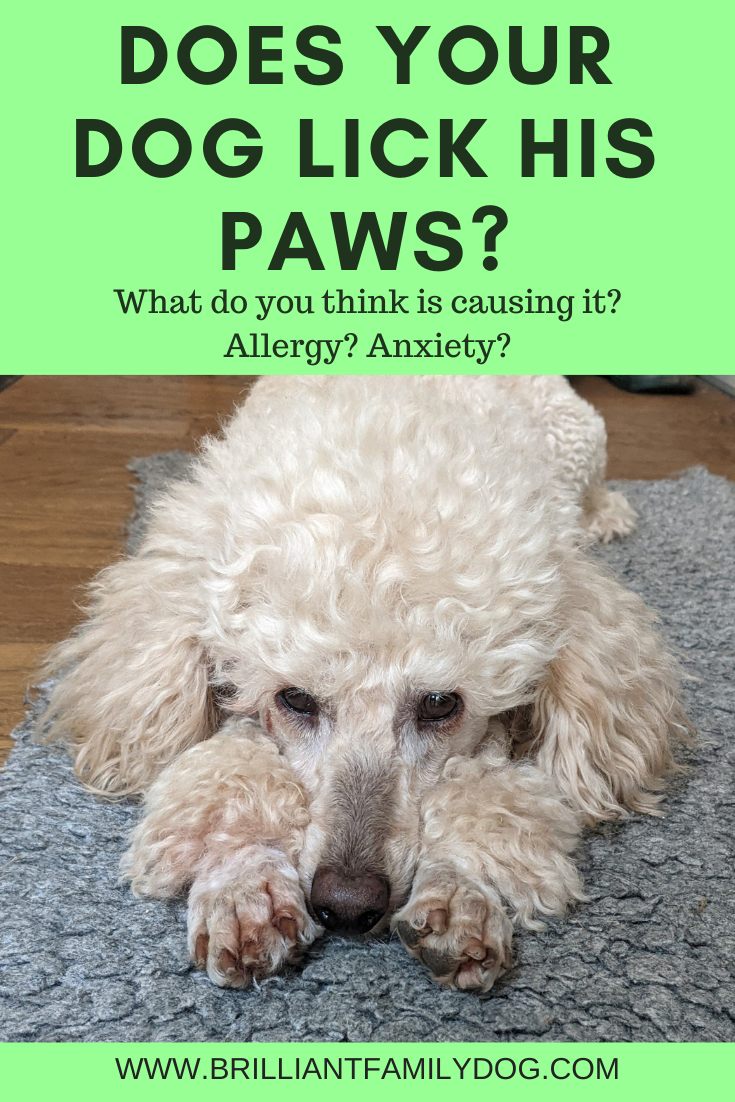
Paw Licking

Whatever the cause of your dog’s sore paws may be, you can fix it! Read this post to find some proven answers. Brilliant Family Dog is committed to improving the lives of dogs and their harassed owners through books and online learning, all force-fr…

Here’s a request from a regular reader:  

“I am wondering if you might be able to address the behavior of frequent (sometimes what appears to be incessant) paw licking.

My dog has been doing this for a while now and as a result the underside of her front paws (the area between her large pad and her toes) is red and irritated.

Is this an anxiety/nervous behavior? Is this a medical issue? Is this an allergy or bacterial infection?

I have spoken to my vets who tell me not to worry unless it becomes a real problem in that she creates a sore. I have researched online, I wipe her paws after our walks, I keep her nails trimmed …

She gets exercise and stimulation and enrichment. Her stress levels appear to be low. Her happiness appears to be high.

Her health is excellent (she just had her semi annual check up) so what am i missing and how can I best help her?” 

I have some experience of this, because Coco was a paw-licker. It took us a long time to eliminate it.

Whatever the cause of your dog’s sore paws may be, you can fix it! Read this post to find some proven answers. Brilliant Family Dog is committed to improving the lives of dogs and their harassed owners through books and online learning, all force-fr…

He would lick between the joints till he made a scald. His feet were pink, and the hair went orange and black from all the licking - looked frightful! You can see his pink paws in this image when he was modelling for the book Let’s Go!

First, as our correspondent was right to do, you need a vet check. Whenever you get a behaviour change you need to check the physical side first. There could be a foreign body or parasite, fungus in the nail bed, a yeast invasion, or an allergic reaction. (In general, don’t use floor-cleaning products that when diluted turn the water cloudy.)

I tried a number of things, and it slowly but surely improved (or didn't, as below). It's important to give a few weeks for each thing to see if it works:


  1. Interrupting and distracting whenever possible - critical!

  2. Washing with clean water after every trip outside

  3. Washing with Hibiscrub solution after every trip outside - helped a bit

  4. Removing chicken from his diet (I picked chicken because raw chicken carcases are what my dogs eat most) - worked for a while

  5. Trying potions: expensive, and no use at all

  6. Covering his feet when indoors, to prevent licking - stopped the scalds developing

  7. Gave him CBD Oil - this seemed to work well

  8. Slowly re-introduced a little chicken once or twice a month

  9. This all took a l-o-o-o-ng time, but it worked. He now has chicken freely, and no CBD drops any more, and his feet are clean and nice!

Whatever the cause of your dog’s sore paws may be, you can fix it! Read this post to find some proven answers. Brilliant Family Dog is committed to improving the lives of dogs and their harassed owners through books and online learning, all force-fr…

Here you can see those nice clean feet he was wearing for his next photoshoot - for the book Fetch it!

Just occasionally he'll start nibbling a patch on his leg: saying "Nibbling" stops him - it’s an interrupter. I never use his name for this as keen readers will know that your dog’s name needs to be precious and only associated with good things!

So how much was irritation, and how much it turned into a habit, is difficult to say. 

Could it be anxiety? Possibly, but I'd imagine it began as a soothing response to some kind of physical stimulus or need, like thumb-sucking. And it then continued to become a habit.

So if this is an issue for your dog, try some of these ideas and see what happens. Be sure to give several weeks at least with each thing you try, to be able to see what’s working and what’s not. Doing it all at once would be hard work, and give you no data.

And do let us know what worked for you (because something is absolutely going to work - but you need to track it down!).

Remember I’m not a vet, and this is just what worked, eventually, for us!