New Puppy? First teach her how to learn!

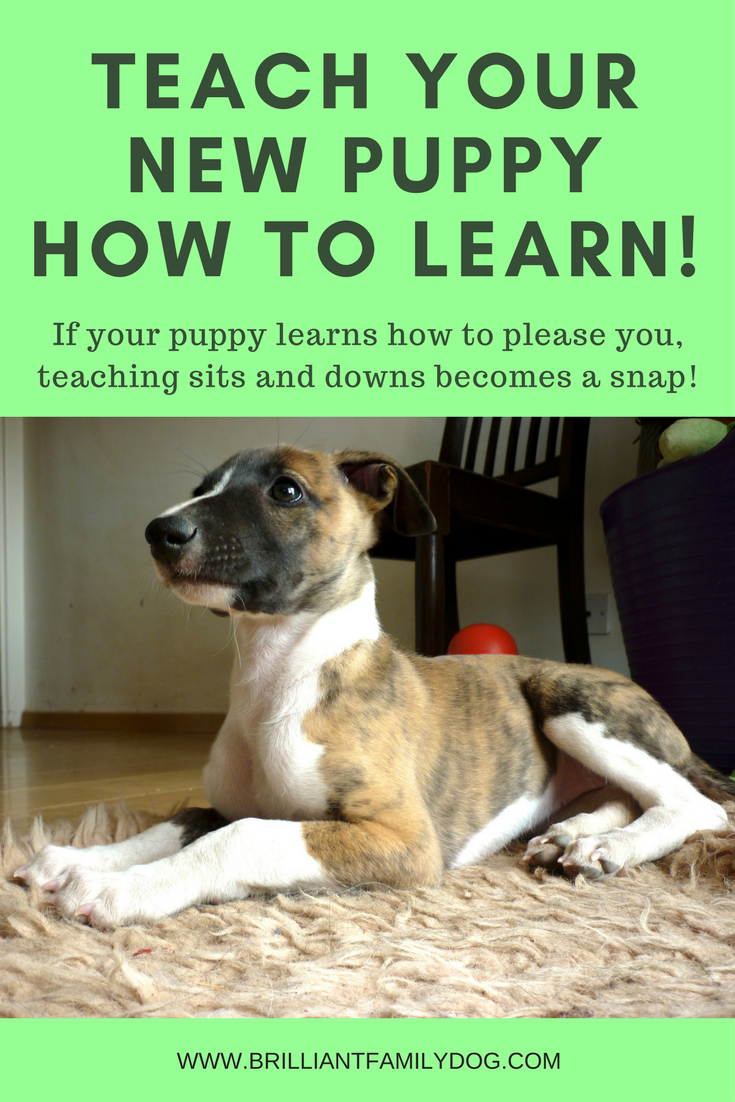
Puppy, New puppy, Puppy training, Choosing a puppy | Teach your puppy how to LEARN and make life easier for both of you | FREE EMAIL COURSE | #newpuppy, #dogtraining, #puppytraining | www.brilliantfamilydog.com

The minute you get your new puppy - she is learning! She's like a sponge, soaking up experiences, processing them, discovering the outcome, and learning whether that thing was good or bad.

So whether you like it or not your puppy is learning every moment she’s awake, and processing that learning while she’s asleep. 

What does that mean for you?

It means that you need to grab this opportunity and teach your puppy as much as possible while she’s in this absorbent, influenceable, state. Once she hits adolescence she’ll be developing ideas of her own, and they may not accord with what you’d like in your family dog!

Now, I’m not suggesting drills and route-marches, "don’t don’t don’t", and some kind of puppy bootcamp! 

If you focus on teaching your puppy how to learn, adding things like sits and downs are a snap

When’s the right age to start?

Get your free email course to sort out lots of dog and puppyproblems

THIS FREE ECOURSE IS A BONUS FOR YOU WHEN YOU SIGN UP TO RECEIVE EDUCATIONAL EMAILS AND OCCASIONAL OFFERS FROM ME. YOU CAN UNSUBSCRIBE AT ANY TIME.
Privacy Policy

In days mercifully gone by (mostly), puppies were given no training at all until six months or so. They were considered too soft to take the punitive methods then popular (and happily becoming less and less popular now). Of course they were! They were babies! But the good news is that there’s no need to use punitive methods at any age. In fact, they’re counterproductive.

These early weeks of your pup’s new life with you are, in fact, the best time of all to teach her how to learn.

What do I mean by that?

Instead of focussing on “commands”, “obedience”, and fighting the puppy’s “stubbornness”, focus instead on teaching her that being around you is good, being in your home is good, being with your family is good. And you do this by simply rewarding everything she does which you like! There isn’t any need for “No!” or “Stop that” or “Get down” or any of the other things that new puppy owners think they have to do to establish superiority. 

You don’t need to establish superiority! The puppy knows which side her bread is buttered, and all she needs is kindness and patience while she works out what has a good outcome and what has no outcome worth pursuing.

And to harness this great learning skill, you simply

Reward what you like
Ignore what you don’t like
and Manage what you can’t ignore

Rewards are anything the puppy finds rewarding - play, cuddles, laughter, tasty treats, dinner, toys, running, chews, garden - etc. Ensure that every action you like is marked and rewarded, and your youngster will soon learn to repeat the things that earn her a reward and not bother with the things that don’t.


Never say NO

There isn’t a place for NO in training babies, of any species. Love and encouragement are what works. But to ensure that you aren’t chasing round after a puppy trying to divert his attention from the electric cables and your favourite dining chair legs you need to set up a safe environment for your pup. 

I like to use crates and playpens or babygates to make a safe area with plenty of chew toys. You want to have the puppy always in the same room as you so you can monitor what he’s up to. Then when you’re busy you can pop him in his crate for some much needed sleep and processing time while you get on with the rest of your life without having to worry about what the pup is doing. And when he’s with you, loose, you can watch him exploring his environment without having to do any “No” or “Ah-ah” because you’re there to divert him if a sniff looks as though it’s going to turn into a nibble.

In general, let your puppy explore everything. Don’t be curbing his enthusiasm for the world he now lives in. While we explore our surroundings largely with our eyes, and babies with their hands and mouth, puppies work largely with their nose and mouth. Let him! You can intervene and distract if necessary, but people are often surprised how little it is necessary if they can simply pay attention to their roving puppy and provide him with plenty of chewables in his playpen or crate.

A cat may look at a king!


Look to your puppy’s physical needs

Puppy, New puppy, Puppy training, Choosing a puppy | Teach your puppy how to LEARN and make life easier for both of you | FREE EMAIL COURSE | #newpuppy, #dogtraining, #puppytraining | www.brilliantfamilydog.com

Think of Maslow’s Hierarchy of Needs which is much the same for dogs as for people.

If you cater for all your pup’s physical needs - shelter, security, food, sleep, exercise, warmth - you’ll then be free to work on her higher needs - companionship, love, self-confidence, and self-fulfilment. Everyone knows that continually nagging and chiding a child will destroy his self-confidence, and we naturally tend to encourage children in their efforts. Puppies are the same! Continual nagging and telling off will damage your puppy’s confidence in her coping abilities, which will seriously affect her ability to learn without second-guessing, fear, and anxiety.

Alongside all this is the necessity for appropriate socialisation. This does not mean thrusting your puppy into the face of every dog you see, or handing him round to strangers to touch. What it does mean is slowly and gently exposing your puppy to all the sights, sounds, tastes, and smells, of our world, and ensuring that all experiences are good ones.


What you expect is what you get

If you think that inviting a puppy into your home is inevitably going to lead to destroyed furniture, soggy carpets, scratched and bitten hands and arms, shredded clothes, and all the rest, then maybe that’s what you’ll get. 

If, on the other hand, you prepare well, supervise your puppy at all times - inside and outside the house - and work with rewards and patience, you’re setting yourself up for a life of harmony with a dog who knows how to please you, knows her boundaries, and is happy to learn whatever you ask her to. 

For an example of how this learning takes place, have a look at this article which gives you a simple recipe to follow to get the results you want - whatever you’re teaching. 

And if you want to know a bit more about the nuts and bolts of Learning Theory in dogs - exhaustively researched and proven over the last 100 or so years - see this piece by the marvellous animal trainer Bob Bailey. There was never any room for sentiment in Bob’s work, training animals and birds for astonishing wartime feats to change the course of history. His work, which guided much of what enlightened dog trainers do today, was based totally in science. 

We want our pups to grow up confident and ready to learn, able to manage new things and new experiences. Excise NO from your vocabulary and you’ll be making a great start!

Want a bible to help you through this stage?

Go to www.brilliantfamilydog.com/new-puppy book page and get New Puppy! in ebook, audiobook, or paperback.

Is your dog or your little puppy throwing up more challenges than you anticipated? Watch our free Workshop and find how to change things fast!


And if you’re just beginning with your precious new puppy - look at

Choosing a Puppy

Housetraining made easy

and

the very valuable cheatsheet on getting your puppy to sleep through the night! 

Got a dog already? Check out this article for successfully rearing a puppy in a multi-dog household.


Want a bible to help you through this stage?

Go to www.brilliantfamilydog.com/ new puppy book page and get New Puppy! in ebook, audiobook, or paperback.

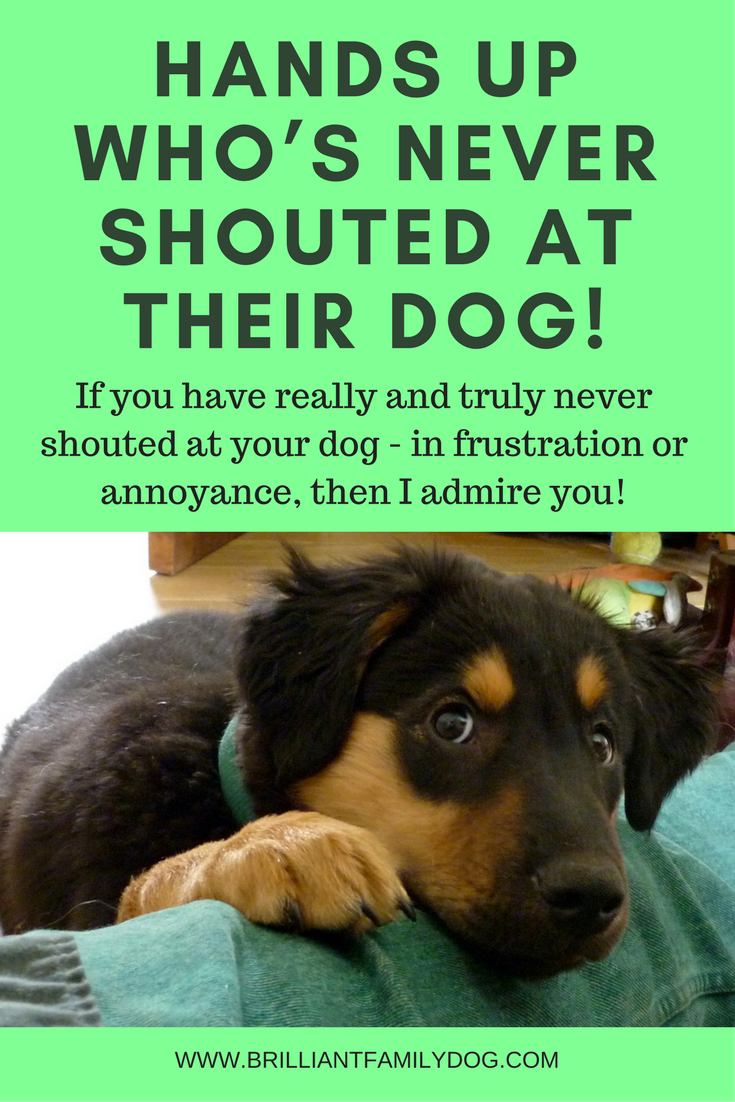
Hands up who’s never shouted at their dog!

Dog training, new puppy, puppy training | Do you get frustrated with your dog by times? Congratulations - you’re normal! | FREE EMAIL COURSE | #newpuppy, #dogtraining, #newrescuedog, #puppytraining, #dogbehavior | www.brilliantfamilydog.com

I don’t see any hands.

I don’t see my own hand either. (More confessions down the page.)

If you have really and truly never shouted at your dog - in frustration or annoyance, then I admire you! You are one in a million. You can go to the top of the class and give out the bones - while I continue with the other 999,999 people.

Now I’m not talking about fury or abuse. That would be inexcusable. 

I’m talking about the daily niggles that cause us to shout at or nag - even those we love most in the world. As soon as we’ve done it we wish we hadn’t. Because, apart from damaging our relationship, it really doesn’t work to get us what we want.

It doesn’t work for family members or work colleagues, with our sophisticated human brains, reasoning power, and social skills.

So there’s little hope of it working for your dog!

Get your free email course to sort out lots of dog and puppyproblems

THIS FREE ECOURSE IS A BONUS FOR YOU WHEN YOU SIGN UP TO RECEIVE EDUCATIONAL EMAILS AND OCCASIONAL OFFERS FROM ME. YOU CAN UNSUBSCRIBE AT ANY TIME.
Privacy Policy

Dogs are simple souls

They do what works. They aim to please - but it’s often very hard for them to know how to please. We say one thing when we mean another; we call them, ask them to sit, tell them to go away, to lie down, to vanish - what do we want?

You have to look at the bigger picture in order to convey clearly what it is you’d like your dog to do. 

For example: You call your dog. He comes bounding over to you with enthusiasm, ready to jump up to give you an extra special slurpy kiss. You say “Sit”. “Sit. SIT. SIT!!” 

One of two things will happen here: 

  1. You are clearly responding to his bouncing with excitement, so he bounces some more. Now you’ve taught him to jump all over you. Out of frustration you begin to sound crosser.

  2. He’s done a smashing recall and instead of appreciating that and congratulating him for his speed and enthusiasm, you are nagging him now about something he doesn’t understand. He mooches off feeling deflated. What’s going to happen next time you call him? Hmm, not so speedy or enthusiastic, I think.

So separate out in your mind what your dog is doing when, so that you can respond to the individual actions rather than the whole thing at once. If you call your dog, you reward him for coming to you. That’s all. Fancy stuff, like sits, can all be added later, when you’ve got the recall down. Allow the little doggy brain to focus on one thing at a time, get it right, and enjoy a reward. 

When you learn ballet you don’t launch into a dance straight away. You learn to stand correctly, to point your toes, to hold your head right. (I’m making this up. I’ve no idea how you learn ballet. But I do know that you start with component parts and gradually fit them together.)

If you can pick out the little things your dog does which you like and respond to those, he will do those things again and again - because it works. 

Yes - dogs can learn to do extraordinarily complex tasks, like opening the washing machine, pulling out the washing and putting it in the laundry basket, for example. But this takes time to teach, and has to be broken down into little stages, each of which is taught separately. When all the parts are mastered, the whole sequence can be put together. On a technical note, this is often taught backwards. The dog first learns to put washing in a basket, then they learn to pull it out of the machine to put it in the basket, and at the end they’re shown how to open the door (stage 3) to get the washing out (stage 2) and put it in the basket (stage 1). 

Dog training, new puppy, puppy training | Do you get frustrated with your dog by times? Congratulations - you’re normal! | FREE EMAIL COURSE | #newpuppy, #dogtraining, #newrescuedog, #puppytraining, #dogbehavior | www.brilliantfamilydog.com

So if you want your dog to perform a complex behaviour, like coming when you call and sitting before you, then you must teach the recall on its own, and the sit on its own. Only when they are both 98% reliable do you join them together. If the recall is rocky, then you’ll never get to the sit. And if the sit is wobbly, you’ll only spoil the recall by focussing on the wrong thing.

If we can keep our part of the bargain, and ensure that we teach what we want our dog to do, and not expect him to learn it by witchcraft or thought transference, life will become easy and frictionless.

Why did you shout at me?

Now recollect the last time you shouted at your dog. You can put up your hand now - no-one’s looking. 


  • Was it because he had dug up the flowerbed? (Who left him unattended in the garden?)


  • Was it because you were in a hurry, the phone was ringing, the saucepan was boiling over? (And that’s his fault?)


  • Was it because he jumped up on a visitor and you felt social pressure to have him behave nicely? (Have you taught him how you’d like him to greet visitors?)


  • Or was it because he did something infuriatingly bad which you thought he could be trusted not to do? (He’s a dog.)


No, my dogs aren’t perfect either. 

And I’m certainly not. 

But I know that whenever I catch myself losing patience with my dog it’s my problem, not his.

Maybe it’s because I’m tired and rushed - that means it’s the perfect time to have a game in the garden with the dogs. That’ll relax me, please them, and get things back in proportion.

“There are no pockets in shrouds,” my grandmother would recite serenely, as she nodded slowly and sucked her teeth. And there are no prizes in heaven (where all our dogs are waiting for us) for having a beautifully clean house and a snapped-at pooch; or a flourishing business and a dejected dog.

What’s more, getting short with my dogs is a sure sign that my teaching has flagged and they have been left without guidance. So I need to up my game and re-teach with crystal clarity the things that are sure to please me. (These things may be incomprehensible to your dog, by the way, but they’ll do them - for you.)

Shouting at a dog is not only unfair, it damages the trust your dog has in you. You have suddenly become unreliable. 

Dogs (and children!) need to know that you have feelings too and they can only push you so far. But shifting the blame onto them is never the answer.


And for all those things which your dog does which frustrate you beyond measure, have a look at the many “recipes” for changing them to things that you’d like him to do, with our free 8-part email course - all force-free, of course. Jumping up, Barking, Digging, Chewing, Nipping - they’re all there!

Get your free email course to sort out lots of dog and puppyproblems

THIS FREE ECOURSE IS A BONUS FOR YOU WHEN YOU SIGN UP TO RECEIVE EDUCATIONAL EMAILS AND OCCASIONAL OFFERS FROM ME. YOU CAN UNSUBSCRIBE AT ANY TIME.
Privacy Policy

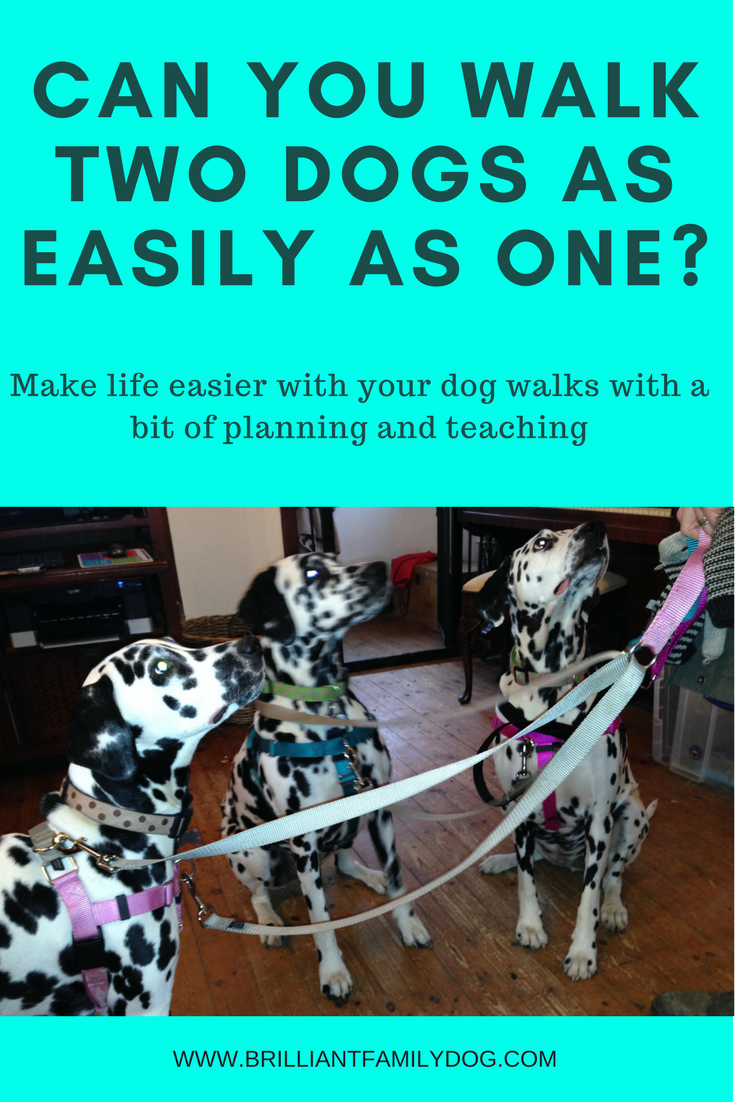
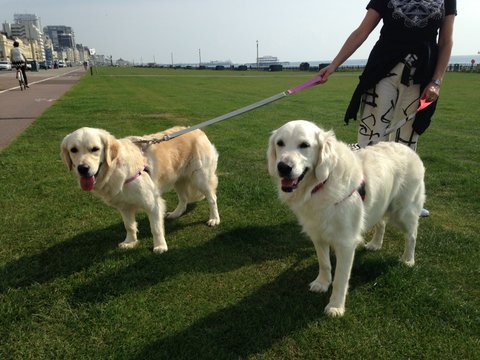
Is walking two dogs the same as walking one dog?

Dog training, new puppy, puppy training, two dogs | Can you walk two dogs as easily as one? With a bit of training you can! | FREE EMAIL COURSE | #newpuppy, #dogtraining, #newrescuedog, #puppytraining, #dogbehavior | www.brilliantfamilydog.com

Emphatically not! There are lots of reasons:

Going on a walk with one dog is a companionable affair. Just the one dog to consider. Just the one relationship. Just one speed. 

Add another and you have your attention split between two dogs. And the two dogs’ attention is split between you and each other. They will interact and react together. So immediately you have some unpredictability in the mix. And there’s great scope for the leads to tangle and for the dogs use you as a maypole.

Add to this the fact that you’ll need to set a pace to suit both dogs - not so easy with one old’un and one young’un. Or a big dog and a small dog. Perhaps you have one surging ahead and the other lagging behind. You have to pick up poo with what - your third hand? - while you try to stop the dogs stepping in it.

You have to decide which hand is holding which lead. You have to work out which lead is attached to which dog. And where do you put your treats?

And if one of your dogs is reactive to other dogs, then you are setting up a learning laboratory for your second dog.

Monkey see, monkey do. Reactivity is highly catching.

And it may result in a “redirected bite” when the frustrated dog lashes out at the first thing that gets in the way - the other dog? your leg? 

Remember that if you’re introducing a new puppy into the household along with your reactive dog you also need to be following a lot of other guidelines that you’ll find in this post.

Get your free email course to start out right with your new dog

THIS FREE ECOURSE IS A BONUS FOR YOU WHEN YOU SIGN UP TO RECEIVE EDUCATIONAL EMAILS AND OCCASIONAL OFFERS FROM ME. YOU CAN UNSUBSCRIBE AT ANY TIME.
Privacy Policy

So it’s not as simple as just grabbing the leads and going! You have to put some thought into this. But a little simple planning goes a long way.

Start with individual dogs

The first essential is to work with one dog at a time. If your loose lead walking with one dog is not stellar, there’s no chance of it suddenly improving when you add another dog. 

Following a step-by-step program like the one you’ll find in Let’s Go! Enjoy Companionable Walks with your Brilliant Family Dog will quickly give you skills with your lead that you didn’t know existed (there’s an art to good lead-handling), and a relationship with your dog that you may have only dreamed of. 

So get that going first, with each dog. You can’t expect them to learn from each other! Well … they may learn from each other, but they may learn some things you’d rather they didn’t. And once they’ve learnt those things, it’s hard to unlearn them (though it can be done, of course). 

And while you’re doing all these solo walks you’re building a huge relationship with both dogs. If you build a relationship with your first dog, then toss another dog into the mix you’re never going to give that new dog the chance to interact with you individually on a walk.

Once you have got each dog knowing exactly where he should be when on a loose lead, you’re ready to put them together. 

I colour-code my dogs, so I know exactly which lead is connected to which dog at any time. This really does make life easier, so look at changing your dog-gear - at least the leads - so you can do this. 


Who’s where?

You also need to establish which side you want each dog, so they don’t criss-cross in front of you, tripping you and each other up. Even if you’ve taught each dog to walk on, say, your left side in solo walks, once they have grasped the principles of keeping the lead loose and staying beside you it’s very easy to flip one to the other side so you have one on each side. Of course, you may prefer both on the same side, but this can lead to jostling and differences of opinion about whose nose should be an inch ahead of the other’s!

Then again some people like their multi-dogs to be out in front of them, like deerhounds. This is fine as long as there’s no tension on the lead. This can be a useful strategy if walking through crowds or narrow streets.

Your focus when on these early walks - well, any walks really - is on helping the dogs to keep the position you have taught them individually.

Using gentle hands on your drooping leads you’ll be able to connect with them without the need to yank or pull at the lead. Frequent rewards given to the dog who’s getting it right will quickly focus your other dog’s attention on how he can get this bounty too. A little competition can go a long way!

While there is no time when my dogs cannot earn a reward for doing something I like, when I have four in hand they may have to be content with a smile and a word of encouragement each time they check in with me. Delving in the pocket for treats with four leads to hold is not so quick! 

What should my dogs wear?

For preference I like to walk my dogs on a well-fitted non-aversive harness with two connection points and a double-ended lead. If you choose a lead with a “freedom” handle this is very easy to manage with one hand. See the video here to show you what I mean: www.brilliantfamilydog.com/harnesses

There are lots of gadgets about for stopping dogs pulling. Many of these are aversive - they work by hurting. And also many of them promise a quick fix. None of them, however kind, is a substitute for teaching your dog where you want him to be when walking!

So slapping on a headcollar without any prior desensitisation is likely to end up with a dog who is forever yanking the lead while he tries to scrabble the offending object off his nose. You can certainly use a non-tightening headcollar - if your dogs have been acclimatised to it first - and it can give you that extra bit of control you may need in extreme circumstances: e.g. walking four dogs across a showground full of excited dogs and activities. The headcollar also comes into its own to help with a reactive dog who has a tendency to lunge out at passers-by.

But I would not see it as an aid to get loose lead walking, and the lead would never be tight so that the dog is forced to pull into it.

So by all means enjoy walking your two or more dogs together! But be sure they know exactly what you want before you start, and remember to walk them individually too on a regular basis, to reinforce that bond that develops between you and your dog, one-on-one.


Get your free email course to start out right with your new dog

THIS FREE ECOURSE IS A BONUS FOR YOU WHEN YOU SIGN UP TO RECEIVE EDUCATIONAL EMAILS AND OCCASIONAL OFFERS FROM ME. YOU CAN UNSUBSCRIBE AT ANY TIME.
Privacy Policy


* This is me. If you’re from UK or Europe and you buy from me I will benefit - but you won’t pay any more!


I'm not spending good money on a DOG!

Dog training, new puppy, puppy training, choosing a puppy | Don’t try to save money on getting your new dog - he’ll cost you more in the long run! | FREE EMAIL COURSE | #newpuppy, #dogtraining, #newrescuedog, #puppytraining, #dogbehavior | www.brill…

“We want a dog, but our commitment is weak. So we’ll just put our toe in the water and save some money while we’re about it.”

“So we’ll get a rescue dog, or a puppy from a farm - not paying all that money for a pedigree dog! And if it doesn’t work out, you can just take it back to the shelter, right?”

“Did you know you can get dog food for £10 a bag at Rubbish For Pets! Have you seen how much that other stuff costs?”

“Classes? No! I’ll teach him what’s what.”

“I’m not paying good money for a collar. This one from the market will do.”


Your dog doesn’t know how much he cost

Get your free email course to start out right with your new dog

THIS FREE ECOURSE IS A BONUS FOR YOU WHEN YOU SIGN UP TO RECEIVE EDUCATIONAL EMAILS AND OCCASIONAL OFFERS FROM ME. YOU CAN UNSUBSCRIBE AT ANY TIME.
Privacy Policy

When you get a dog, you’ll soon find out that things cost the same whether you have a pedigree or a mutt. They have the same size stomach, the same basic needs, the same hunger to learn and fit in.


  • Vet care costs the same - vaccinations, worming, operations - the only difference is the weight of the dog for medications - the bigger the dog, the bigger the bill.


  • The advantage of a pedigree dog is that you can choose an accredited breeder who does endless, expensive, health-tests, and know that your dog is as healthy as can be and has had the best start possible. You’ll have an idea of what temperament you’re likely to get (though your puppy is an individual and can still surprise you!). The vet bills will start mounting alarmingly when genetic defects like Hip Dysplasia and skin problems appear.


  • Of course you can find nicely-reared pet dogs, but you need to know where to look and what to look for … bit of a minefield for the unwary.


  • Pups reared in a shed can have HUGE problems adapting to life in the real world. You may need professional help.


  • Rescue dogs can come with baggage. There may be a very valid reason why they were abandoned (not forgivable, but valid nonetheless). That’s fine if you have the will and the dedication to work through it all, as so many good people do. But be aware: it could get expensive.


  • If you’re sued because your dog causes an accident or an injury, the lawyers won’t care where the dog came from.


Dog training, new puppy, puppy training, choosing a puppy | Don’t try to save money on getting your new dog - he’ll cost you more in the long run! | FREE EMAIL COURSE | #newpuppy, #dogtraining, #newrescuedog, #puppytraining, #dogbehavior | www.brill…
  • And as for food - the better you care for your dog, the fitter and happier he’ll be. Many people don’t realise that behavioural problems can be exacerbated by a poor diet just as badly as the obvious physical problems - like joint pain, digestive issues, skin problems. Aim for the best food you can afford - it’ll pay you back in the long run through hugely reduced vets’ bills! Check here to find out what you should be feeding and why, and how to get the best price.


  • Training - you need to source a force-free trainer who uses the latest methods based on scientific research. This is a good starting place to look for UK readers. And here for USA readers. Unless you do a lot of study yourself, you’re likely to fall back on outdated methods from the (happily buried) past that can cause more harm than good. A really good puppy class will show you how to understand your dog and set you up for a lifetime of fun together. If you’ve never experienced an up-to-date, force-free training school you’ll be amazed at what happens in these classes!


  • Cheap collars and leads? A motorbiking friend of mine used to say “If you’ve got a £5 head get a £5 helmet.” That collar’s not very cheap if it snaps on the main road and an accident ensues …


Can you commit?

Getting a dog is a big commitment. You are pledging to share your home with this animal for the next 12-15 years. Trying to cut corners and save money is shooting yourself in the foot. The savings indicated above are truly false economies. It costs money to look after an animal properly so you may as well pay upfront and get it over with, rather than paying piecemeal for the rest of the dog’s life.

Show your pet the same respect as you show anyone else you share your home with.


Time, like fresh air, is free.


And if you really can’t bear to pay for a decent puppy class (or there isn’t one near you) get started with our free 8-part email course: 

Get your free email course to start out right with your new dog

THIS FREE ECOURSE IS A BONUS FOR YOU WHEN YOU SIGN UP TO RECEIVE EDUCATIONAL EMAILS AND OCCASIONAL OFFERS FROM ME. YOU CAN UNSUBSCRIBE AT ANY TIME.
Privacy Policy

Trust your dog, don’t control him!

Dog training, new puppy, puppy training, dog behavior | Learn to trust your new puppy while you teach him - freedom for both of you! | FREE EMAIL COURSE | #newpuppy, #dogtraining, #puppytraining, #dogbehavior | www.brilliantfamilydog.com

Lizzie had recently retired from a responsible position. 

She lived in a spotless and perfectly-kept home in the countryside with a husband who was always out at work. She wanted a dog for companionship and pleasant country walks.

Her children were long grown so it was a good while since she’d had a young thing to look after. 

So the advent of her puppy Bracken brought up all kinds of fears and anxieties in Lizzie - she was terrified something dreadful would happen to him, but she also struggled with the disruption a puppy brought to a neat, clean, adults-only, house.

At Puppy Class, Bracken was distracted and lively - typical of his busy and active breed - not, perhaps, the best choice for a first-time dog-owner of later years. 

Lizzie got very anxious and embarrassed by his behaviour at class. 

Get your free email course to learn how to change things kindly and without force!

THIS FREE ECOURSE IS A BONUS FOR YOU WHEN YOU SIGN UP TO RECEIVE EDUCATIONAL EMAILS AND OCCASIONAL OFFERS FROM ME. YOU CAN UNSUBSCRIBE AT ANY TIME.
Privacy Policy

She felt ashamed that she couldn’t “control” this puppy, and felt he was showing her up. 

She was perplexed that her image of the perfect dog trotting at her heels across hill and dale was not matched by the reality of a puppy who seemed to be always straining to get as far away from her as possible!

So I wasn’t surprised when Lizzie got in touch with me a couple of months after her Puppy Course finished to give me a long list of problems she was having with Bracken, and to ask for help.

Enter the prison!

When I arrived at her home I found something more akin to a prison! I was ushered through an airlock of two doors at the front door (a good practice in itself) to see an excited puppy leaping up at a baby gate. Bracken was not learning how to greet people stuck behind a gate!

She had four metal playpens barricading various rooms and corridors. She had baby gates in most of the doorways - this in addition to a couple of crates. And outside she had had fencing built round the patio to prevent Bracken’s access to the garden.

The house itself was spotless, with no sign of Bracken’s toys which had all been put away. 

Her focus was entirely on containing and controlling her eager youngster.

Her list of problems included:

  • Bracken was not yet reliably housetrained

  • He’d grab anything he could find in the house and initiate a chase game

  • Outside he’d get hold of stones and slugs, which Lizzie frantically tried to get off him

  • This was leading to a Resource Guarding problem

  • He’d steal any food so everything was locked away

  • He’d race off to any dog he saw on walks, play too roughly, and refuse to come back


The Program

This is what made Lizzie happy!

This is what made Lizzie happy!

  • I revised with Lizzie the games she’d learnt in Puppy Class - which had all been forgotten in the new clampdown era

  • I taught her new games - particularly for focus and recall - to show her that Bracken could keep his feet on the floor and engage intelligently with her

  • We played fast games so Bracken could learn to respond even while highly excited

  • Housetraining - we went back to new puppy basics

  • She revised her matwork with Bracken so he could reliably go to his mat when asked - and stay there till released

  • She learned to swap, not to snatch or chase. This stopped the stealing and the resource guarding, and dealt with the potentially dangerous slug ingestion

  • Lizzie learned to stop caring about stolen items so that grabbing stones was no longer the prompt for a chase game for Bracken, so it just died out on its own

  • She improved Bracken’s diet, going for a grain-free option

  • She learned how to handle a long line with soft hands so she could give Bracken comparative freedom without getting too anxious herself

  • She got a Freedom Harness for control without coercion

  • These both improved her Loose Lead Walking dramatically

  • We worked on a system for greeting dogs and people with self-control

  • She polished up her Tug play from class so that it incorporated masses of impulse control along with masses of high energy fun

  • She did some work using Dr. Overall’s Relaxation Protocol to teach Bracken to self-soothe and settle

  • And she started to use impulse control at every opportunity - every time she opened the fridge, every time she opened a door, picked up a toy or Bracken’s lead


The result

Over the course of a month - with much reassurance that Yes, Lizzie was an excellent owner for Bracken, and Yes, she could look after him well and give him what he needed, and Yes, he would become her perfect companion over time - all the playpens, fences, and gates disappeared. 

She became able to walk him on a loose lead instead of the vice-like grip on a tight lead she had before, and she was able to let him loose on walks without panicking that he’d escape (or even want to escape). 

She had entirely stopped chasing Bracken for stolen items, with the result that he no longer bothered to steal them - he’d much rather have the offered game instead.

Housetraining? “Oh yes, he’s fine now!”

The Conclusion

Bracken was a grand little pup who was being wound up on a daily basis with constant nagging, recriminations, and control.

He was simply exhibiting puppy and early adolescent behaviours which provoked a huge over-reaction in Lizzie, owing to her anxiety that she was somehow failing the dog.

Once Lizzie learnt how to relax and release - and to stop worrying herself into a panic - everything started to run smoothly.

By relinquishing control and instead giving Bracken choices, she elicited really good responsive behaviour from him. 

It was a delight for me to see that both Lizzie and Bracken felt free to trust and enjoy each other. The journey could now begin!


Get your free email course to learn how to change things kindly and without force!

THIS FREE ECOURSE IS A BONUS FOR YOU WHEN YOU SIGN UP TO RECEIVE EDUCATIONAL EMAILS AND OCCASIONAL OFFERS FROM ME. YOU CAN UNSUBSCRIBE AT ANY TIME.
Privacy Policy

Two dogs - twice as nice or twice the trouble?

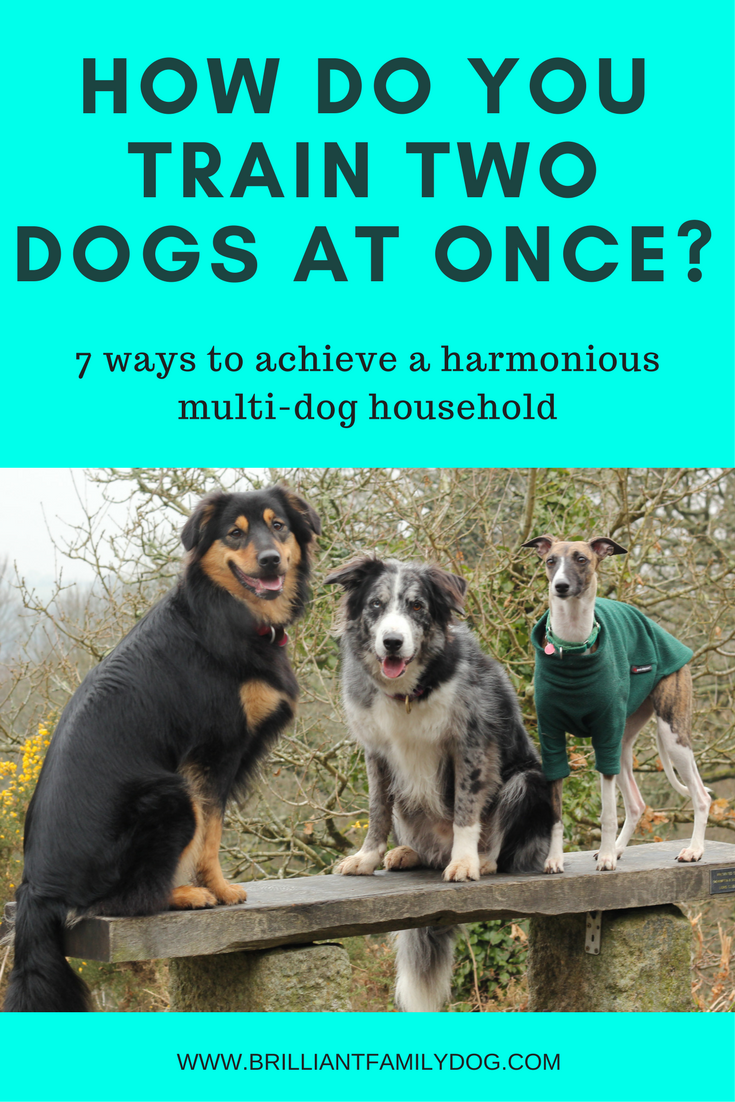
Dog training, new puppy, puppy training, dog behavior | How do you train two dogs at once? 7 steps to a harmonious multi-dog household | FREE EMAIL COURSE | #newpuppy, #dogtraining, #puppytraining, #dogbehavior | www.brilliantfamilydog.com

You may think that having one dog is such fun that you’d like to double up on your happiness by having two. And as one who has had multiple dogs for many years I can confirm that it is fun! 

But it’s also very hard work. Think four or five times the work, not twice the work. Because you have two (often very different) individuals to cater for, at the same time. There’s how they interact with you, how they interact with you individually, and how they interact with each other, that you have to know, understand, and manage.

Sometimes people get so swept up in the melee of dogs that they struggle to get even the simplest tasks of feeding and walking done. They have no room or energy left for training. 

If you’re always trying to address a crowd of dogs, you’re never going to be able to assess and deal with each of them satisfactorily. They will bounce round you while you try to lead them up for a walk, for instance, and as soon as you get one to sit the other jumps on him and they’re off again. This is a common picture of preparing for a walk in a household where there’s more than one dog, and it spreads across the whole day so that every interaction becomes noisy, boisterous, frustrating, and very annoying! At this stage the owner is tempted to give up, admit defeat, and let the lunatics take over the asylum.

Don’t!

You can turn this round.


Work with each individual dog to discover his special qualities

And the first thing to do is remember that you don’t have a pack of dogs, you have two charming individual dogs. They both deserve equal attention from you.

So here are some pointers that will help you get back on track and build a great relationship with each dog.


1. When you first introduce a new dog or puppy into your dog household, ensure that the first dog continues to get lots of your attention, that he gets very little attention (or fuss or bother) from the newcomer, that he can find a safe haven away from the attentions of the new dog (which, after all, you chose to get - he didn’t), and is never chastised for showing his impatience with or dislike of the incomer.


2. Meanwhile, focus on building a relationship directly with your new dog that does not involve your first dog. If you just chuck ‘em in together and let them sink or swim, you’re never going to be the most important thing in your new dog’s life. He’ll see himself and Dog no.1 as “Us” and you as “Them”. So while you spare your first dog being badgered by the new dog, you focus most of your training attention on the newbie. This is very easy with a puppy as they need to sleep so much, leaving you lots of time for one-on-one interactions with Dog no.1. But even mature dogs need a lot of daytime rest too, so if you’re bringing an adult dog into your home have a safe secure place for each dog to go for these extended naps. You’ll find crates and baby-gates invaluable.


Want more tips like these to flop into your inbox? Enter your details here for a free 8-part email course

THIS E-COURSE IS A BONUS FOR YOU WHEN YOU SIGN UP TO RECEIVE EDUCATIONAL EMAILS AND OCCASIONAL OFFERS FROM ME. YOU CAN UNSUBSCRIBE AT ANY TIME.
Privacy Policy

3. Limit free play between the dogs. Lots of play with you and one dog, or you and two dogs, but very little play between the two dogs. Later on they can play when they like, but not in these crucial first few months when you are establishing the new relationships.


4. Solo walks. This is essential for training and for life. My solution is to have a solo roadwalk with one of my dogs each morning by turn, and group free-running walks of two or all four at other times. This way no dog misses out on my personal attention when out or on the vital training, and they still get plenty of time to roam and explore together too.


5. Solo training. This is where many people come unstuck! They’ve seen that trying to “group-train” doesn’t work and they have every intention of working on their dogs individually. But how to do it? Put one away in crate or the other room and he cries and scrabbles at the door. Then the dog being trained is distracted too. Frustration all round. So the answer is to teach them to take turns: first you can simply name the dog and offer a treat, name the other dog and offer a treat, and so on. Each dog will learn to wait for his name before attempting to take the treat. Once they’ve grasped this concept, you can grade up to matwork.


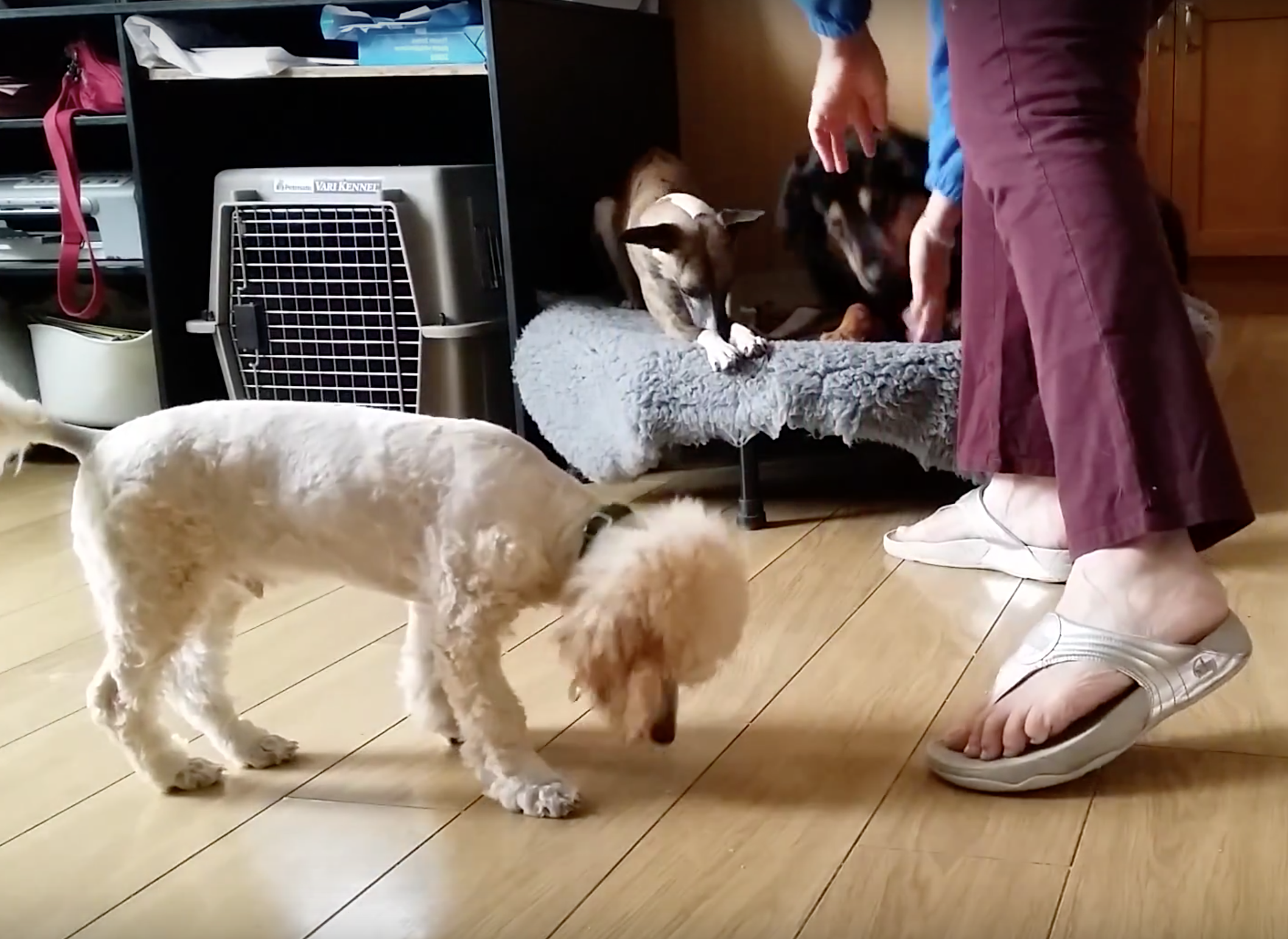
Cricket and Lacy are rewarded for staying on the bed while Coco Poodle pup gets some valuable training

Cricket and Lacy are rewarded for staying on the bed while Coco Poodle pup gets some valuable training

6. Matwork is the answer to all of the questions I get which involve management of a multi-dog household. Teach each dog to stay on his bed/mat/chair regardless of what else is happening. You’ll have to do this with them alone to get started, so maybe choose a time when your partner can take one out for a walk. Failing that you’ll have to crate one near you while you start the matwork training with the other.

If you follow the step-by-step process in Calm Down! Step-by-step to a Calm, Relaxed, and Brilliant Family Dog - available as a free digital download at all ebook stores - you’ll find this goes extraordinarily fast! So once they each know their own mat and what to do with it, you can start super-short sessions with both of them on their mats. I would have both dogs on their mats being rewarded between the paws as usual, then “break” one dog off the mat (you’ll learn how to do this in the book), reward the other heavily for not getting off his mat, return the first to his mat for a few treats, then “break” the other dog, reward, return to mat.

Once they can both do this - and remember, one will learn faster than the other! - you can extend this by breaking Dog 1 then asking him to maybe Sit or Down or whatever trick he knows while you heavily reward Dog 2 for staying on his mat before returning Dog 1 to his mat … and so on. Each dog will have a couple of turns of coming out for a Sit (or whatever) while the other waits calmly. If they are bouncing off their mats to join in, you’ve gone too fast! Go back a few steps and strengthen your foundation work before putting it to such an extreme test. Keep sessions very short - maybe 10 treats each, over a period of one and a half minutes, then put the mats away for next time.

Always keep in mind that the dog on the mat is working just as hard as the dog having a training session with you, and needs to be rewarded at least as frequently as the dog who is off his mat. You will soon be able to do extended training sessions (several minutes) with one dog while the other waits patiently for his turn. Switch them round and off you go again!


7. Once both dogs know exactly what to do on their mats, you can teach them to keep in whatever spot you choose for them. When I’m training in the garden, three dogs will be parked on top of the picnic table while I work the fourth. Indoors I may just drop them wherever they are (or there are lots of beds around the place they can choose!). Now you have a fully portable behaviour of keeping still when required, whatever the temptation and excitement.


Once you’ve got this going well, you can extend the dogs’ impulse control and get them both waiting nicely when you want to put on their walking gear, have them sit at doors till you open them and release them one by one by name, have them wait in the car till called out individually, and so on. 

You can accommodate their individuality, and their individual speed of learning. You can understand their fears and foibles and know what each dog needs to live a happy life.

And once they’re living a happy life - you can live a happy life with them! You’ll get the pleasure and enjoyment from your two companions that you longed for at the start. And who knows, now you know the recipe, you may even consider a third dog (not three times the work, but nine times the work! Remember you have to work on the interactions between each dog and the others, and each dog and you.) 

Of one thing I’m fairly sure: once you’ve experienced the fascination of having two different personalities with their own likes and dislikes and their own individual personalities - with hopefully an increased understanding and tolerance of all dogs, however different from yours they may be - you probably will never want to go back to having only one dog again.

So that statement contains an awful warning! When you start out with a multi-dog household, you’ll probably have a multi-dog household for ever - there’s no turning back. Make sure you have the time needed to put in all the extra work, especially in the first six months or so, which will make your family life run smoothly and without chaos and mayhem.


Meanwhile, for help with lots of everyday dog problems, get our free 8-part email course here:

Want more tips like these to flop into your inbox? Enter your details here for a free 8-part email course

THIS E-COURSE IS A BONUS FOR YOU WHEN YOU SIGN UP TO RECEIVE EDUCATIONAL EMAILS AND OCCASIONAL OFFERS FROM ME. YOU CAN UNSUBSCRIBE AT ANY TIME.
Privacy Policy