Is raw feeding safe for my dog? Let’s get to the Bare Bones

Dog behavior, dog feeding, dog diet, dog health | Is raw feeding safe for my dog? Let’s get to the Bare Bones! |  #doghealth, #dogbehavior, #rawfeedingfordogs | www.brilliantfamilydog.com

The dog with his bone. An archetypal image. Everyone knows that dogs love bones. Aesop knew. Early painters knew. Most people know not to approach a strange dog with a bone - they know it’s the highest value item and not to be shared. Or even looked at.

So WHY do people act so surprised when I tell them I feed my dogs bones as a regular part of their diet?  Indeed it’s the basis of their diet!

There seems to be an awful lot of mythology out there about bones. This has coincided with the huge upsurge over the last forty-odd years in commercially manufactured pet foods. Is this disinformation put about by the pet food companies (innocently or otherwise)?

The dog's eating system

You only have to look at a dog’s mouth and teeth to know that raw bones are what they are designed to eat. They have small ripping and tugging teeth at the front. Their canines on the front corners are what would have brought down their victim and ensured it had no escape - it would also probably dispatch the animal with these teeth. The back teeth are for cutting and crunching big bones. Dogs have a scissor bite, and can’t grind their back teeth as we do to break down cereals and vegetation. They chomp and swallow. 

Digestion takes place in the gut, not partly in the mouth as in our case. And this is why they are unable to break down cellulose and digest vegetation. One of the reasons they will go for the stomach of their prey is because the nutrients are already broken down by the time they get there (either through the long digestion process or via the four stomachs), and are therefore accessible to them.

These jaws are immensely powerful, and dogs can use their back teeth to cut through rope or crunch through bone - quite large bones too. And they can clamp down on a rope to grip it without cutting it . It’s a measure of their exquisite sensitivity and control that they can also carry a puppy or a fresh egg in their mouths without causing any damage to their burden.

Over the last few thousand years of living alongside humans, dogs have adapted to be able to eat more or less anything. But their mouth and digestive system is still the same. 

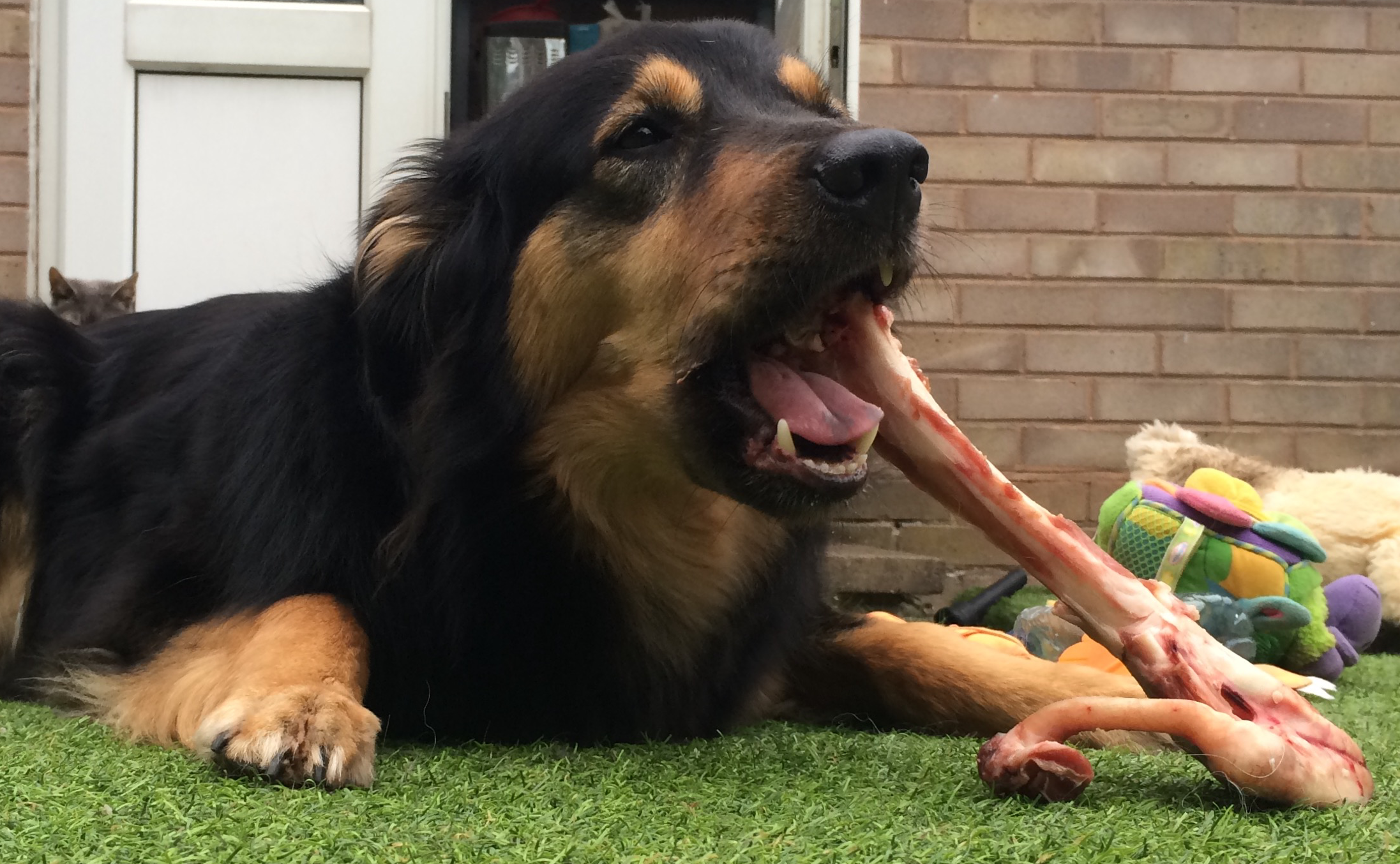
So it’s clear that raw meaty bones, with flesh to be ripped and tugged off, hard bone to crunch and mash, and marrow to be licked out, are ideal food for the dog's eating and digestive machinery. Add to this that they get a full-body workout while attacking a bone: they really have to put their back into the work! The paws will hold the bone in place while they rip food off it. They can stand on the bone and heave against it to strip off the valuable meat and sinew. They stand, lie, move around their prize. At the end of this meal - which can go on for 30 active, hardworking, uninterrupted minutes at a stretch, they are tired! Instead of hoovering up a load of flavoured carbs from a bowl in a matter of seconds, they can extend the eating sequence to a very satisfying hour or more till they have a quick wash and brush-up and doze off over their bone.
Dog behavior, dog feeding, dog diet, dog health | Is raw feeding safe for my dog? Let’s get to the Bare Bones! |  #doghealth, #dogbehavior, #rawfeedingfordogs | www.brilliantfamilydog.com

What’s more, these bones will gain in favour and flavour as they age. If you’re squeamish about this, institute a bones-only-in-the-garden-or-outside-kennel rule. (I have a no-bones-upstairs rule. They learn it very fast - just give your dog the choice of staying downstairs with his bone or coming up without it: it’s up to him.) The soft tissue is soon removed from the bone, and the resulting white bone will be revisited and chewed and gnawed for weeks. It’s not a fly hazard - certainly not in our temperate climate, though I appreciate that that could be different if you live in a hot climate. 

Is it dangerous for the dog?

I have heard horror stories about dogs getting blockages or cracked teeth from eating bones. I can only say that in 30+ years feeding a raw diet to 3-4 dogs at a time (so that’s over 100 years total!), I’ve never had such a problem. 

I don’t feed marrowbones or any weight-bearing bones of cattle, as they tend to be too hard and mature.

The essence of my dogs’ diet is that it’s at least 50% raw bone. Pigs’ trotters, chicken and turkey carcases all fit this requirement. Beef bones, even meaty ones, have a higher proportion of bone, but a couple of meals of offal or fish or raw eggs balance this out nicely. In case you’re confused by this, just remember that raw bones are fine. It’s cooked bones we’re warned against, as the cooked bones can splinter. 

It's entirely your choice what you feed your dog!

The important point about dog-feeding is that you give your dog the nutrients he requires. 

So as long as this requirement is met, you can feed whatever is convenient for you

As long as you do your homework and provide your dog with the right food, you can do it any way you like - home cooking, commercial kibble, raw meaty bones. This is not an area for crusades! 

Dog behavior, dog feeding, dog diet, dog health | Is raw feeding safe for my dog? Let’s get to the Bare Bones! |  #doghealth, #dogbehavior, #rawfeedingfordogs | www.brilliantfamilydog.com

Of course you can mix and match too. While switching kibble seems to need an adjustment period of a few days to allow the gut flora to catch up, you can feed raw straight away without this changeover period. So you may choose to have a bone day once or twice a week. 

There are some very good commercial dog foods available - indeed I always have a backup bag of food handy in case I’ve ever forgotten to defrost something. Currently my dogs are enjoying Skipper’s Salmon and Sweet Potato. Another firm favourite is Butternutbox who also have an unbelievable offer right now, just for my peeps! With four dogs you can’t just open a can of sardines if you’re caught short! I also take kibble or Butternutbox for some days on camping trips - for compactness and convenience.

A word about hygiene

Dogs are able to cope with pathogens that would make us ill. In other words, wash your hands and utensils after preparing their raw food. While it’s more awkward preparing raw treats, it’s a good thing to do with a puppy, when all his meals are coming as training rewards. You can get some terrific poultry shears and cut necks and wings up very small. 

How can I tell what commercial dog food to buy?

But bag foods are very variable in quality, and you have to do some research to find the right one. Just because it comes in a bag and has a pretty picture of a dog on it, doesn’t mean it’s any good. They are definitely not all created equal! I recommend you have a cruise round www.allaboutdogfood.co.uk and learn about what actually goes into a lot of these manufactured foods.

This site is run by a canine nutritionist and is not affiliated to a manufacturer. You will still learn a lot from it, even if you are not in the UK and have different brandnames where you live (though you’ll see some are global, and many brands belong to just the same few companies). The principles are the same, and they have a simple Nutritional Rating by percentage to make it all easier. You'll find all the ready-prepared raw foods in the 90%+ section. You see - you don't have to fell an ox every month and do it yourself!

And as a halfway house between fresh raw food and the convenience of dry kibble - UK readers may like to check out Butternutbox.com where you can get really delicious "home-cooked" food specially designed for your dog and his likes and dislikes. You can get a three-week trial entirely free, without obligation! Go check it out!

You need to research carefully and get the best food that fits your budget. The better the food you feed, the less you’ll see of your vet, so you’ll save money in the long run!

When I first signed up with my present vet he asked me what I fed. When I said “raw” he replied, “Oh, I won’t be seeing much of you, then.” He knew that I was feeding an excellent species-appropriate diet

And if you’re a vegetarian or a vegan, then that’s fine for you, but keep in mind what your dog is designed to eat. I wouldn’t feed a horse rump steak just because humans can eat it! You have to feed what the animal is programmed to eat, digest, and benefit from. You have to take even more care and study to provide the required nutrients for your dog with any form of restricted diet.

Will my dog growl over his bone?

You can introduce bones to a dog at any age but - be warned! He will say, “Oh my gosh, this is REAL food, this is the first REAL food I’ve ever had,” and he just may guard it to the death. This may appear comical in a 7-week-old puppy, but it’s not: it’s serious. So first time out, just give him his bone and let him get on with it. When he’s finished and gone out of the room, you can gather it up if you wish. If he gives you a stony glare, whites of eyes showing, lips flicking, head rock-still over his prize, then on no account try to take it from him - you may well force him to bite you. Wait till he’s out and take it then. 

Dog behavior, dog feeding, dog diet, dog health | Is raw feeding safe for my dog? Let’s get to the Bare Bones! |  #doghealth, #dogbehavior, #rawfeedingfordogs | www.brilliantfamilydog.com

Now you can embark on a program of swapping good things for equally good things. Never challenge a dog who is guarding something, and never try to take it away. Once you’ve practiced lots of swapping, he’ll know that you are not trying to take something away from him - rather give him something better. Then you can graduate to two similar bones. If you have a dog-owning friend who has some well-gnawed second-hand bones - rather than fresh, red, meaty ones - these would be an ideal start. 

My four dogs are at the moment contentedly munching bones near my desk. Every now and again they move about, swap bones, and carry on. There’s never been a bone-fight here, ever, in all those 30+ years of feeding multiple dogs bones.

And I very seldom visit the vet. Just the odd stitch for an injury. My dogs are wonderfully fit and healthy.

So by all means give your dog the bone he craves. Just be sure it’s a raw bone.

By the way, for English readers, here’s a load of money off a super food I regularly use and here’s another where you can get a big discount using this link - they provide high-quality fishy treats and foods, which are firm favourites with my crew!


RESOURCES

The Barf Diet - raw feeding bible from a vet to get you started
www.rawmeatybones.com - another vet book
www.allaboutdogfood.co.uk

www.butternutbox.com

Free email course to deal with lots of puppy and dog problems

30% off high-quality fish treats and food


Digging, Chewing, Chasing, Barking: Instinctive Drives you Love or Hate?

 First published at positively.com and reprinted with permission

Dog prey drive, bad dog behavior, dog training | Digging, Chewing, Chasing Barking: Instinctive drives you love or hate? | #newpuppy, #dogbarking, #dogbehavior | www.brilliantfamilydog.com

Instinctive drives are hard-wired behaviours with which we all come equipped. The most obvious one would be eating. We all have to eat. And trying to suppress that desire will only drive it underground. If someone’s hungry and is prevented from eating, they will steal food. If you try to control something that strongly embedded, you’ll get evasive and deceitful responses.

So too with many of the behaviours we see in our dogs. Taken to excess, these compulsions would become annoying or even dangerous. But if you can accommodate them - by giving your dog an outlet for his natural inclinations - you’ll have no trouble with them.

Don’t fight nature!

The Four Instinctive Drives people struggle with

There are four instinctive drives that people tend to complain about most. Contrary to popular perception, all dogs don’t do all these things. It’s not something you have to resign yourself to when you get a puppy. Many dogs will indulge them just a little, some just during puppyhood, and some not at all. But they can all be modified without taking the dog’s enjoyment and basic needs away from him!

Here are some ideas to get you started.

1. Digging

Particularly evident in earth dogs - terriers, ratters - though by no means confined to them. Provide digging opportunities for your digger! 


  • Half-bury old bones, plastic bottles and such like in a part of the garden you earmark for digging. Don’t leave your dog outside unattended - telling him off after the event is a waste of time. As soon as he starts digging, run excitedly to your dig-spot and start digging yourself. Encourage him to dig himself to a standstill!


  • Indoors you can play “Dig for the Toy (or Person) Under the Duvet” games. Be sure to protect the person’s face from those ravaging claws. This exciting game usually results in much laughter all round! Let them dig their bed to bits. Instead of one boring piece of padded bed, give them lots of cushions and blankets they can rearrange and tunnel into. They enjoy the release of energy in ferocious digging, so they need to be able to do it. So what if they damage their bed? It’s their bed. And you can get a new one if they shred it.


  • Digging often wanes with age. My Border Collie Rollo used to pounce on the grass and dig as a puppy - clearly he could hear something creeping about in the earth. He lets the underground traffic of mice and beetles carry on unheeded now. I captured the entertaining pouncing action though, and he’ll still rear up and dive when I say “Rabbit!” Cricket the Whippet enjoys digging so much that she is encouraged to dig her bed, and we’ve kept that behaviour of frantic digging going - long past puppyhood!


2. Chewing

If you don’t want her to chew your things, then you need to supply her with plenty of her things that she can chew. 


  • Large bones she really has to stand on and fight with are the very, very best and most popular chew toys. Choose raw beef bones - ribs or larger. She’ll soon strip off anything fleshy and happily gnaw the clean bones for months. I have a multi-dog household and there are never any bone-fights.


  • Rawhide chews are not the natural product you may think them to be. They’re heavily processed and may have lots of additives and junk.


  • Food-toys are great to soothe anxious chewers and occupy those jaws safely. You can use anything you have handy to fill them: squeezy cheese, liver pate, peanut butter (additive-free), last night’s left-over pasta and sauce. Freezing them makes them last longer. Kibble works well in containers that have to be rolled or wobbled to give up their bounty.


  • All discarded containers (like cereal boxes, toilet roll middles, plastic bottles, for instance) can become food toys. The dogs are welcome to shred them and rip them apart to reach the goodies inside. Ripping and tearing is enormously satisfying for them.


  • I would not want to give my puppy anything to chew now that I didn’t want her to chew later. Old shoes, old jumpers, best Jimmy Choos, favourite blouse: how can she tell the difference? You can launder and recycle old clothes into plaited dog ropes.

Dog prey drive, bad dog behavior, dog training | Digging, Chewing, Chasing Barking: Instinctive drives you love or hate? | #newpuppy, #dogbarking, #dogbehavior | www.brilliantfamilydog.com


3. Chasing


Chasing - you or dog-friends - in a safe area is fine. Hurtling across a road chasing a squirrel is not.


  • Equal chasing - taking turns to chase each other - makes for great excitement. In a good game dogs will adjust their pace to suit their playmate. They take turns at being chaser and chasee. The game can be fast, but not intense.


  • Flat-out, head-down chasing - leg-biting, flank-grabbing, frustrated barking - are not good. You’ll end up at the Vet with a dog needing stitches. Teach your frustrated chaser to hold a toy in his mouth when chasing. Hanging on to the toy gives him something else to focus on and bite down onto. It muffles the woofs too! If he can’t chase nicely, with or without a toy to hold, then he doesn’t get to chase live things - dogs, people, cats, etc. Some herding dogs and sighthounds need to learn how to chase safely, without nipping or grabbing.


  • Chasing crows. As long as the area is safe I’m happy to let mine chase foraging crows off the ground as we approach. They’ll never catch them, so the birds are in no danger. This tends to be a puppy thing, as they give up the unequal contest after a number of failures. But it gives the dog an outlet for that very rewarding surge of energy and focus that comes with a good chase.


  • Teach your dog to chase with rules. A flirt pole is ideal for this. He may not grab it from the air or your hand - he has to wait till you release him to pounce on it. You can build up to this level of self-control. To begin with it will be a massive outlet for his chasing desire. It will also wear him out very fast - great for days when there’s too much energy and too little opportunity to get out and use it up. Regular play with the flirt pole gives my whippet an outlet for her very strong rabbit-chasing instincts, making recalls off rabbits a snap.


  • “You can’t catch me!” A chase game round the garden with a toy reward can be great fun and use up a lot of energy (for both of you!). As long as your dog will come right to you when you want to hold her collar, playing Keep Away is fine.


4. Barking

Some breeds or types of dog are very barky. It’s pointless to attempt to suppress this barking. You will lose. Try channelling it instead.


  • Teach your dog to bark on cue. “Woof!” followed by “Quiet!”, repeat till your ears are ringing.


  • Pair “Thank you” with a treat. Then thank your dog for alerting you to the serious danger of the mother pushing her pushchair down the road past your house, or the terrifying prospect of invasion from the postman. Reward her for coming to you when you say Thank you - every time. Quite soon you’ll have a dog who draws breath to bark, thinks again and comes trotting to you for a treat. Be sure to reward her mightily for this excellent decision!


  • As soon as your dog starts barking, toss some hard treats or kibble at a hard surface (door, hard floor, cupboard door). She’ll scurry across to gobble them up, and probably look at you for more. Now you have silence and her attention! And all without shouting, yelling, or barking yourself.


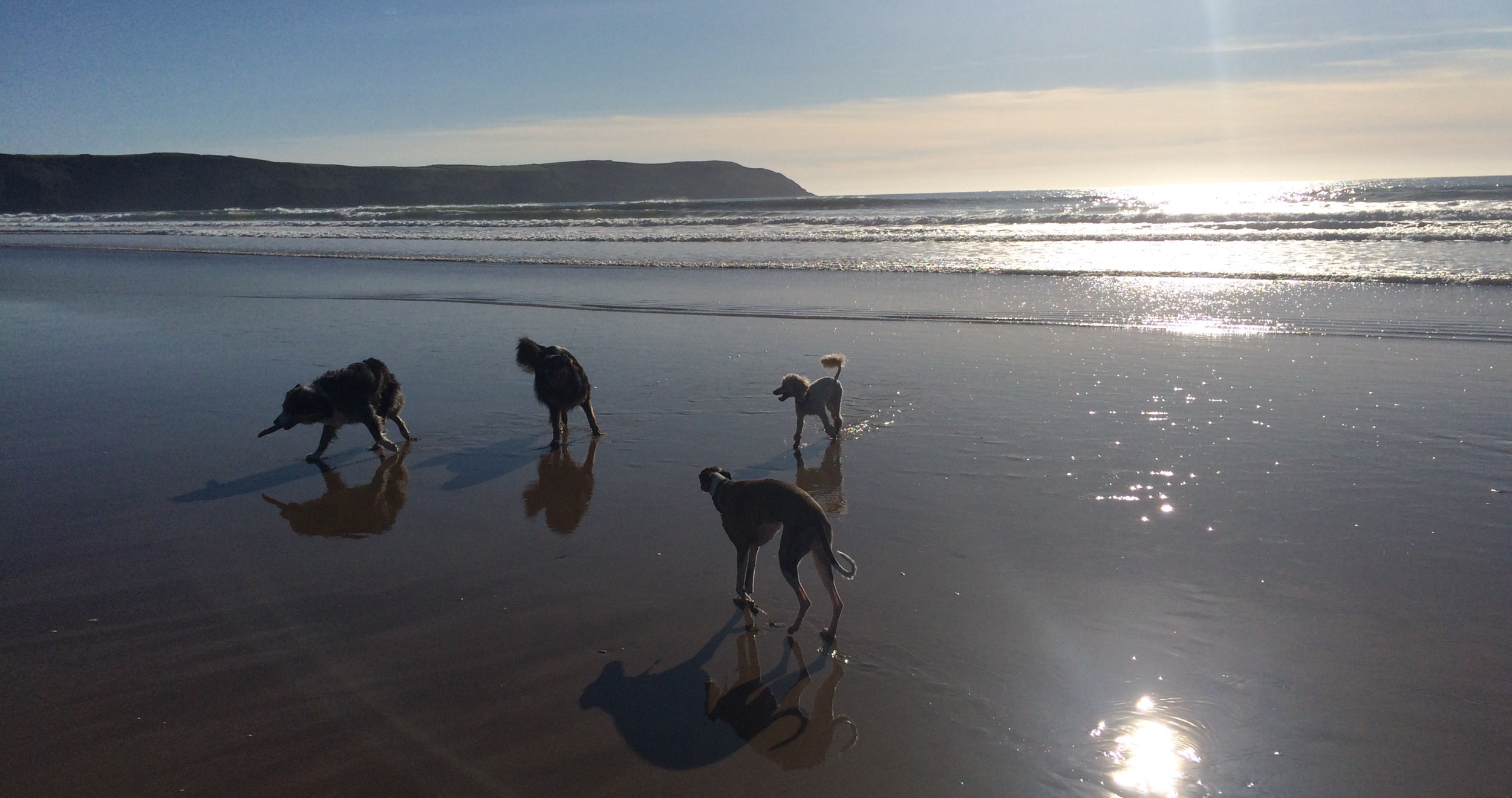
  • On our own in a huge forest or an empty beach is the place where my barkers are encouraged to bark themselves silly.


If you choose to share your life with a dog, you have to take the rough with the smooth. But I’ve just given you a load of sandpaper to smooth off the rough edges a bit, without suppression, judgment, or bossiness. Use your dog’s instinctive drives as a starting point for new and exciting games you can enjoy together. 

Key takeaway? Enjoy your dog as he is, not the perfect dog you thought you wanted when you got him.

Much more to learn in our free email course for common dog problems

And if your dog is chasing or barking aggressively, head here for another free email course


Watch our free Workshop to get your dog to listen, and find out just how much of the learning is for you!

Once you change what you’re doing, your dog will automatically change. Exciting!

Love the dog - hate the name!

New dog, new rescue dog, new puppy, dog behavior | Love the dog, hate the name? Here's how to give him a new name that you all love! | FREE EMAIL COURSE | #newrescuedog, #newpuppy, #dognames | www.brilliantfamilydog.com

You’ve been visiting your new dog in the shelter for weeks. You’ve been longing for the moment when you can bring him home. And it’s today!

You’ve got everything prepared. Beds, food, toys, training classes booked … You’re ready to help this little dog forget his past and settle into your home as your pet. 

There’s only one snag … you hate his name. 

The good news - that’s ok: just change it!

You all need to love your new dog's name - especially him!

The name the dog came in to the shelter with could have a long history of association with bad things. It will constantly remind him of his previous owners (who were either neglectful, uncaring, incapable, dead, or positively nasty), and his ambivalent feelings about that word will be revealed in his response to it. Total lack of response, quite often. The name has become meaningless through being meaningless - or worse - perhaps it has become “poisoned” by always signifying a punishment of some kind. Would you respond to a name which meant “Get over here you bad dog”? I don’t think so!

We all have a history

Is your new dog even housetrained? Get this headache out of the way fast with your free guide to Errorless Housetraining

THIS GUIDE IS A BONUS FOR YOU WHEN YOU SIGN UP TO RECEIVE EDUCATIONAL EMAILS AND OCCASIONAL OFFERS FROM ME.  YOU CAN UNSUBSCRIBE AT ANY TIME.
Privacy Policy

Some dogs come with no history (they always come with baggage though!) so the shelter staff give him a name. They are very busy and there are often many volunteers at a dogs’ home, so there’s no guarantee that his name was never barked out in frustration or as a telling-off by someone who didn’t realise what a huge effect this could have.

However good and kind the staff and carers were in the shelter; however enlightened and nurturing the system they had - there’s no doubt that a stay in a shelter is a very stressful experience for most dogs. 

So the best plan is to start from scratch.

Choose a name which you like, which represents the perfect dog to you, and which sounds quite different from his previous moniker. 

And be careful what you wish for! Do you really want your dog to be “Trouble”, or “Rumpus”, or “Chaos” …….. These names can become self-fulfilling prophecies - really not what you want! A softer, prettier, name coming out of your mouth will carry softer, gentler thoughts with it. 

I was once told by someone who worked at a shelter in a particularly bad area of her city, that all the dogs that came in were Staffies (NO! Don’t send me hate-mail: I don’t dislike Staffies! It’s just that a lot of people think they’ll fight and that’s why they want them), and she told me that all the males were called “Killer” and all the females were called “Bitch”. Their names clearly show what their owners thought of them. Poor, poor, dogs.

So once you’ve decided on a lovely name which the whole family loves, simply pair that name with good things (more help in this post).

So it’s

“Rover!” - treat

“Rover!” - treat

“Rover!” - open garden door to go out

“Rover!” - get lead for a walk

“Rover!” - treat

“Rover!” - muss up his hair

“Rover!” - present dinner bowl

“Rover!” - “get your ball!”, and so on.

It will take Rover no time at all to learn that this new word means very good things when he hears it, giving you the start of your super recall

And you’ll feel that Rover really is your dog. For ever.


Watch our free Workshop and learn how to communicate effectively with your dog or your new puppy, right from the start!


A roundup of the Old Year - and your plans for the New Year

Dog training, puppy training, 2018 | Plan your dog training year now | ONLINE COURSE | #dogtraining, #puppytraining | www.brilliantfamilydog.com

As we relish the last few days of the holiday season, cuddling up before the fire after bracing winter walks (or, if you’re on the other side of the world - perhaps having a long cool drink by the swimming pool?) we can reflect on the last year. 

    •    What did it do for us?
    •    What did we achieve?
    •    Did we really spend more time training with our dog?
    •    .. or do we just think about it and expect it somehow to happen ;-) ?
    •    Is our relationship with our pet further on than it was last year? 

Reflection is an important part of progress. It’s vital to see what you’ve achieved, and perhaps what you failed to achieve, in order to make sensible and do-able plans for the coming year. We learn all the time what we can and can’t do, where we are strong and where we need a bit of help. 

Last year

Personally, I can say it was a year packed with achievement for me. I published three more books, four more online courses, and hosted a live workshop which was hugely popular. The books are continuing to collect many 5-star reviews on Amazon, and students have voted with their feet by joining the new online courses and their busy support groups.

I’ve started Coco Poodle on competitive Obedience training and have been fortunate to find a fantastic trainer - who has made up several Obedience Champions herself. And Lacy goes from strength to strength, able to cope with almost any situation, especially the important task of monitoring Squeak the Cat’s comings and goings. 

Rollo the Border Collie continues to guard his chickens, and they repay his attentions with plenty of eggs.

Cricket in the learning stage of covering herself with her duvet

Cricket in the learning stage of covering herself with her duvet

And as for Cricket the Whippet? Well, this year she learnt how to get into a folded duvet and smother herself warmly with it. Quite an achievement for a little woppit. She can now wrap herself up so I don’t have to be forever swaddling her and tucking tail and feet and pointy nose and ears in under the covers.

We’ve been to lots of new places around the country in the van, making new friends and discovering exciting new beaches and forests.

Next year

I’m now planning this coming year, which is set to produce more books, and more online courses! More beaches and more forests. I’ll be planning Coco’s Obedience debut, and teaching all of them more tricks. Even Cricket is now able to stack two beakers …

Dog training, puppy training | Holidays with my four dogs | ONLINE COURSES | #dogtraining, #puppytraining | www.brilliantfamilydog.com|

To help you reflect, I’ve picked out the five most popular posts on Brilliant Family Dog over the last year - the ones which got most reads, most sharing and prompted most emails - so you can have another look and see if there’s anything you missed. Here they are, in order of popularity: 


I HAVE A NEW PUPPY: WILL I EVER GET ANY SLEEP AGAIN?


WHY DOES MY DOG BARK AT SOME DOGS AND NOT OTHERS? (4 STEPS TO CALMER DOG WALKS!)
 

10 WAYS TO STOP PUPPY BITING
 

ZIP IT! AND GET A FAST RESPONSE FROM YOUR DOG
 

TRUST YOUR DOG, DON’T CONTROL HIM!


I wish you all a happy, healthy, and productive 2018 

    •    Perhaps this is the year you’ll get a cracking recall from your dog? 
    •    Maybe you’ll be able to leave food anywhere by next Christmas without it being scarfed down? 
    •    Maybe your reactive dog will get a bit more confident and able to take more in her stride? 

Make your plans, and go for it! And if you think I can help you - just ask.


Want to learn more about how to build up the GOOD habits? Enjoy our free Workshop on getting your dog to LISTEN!

Beware the deadly mince pie! Christmas hazards for dogs

Dog training, new puppy, puppy training, Christmas, dog health | Some foods are dangerous for dogs | CLICK FOR THE LIST | #newpuppy, #dogtraining, #newrescuedog, #doghealth, #dogbehavior | www.brilliantfamilydog.com

In the excitement of Christmas Eve, somehow Jessie managed to scarf down a six-pack of mince pies. The shredded packet was all the evidence needed, plus an unusually quiet Jessie.

Fortunately Jessie’s owner knew the seriousness of the situation - she knew that raisins can be fatal to a dog - and rushed her to the vet without waiting for her to get sicker.

And that’s where Jessie stayed over the Christmas break, in intensive care, on a drip, while they worked to save her kidneys. 

That story has a happy ending. Jessie came back home, weak and tired - but with fully functioning kidneys. It was a harsh, frightening, and probably very expensive lesson for Jessie’s family. You can be sure there’ll be no mince pies left lying around in that house in future!

Nor any Christmas cake, fruit cake, chocolate, chocolate with raisins, headache pills, artificial sweeteners, slug pellets, rat poison - the list goes on. 

Not to mention rubber bands, paper clips, mothballs, small pebbles, cooked poultry, wooden meat skewers, plastic meat wrapping, and elastic netting and string for parcelling meat.


Check out my new online Challenging Dog Mini-Course and Wild Puppy Mini-Course teaching new dog and puppy owners to achieve lasting results through a few crucial lessons of dog-friendly training


The world is such a dangerous place! 

Not really. We don’t need to get anxious about it. Parents of toddlers automatically keep the area clear of known hazards.

We just need to know about a few hazards that are peculiar to the dog.

Like raisins and chocolate, for instance.

Who’d have thought the humble mince pie could cause so much trouble?

Leave It!

“I know he's only a puppy, but …” What you expect is what you get!

New Puppy? | Superb online Puppy Training Course with daily video lessons! | CLICK FOR DETAILS | #newpuppy, #puppypottytraining, #puppytraining | www.brilliantfamilydog.com

The lady on the phone sounded harassed. 

She was ringing to look for help with her 16-week-old puppy. 

I asked her how her puppy was doing, and she replied:

“He’s very bitey, and he jumps up on everyone. I can’t tell you how many things he’s destroyed. I’m looking forward to him being clean and dry in the house - we’re not there yet. I know he’s only a puppy, so perhaps I’m expecting too much.”

No! You’re expecting far too little!

I had to explain to this caring owner that she was asking too little of her puppy, and instead of giving him the chance to grow, she was keeping him a baby.

With the exception of the jumping up, which can take longer check for more tips, all of these things should be resolved by 10-12 weeks.

The sooner you start, the better!

And the longer you leave it, the more you have to undo!

That’s why I welcome puppies at Puppy Class from 9 weeks of age. And my own puppies are learning from the moment they come through the door - at 7 or 8 weeks.

The new arrival

When your puppy first arrives, it’s very simple to lay down the ground rules. He’s tiny, a bit anxious, eager to please, ready to learn, bursting with enthusiasm, and he needs to sleep most of the time. What better time to start building a solid relationship of trust?

Using a crate from Day 1 answers most of the problems this lady was having. If a crate is not possible, then at least have a puppy playpen or baby-gates. But a crate is best and will establish firm boundaries for the future.

1. If he gets too bitey in play, this is a sure sign that he’s overtired and needs a nap: into the crate for a while for a restorative ziz

2. Always wait till he’s stopped bouncing before you open the crate door - you may need to walk away from the crate and come back a good few times before he realises that staying still opens the door, but bouncing keeps it shut. Then greet him at his level as he emerges while you clip the lead on and whiz him out to the garden for a pee.

3. He can’t destroy anything if he’s in his crate with his chewtoys at those times when you can’t be actively supervising him. Bliss! Remember he needs oceans of sleep. If he’s been awake for an hour you’re back to No.1 above.

4. Housetraining is a breeze when you use the crate and some simple rules. Free download here


I don’t want my dog to think the crate is a punishment

I don’t know why I sometimes meet resistance to the use of a crate. 

Most parents will use a cot for their baby or toddler to ensure that she’s safe and secure when left alone. The crate is the exact same thing for a puppy. 

There is no hint of punishment. So, just as with your baby, put the puppy in the crate, shut the crate door, and leave the room. 

He’s safe. He can sleep. A well-reared puppy is unlikely to soil his bed. You can relax and do something else for a while.

And know that you’re putting your puppy on the path to becoming a Brilliant Family Dog right from the start.

It’s all about connection

If you can make a connection with your dog, you can build trust, understanding, confidence. 

The quickest and best way to make this connection is through Choice Training.  Have a look at how fast people were getting results on my recent 5 day online Workshop:

Chewie waits patiently instead of jumping up to steal the food!

Chewie waits patiently instead of jumping up to steal the food!

“Just want to say a massive thank you for the 5 day Workshop. Chewie would jump up and try and grab and bite me if I was prepping food. Now he’s lying down with treats dropping. Loving his focus.”
Jan & Chewie

“Thank you Beverley from Molly and me! We have enjoyed the workshop immensely and made a lot of progress in a short time.”  Robin & Molly

“Bonnie and I are having great fun with the Sit Game - all round the house and outside too. Feels like she’s listening better and I’m more relevant to her when there’s distractions (and she’s a working cocker spaniel with a history of pulling like a train!).”
Sheila & Bonnie

“Really enjoying the Workshop. Willow now getting so much better and more eye contact. Thank you for all your time and hard work putting this together.”
Pat & Willow and Poppy

“I was amazed at the results encountered during your 5-day workshop and could not wait to get started on this course*.”
Scott & Gabriel and Gizmo


*What course is Scott talking about? Our new online Puppy and Dog Courses! 


Want to join us and get results like this?  Yes - as you can see above, you CAN learn all this online, and transform your life with your dog.

To change your dog you need to change yourself first! Watch our free Workshop and find out how to transform your “deaf dog” into a LISTENING DOG!