![Dog training, new puppy, puppy training | My dog keeps ... [insert annoyance here]! How to stop your dog doing stuff you don’t like | FREE EMAIL COURSE | #newpuppy, #dogtraining, #newrescuedog, #puppytraining, #dogbehavior | www.brilliantfamilydog.c…](https://images.squarespace-cdn.com/content/v1/58611419579fb36de6708b96/1511785151168-0AZHNAMT1XDT88M5ZK5C/Dog+training%2C+new+puppy%2C+puppy+training+%7C+My+dog+keeps+...+%5Binsert+annoyance+here%5D%21+How+to+stop+your+dog+doing+stuff+you+don%E2%80%99t+like+%7C+FREE+EMAIL+COURSE+%7C+%23newpuppy%2C+%23dogtraining%2C+%23newrescuedog%2C+%23puppytraining%2C+%23dogbehavior+%7C+www.brilliantfamilydog.com)
People are often looking for an instant fix to something they don’t like.
Me too!
I’d like a magic wand to wave over life’s problems. Trouble is, people come to me thinking I can wave a magic wand over their dog’s problems and they won’t have to do a thing.
A recent query was along the lines of, “My dog runs around barking all day in the garden. How can I stop him?”
You don’t have to be a genius to see that your first step must be - don’t leave him unattended in the garden! You can’t hope to change his behaviour until you’ve changed things enough to prevent him indulging in it.
My dog keeps … [insert annoyance here]!
Here are some starters for you:
• Jumping up on the furniture
• Raiding the bin
• Running off on walks
• Barking
• Destroying shoes
• you name it
Whenever someone tells me one of these things, I have one (smug) question:
“Where were you when he was doing all this?”
If you cannot yet trust your dog in any of these areas, then you shouldn’t give him the freedom to carry on doing what you don't like!
Practice makes Perfect - this doesn’t just apply to piano and tennis!
Every time your dog indulges in one of these annoying activities he’s getting more fun from it, and getting better at it. It becomes a habit - and we all know how hard habits can be to break.
The good news is that good habits are just as hard to break as bad ones.

Free online training workshop for you and your dog!
If your toddler had a fascination for the oven, you wouldn’t be leaving her unattended in the kitchen.
If your 6-year-old is a danger on his bike, you wouldn’t let him out on the road on his own.
If your teenager was beginning to mix with the wrong crowd, you wouldn’t be cheerily waving him goodbye of an evening, knowing you’ll be finding him in the police station later that night.
So if your dog is doing something you don’t like, the first thing to do is make sure he can’t do it.
You can shut the door to the front room when you’re not there (this will prevent chewing the furniture and barking at the window).
You keep your dog in the same space (room/garden) as you so he can’t chew shoes, raid bins, dig up the flowerbeds, bark at the moon.
And if he runs off on walks - you use a long line so that he can roam but not ramble.
That's just for starters ...
Now that isn’t the end of the story. And none of this should be forever.
Once you’ve got a measure of control over the situation, and you’ve removed the frustration and the yelling, you can start to re-teach your dog what you’d like him to do.
Dogs don’t exist in a vacuum. They can’t NOT do something - they’re doers.
So once you’ve eliminated what you don’t like, the way is open to change your dog’s habits to what you do like.
Dog or puppy problems?
Get your free 8-lesson email course and discover practical, force-free solutions to common training challenges—delivered straight to your inbox.
To change your dog, you need to change yourself first!
Explore our free and premium courses to discover practical, force-free training that can help your dog become a more willing listener.

Can I really train my dog by giving him a choice?

We all want to do the best for our dogs. Of course we do!
We love them dearly and want only good things for them. That’s why you’re here!
But it’s so frustrating that when it comes to training for your pet there are often so few options in your locality. Either the classes are at difficult times, too far away, or there’s just too much going on in your life. You were already using your allotted 24 hours in full before you got a dog! Now you’ve got to fit all this in - maybe three hours out of one of your valuable evenings at home with the family.
Then there’s the trekking to the class, perhaps in the dark, having to organise babysitters - many won’t allow children. The weather may be awful, you may be held up at work, your car may break down! It’s common for even the most dedicated of dog-owners to have to miss lessons from the local class they’ve enrolled at. Life happens!
Another problem is that you can’t find any trainers you’d want to work with. There’s an awful lot of harsh training out there, often masquerading as good training - making it very hard to know what you’re letting yourself and your dog in for. Having your dog shouted at by a “trainer” is bad - being shouted at yourself, belittled, shown up - is even worse!
So all in all I do understand why lots of people decide to pass on classes and “do it themselves”.
Trouble is, that only works if you know the answers already! Otherwise you may just be passing on the old-fashioned methods and old wives’ tales handed down to you in your childhood.
You need to have access to the latest in scientific training techniques, with convenient classes led by an experienced and understanding trainer.
Times they are a-changing

Well, I may have an answer for you! As a trainer who uses only dog-friendly methods, based in science (no pixie dust or magic mushrooms!), and who genuinely has the dog’s wellbeing at heart, I could be just who you’re looking for. I’m also people-friendly! You won’t be shouted at or belittled as sadly so often happens in dog training classes.
I get amazing results very quickly, and it’s all done by giving the dog a choice - just as you do with your family and workmates. You don’t order them around and expect them to comply! You show them what you’d like, then encourage them to choose to do that for you.
As you know by now, I don’t talk gobbledygook. Look at these emails - representative of many that I get. Life is too short to be trying to unfathom deep mysteries! We want it explained in language we can understand.
“Thank you for sharing your easy-to-follow tips, helping us to help Smidge become our Brilliant Family Dog!”
Janet and Smidge Patterdale x
“Thank you for your books and articles - they are a great help: clear, simple and easy to follow and remember. I've read similar books, but almost all are much more wordy and hard to remember.”
Carol and Charlie in Singapore
“Wow! Back to Amazon! :-) I’m only partway through the first book but it’s great. So easy to understand. So well explained.”
Shirley and Hettie, Huntaway
So that is always my aim. It’s absolutely pointless having information about how the dog’s mind works, and being unable to convey it to the person the dog has to live with - through not understanding how the owner’s mind works!
Hmm … but just look at the map
BUT - I hear you cry! - you live in the middle of England and I live in Australia / West Coast of America / Hong Kong / Scotland / [insert your location here].
Thanks to the wonders of the internet, things are changing. Anything can be taught effectively online, from baking to weight loss, from ancient philosophy to astro-physics, there are even popular courses on blacksmithing and aerial dance! I have personally taken a lot of online courses and found them hugely helpful.
And dog training is another subject that works really well! You follow the course in your own time, and in your own home! If things are explained thoroughly and understandably, and you are shown videos of the training in action, you can learn really fast.
If you're living with a reactive, anxious or growly dog, explore our free and premium courses for practical, step-by-step, force-free training to help you move forward together.
Five Ways to teach your dog that coming to you is the best thing ever!
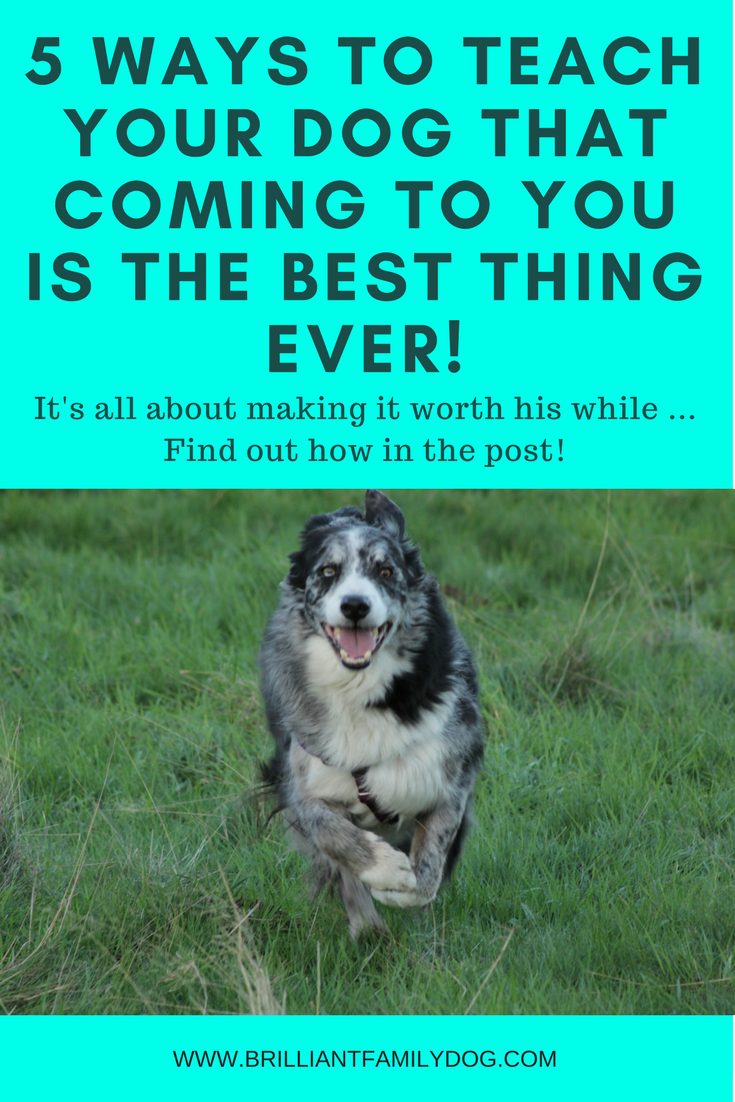
If you want your dog to come when you call, you need to get into his head that arriving with you is the best thing ever!
Instead of asking your dog to leave an exciting something to come to boring you, change his mindset so that he sees your call as an opportunity to spin on a sixpence and race straight to you like a missile.
20-week-old Rocco races to his owner at high speed!
And here are some NEVERS and some ALWAYS’s to keep you on the straight and narrow
1. NEVER, EVER, reprimand your dog when he comes to you. If he runs to you and you tell him off, how likely is it that he’ll come next time you call? It doesn’t matter what he did when he was “out there” - coming back to you has to be the best thing he ever did. Be sure he knows that his prompt return always makes you very, very happy!
2. NEVER go on a walk without a stash of really good treats in your pocket. ”Really good” does not include his kibble, cat biscuits, or pocket fluff. Rather - cheese, sausage, hot dog, beefburger … If you did a good turn for someone and they gave you a dry biscuit as a reward, how likely would you be to put your hand up next time they’re looking for a favour? A whole chocolate cake? Now that’s a different matter!
3. NEVER call your dog, and - when he doesn’t respond - say “Ah well, I’ll call him a bit later.” This has been noted, documented, and logged by your dog, and filed under the heading “I only need to come when I’m called sometimes.” This is the absolute last thing we want him to learn! He needs to know that when he hears his name, he comes back - every time.
4. ALWAYS vary your rewards. Sometimes he gets a lump of beefburger when he arrives with you; sometimes he gets 1 - 2 - 3 - 4 - 5 - 6 tiny bits of cheese posted into his mouth one after the other; sometimes you hurl his toy behind you as he approaches, then race him to the toy; sometimes as he runs towards you you take off at high speed away from him - game on! - dogs all love to chase! What else could you do to excite your particular dog?

Puppy Cai loves this recall game with his young owner
5. NEVER call him unless you have a 90% chance of him coming. Choose your moment, call him and refer to no.3 above. He doesn’t come? Then if the mountain won’t come to Mohammed, Mohammed must go to the mountain. Go up to him and call him from one yard away. Success! Big lump of sausage!
How soon should I start training my puppy to recall?
Immediately!
Straight away!
As soon as you get your new puppy or new dog, they should be learning that responding to their name is the best thing ever. Read this post to give you a start.
Dogs love running fast. Make sure that running fast towards you is always more rewarding than running fast in the opposite direction.
It takes time and steady application to develop a super recall. But think how proud you’ll be when you can call your dog’s name (once!) and he stops dead, spins round, and hurtles back to you! And think how relieved you’ll be if he had been racing towards a road, or a sabre-toothed tiger (or whatever hazards you have in your neck of the woods).
THIS FREE ECOURSE IS A BONUS FOR YOU WHEN YOU SIGN UP TO RECEIVE EDUCATIONAL EMAILS AND OCCASIONAL OFFERS FROM ME. YOU CAN UNSUBSCRIBE AT ANY TIME.
Privacy Policy

My dog’s NOT afraid of fireworks! But why?

Fears have been high up in doggy discussions recently. It’s the Fireworks season in the UK and this is what’s brought them bubbling to the surface again.
Remember, remember, the 5th of November - gunpowder, treason, and plot!
And one thing common to a lot of these discussion threads was the surprise registered by owners of reactive dogs who were not upset at all by the noise. Some of these new owners had got prepared for the onslaught and were expecting the worst - then were utterly astonished that their dog couldn’t care less about it all.
So perhaps a little look at the subject of fear would be helpful here.
Free Puppy Socialisation Guide

Learn new force-free ways to teach your new puppy!
THIS GUIDE IS A BONUS FOR YOU WHEN YOU SIGN UP TO RECEIVE EDUCATIONAL EMAILS AND OCCASIONAL OFFERS FROM ME. YOU CAN UNSUBSCRIBE AT ANY TIME. Privacy Policy
Is all fear the same?
Humans are born with only two fears: fear of falling and fear of loud noises. And these fears are stimulated in the Apgar tests for newborns, to elicit the startle reflex and check that all is well neurologically with the baby. All other fears are learned.
So fear of ghosts, planes, spiders, heights, and so on, are acquired on our journey through life. Many of these fears are developed early on, and can be heavily influenced by our family's response. A mother who is afraid of spiders can quickly transfer this fear to her children, while the mother who is happy to pick up an insect and take it to a place of safety is likely to have children who are curious about the other species in their environment and not fearful of them. It’s also true that a natural predisposition to be cautious around predators means that people are more likely to be afraid of creatures than of … bicycles, or trees.
Now the jury is out on whether dogs are born with any fears. Certainly there will be a predisposition to fear certain things, and the social influence of the mother and the environment in which the pups are reared are definitely going to have a big effect. Hence the supreme importance of early and proper socialisation for puppies up to the age of 12-15 weeks (jury is out on the timescale too).
But we can certainly influence this fear by showing extreme fear ourselves.
Will I make my dog worse if I cuddle her?
Fear is an emotion. And you cannot reinforce an emotion. It’s either there or it isn’t. You can only reinforce a chosen behaviour. While it is not possible to reinforce the emotion of fear - that is, to reward it and encourage it and make it stronger and more likely to occur - by giving comfort to a frightened person or dog, it’s certainly possible to plant the idea that fear is the correct response to something. Hence the general firework advice to mask the noises and flashes as much as possible (loud tv, curtains drawn, prepare a den) and carry on as normal yourself.
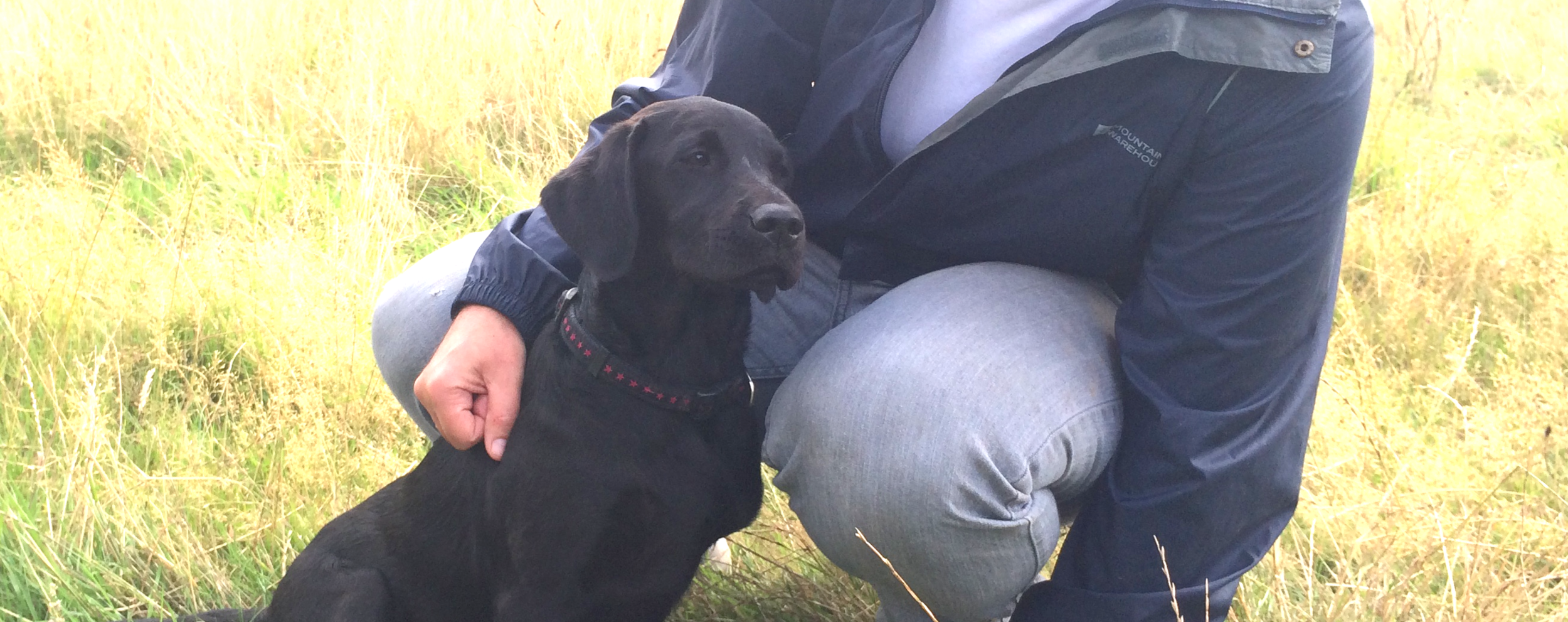
You can't make your dog more afraid by comforting her.
And this advice also extends to not making your dog afraid of other dogs by being afraid yourself! So many people anticipate a bad outcome at the sight of another dog - maybe because their dog is reactive and has barked and lunged in the past - that they will tense up, breathe quickly, panic, tighten their grip on the lead, winding it six times round their hand to shorten it. This is telling your dog that you are afraid of the incoming dog, and that strange dogs are inherently dangerous. As you’ll see in the Growly posts on this site, your first response at sight of an incoming dog should always be
Relax hands
Relax shoulders
Breathe out
Relax lead
This will be telling your dog that you are ok with the incomer. (Whether you are or not is beside the point!)
What’s conditioning? And what’s counter-conditioning?
So fears grow in people and in dogs through experience, through social learning, and from a pre-disposition - self-preservation is all-important, so being afraid of things about to pounce on you is sensible. There’s also genetics to factor in. Some dog breeds are more alert to strange things in their environment than others, and are going to be faster to develop fears - unless that careful socialisation, familiarisation, and habituation, is done.
So your puppy is being conditioned to certain fears through his life experience. A snake appears and mum runs away from it: noted - snakes are dangerous.
Counter-conditioning is when we weigh in to lessen a fear, or lessen the impact the fear will have, by changing the association in the dog’s mind to something good. If every time that pup sees a snake you stuff pork pie in his mouth - his emotional response is going to change, over time! No, we don’t want him getting curious about the snake and approaching it - but we equally don’t want him to panic and run off - into the path of our modern-day killer, a car.
Your dog is going to be afraid of things he’s learnt to be afraid of. It follows that without that experience he’s not going to have the fear in place. Of course there are dogs who are so psychologically damaged that they have a generalised fear of everything. But even these can be brought to a level of comfort with patience and dedication, and possibly medication.
So being afraid of snakes is not going to make your dog also afraid of cars. And being afraid of other dogs is not going to make him afraid of horses, or sheep, … or fireworks.
Cricket will sleep through a thunderstorm!
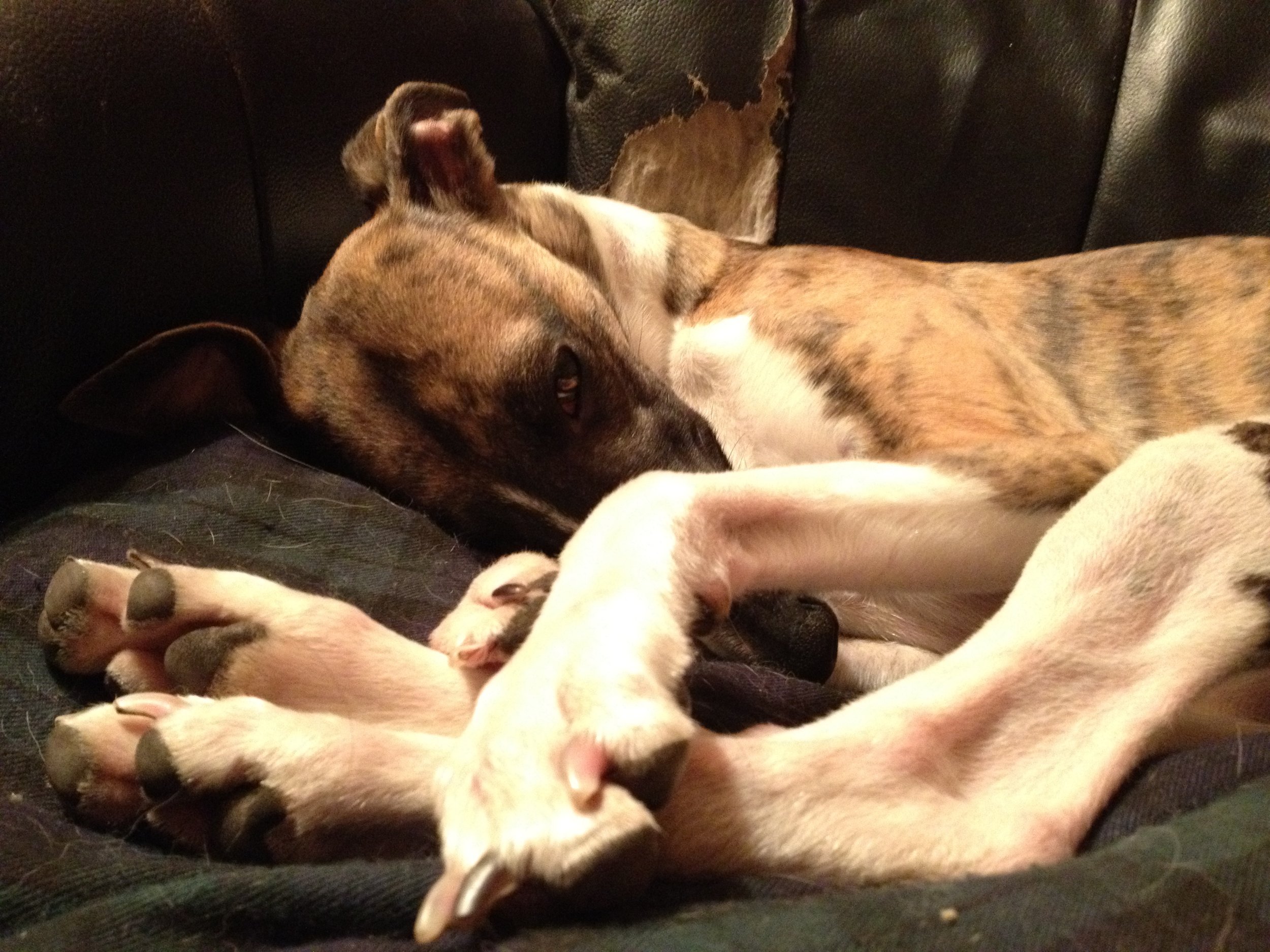
Cricket the Whippet will sleep through almost anything!
In my own household I have two (Lacy and Coco) who will ignore most fireworks, but bark at a very loud bang - it’s an “alert bark” not a panic attack - one (Cricket the Whippet, the professional sleeper) who is not at all bothered, and Rollo the usually independent Border Collie who gets very unhappy and worried.
During the firework season Rollo sticks to me like a limpet, wedging himself under my legs and following me pathetically wherever I go. It’s at least reassuring that I am considered a place of safety. The situation is manageable without medication, as he doesn’t panic and damage himself trying to escape - as some dogs do.
The interesting part - for the purposes of this discussion - is that Rollo is not what is commonly termed “reactive”, while Lacy and Coco most definitely are.
Border Collies are a sensitive breed with superb hearing. So if they’re going to be worried about anything it’s understandable that loud and sharp noises would be up there. But it’s not automatic that a Collie would be noise-sensitive, any more than the dog who is afraid of men in hats, for instance, should also fear children.
So what you can take away from this is that fears will exist in your dog; you can minimise those fears with appropriate socialisation at the correct age; you can help make those fears manageable with careful training; and that a fear of one thing does not automatically imply a fear of anything else.
Want some more help with your fearful or reactive dog? Here's a free email course that will get you on the road to success!
THIS E-COURSE IS A BONUS FOR YOU WHEN YOU SIGN UP TO RECEIVE EDUCATIONAL EMAILS AND OCCASIONAL OFFERS FROM ME. YOU CAN UNSUBSCRIBE AT ANY TIME.
Privacy Policy

I can help you so much with your dog!
If you're struggling with a reactive, anxious or growly dog, take a look at our free and premium courses, where you'll find kind, practical training to help you understand your dog and build confidence together.

Our family’s always had dogs, why is this one so difficult?

“Archie just goes mad,” said Anne.
“He’s so full of energy he doesn’t know what to do with himself. He’s always stealing things, getting on the chairs, he knows just how to wind me up …
And then, when we go out, he’s not at all friendly with other dogs. Some children were rushing past on their scooters the other day - I thought he was going to grab them!
We’ve always had dogs - but I’ve never had one like this before!
What’s wrong with him?”
This is a shame. Anne was very pleasant, well-meaning, and obviously devoted to the naughty Archie. When I visited her I saw the life that Archie lived and found the root of the problem fairly quickly.
Anne was indeed experienced with dogs. For forty years there had always been a family dog.
Now she had the dog … but no family!
Her previous dogs had been brought up in the rough and tumble of family life. From morning till night (and sometimes during the night) there had always been activity. The electric energy children bring to a home was ever-present.
There would be visiting children, bikes to chase after, tears and jam to be licked off cheeks, shrieking, dropped food to be cleaned up, toys, gadgets, running and racing, tree houses to climb up into, a sick child to cuddle up with …
Free Puppy Socialisation Guide
Learn new force-free ways to teach your new puppy!
THIS GUIDE IS A BONUS FOR YOU WHEN YOU SIGN UP TO RECEIVE EDUCATIONAL EMAILS AND OCCASIONAL OFFERS FROM ME. YOU CAN UNSUBSCRIBE AT ANY TIME. Privacy Policy
Housekeeping in a busy family was basic maintenance, not perfection.
And then there were the school runs, walks to the shops, family holidays on the beach.
Archie’s predecessors had had a very different upbringing!
And Archie had missed out on all of this.
What Archie had missed
• He hadn’t learned to cope with children (Anne never walked to the shops these days and there were as yet no visiting grandchildren.)
• He did not encounter many dogs in the rural area Anne had retired to
• The house was painfully quiet - and spotless. Anne was very, very houseproud.
• He’d never been to puppy class (“The other dogs had never needed it,” said Anne, “so I didn’t bother.”)
• He didn’t know how to use up his energy in the day
• He had plenty of long country walks which made him stronger, but his mind was never tired
• This was all exacerbated by the fact that Archie was a high-energy dog, bred to work till he dropped
So while Anne thought she was rearing her young dog the same way as her previous family dogs, in fact she was missing a huge chunk of his essential upbringing!

"I'm bored! If something doesn't happen soon, I'll have to make it happen!"
In this case we started a program of belated socialisation and habituation, Archie came to class and was very quick to learn the games and tricks I teach there, and Anne learnt that mental stimulation is infinitely more tiring than physical exercise!
You cannot “socialise” an older dog. This is something that can only happen in the dog’s brain up to the age of 15-16 weeks. What you can do is get him out and about, having new experiences, and enjoying them! If he’s not enjoying - for instance another dog walking towards him - then about turn and withdraw to a safe distance where he can observe the dog passing while you pop treats into his mouth. The distance will vary, but could be at least 50 yards.
Anne didn’t need to take Archie on ever longer walks, building his stamina so that his energy was boosted - just spend a few minutes here and there during the day when she could play some of the games and tricks he’d learnt in class, and mind games to satisfy his busy brain. Here's a great book to get you started.
As a working dog, Archie quickly took to the games which involved his amazing powers of scent. Hide and Seek, in the house and the garden, became very popular! We even taught Archie some useful tricks: fetching Anne’s indoor shoes when they arrived back from a walk was very popular all round. It gave Archie a job to do straight away, and Anne was able to dry his feet when he brought her shoes, before he’d started running all over the house.
Family Dog but no family?

Children go so well with puppies!
So if you're like Anne - you want to get another family dog but don’t have the family at home any more, here are a few things to consider:
• Early socialisation to everything in our world is vital. This includes towns, shops, countryside, schools, fairs, horses, bikes, trains, dogs, children, etc. “Early” means from the day after your puppy arrives, at 8 weeks.
• A first-rate force-free Puppy Class will give you lots of tools and experience
• Mental stimulation is more tiring and satisfying than physical exercise alone. This was a big surprise to Anne!
• Playing with your dog is much more fun than telling him off
• Care less about the spotlessness of your home - you have a dog!
• Choose a breed that was not designed to run over moor and mountain for eight hours a day
• Worry less about what your dog is doing, and more about what you are doing
Most of all, enjoy your puppy!
THIS FREE ECOURSE IS A BONUS FOR YOU WHEN YOU SIGN UP TO RECEIVE EDUCATIONAL EMAILS AND OCCASIONAL OFFERS FROM ME. YOU CAN UNSUBSCRIBE AT ANY TIME.
Privacy Policy

Three words to your dog that reveal the wrong attitude

“She’s stubborn. She doesn’t obey my commands.”
When I hear someone talking about their dog like this, I know just what to expect when I visit them.
There will be a lot of shouting, in an increasingly stern and abrupt voice. There will be finger-wagging, the owner will bend over the dog and stare at him. And the dog will either fly around getting more and more excited (read “stressed”) or shut down completely and opt out. The owner will think his dog is complying, but this is what’s known as Learned Helplessness - “I can’t do anything about this so I’ll give up”. There will be much frustration all round.
This has come about not because the owner is nasty or domineering, but because of how they think they need to act with their dog.
Old sins have long shadows!
They seem to have got the idea that you have to be firm, authoritarian, dominant - whatever you like to call it - with a dog. While they accept that this is not going to work with people, they blindly accept that this is what you do with dogs. It’s true that dogs - all animals - had a hard time in the past, and still do in many cultures. They were regarded as second-class beings - some people even believe they don’t feel pain as we do.
These people should open their eyes and look around them! Have they not seen Guide Dogs leading their blind owners safely past street hazards? Assistance Dogs opening washing machines and putting the clothes into a basket? Have they not seen a dog telling his deaf owner that there’s someone at the door? (Yes, mine tell me that there’s someone at the door, but because they’re anxious about the invasion, not because they’ve been trained to quietly indicate to me!)
Then what about the astonishing displays of Dancing with Dogs, where the dog learns an extended routine of actions to perform in harmony with its owner? Here’s a superb example.
THIS FREE ECOURSE IS A BONUS FOR YOU WHEN YOU SIGN UP TO RECEIVE EDUCATIONAL EMAILS AND OCCASIONAL OFFERS FROM ME. YOU CAN UNSUBSCRIBE AT ANY TIME.
Privacy Policy
If you see the enthusiasm and joy expressed in that video (do watch it, it's not long and you'll be enchanted), and in the dogs who excel at Agility and Flyball, you’ll realise that this can’t come from being nagged or punished. It’s pure enjoyment, harnessed.
Even the police - who used to claim they had to be hard on their dogs to be confident that they’d protect them - are now finding that working with the dog rather than against him is infinitely more successful and rewarding for both dog and officer.
We don’t treat children, spouses, or employees like this any more, so why do it to our dogs?
Lazy habits and popular tv
There has been so much change in the way we live over the last century. But it seems that animal care and education lag behind the general trend - by a good number of years.
Doing things a certain way, unquestioningly, because that’s how our parents did it, is not going to move us forward. That thinking would have kept us in caves! We have to take the learning available to us and implement it in our lives. So we must question what we are told to do. This is one of the valuable aspects of the teenage years - question, reject, question, reject. Of course you have to replace what you’ve rejected with something better!
And this would mean being picky about what you watch on television. Just because it’s printed in the paper or broadcast on the screen does not mean it’s right! There are plenty of people making good money from programmes indicating that a sharp, quick, fix is what’s needed to solve all dog behaviour problems. If you still think that beating a child for a minor transgression is ok, then you probably believe this twaddle.
But most of the people I work with are good, kind, people, who wouldn’t dream of abusing their children. Yet somehow they have allowed this dissonant belief - that animals are different and need to be abused to be acceptable - to take root in their heads.
I recently saw video of one of those tv personality, non-qualified, self-styled “dog trainers” giving a course on teamwork in the workplace. He used his unpleasant practices on their dogs - leaning over them and shouting, sneering, jabbing them, yanking their lead - to demonstrate. I was appalled that the owners were accepting all this! Suppose they were to go back to their office and shout at their staff, belittle them, jab them in the ribs, pull and push them around?! I feel sure this is not something they would countenance - and if they did they’d soon be advertising for more staff! - yet they swallowed all this because this guy had given himself a funny title and been on television.

"My dog is stubborn" No he's not! Find out what really motivates him
People seem to lose their critical faculties when dealing with their dogs!
Dogs are not “stubborn”
Dogs are simple souls who try to please. They have fears and anxieties just as we do. They do what works.
Your puppy who sits down on the pavement and refuses to move is not being stubborn.
She’s just afraid.
If you’re not sure whether you’re heading into a swamp or a quicksand, sitting still and pondering is a good survival tactic. And if you’ve only been on the planet a few weeks, sitting still and waiting for Mum to guide you is also a good move.
So if you find yourself describing your little puppy as “stubborn”, “obstinate”, “wilful”, and the rest, try substituting the words “fearful”, “anxious”, “eight weeks old” into what you just said and see if that fits better. You’ll surely treat the situation differently once you look at it differently.
Working with someone is so much more pleasant - and effective - than imposing your will on them. Giving the dog a choice (heavily loading the odds in your favour!) will get the result you want without all the expenditure of effort involved in shouting, repeating yourself, and trying to sound masterful.
Dogs do not arrive with us with a perfect grasp of English, or any understanding of our wavy arm gestures. Before you can expect her to respond to what you’re saying, you need to teach your dog what it is you want. Then you can concentrate on the good things your dog does, and ignore the rest.
What you focus on is what you get.
If you tell a child he’s a cheat and a liar, that’s what he’ll be.
Turn your focus to what you do want, rather than what you don’t want.
Catch your dog doing something you do like - and be very excited about it! Once I’d understood this, life with my dogs became a breeze. Most things I don’t appreciate are ignored - no point in stressing about something that is over.
So if shouting “commands” at your dog is not working, try treating your dog as you would a shy two-year-old, and quietly ask her for what you want. You may be astonished at the response you get!
P.S. You’ll have worked it out by now: those three words are “stubborn”, “obey”, and “command”. Banish them from your vocabulary!