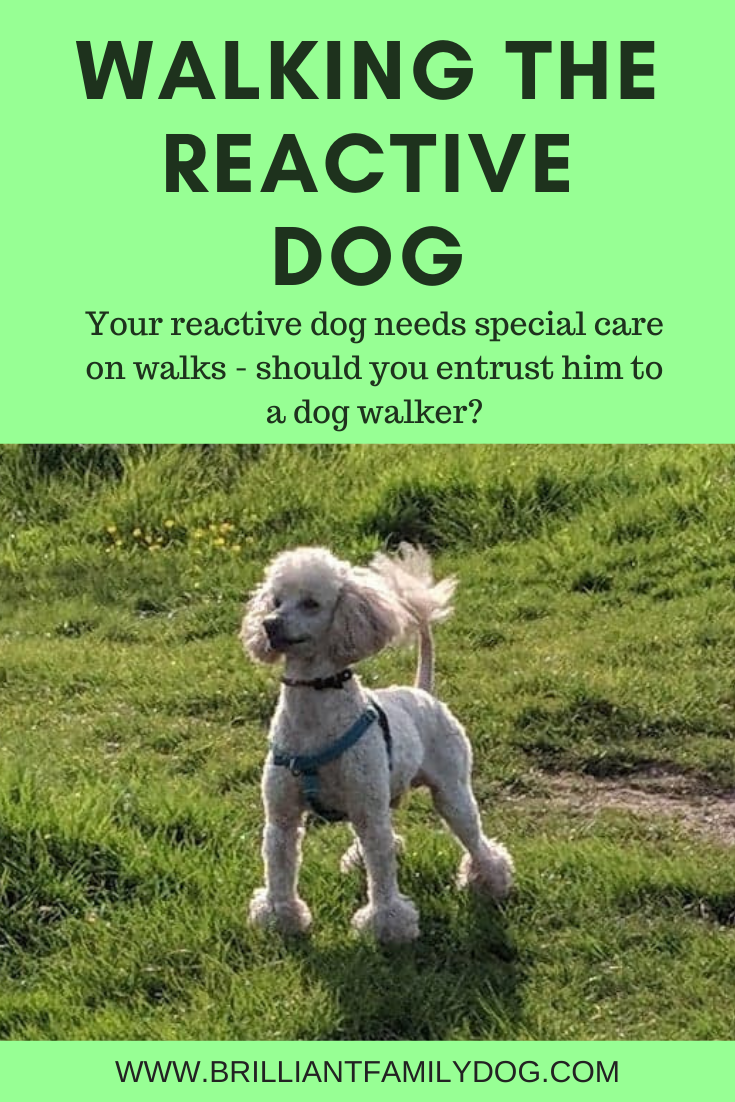
My dog walker says my reactive dog is FINE!

It can be hard to find a dogwalker with sufficient training and knowledge to entrust your reactive dog to them. What alternatives could you find? Brilliant Family Dog is committed to improving the lives of dogs and their harassed owners through book…

Many people choose to employ a dog walker to exercise their dog.

It may because of being out at work all day, or physical infirmity, or many other reasons.

There are two things to consider here:

  1. If you’re not enjoying getting out and about with your dog every day, what did you get a dog for?

  2. By abdicating responsibility for his outings, you are handing someone else - possibly not sufficiently skilled - the task of managing and teaching your dog (for your dog is learning every moment of every day!). And this is compounded when your dog is reactive - anxious, shy, “aggressive” . . . Growly.

Knowledge and understanding of reactivity

I’ll take no.2 first.

If you know your dog is reactive, then it may be better for you to avoid having someone else manage his interactions with the outside world.

Dogwalking is an unregulated business. This means that anyone can set up as a dogwalker, with ZERO knowledge of dog training the ordinary dog, never mind a reactive one.

Now, there are some excellent, knowledgeable, dogwalkers. They have studied the subject, they know how to manage a reactive dog, and they’ll be keen to follow your instructions regarding how you do this (force-free and fear-free, of course!).

These unicorn dogwalkers will probably take your dog out solo or with a very small carefully-selected group. Got one of these walkers? HANG ON to them! They are rare beings.

I frequently find that a student dog’s increasing agitation and inability to cope with the existence of other dogs has stemmed from - or been exacerbated by - being walked by one of these inexpert walkers.

And these are the ones who will say, “Yes! Your dog is FINE!” Sadly, they are unaware of what is really going on and therefore have no idea of the damage they may be doing by mishandling the situations that arise.

Dogs are simple souls. And it won’t take many incidents where your dog feels unhappy, for him to don a suit of armour whenever the lead is put on. In other words, his reactivity will increase.


What can I do?

So now you’re saying, “I’m unable to exercise my dog - what on earth can I do?”

And before you plump for all-day daycare, be aware that the same problems exist there. There are very few establishments - in my experience - to whom I would entrust my reactive dog. Like the unicorn dogwalkers, they do exist! But you may have to hunt hard to find them in a location convenient to you.

My own solution, if I have to be out for the day, is to have one of these wonder-walkers visit my home and entertain the dogs there. The active dogs play in the garden with their new friend, the dozy ones enjoy a cuddle instead. The walker can make herself coffee and take a break with them. But they don’t walk anywhere!

If this is you, you are missing out!

Back to Point no.1.

Why did you get a dog?

Presumably to share your life with, to teach, to enjoy, to cuddle, to nurture, to get you out of your armchair and into nature . . .

It can be hard to find a dogwalker with sufficient training and knowledge to entrust your reactive dog to them. What alternatives could you find? Brilliant Family Dog is committed to improving the lives of dogs and their harassed owners through book…

If you hand what is possibly the most exciting part of your dog’s day to someone else, you are missing out!

You are missing the joy of seeing your dog interact with the world, run, jump, sniff and snuffle, chase frisbees, climb, explore - and seeing his pleasure at doing it all with you.

I realise there are those who for physical reasons are unable to walk their dog. Maybe it would be possible to drive to a suitable place and sit down and enjoy watching their dog’s freedom and joy?

And if you’re out at work all day - how about carving out a space early in the morning or after you get home? Be aware that your dog doesn’t need to be walked every day! This joy should not be a burden. And the reactive dog will benefit hugely from the reduction in stress this will bring.

This is such a valuable part of your dog’s life that you want to make every effort to enjoy it with him!

And if your dog is reactive - he needs YOU to be with him to help him cope with our world.


Want some help on managing your reactive dog?  

Get our free e-course with extensive lessons on how to get started on a force-free way of helping her.  

THIS E-COURSE IS A BONUS FOR YOU WHEN YOU SIGN UP TO RECEIVE EDUCATIONAL EMAILS AND OCCASIONAL OFFERS FROM ME. YOU CAN UNSUBSCRIBE AT ANY TIME.
Privacy Policy

The right dog bed for your dog, and you!

So rather than fit the dog bed with YOUR decor, make sure it’s a bed your dog will love and be happy to spend time in! And, of course, make sure it’s washable. Brilliant Family Dog is committed to improving the lives of dogs and their harassed owner…

Some dogs like luxurious dog beds, some are more Spartan. Some dogs like to burrow into their beds and make a nest, others are happier dozing on top of the kennel with a layer of snowflakes covering them . . .

I know because I have a Whippet who thinks almost exclusively about her own comfort, and Border Collies who have coats designed to keep them warm in a blizzard on a Scottish mountainside.

Want more tips like this for everyday living?

THIS FREE ECOURSE IS A BONUS FOR YOU WHEN YOU SIGN UP TO RECEIVE EDUCATIONAL EMAILS AND OCCASIONAL OFFERS FROM ME. YOU CAN UNSUBSCRIBE AT ANY TIME.
Privacy Policy

You need dog beds that are serviceable and easy to wash for the working dogs in the family and beds that are cosy and warm for the lapdogs (for when there is no lap available!).

The advantage of having a dog bed that your dog actually likes is that you can position the bed where you want your dog to be when he’s switched off, then you don't have to be tripping over him every time you turn round.

I have beds under one of the worksurfaces in the kitchen instead of cupboards. That's where the crate goes too, when we have a new dog in the household.


Keep it clean

I think the most important factor of a dog bed - from the owner’s point of view - is its cleanability. You don't want nameless stains showing up on your carefully laundered bed! That's where a patterned finish is handy. A removable machine-washable cover is ideal, and I find the fleece that you can buy by the yard is excellent. You can bio wash it or hot wash it in the machine, and it dries in no time. Great beds for dogs who like to bundle them up, carry them to their preferred spot, and hide their toys in them. You can easily fit them into a car crate too.

I have hard floors downstairs, so the 2-metre lengths of fleece double as beds and non-slip walkways. These can be very useful at corners where puppies and old dogs in particular are likely to slip in their haste. This can cause serious ligament damage.

Also in the car you can have tough plastic-backed blankets or even fully fitted dogproof seat covers. Just imagine how much time that's going to save you picking up hairs and mud! But your best option for the car is washable beds inside a fitted crate. See this post for more info.


It all depends on the dog

Tunnelling dogs will appreciate a cosy bed to dig down into. They tend to be thin-coated dogs, like Terriers and Whippets. Cricket the Whippet took some time to learn how to get herself under her duvet without needing help every time she wanted to get into her bed. But now she’s a pro and can whoosh herself in and under in seconds.

Such dogs often like to sleep in heaps. A pair of noses peeping out from a pile of lambskins is very appealing, as you can see here with Sky and Bolt.

So rather than fit the dog bed with YOUR decor, make sure it’s a bed your dog will love and be happy to spend time in! And, of course, make sure it’s washable. Brilliant Family Dog is committed to improving the lives of dogs and their harassed owner…

As to the wicker basket so beloved of artists and birthday card designers . . . well, they may look good, but don't put your dog in one till you're quite sure he won’t chew it to shreds. Not only will it make a mess of your costly bed, but lengths of willow are not easily digested!

Instead, get one of those hardshell dog beds which are easy to sweep out and hose down. They can take up a lot of space but are excellent for keeping the dog’s bedding in one place.


That’s MY bed!

The important thing about your dog’s bed is that it’s his! He must know that he can rest there in peace without being trodden on, badgered by children, hugged by affectionate toddlers, or shoved off it onto the floor by another dog (or cat!). He needs somewhere he can relax and treat as his den.

Make sure it’s a bed your dog will love and be happy to spend time in! And, of course, make sure it’s washable. Brilliant Family Dog is committed to improving the lives of dogs and their harassed owners through books and online learning, all force-f…

If you have multiple dogs be sure you've got a bed per dog plus one extra so you never get arguments over beds. It’s easy enough to teach them to share - either to share a bed together, or move round to a different bed - though this can result in some comical sights when the cat commandeers the big dog bed and the big dog tries to squish into the cat donut!

In my own household of four very different dogs, we have flat memory foam beds for the hot dogs (Collie and English Shepherd), and heat-reflective bed with duvet for Cricket the Whippet - along with tunnel beds and soft cushionbed-on-armchair for her, so her majesty can select the right bed at the right time! Coco Poodle is happy in his fleece-lined bucket bed at night, and chooses to perch on lambskin-covered footstools in the day.

At the last count there were 14 dog beds here and 3 cat beds, though these are often shared.

What bed do you find best for your dog?


Do You Dream Of Your Dog Flying Back To You Every Single Time You Call? Start Here!

First published on positively.com and reprinted here with permission

What would it mean to you if you could give one call, and your dog zoomed in and arrived at your feet? Every time!

Hard to imagine? Maybe.

Possible? Most definitely!

Fun? Very much so. (If it’s not fun, your dog won’t do it. So there’s lots of fun!)

Little by little

The problem is that many people think their dog comes with a recall installed.

No! Whether a puppy or a rescue, you’re getting Dog 1.0 - the basic version. Upgrades are installed through hours of fun and games, aka force-free dog training.

When your new little puppy arrives, you may be tempted to think she has a great recall because she quickly finds you. This is just her infant clinginess.

Like a lamb at foot, the young puppy tends to keep close to her minder. Once she starts to grow a bit, in confidence as well as in size, you’ll find that infant clinginess will evaporate.

And if that’s what you’ve been relying on, you are now up the creek without a paddle.

So you need to get in early, ensuring that you use that time when your puppy wants only to be with you, to build a thumping good recall. Naturally, with a puppy of a few weeks old you’re only going to teach through games!

The secret is to keep those games going as your dog gets older, so they will always choose you over the distraction they were about to hurtle towards.

Old School training

In days gone by (thankfully), people didn’t start teaching dogs till they were six months old or so - the reason being they had to be tough enough to stand up to the harsh treatment meted out to them.

What a trick they missed!

All those early weeks and months when your puppy is like a sponge soaking up new information!

Why on earth let your pup run wild for months learning to do all kinds of things you don’t want her to do - then say, “Right, now I expect you to behave differently.”?

So with your new puppy, start the day she arrives.

With a new rescue dog you may have a lot of history to work against. The easiest way to achieve what you want is to imagine this is a new puppy and teach the exact same way.

First things first

There are two things you need to be clear on before you start:

1. If you don’t want your dog to do something, then don’t let it happen

So if you have any suspicion your dog may run off and not come straight back - highly likely in a new rescue dog - then you need to learn how to use a long line safely (not an extendable lead) while you teach your super instant recall.

This does not mean you never let your puppy off-lead! This will not teach her anything except to want to get away from you.

Your dog must be free in order to make a choice to come back. But only let her off-lead in an enclosed area. Gradually your dog will earn her freedom in larger areas.


2. Everyone on the planet listens to the same radio station: WII fm

WII fm? That’s “What’s in it for me?”

Your dog will be making a choice whether to hare after the distraction or shoot back to you. What’s in it for her?

You need to make your recall games such fun that her response becomes automatic. And an easy way to train in any kind of knee-jerk reaction - so that her recall goes onto auto-pilot - is to use rhythm and patterning in your games.

Step by step

When you were learning to read, you were not given a copy of James Joyce’s Ulysses and told to get on with it!

You were taught shapes of letters or words and their sounds, gradually slotting those jigsaw pieces together till you could hit a line of text running, read it and understand it.

So letting your dog wander off then calling her and expecting her to know what to do is just as mad as giving your toddler Ulysses.

The very first thing your pup needs to learn is that her name means good things, and only good things. You should never use your dog’s name if you are frustrated or annoyed with her. Any other word! - but not her name.

Here’s a simple game to get you started. Watch out for other family members as well as yourself. You may be surprised at how much negativity is being attached to your dog’s name on a daily basis!

1. Say dog’s name once

2. When she responds - by raising an eyebrow or hurtling towards you and crashing into your legs - reward her with something good

3. Repeat at every opportunity throughout the day

4. Enjoy your dog

What should her reward be? That’s something that you should be finding out if you don’t already know!

What does she like?

🐾  A run and laughter?

🐾  A piece of cheese?

🐾  A game with you and a toy?

🐾  A game of chase?

Whatever “is in it for her” is what you use to reward her response to her name.

One day her willing and instant response to her name may save her life. Be sure to take time building that response.

And for a step-by-step guide to a lightning-fast recall - every time - go and take a look at Here Boy! Step-by-step to a Stunning Recall from your Brilliant Family Dog, the fourth in the series of Essential Skills for a Brilliant Family Dog, available in ebook, paperback, and audiobook. Go now, and you can be reading it within minutes!

Picture this: your dog is racing towards another dog, you call her name - once - and she spins and races back to you at the same speed, arriving with a smile on her face and a happy waving tail, saying, “Didn’t I do well?”

This can be you and your dog!


Want to teach your dog to LISTEN?

Enjoy our free Workshop here


Where did Brilliant Family Dog begin?

If everyone’s first dog were as amazing as mine was, they would never be without a dog again.  Brilliant Family Dog is committed to improving the lives of dogs and their harassed owners through books and online learning, all force-free and dog-frien…

I can remember it as if it were yesterday.

It was 6.30 in the morning, and I was sitting on the cold pavement outside Battersea Dogs Home, London’s most famous animal shelter. Today was the day the puppy I had chosen became available for re-homing, and I was up - about three hours earlier than usual! - to be sure of getting her.

I was the first there, and I looked anxiously at the others waiting in line. We talked to each other and said which dog we wanted. Nobody else wanted “my” puppy, so I relaxed and focused on keeping warm.

Eventually 9 o’clock came round and I and the handful of other dedicated dogseekers were let in. Everyone rushed to the area they knew “their” dog was in, anxious to be there first. I reached the puppy pens and there she was, sweet and beautiful and ready for the adventure.

A few forms later, and I was out on the street again, this time clutching my precious new puppy to me. Precious, but not materially. She cost all of £9.80, including the collar and lead!

That was how I came to have Poppy. And that’s where my adventure began! There had been dogs at home where I grew up, but Poppy was the first I could call mine.

Want to make the most of your new dog?

Watch our free Workshop on Getting your Dog to Listen! and learn new ways to communicate with each other.


Life with Poppy

Fresh from the streets … thin and anxious

Fresh from the streets … thin and anxious

Poppy nearly died over the next few days, having caught some nasty puppy disease, probably on the streets before the Home picked her up. But, showing the spirit for which she would become known, she pulled through and we started our 16-year love affair. The adoration was mutual.

A few months later when I moved from London to rural Ireland, Poppy helped me make new friends. In fact her bright and endearing nature and endlessly-wagging tail got her talent-spotted by a dog training club instructor.

Now a whole new world opened up before us - Obedience, Working Trials, Agility. Oh, the miles we travelled - all over the British Isles - the friends we made, the rosettes we won, the fun we had!

Poppy flies over the 6 foot scale!

Poppy flies over the 6 foot scale!

The high point of our competition career was when my little Battersea stray became Working Trials Champion Flower of Battersea, CDEx, UDEx, WDEx, TDEx. Why, she had more letters after her name than I did!

Here she is scaling a 6 foot barrier in terrific style! She also held the Irish High Jump record at one stage, clearing 3 foot 6 inches.

What a long way from those London pavements! As one Obedience Judge put it: “Such grace and elegance from humble beginnings as shown by her name.”


Poppy loved everybody

… adults, children, dogs, puppies, cats, chickens, geese, goats, sheep, cows, donkeys - everyone she came across. She “didn’t have a bad bone in her body,” as my Irish neighbours would say.


Of course I don’t think any dogs have bad bones in their body, but that was rather forward-thinking in a time when blaming the dog for the owner’s shortcomings was the standard. And sadly still is, for many folk.


So I tried one dog, then I got another … and another - the story of addiction! There was no stopping me.

Since then I have had many dogs. Mostly Border Collies, but also others including Whippets - linking back to Poppy: one of her 57 varieties was definitely Whippet!

And for many years I competed with all of them - largely in Working Trials (that’s based on nosework and tracking), but also Obedience, Agility, Heelwork to Music. And we carried on the learning - scent discrimination, searching, lots of different types of retrieving, tricks …


But how did Poppy influence Brilliant Family Dog?

I decided to put pen to paper, or rather fingers to keyboard, because I wanted other people to experience some of the immense pleasure I have had from sharing my life with dogs. I started with Good for Dogs, which also served my dog school students in Worcestershire. Then graduated to Brilliant Family Dog, with all its online courses, books, audiobooks, and over 300 articles! Check the navigation bar above.

This site is more than a dog-training resource, it’s a dog-living and dog-loving site - a dog-celebration, you may say!

And it all started with my little Battersea waif, who introduced me to a new world.


Want to teach your dog to LISTEN?

Enjoy our free Workshop here


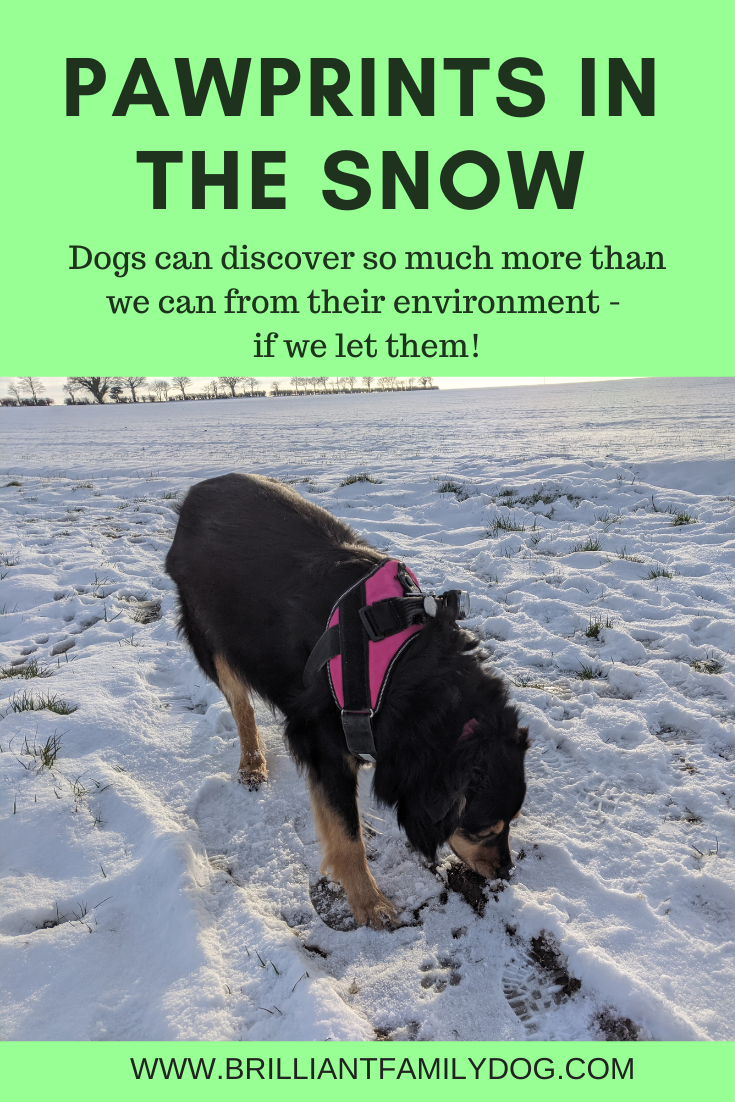
Pawprints in the snow

The dog’s nose is majestic - so much more powerful than ours. It’s important to allow your dog to use his nose as much as he wants!  Brilliant Family Dog is committed to improving the lives of dogs and their harassed owners through books and online …

As humans we have a tendency to think that we know best.  

But when it comes to working with a dog we don't know best!

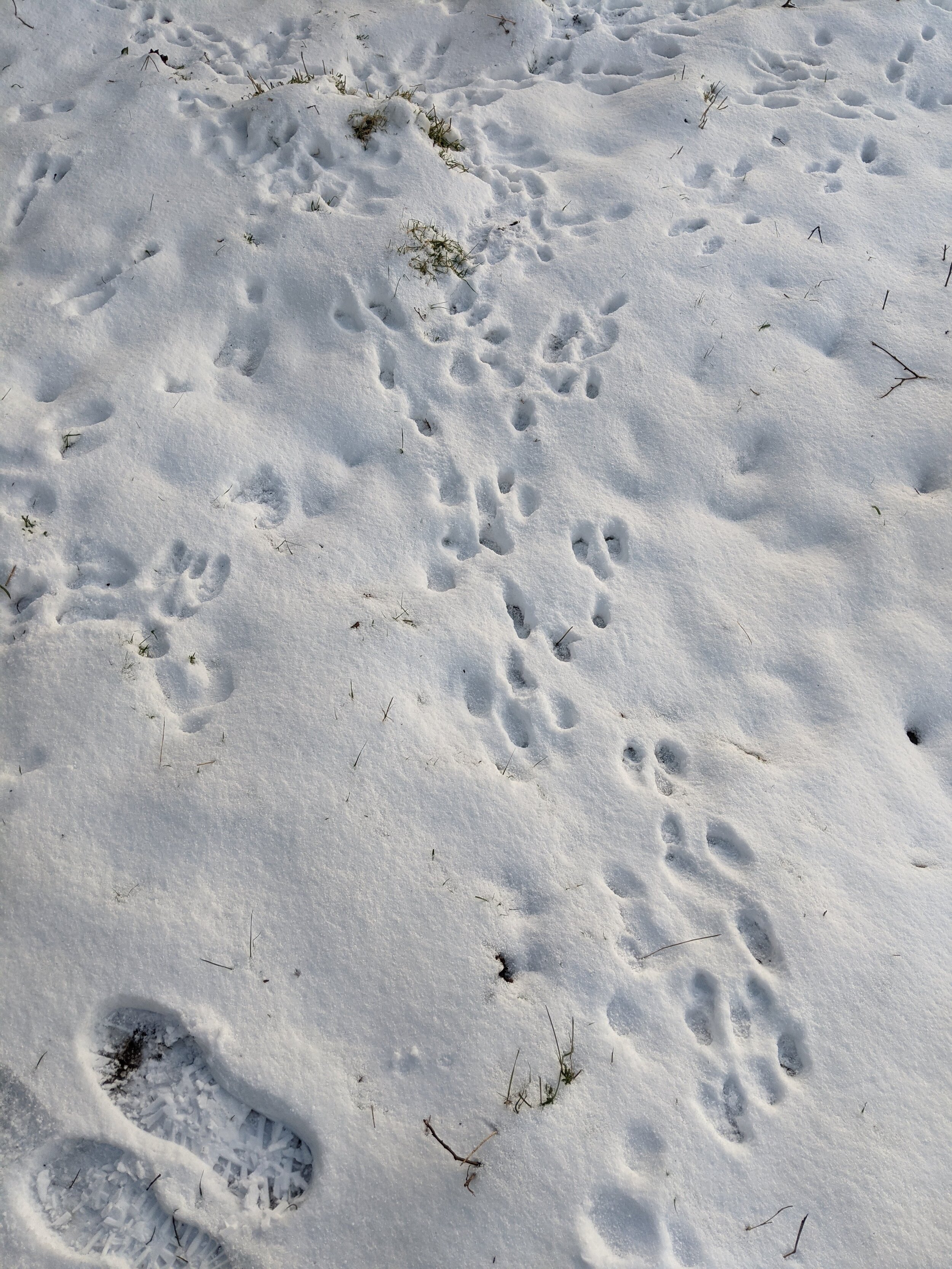
They have powers way beyond ours! When there’s snow on the ground you can see all these footprints. They are something that we don't normally see, but your dog is aware of them all the time - snow or no snow.

When he's sniffing and wants to pull over to somewhere and you say “There's nothing there - come on, let's go,” he's right and you're wrong!

bunny prints in the snow.jpg

You can see here that there’s been a late-night bunny party, heaven for your dog to check out. But normally we have no idea of all this activity. Your dog, though, can “see” this every single day.

Scent in the dog’s brain

Did you know that a third of the dog’s brain is taken up with processing scent? 😳

And look at the size of their hooter compared with ours! (That’s a normal-shaped dog’s nose - not one squashed and altered by designer breeding.)

That nose is meant to work! And in many cases it’s put to work for our benefit.

There are dogs for medical alert and seizure detection, drug dogs, customs dogs, police tracking dogs, hunting dogs, cancer detection dogs, search and rescue dogs, quartering dogs, flushing dogs.

So many useful applications of that wonderful scenting ability!

But there’s also the fun stuff. Scent discrimination in Obedience competitions is highly sophisticated, but taught - or should I say refined - for fun.

And Working Trials is a terrific way for the layperson to enjoy high-performance tracking. In the higher levels of Trials, you and your dog are confronted by upwards of 30 acres of empty space with just a pole to indicate the start of the track. The track will be three hours old, and have three tiny articles (think key, matchbox, metal bolt) somewhere along its half-mile length. In all weathers!

And with dedication and application - and a lot of hard work! - a dog from the humblest beginnings can excel. My little Battersea foundling Poppy became WTChampion Flower of Battersea CDEx UDEx WDEx TDEx.

That’s a very high level of expertise to be exhibited by both dog and handler. It’s genuine teamwork, where the dog is the expert.

Nosework in the home

It’s not necessary to walk the legs off your dog (and you) every day with a view to tiring them out. Using their brains is much more tiring!

Hunting for your lost keys, socks, or wallet is a great way to partner up with your family dog to make life easier for you, and definitely more fun for her!

Just playing hide and seek in the house is a great start.

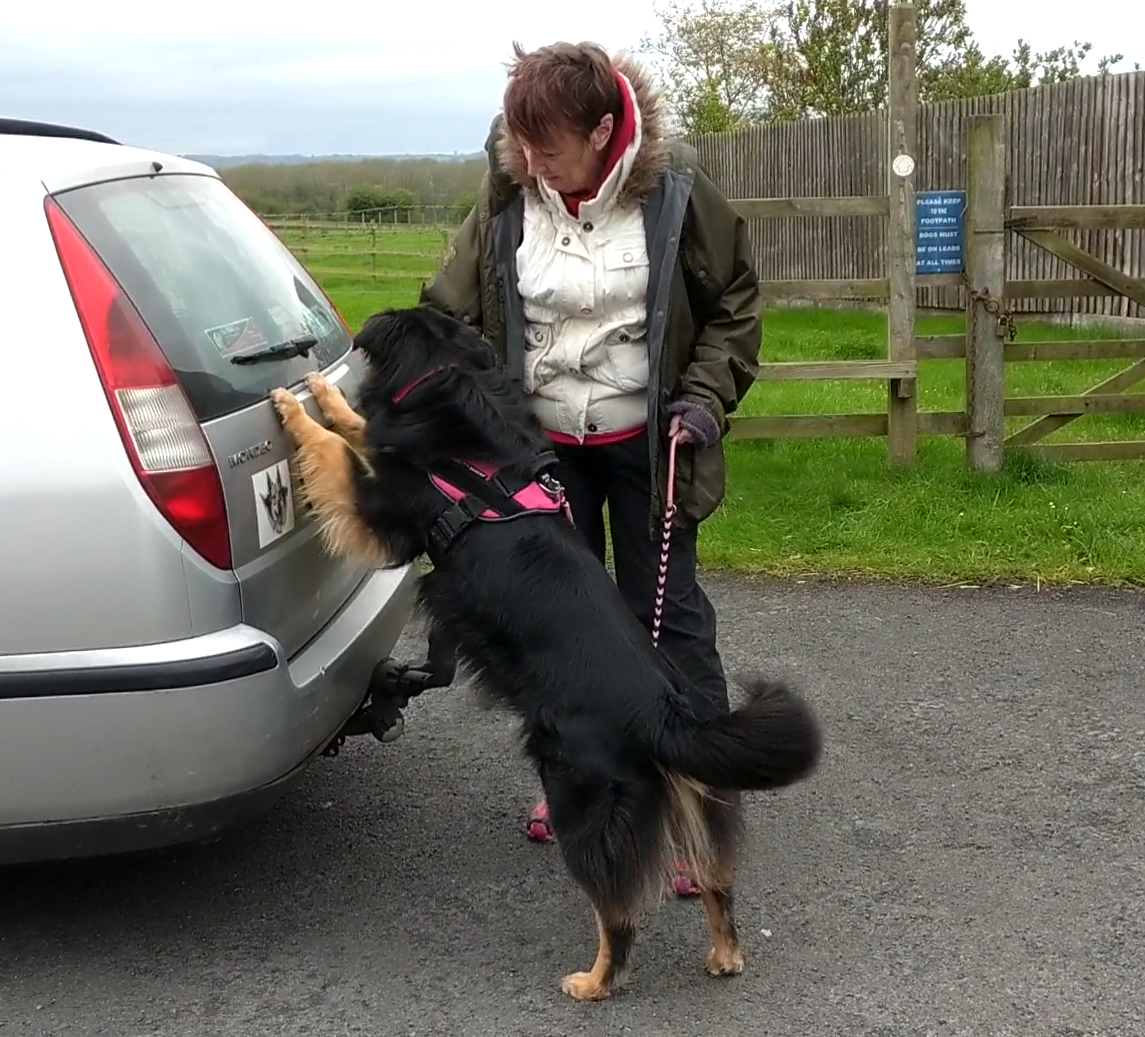
Here you can see Lacy searching a car for hidden “contraband”. In this case it was a toy rat. You can scent this with a tiny drop of innocuous essential oil, or just with your hands. Even in this still photo, you can see her tail was swishing with excitement as she got into her task.

The dog’s nose is majestic - so much more powerful than ours. It’s important to allow your dog to use his nose as much as he wants!  Brilliant Family Dog is committed to improving the lives of dogs and their harassed owners through books and online …

This post is designed to get you thinking about what your dog can do better than you can - and how you can enhance both your lives by working with your dog, and not against her.

There's so much we can actually learn from our dog if we're prepared to open our minds and look . . . and it's not only about dogs.

If you take off your blinkers (what are they called in America? Blinders!)  you'll begin to see an awful lot in the world that you didn't know was there.

 So start now by incorporating some scent games into your lives!


Need some ideas for getting the best from your dog?

Get our free email course and solve common problems without conflict!

THIS FREE ECOURSE IS A BONUS FOR YOU WHEN YOU SIGN UP TO RECEIVE EDUCATIONAL EMAILS AND OCCASIONAL OFFERS FROM ME. YOU CAN UNSUBSCRIBE AT ANY TIME.
Privacy Policy

Pandemic Puppy home alone

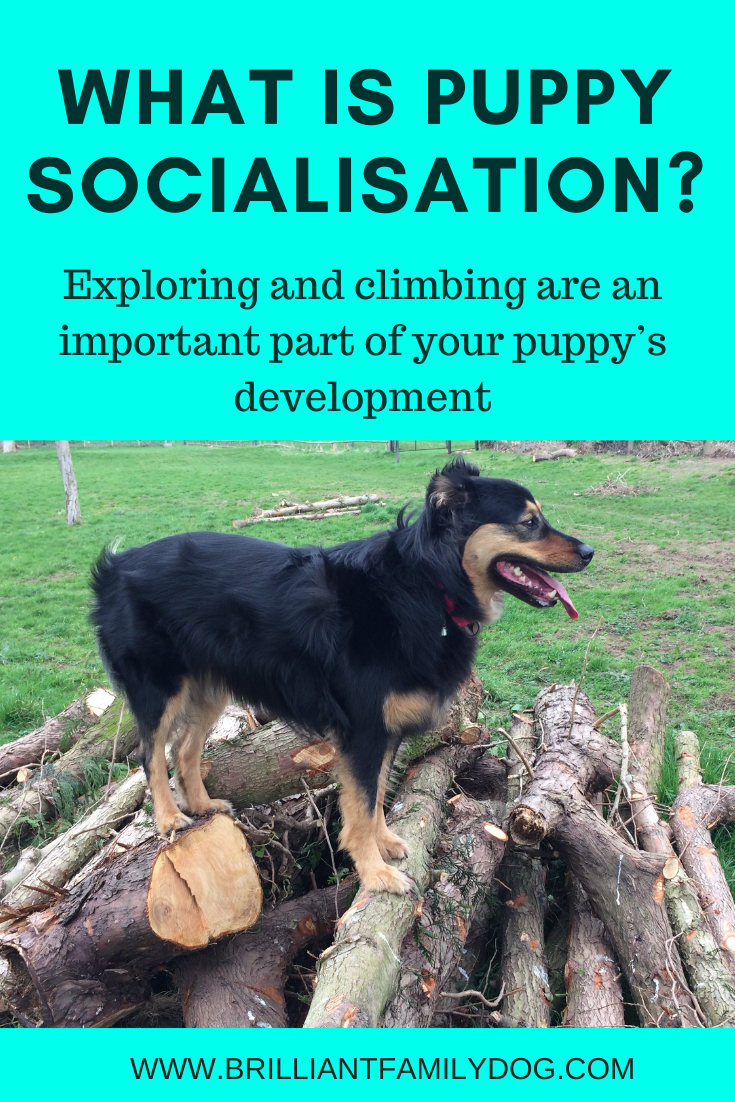
We teach all our pups to climb safely and learn how to use their bodies. Such agility lessens the chance of injury later on.  Brilliant Family Dog is committed to improving the lives of dogs and their harassed owners through books and online learnin…

I wrote recently about all the new dog-owners who grabbed the opportunity of working from home and got themselves a puppy in this post, and I’m revisiting it because of all the questions I’m getting about it. 

People are often confused about “socialisation”, and now they’re more confused than ever!

   Get your free guide to teach and learn just how to socialise your puppy

  THIS FREE GUIDE IS A BONUS FOR YOU WHEN YOU SIGN UP TO RECEIVE EDUCATIONAL EMAILS AND OCCASIONAL OFFERS FROM ME. YOU CAN UNSUBSCRIBE AT ANY TIME.
Privacy Policy

 
  • Socialisation is NOT shoving your puppy in the face of every dog you see!

  • Socialisation is NOT a question of packing as many strange new things into one outing as possible.

  • And Socialisation is definitely NOT only about dogs!

Socialisation

Socialisation - to give it its full handle: Socialisation, Familiarisation, and Habituation - is about getting our new dog or puppy used to our world.

Getting your new puppy out into the world - to experience lorries, shouting, rain - as soon as you can, is vital. Don’t wait for injections to be done - that’s way too late! You can carry him for “arm-walks” as one of my students calls them. If your pup is too heavy for you to carry, you can borrow a push-chair, or you can park your car somewhere and sit in the boot with him beside you, watching the world go by.

Socialisation is not just about meeting other dogs! Everything your pup has to learn about life with you is socialisation. Brilliant Family Dog is committed to improving the lives of dogs and their harassed owners through books and online learning, …

Socialisation includes other dogs, sure - but it also includes lots of things people don’t tend to think about . . . until there’s a problem.

Vacuum cleaner, dropped saucepans, tv images, children, babies screaming, electronic sounds, snow, sand, wobbly planks, stairs, grooming, nail-trimming, food-toys - all these are essential parts of what your puppy has to get used to.

Separation Anxiety

And another important part of socialisation is teaching him to be on his own. It’s understandable that the enthusiastic new puppy-owner wants to spend every moment with her new charge. But this is not helping the puppy!

Just like humans, dogs need to learn to enjoy their own company. Safely! So an important part of this is to have a safe place (a crate is ideal) where you can leave your pup without worrying he’s going to chew an electric wire and kill himself, or pee all over the carpet.

Start with short absences from the room when the dog is awake. Don’t make a song and dance when you return - keep it cool and matter-of-fact. Your new puppy will be sleeping in his crate more than anything else, so it’s easy to introduce these brief exits from his space.

These short absences will demonstrate to your puppy that you will always come back. If you time them carefully when he’s been fed, watered, played with, and wee-ed, he’ll be ready for another nap anyway.

A bit of complaining is natural. What is termed Separation Anxiety is when the dog becomes desperate, ripping doorframes, losing bowel control . . . Don’t confuse this with your puppy saying, “Hoi! Get me outa here!”

Having a routine is very helpful for your new dog to understand what’s going on. That doesn’t mean rigidly sticking to clock times. It means having sequences so that each thing predicts the next step. The last step will be into bed, and you leaving.  

Nighttime routine

Oh, and to begin with, I always have a new puppy sleeping in his crate right beside my bed. You can forestall any fears by being there when your pup stirs in the night. A few soothing sounds and a touch from you will send him straight back to sleep again.

If you want, you can transfer your dog and bed to another space once you have regular blissfully quiet nights!

Full-blown separation anxiety is not that common, in my experience. And it can easily be avoided by taking these early steps to give your dog confidence in you.


And for lots of ideas to change all those things you don’t want from your dog - like jumping up, barking at the window, and chewing everything (including you) - get our free ecourse here

THIS FREE ECOURSE IS A BONUS FOR YOU WHEN YOU SIGN UP TO RECEIVE EDUCATIONAL EMAILS AND OCCASIONAL OFFERS FROM ME. YOU CAN UNSUBSCRIBE AT ANY TIME.
Privacy Policy