Why do people want to fight with their dog?

I’m not, of course, talking about people organising dogfights - which is barbaric and against the law in most civilised countries.

What I’m talking about is the need people often have when they get a dog, to order it about, “command” it, make it do things, stop it doing things, control it, in general have a master-slave relationship.

Do they get a dog because they need someone to boss about?

Thing is, this is a-a-a-a-ll conflict.

Conflict-based.

This is what leads them to complain that their dog is “stubborn”, “defiant”, “ignores me”.

The way some people want to be with their dogs is centred on conflict.

And it’s a mystery to me!

Love

The great dog trainer and trailblazer in how we treat our performance dogs is Susan Garrett.

And she saith:

Dog training is really relationship building

 This is what it’s all about, guys!

It’s not about making your dog do something, or stopping it doing something.

It’s about developing a relationship with your dog, living a full and enjoyable life with another creature. From another species, sure - but a sentient being who can work things out, solve problems, seek pleasure, who has fears, likes and dislikes, JUST LIKE US!

Remember Shylock’s impassioned speech in The Merchant of Venice?

“If you prick us, do we not bleed? If you tickle us, do we not laugh? If you poison us, do we not die? And if you wrong us, shall we not revenge?”

He was talking about being a Jew. He could have been speaking as a dog, or any other animal!  

Frustration

If you’re frustrated with your dog on a daily basis, I suggest that it’s because you are looking for Confrontation and Conflict on a daily basis.

It’s an “I’m right, so you must be wrong” approach. Whereas anyone who has ever lived happily with another person knows that it’s Compromise and Compassion that win the day.
If you’d like to find a better way to live with your dog - to banish conflict from your life and have fun instead - start with our free Workshop here and sprinkle a little stardust in your home!


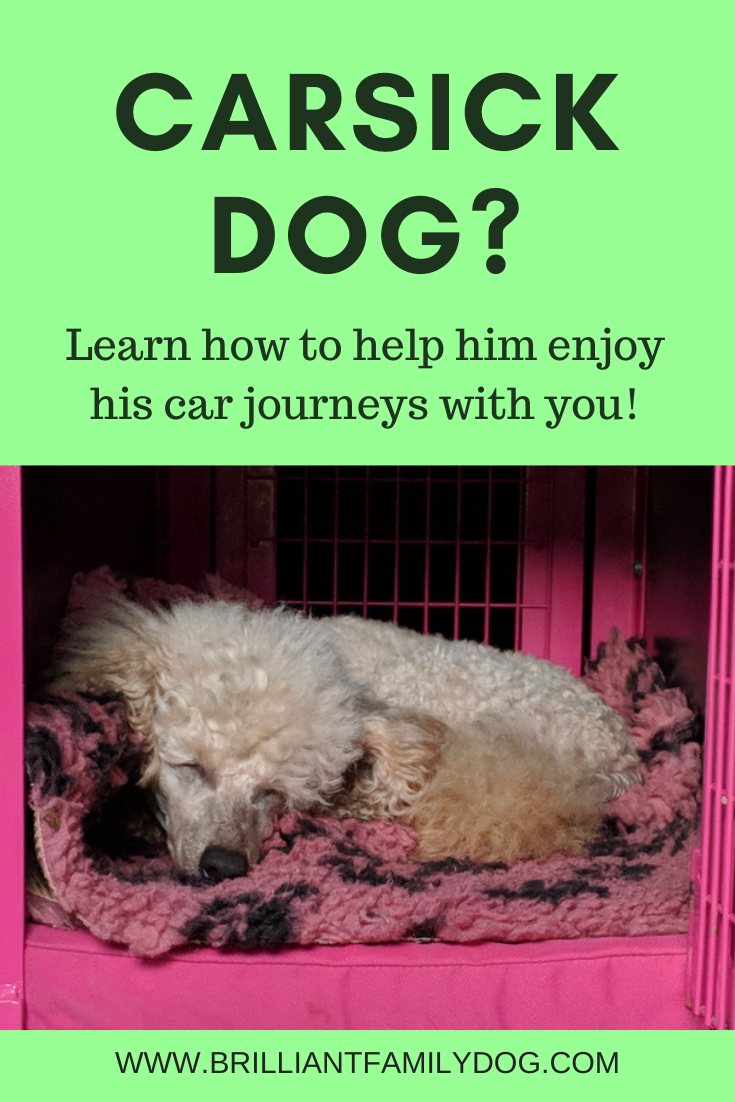
Does your dog get carsick?

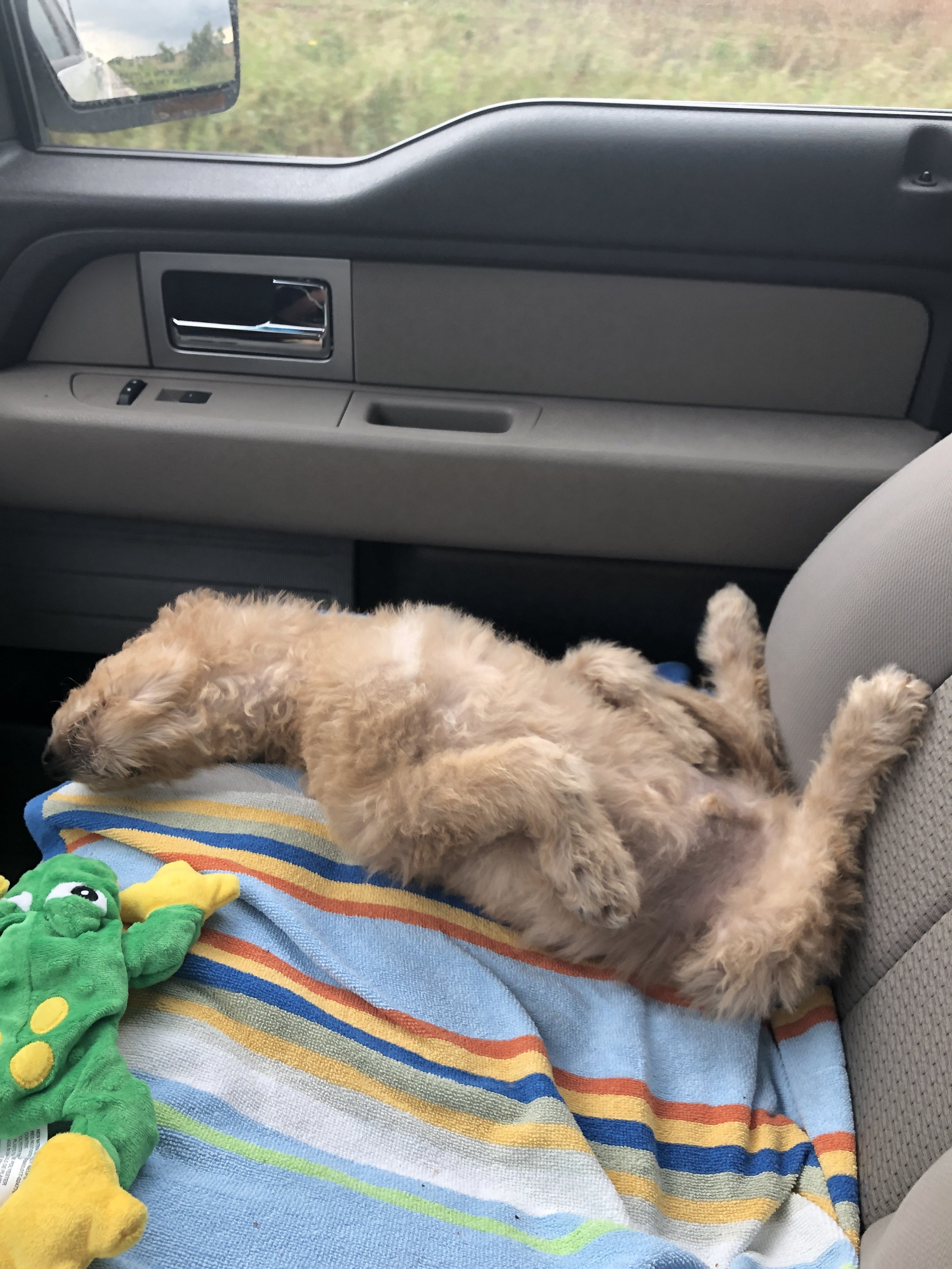
In my experience, puppies are either carsick or they're not.  

And if they are, you've just got to cope with it till they grow out of it! Just like with small children.

I've never found anything in the way of medication that works. But I have found a number of things that do work.


  1. Have the pup in the middle of the car, not the boot or tailgate or trunk or whatever you term it, as there's far less movement between the wheels. If you imagine a little toy car swivelling on a pin going down the centre of the car, you’ll get the idea of the swing at the back end. Lots of builders’ plastic sheeting will be very useful here, as you can hose it down outside the car.

  2. Never leave any dog or puppy loose in a car! There are many reasons for this, but in this case you don’t need much imagination to see why it’s not a good idea! Have him in a washable crate or cardboard box, or in a towel on your lap if you're a passenger. You can connect his harness to your seat belt for safety. Vomit can reach every nook and cranny in a car - down the side of the seats is its speciality! - so containing him is really the best option. If he can see out of the window, so much the better. Don't mollycoddle him - be matter-of-fact.

3. Take corners and winding roads slowly and be light on the controls. Be ready if possible with a bucket to stick his head in when he's about to throw up, so less mess, and have plenty of towels around. If he’s harnessed in the passenger seat beside you, this is pretty easy - though you have to stop the car safely first! 😎


4. Bring water and towel to clean him down when you arrive, don't feed him for a couple of hours before departure, and aim to get anywhere 15 minutes early so he can walk around and play and get over it.


5. This too shall pass! But it can become a habit. When my puppy Rollo got into the car, he’d start drooling even before the doors were closed. So I started a counterconditioning program with him hopping in and out of the car and getting very tasty treats for just being there. When that happened we graduated to closing the doors, then to switching the engine on. Gradually the drooling died out, and he grew to love the car and where it took him, and became a perfect traveller by about six months of age. Some dogs may be so car-averse that you’ll want to start this process outside the car till they’re happy to enjoy the treats. Then move to the front passenger seat.


Triggers

As a child I was always sick when my parents took us on outings. I can remember the triggers clearly - the motion, the leather upholstery of my father's car, and my mother's expensive perfume. So he may fare better in one car than another.

A friend shared that her childhood carsick triggers were the smell of coffee from a flask that my parents always took on long road trips, and being jostled for mile after mile after mile.

The fact that we both remember these triggers so clearly so many years later, demonstrates how deeply embedded they can be. Hence the need to make haste slowly!


And for more help with your dog - get our free email course on common dog problems! Lots of help for you there.

THIS FREE ECOURSE IS A BONUS FOR YOU WHEN YOU SIGN UP TO RECEIVE EDUCATIONAL EMAILS AND OCCASIONAL OFFERS FROM ME. YOU CAN UNSUBSCRIBE AT ANY TIME.
Privacy Policy


Giving eye drops to your dog!

I got a cry for help from a dog-owner recently. They had to administer eye drops to their little dog, who is normally happy to be handled all over.  

But the very sight of the eye dropper caused him to snap and growl - quite out of character for this fellow.

So here are some suggestions I gave them - that you may find useful if you’re struggling to give ear or eye drops to your frightened dog!

  1. Ideally, get him used to funny interventions in advance of actually needing them. You can pretend to give eye drops or ear meds, doing everything bar actually putting anything in the eye. Make it fun and rewarding - with treats to follow, and a toy game if your dog likes that.

If you do this regularly, your dog will be quite happy to put up with this strange behaviour.

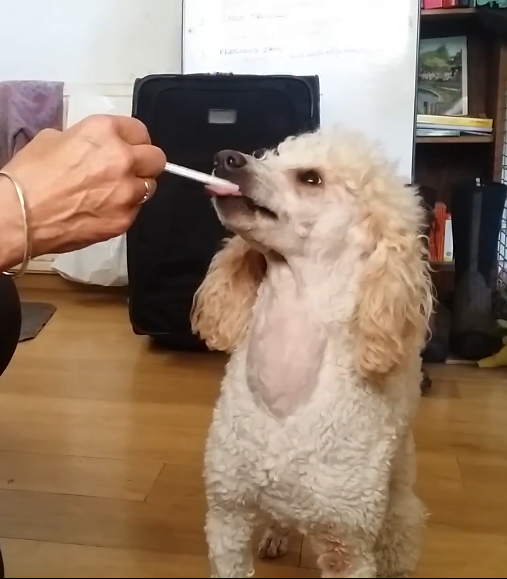
In the photos on this page you can see Coco keen and happy to get his anti-inflammatory meds. This happened because of careful desensitisation round meds, droppers, syringes, and the rest. No restraint needed!

2. If the drops appear to sting his eye, see if your vet can prescribe something more gentle.


3. If it’s permitted, ensure the bottle is warm, or at least the load in the dropper is at room temperature, so your dog doesn’t get the shock of cold liquid in his eyes.


4. Use a muzzle, or a fabric lead or soft scarf round his snout for a moment. If you’re alone, drop the scarf over the nose, cross it under the chin and tie behind the head. Be quick! And If you have a helper, ensure that one of you holds the ends tight while the other QUICKLY drops in the drops, being sure not to touch the eyeball. You can pull up the eyebrow (not the lid) to give you plenty of space to drop.

My enquirer also chose to wrap her dog in his customary after-bath towel so he felt cuddled and warm. And this and the scarf method worked perfectly, with no distress to their dog.


5. This is a time for breaking out the Class A stuff - fresh or dried sprats, cheese, sausage - leave your dog with the happiest memory of the intervention.


6. If all else fails, ask if you can get the vet nurse to administer the drops so that you’re not the bad guy!


You’ll want to follow much the same steps for ear meds. I always favour powder rather than wet stuff in the ears, with all the unpleasant noise that can make. I use Thornit (which you can readily get from Amazon) and that’s also brilliant for drying up hot spots and wet patches.

It’s great that we can get help for our dogs so easily these days. If you have to administer something, be sure to get a lesson from the vet or nurse before you leave the surgery. Ask them to show you in slow motion!

And start a program of desensitising your dog to all this right away - before you need it!


For more practical tips on making life run smoothly for you and your dog, get our free email course here ...

THIS FREE ECOURSE IS A BONUS FOR YOU WHEN YOU SIGN UP TO RECEIVE EDUCATIONAL EMAILS AND OCCASIONAL OFFERS FROM ME. YOU CAN UNSUBSCRIBE AT ANY TIME.
Privacy Policy


Yay! A new year for our dogs and us!

Such fun! A whole new year is ahead of us - us and our dogs.

So … what are we going to do with it?

Maybe this will be the year you try competing - in Agility, Rally, Obedience, Working Trials …

Maybe this will be the year you learn a new skill with your dog - Search and Rescue, Scentwork of any kind, Assistance Dog work …

Maybe you’ll determine that this is the year you teach your dog some new fun activities - Tricks, Parkour, Waterwork …  

Or maybe you’ll carry on just as you always have.

And this could be absolutely fine!

You don’t have to do anything special with your dog if you don’t want to.

But to keep you both fully-functioning for as long as possible, you want to ensure there are lots of stimulating walks for you and your companion, new places to visit, new landscapes to explore.

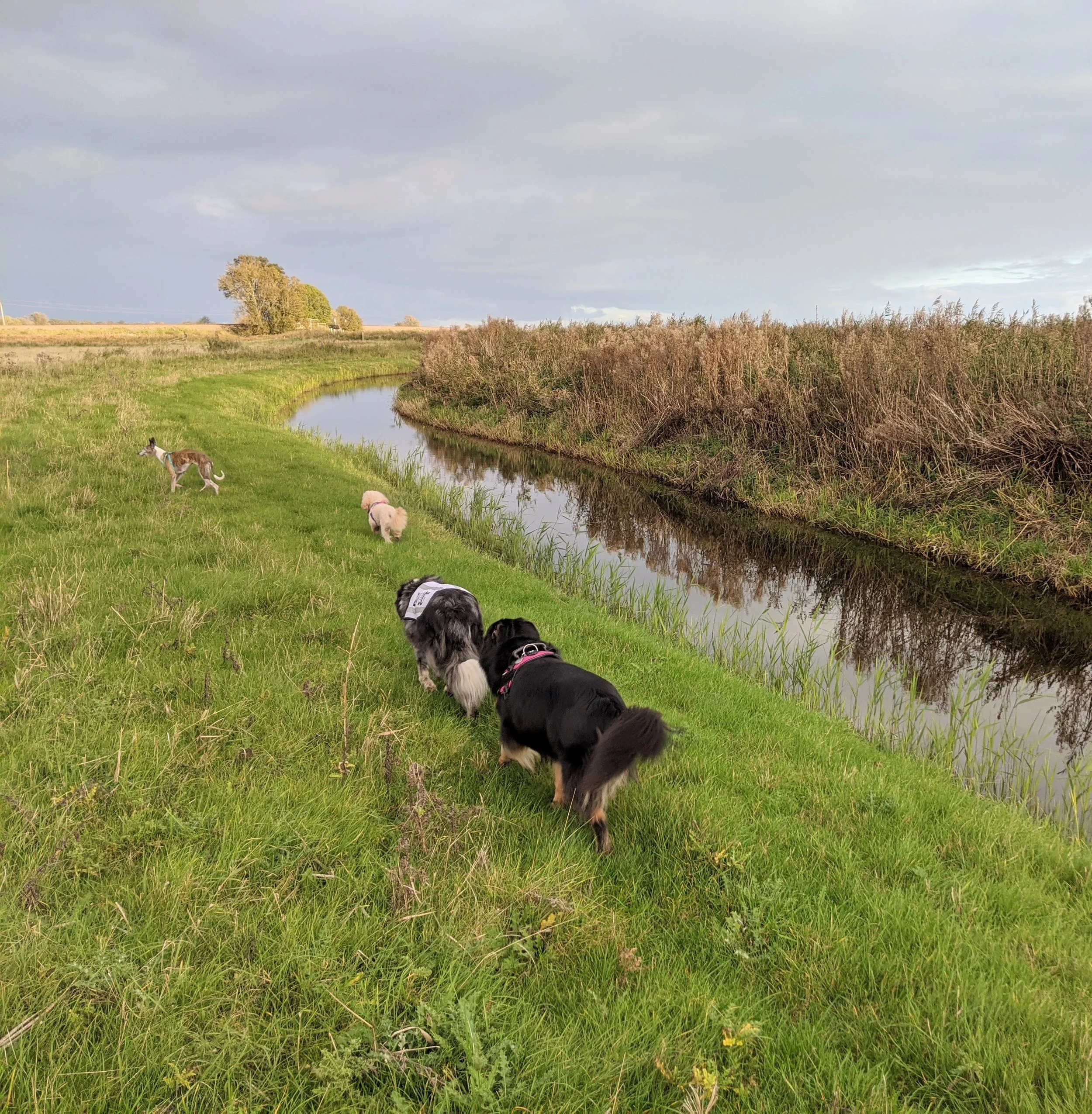
I make a point of walking my dogs in all the different terrains that are available to me here.

🐾 So one day we’ll be on one of our lovely long-distance footpaths.

🐾  Another day we’ll be at the beach.

🐾  Or open fields and pasture, or commonland.

🐾 Woodland or forest another day.

🐾   We may mooch round the village or a nearby town.

🐾 A canal-side or riverside walk is full of new experiences.

🐾  And we love the solitude of the Marshes.


What do you do to keep your dog’s interest alive? Comment below and tell us!


New thoughts for your dog

We don’t stand still in life, and neither does our dog!

We change all the time. We’re not the same person we were 5 years ago, 10 years ago, 20 years ago.

And your dog is not the same dog who ventured into your life all those years or months ago!

He’s changed too. You’ve grown together. You understand each other. You’ve developed a cosy routine that works for you.


Does this routine work just as well for your dog?


But just as you learned to read and didn’t stop there - you went on to read thousands of books, millions of words - your dog may have learnt to sit. But it needn’t stop there!

Continually stretching your dog’s mind is what will keep him fit and well right into old age.

While diet, healthcare, and exercise, are important - it’s the mental stimulation that will keep your dog young, engaged, and happy all his life!


So how about having a re-think?

Perhaps it’s time to re-assess where you are with your dog.

🐾 When did you last teach him a new thing?

🐾 When did you introduce a new game into your lives together?

🐾 When did you last become adventurous with what you feed him?

🐾 When did you go on a new walk?

🐾 How about a different outing, a new cafe visit?


You had such fun together when your dog was new!

Be sure to keep the fun alive so he doesn’t become part of the furniture.

Want to learn some new tricks? Start here with our free Workshop! And have FUN with your dog!


Your puppy’s first Christmas is coming!

If your puppy is brand new and very young, then he needs to be protected - as you would protect any baby - and keep his routine as near as possible to how it usually is.

If your puppy is older, more excitable, boisterous - or perhaps nervous around strangers - then a slightly different approach is indicated.

Either way it’s important that you are on the ball and can give your puppy the attention and care he needs, regardless of how busy your schedule may be.

In general, Christmas is a time of upheaval for dogs.

Upheaval = stress

Stress for your dog = stress for you, and for your guests!

So what can you do to minimise the stress?

Very young puppy up to 15 weeks old

Let’s look at the brand new puppy first.

This is a vital time for your puppy’s socialisation - which can only effectively happen between the ages of 3 and 15 weeks.

As ever, ALL experiences must be positive!

So this means you are on duty the whole time your puppy is awake and there are visitors and new activities taking place. As this young a puppy should be sleeping at least seventeen hours a day, this really isn’t hard!

For a puppy who’s still a bit leaky, greet your visitors outside, then it won’t matter if the excitement causes damp patches on the pavement.

It’s important that you maintain his usual schedule, in terms of sleeping, eating (should still be on 3 or 4 meals a day), and housetraining. You’ll have a cosy, quiet, place for him to do all of this, and you need to ensure that your puplet won’t be disturbed by anyone, especially over-excited children!


If you haven’t already got a cosy nest, make one now - set it up in a quiet room whose door you can lock - and start using it straight away! Consider soft lighting, half-covering the crate, soft music (classical, Mozart, is best - but you can also find stuff on Youtube). The music will not only soothe and calm your dog, but also muffle some of the sounds of the household.


The older puppy, over 15 weeks

Your older puppy is well past the socialisation period, but you have hopefully been introducing him to new experiences - happily - ever since.

The more novelty your young dog enjoys, the better he’ll be able to cope with novelty in the future.

You’ll be following the same guidance as for the very young puppy, but he’ll be sleeping an hour or so less. And depending on how much he’s learned of the outside world, you may need to do some counterconditioning work to help him cope with visitors invading his usually quiet home!

We can show you how to do this in detail in the Brilliant Family Dog Academy, but what counterconditioning means is gradually acclimatising your dog to something new - firstly in a very dilute form (I.e. at a great distance) and slowly nearer, always with lots of tasty treats. How do you know how to get nearer? When your dog shows little more than curious interest at the sight of the thing that previously worried him.

Remember he’s still very young, and very impressionable!

And remember too that lasting damage can be done if you fail to protect his burgeoning personality, his confidence.

Not to mention the damage that can be done to squawking children or furniture if your puppy is allowed to get overstressed and exhausted!

You’ll find more ideas in our free e-course with eight lessons here.