Can Choice Training help my Reactive - Growly - Dog?

Training your dog with choice is much easier and more effective than you may have thought | FREE EMAIL COURSE | #newpuppy, #dogtraining, #newrescuedog, #puppytraining, #dogbehavior | www.brilliantfamilydog.com

One of the interesting things I’ve observed recently is how much simple Choice Training changes life for those of us blessed with a Growly Dog - a reactive, anxious, aggressive, dog.

Of course, I always knew that! But it’s great to hear it come back from students and folk on my recent Workshop. That was all about Choice Training - training your dog by offering him a choice instead of telling him what to do.

And the results have been remarkable for many people!

They were surprised - and delighted! - to find that their growly dog was much better able to cope after only a couple of days of trying this new approach. Well, it was new for many of them …

For help with your reactive, anxious, aggressive, “growly” dog, get our free email course here.


  THIS FREE ECOURSE IS A BONUS FOR YOU WHEN YOU SIGN UP TO RECEIVE EDUCATIONAL EMAILS AND OCCASIONAL OFFERS FROM ME. YOU CAN UNSUBSCRIBE AT ANY TIME.
Privacy Policy

How can a few simple games change my reactive dog?

What happens is that - through offering your dog a choice and not continually “commanding” him what to do - you build a completely new relationship with your pet!

No longer are you yelling and dancing, coaxing and cajoling, to try and get what you want. Instead you have a happy companionship where your dog is keen to do what you want because it’s what he wants too!

What I love about this way of training is that the dog doesn’t have to “be trained” at all. So how does the change happen? By you, the OWNER, changing!

Simple as that! Once you change your ways, your dog will just change with you.

And while you’re building up this amazing new bond between you, your anxious dog is getting less anxious, your reactive dog is able to cope much better with his fears, and your aggressive dog finds that - with you on his side - he doesn’t need to be aggressive any more.

I love my dog but …

Training your dog with Choice Training is much easier and more effective than you may have thought | FREE EMAIL COURSE | #newpuppy, #dogtraining, #newrescuedog, #puppytraining, #dogbehavior | www.brilliantfamilydog.com

Many people come to me saying “I love my dog to bits, but …” What’s happening is that they undoubtedly do love their dog, but they don’t actually understand why he’s doing what he does. They know there’s a disconnect there, but are unaware how to fix it.

Once they start using Choice Training, things change fast. They become a team with their dog. They can now love him with understanding and empathy.

When I’m working with Growly Dogs specifically, I use a lot of strategies and techniques to achieve the desired change in the dog’s behaviour. But these are all based in giving him a choice and letting him decide on a good course of action.

When you have very young children, you have to show them and teach them all the time. Once your child is older, you’re no longer saying “do this, do that,” but you are backing them up in the informed choices that they are now able to make. This is what I aspire to for my Growly Dog students. That they can work together with their challenging dog to get the results they want.

One of the best things about Choice Training is that you can start it with your new puppy when he comes through the door at 7-8 weeks old. People used to say (some unenlightened people still say …) that you can’t train a puppy till it’s 6 months old. Why? It’s simply that the type of training they’re thinking of - harsh, punishment-based training involving physical pain - would be too tough on a puppy.

Why use it on any dog??? It’s quite unnecessary, as you’ll see from any of the 130-odd articles on this site, not to mention the many books, the audiobooks, and my free - as well as paid - programs.

And if a training technique won't work for a toddler, then it likely won't work for a dog —Stanley Coren

Take a look at this post which goes into the whole subject in great detail. There are some academic resources listed there for those of you who want to dig deep!

The fact remains, if you can treat your dog with the same courtesy, kindness and respect that you give to any toddler, then you’ll get the results you want!

For help with your reactive, anxious, aggressive, “growly” dog, get our free email course here.


  THIS FREE ECOURSE IS A BONUS FOR YOU WHEN YOU SIGN UP TO RECEIVE EDUCATIONAL EMAILS AND OCCASIONAL OFFERS FROM ME. YOU CAN UNSUBSCRIBE AT ANY TIME.
Privacy Policy


Is it possible for a dog to be reactive to the unexpected?

Do dogs like surprises? Their job is to spot surprises and alert us | FREE EMAIL COURSE | #newpuppy, #dogtraining, #newrescuedog, #puppytraining, #dogbodylanguage, #dogbehavior, #reactivedog | www.brilliantfamilydog.com

I had a great question recently:

“Is it possible for a dog to be reactive to quiet and ‘the unexpected’?”

The person who posed this question was puzzled that their dog seemed able to cope with busy or noisy situations, but would react violently to any sight or sound when the environment was otherwise empty or quiet. The owner was worried that his dog may be unusual or wrong in some way.

As I answered, it became clear that quite a few owners of reactive dogs are puzzled by this. So I’m giving you my answer as it may answer a question that you have too!


This is a good question! It baffles and misleads a lot of people.  

Picture this: you are visiting your local shops. It’s afternoon, the shops are busy, there are mothers with pushchairs, delivery vans, people with shopping bags, boys on bikes … How do you feel?

Absolutely fine and comfortable, I’d bet.

Now imagine you go there at 1 in the morning. The place is deserted. You hear footsteps getting louder, and peering into the gloom you can just make out a figure heading towards you. How do you feel?

Most of us would be on high alert at the very least, possibly really alarmed.

The same man ambling through the crowds in the afternoon probably wouldn’t have bothered you at all.

There is a technical name for this - it’s SEC or Sudden Environmental Change.

Dogs are designed to spot things which are different, things which shouldn’t be there. They can single out something amiss and focus intently on it. This is one reason why they have earned their place in our homes down the ages. They are alarm sensors!

So your dog is behaving absolutely normally.


Want to learn more? Check out this free email course that will give you lots of Aha moments about your reactive, aggressive, anxious - Growly - dog!


  THIS FREE ECOURSE IS A BONUS FOR YOU WHEN YOU SIGN UP TO RECEIVE EDUCATIONAL EMAILS AND OCCASIONAL OFFERS FROM ME. YOU CAN UNSUBSCRIBE AT ANY TIME.
Privacy Policy

Sudden Environmental Change? Wha’?

There is a reason so many of our working dogs are so useful in their work. Take German Shepherds for instance, who can spot an intruder or an escaping criminal in a split-second, and take action.

Border Collies, those wonderful sheep-herders, can instantly spot a ewe whose ear is twitching in the wrong direction, indicating that she’s about to break and take the flock with her. The Collie can get round in an instant to block the ewe and make sure she keeps going in the right direction.

In the image at the top of the page, young Coco Poodle just has to check out this strange sign in an otherwise green and empty landscape.

Do dogs like surprises? Their job is to spot surprises and alert us | FREE EMAIL COURSE | #newpuppy, #dogtraining, #newrescuedog, #puppytraining, #dogbodylanguage, #dogbehavior, #reactivedog | www.brilliantfamilydog.com

Sighthounds can spot the tiniest movement in a still place at a huge distance. Something moving in the landscape could well be dinner!

Dogs searching for evidence may not have a specific scent or object in mind - they’re just looking for something that shouldn’t be there.

And this is why your dog may react dramatically to the doorbell, or a car door slamming outside your home.

WHO IS THIS?

WHAT ARE THEY DOING HERE?

ARE WE UNDER THREAT?

For this ability alone, dogs have earnt their place by our fireplaces for so many thousands of years - it’s about 30,000 years, in fact.

Dogs’ gifts

The fact is that the hearing and sight capabilities of the dog so far outweigh our own. When it comes to their noses, they are unparalleled, and are the reason dogs are an important tool for the police, and in airports and ports worldwide. They’re far quicker at discovering evidence and identifying contraband than much of the sophisticated machinery also in use!

Is it possible for a dog to be reactive to quiet?


Is your dog throwing up more challenges than you anticipated? Watch our free Masterclass and find how to change things fast!

Window barking and fence running

I can’t tell you how many owners of reactive dogs tell me their dog is a nightmare because he barks all day at the window.

“He barks at the window at everything he sees”

“He looks out of the window all day, if anyone comes past he barks and barks.”

“He spends his days attacking my front window as people pass by”

Or races up and down the garden barking at anything the other side of the fence.

He also fence fights with our neighbour’s dogs when they are out so that is a daily challenge”

“The biggest issue is that whenever our neighbours walk past our garden fence she goes on the defensive, jumping up the fence to try and get to them”

He will run the fence if allowed”

There are two problems here

1. The dog is driving the owner mad, so there’s disharmony in the house, frustration from both owner and dog, maybe wrecked furniture or lawn, worry about what the neighbours think.

and

2. The dog is continually wound up like a coiled spring. He’s getting no rest, and his cortisol levels (that’s the fight or flight thing) are continually elevated.


We all know how an overtired toddler is impossible to manage. Dogs are the exact same. This dog who spends his days on guard duty at the window, straining for any movement he can see, then leaping about scrabbling and barking at the window, is getting no rest. He’s getting tenser and tenser.

By the time you set out on your walk with him he’s already on his toes, on full alert! There’s little chance of escaping your outing without some kind of incident - barking and lunging at anything that moves, and going nuts on sight of a dog, or a bicycle, or whatever upsets your dog.

The dog who heads out to the garden for a quiet sniff about is not going to get that if he’s hurtling up and down the fence screaming at anything the other side.

I’d go so far as to say that you are going to have little impact on changing your walks to calm, quiet, and enjoyable, if you don’t first fix these problems at home.

So how on earth can I stop it?

Like most problems, it’s always best to prevent it even starting. But that’s with 20/20 hindsight! If you’ve already got this as an established problem, it’s no help to you to say don’t let it start!

But you can mostly certainly change it. For good.

Let’s start with the windows

You need to prevent your dog’s access to the windows that are causing the problem. Probably the front windows. So first stop is not to let him in that room unless you are with him to manage the situation. If you’ve got a tiny home, or an open-plan one, you may find baby gates help (baby gates are most definitely the dog-owner’s friend!).

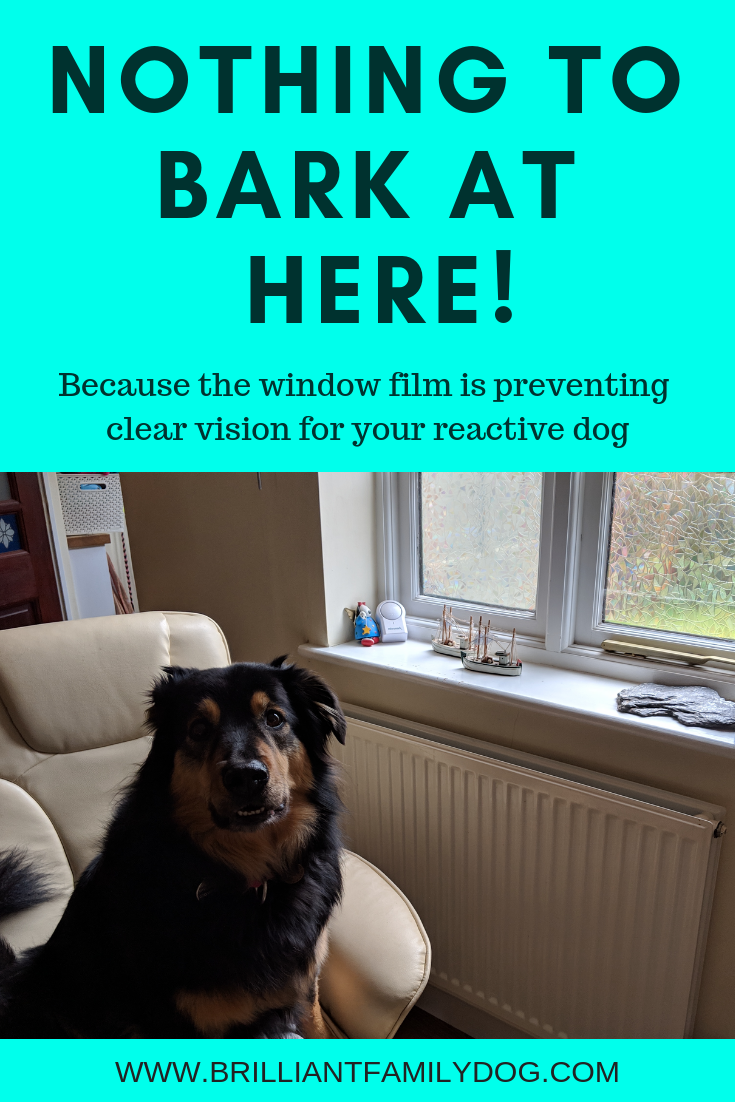
Or move to Plan B. Which is to use window film! This wonderful invention will still allow light into your home, but present a fuzzy image to your dog. He can only see something really close up to the window, not out on the street. You can get all sorts of designs, and it’s really easy to apply - and just to whip off when you want (you won’t want: you’ll be so pleased with the calm it brings you’ll never want to take it off!).

And you don’t need to cover the whole window. Just the part your dog can see out of.

You may need to move your furniture about a bit, so he doesn’t have a handy perch!

So window-barking is now eliminated! Hooray. You’ll wonder how you ever stood it before. And you will see a distinct difference in your dog who is now getting something approaching the 17 hours (yes, seventeen hours) of sleep he should have every day for optimum health and lowered stress.

“But I don’t want to cover my windows!” Then unless you can keep your dog away from them another way, you will continue this mad barking and over-stimulation, which will prevent you making the important changes in your reactive dog’s behaviour out of doors! Your choice …

So what about fence-running?

Putting film on your fence is not going to work!

If you can, talk to your neighbours and arrange things so that you are all not driven mad. See what this resourceful student does to prevent these senseless and energy-sapping battles at the fence:

“My neighbour and I text each other for the all clear before letting them out!”

Those of you without such amenable and sensible neighbours will have to manage it all by yourself. Careful observation of your neighbour’s timetable will help.

 But in any case, you will always be out in the garden with your dog!

If necessary, you could have her on lead. It’s essential to teach your dog a new way of being in the garden. You’ll find simple counterconditioning very helpful. You just post treats into your dog’s mouth whenever there’s something over the fence that worries her. This way you’ll change her emotional response to the frightening thing.

You may have to start this from inside the house! Wherever your dog is calm enough to take treats will get you started.  

No more barking and screaming!

These problems are very simply solved. Note I didn’t say “easily”. It takes application and observation. But the solutions are simple and straightforward.

All it needs is a little effort on your part, and the deafening noises, frantic behaviour, and over-arousal, will all be a thing of the past.

Come and see what else thousands of folk are learning in our free online Masterclass!

And to get started straight away with lessons to help your Growly Dog cope with our world, watch our

Free Masterclass for Growly Dogs

Can you help my Reactive dog?

Yes, there is a way to change your reactive dog and enjoy walks again - all force-free and dog-friendly | FREE 5 DAY ONLINE WORKSHOP |  #aggressivedog, #reactivedog, #dogtraining, #growlydog | www.brilliantfamilydog.com

This is a question I get all the time!

You get a dog for your life and for your family because of all the pleasure it’s going to bring you.

You’ll be able to care for another creature, teach her and nurture her. You’ll be able to go for long tramps across hill and dale, enjoy a coffee at your local cafe, with friends. You’ll be proud to show off your dog to visitors to your home, and go for group walks with others and their pets in the park.

NOT.

It just didn’t work out that way for you.

Your dog is difficult. She barks at all comers. She shows her teeth to other dogs. You daren’t let her off the lead for fear of what may happen. And as for sitting quietly in a coffee shop or enjoying family visiting your home … that seems a pipe-dream.

And naturally you are grieving for the loss of your dog. The dog you thought you were getting.

I get that. I really do.

But all is not lost!

You really can enjoy many of those things. But you have to change a few things first.

 You think I mean you have to change your dog, don’t you!

Train him to within an inch of his life. Stop him pulling on the lead. Force him to change his attitude to other dogs, bikes, joggers, visitors …

But no, I don’t mean that.

What you have to do is change what you’re thinking! Yes, really! It’s not about teaching your dog a different way to be. It’s about looking at a different way YOU can be. A better way to reach your dog’s mind and make the changes you so devoutly desire.

Many people come to me in a state of near-despair. They think it’s all their dog’s fault. Or they think it’s all their fault.

Can you imagine the relief when they find that it’s neither their dog’s fault NOR their fault?

And the flood of relief they get when they find how easy it can be to change things - once they make the changes to their own thoughts first!

Results

I absolutely love it when I get emails like this one:

“Zoe is so much better in every way – much calmer, gaining confidence, more trusting of life. Thank you Beverley, for being there, and for all you do.”

Or how about this one?

“These training sessions with you really have been invaluable and Romy’s really benefitted so thank you very, very much from the three of us.”

 Or even this:

“The best thing that has come out of this program is that our relationship has just grown and grown – we both trust each other and look out for each other.”

I am touched that I have been able to help these good people and their equally good dogs!

And their results came mainly from how those owners changed their own thoughts and feelings about the whole “reactive dog” thing.

What to do next?

So, in an effort to reach more of you, and to help transform the lives of even more dogs and their people, I’m running a free Masterclass for your Growly Dogs (that’s shy, anxious, reactive, or aggressive, dogs) - entirely free.

I’d love you to come along and start on your own new journey with your much-loved dog.

Click here to find out just what you’ll get and how to sign up!

“I was feeling hopeless, overwhelmed, stressed and isolated. I felt like a failure because I did not know how to help my reactive dog ..... and then, one fine day, I found Beverley Courtney.”


This could be your story too!


And to get started straight away with lessons to help your Growly Dog cope with our world, watch our

Free Masterclass for Growly Dogs

Reactive dog? Anxious dog? Aggressive dog? Calling all Growly Dog owners!

Great excitement here at Brilliant Family Dog HQ! We’re getting ready to host the first Growly Workshop of 2019. Click here for details and to sign up, free.

Brilliant Family Dog is becoming known for the free 5 Day Workshops we run. They are hugely rewarding - both for the students who work along for the week and for me watching their fast and genuine progress.

People who had almost given up hope of finding a way forward with their difficult dog find a home with us. A nurturing, friendly, supportive home. They are amazed - not only to find they are no longer alone - but to feel the warmth of hundreds of others who are in the same boat with their dog!

Transformation stories abound:

“Love your workshop! Looking forward to tonight’s live training.You should be so proud of yourself taking the time to help and guide us -  thank you from me and Barney xx” SS

“Beverley you are a marvelous teacher and trainer and writer!!! Way to go! You make it easy to understand so I can follow your directions.  Thank you so much.” SH

“Just want to thank you for giving your time freely for the five day course, I found it very interesting and informative. I did not realise just how anxious my dog actually is. It is also lovely to interact with others who experience similar problems.” JC

“Hello! I just wanted to say thank you so much for the course that I did. I thought you might like an update! My working lab is now eleven months old and from pulling like a steam engine he is now walking beautifully” SO

“Thank you Beverley for your generosity and time over the workshop. I look forward to continuing along this path with you!” AG

“Lulu is taking things slowly but already I have seen a difference. Went for a walk on Sunday with friends and their dogs and she behaved better than any of the others!” PM


How about you and your dog?

Join our FREE 5 Day Live Workshop and make huge changes with your reactive or anxious dog - all force-free and dog-friendly! | CLICK TO SIGN UP | #aggressivedog, #reactivedog, #dogtraining, #dogbehavior, #growlydog | www.brilliantfamilydog.com

 Will you be with us?

As you can see, in just five days you can get a huge boost forward in your journey with your dog. I’d love to reach as many dogs as possible, to change their lives and the lives of their bewildered but devoted owners. That means I need you to spread the word!

Go and sign up straight away and see what you get (there’s a new surprise gift for everyone who joins! Don’t you love surprises?).

But don’t just bring yourself - bring a friend too. Another dogwalker who struggles with their dog. Or someone who tells you they can no longer walk their dog at all because they’re too ashamed and embarrassed.

So if you want to enjoy walks with your dog - to beaches, forests, fields, parks, cafes; to have visitors in your home again for the first time in years; and to simply accept your dog for who she is and KNOW how best to help her enjoy life too, come and join us now.


I’ll close with a moving note from a previous workshopper:  

“There are no words for how grateful I am for the start Beverley has given me.” VB


The workshop is now over, but you can watch our free Masterclass for Growly Dogs here!


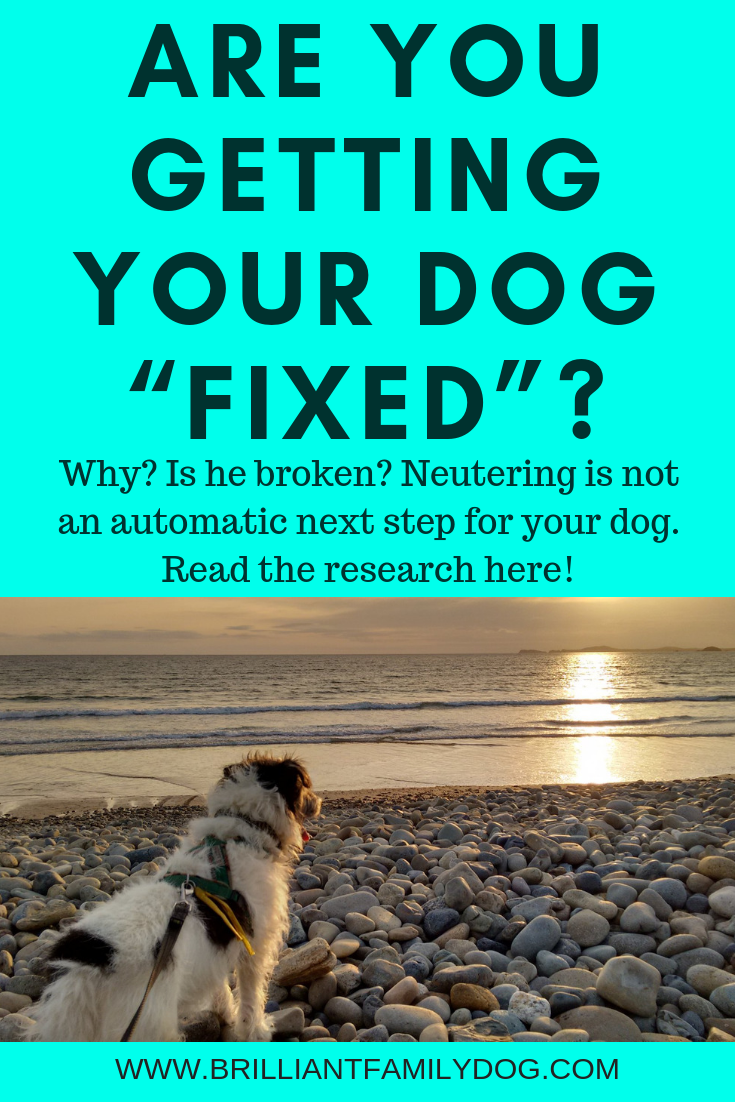
Are you thinking of neutering your dog?

Do you plan to neuter your dog as the automatic next step? Think again! Neutering can have a lot of unwanted effects on your pet. | FREE EMAIL COURSE | #aggressivedog, #reactivedog, #dogtraining, #growlydog, #doghealth, #dogneutering, #dogspaying | …

There’s a lot more to neutering than just preventing procreation. A huge lot more. But people seldom consider these side-effects in their dogs when deciding to get them “fixed”.

I actually hate that term “fixed”. It suggests that the dog arrived in some way faulty and has to have his or her insides rearranged to make him or her acceptable. This is crazy!

The dog arrives in a perfect state. If we want to alter our dog to suit ourselves, we should be prepared to admit this to ourselves and not in some way blame the dog for being wrong.

There are times when neutering is a good idea and times when it is a very, very bad idea. I’ll break these down for you, in terms of the effects.

How will neutering affect my dog’s body?

There are some medical issues where neutering is the wisest or only course to keep the dog healthy - or just alive. Infection of the uterus in a bitch, and an undescended testicle in a dog would be two of these. One is acute, the other chronic.

There are arguments that this or that cancer or condition is more likely in an unneutered dog. But there are arguments of equal weight which say that this or that other cancer or condition is more likely in a neutered dog. The percentages are tiny in either case.

The other thing to consider here is how removal of the sex hormones affect the physical development of the dog’s skeleton. The growth plates close with sexual maturity, somewhere around 9-18 months of age. So the effect of early neutering - before this age - can be relative elongation of the long bones and consequent disruption of articulation in the joints. The net result can be less efficient movement (no good if you got your dog for working or performance) and then joint problems in later years (no good for anyone).


For this reason alone I think that neutering of either sex shouldn’t be contemplated till the dog is sexually mature. For bitches that would mean a few months after the first season at the earliest. Dogs would need to be 10 months to 3 years, depending largely on the size of the breed. The larger the dog, the longer it takes to mature.

I have now reached the limit of my medical knowledge, so I’ll move on to an area where I’m more comfortable!

How will neutering affect my dog’s mind?

The key thing for me is the effects neutering can have on how your dog is, on a day-to-day basis.

Many people believe that neutering their dog will calm them down. In fact, studies have shown that the opposite is true! Your neutered dog or bitch is likely to be more excitable than an intact dog. So please kick that one to the kerb.

Is neutering your dog the automatic next step? Think again! Neutering can have a lot of unwanted effects on your pet, many of which you may not know about! | FREE EMAIL COURSE | #aggressivedog, #reactivedog, #dogtraining, #growlydog, #doghealth, #do…

There has been a lot of scientific research over recent years. Studies have to cover a lot of dogs for a lot of years to be of any use, so they take a long time to emerge. I list a load of them in the Resources below. 

My main interest is how neutering can affect reactivity. As you’ll see from some of these studies, neutering can have a big impact on this!

“It has been shown, in a number of recent scientific studies, that neutering - especially early neutering - will increase sound sensitivity, touch sensitivity, fears, and aggression, in both males and females. In some cases that increase is “significant” or “highly significant”. People-directed aggression in females, for instance, was significantly elevated in the neutered bitches studied. (See the Resources Section for chapter and verse on this.) That’s what those studies found. A lot more research is needed to get more answers, and these studies can take years to produce reliable results.

These unfortunate outcomes are - of course - not guaranteed to happen if you neuter your dog! But it’s important to be aware that they just may happen. And if they complicate an already complicated situation, that’s not helpful.

Neutering has the potential to make your dog worse.”

Essential Skills for your Growly but Brilliant Family Dog

In brief, neutering a dog when he is experiencing fear of anything in the world around him (i.e. he responds to novelty or movement with barking, lunging, trembling, hiding … any action that does not demonstrate confidence) has the potential to make him MORE fearful.

And neutering a female who is already showing fear of other dogs has the potential to make her reactive to people as well after spaying.

You’ll see the facts and figures in the studies below.

If you’ve already neutered your pet, that’s water under the bridge. You can’t change it now.

BUT if you’re happily planning to neuter your dog simply because you think society expects it of you, or your vet suggests it as the automatic next step, please think again.

Once it’s done, it’s done. And if it changes your beloved dog’s nature and makes life harder for both of you, then you’re up the creek without a paddle.

But you have to neuter your dog, don’t you?

And what about the chief reason usually given for choosing to neuter? It’s to do with reproduction. Preventing unwanted puppies. It could also be to prevent bitching, wandering, fighting in males. But responsible management will do this for you! If you’re reading this post, it’s unlikely that your dog is wandering abroad without you knowing where he or she is.

Since neutering became the big thing - the answer to the stray dog problem - has anyone noticed the shelters getting empty? Irresponsible dog-owners will neither neuter their dogs nor contain them. I’m afraid there’s a lot of “preaching to the choir” here. And the fallout is that a lot of dogs’ lives have been unnecessarily altered for the worse, because of only partial education.

A little knowledge is a dangerous thing

You need to see the whole picture before making what is essentially a fundamental and momentous decision about the future of the dog in your care.

I’m suggesting that you need to change your mindset from neutering being an automatic next step for your puppy to seeing that you have a choice in this.

In some European countries it is considered barbaric to mutilate dogs, and neutering of either sex is usually only done for medical reasons. At the other extreme we have cultures where people are vociferous in declaring that all dogs should be neutered and it is our duty as a citizen to do this. I’ve had people writing to me from these countries asking if that’s a thing? You can actually NOT neuter your dog? Unheard-of.

In case you think I am on a mission to ban neutering, I can tell you that only one of my four dogs is entire at the time of writing. You have to decide what is right for your situation. I just want you to realise that there’s more to this than meets the eye, and you do have a choice.


RESOURCES

The effects of neutering on health and behaviour: a summary

Neutering Causes Behavior Problems in Male Dogs

Neutering bitches trebles the risk of urinary incontinence

Royal Veterinary College research, also shows which breeds are most at risk

Behavioral and Physical Effects of Spaying and Neutering Domestic Dogs (Canis familiaris)

Summary of findings detailed in a Masters thesis submitted to and accepted by Hunter College by Parvene Farhoody in May, 2010


Evaluation of the risk and age of onset of cancer and behavioral disorders in gonadectomized Vizslas

AVMA, Vol 244, No. 3, February 1, 2014

M. Christine Zink DVM PhD, Parvene Farhoody MA, Samra E. Elser BS, Lynda D. Ruffini, Tom A. Gibbons MS, Randall H. Rieger PhD

Non-reproductive Effects of Spaying and Neutering on Behavior in Dogs

Deborah L. Duffy PhD, and James A. Serpell PhD

Center for the Interaction of Animals and Society, School of Veterinary Medicine, University of Pennsylvania

Joint Disorders, Cancers, and Urinary Incontinence associated with age at neutering

Benjamin L. Hart, Lynette A. Hart, Abigail P. Thigpen, and Neil H. Willits, July 2020

School of Veterinary Medicine and Department of Statistics, University of California, Davis, California

For help with your reactive, anxious, aggressive, “growly” dog, get our free email course here.

  THIS FREE ECOURSE IS A BONUS FOR YOU WHEN YOU SIGN UP TO RECEIVE EDUCATIONAL EMAILS AND OCCASIONAL OFFERS FROM ME. YOU CAN UNSUBSCRIBE AT ANY TIME.
Privacy Policy