growly dogs

How can I help my fearful dog?

Brilliant Family Dog Beverley Courtney

So many of us battle daily on our walks. 

  • Will my dog react to that dog/person/car? 

  • Is there anyone coming?

  • Help! This is so stressful … What can I do??

There are answers. But they take commitment and perseverance.

And then the rewards are marvellous! 

Worth a try? 

“I did not realise just how anxious my dog actually is. It is also lovely to interact with others who experience similar problems.” JC

BAT for dogs

This is a very condensed version of BAT for dogs. (That’s Behavior Adjustment Training designed by Grisha Stewart.) You can learn the full system here: From Growly Dog to Confident Dog

But for now, let’s just get you started on the principle of the thing. 

Your dog sees something that alarms him.

He fixates. He’s deaf to you. He’s focussed on what’s ahead.

He’s probably straining into his lead, ready to erupt.

This tension on his collar or harness is actually exacerbating the situation: he feels trapped! This is life or death! 

Now, the first thing for you to do is work out what is a “safe distance” for your dog. 

This may be 25 yards - more probably 50 or 100 yards. 

So your first step is to make distance.

Once you are far enough away from the approaching hazard to lessen your dog’s fears, what you need to do next is

RELAX THE LEAD!

Now I know this may not be easy. As soon as you relax the lead your dog jumps another yard forward .. This tells me you’re still too close.

You should be able to get to a distance where he’s not straining forward in his anxiety. 

This is when you relax your lead.

(If he shuffles forward, gently draw him to a stop - then relax the lead. This does work!)

Suddenly, peace and light descends!

“It is so kind of you to offer this for free, it really shows that you are passionate about helping people to make a positive change and helping all those anxious dogs.” GC Register for the free Growly Dog ecourse

Your dog can relax. He may be sitting or standing, but he’s standing freely on a loose lead, his legs are under him, not pushing out behind. Now he’s able to study the danger dispassionately. 

And you know what? 

There’s a very high chance he’ll say “Ah well,” and turn away and start sniffing or mooching. 

Bingo! 

That’s just the result you’re looking for. 

Not only has your dog not erupted (phew!) but it was his decision to stay calm. 

Yes, you helped him, but it was the dog who decided.

What next?

In time, you’ll find this is a new sport for you. You’ll actually be seeking out your dog’s triggers (the things that upset him - dogs, people, cars, whatever) to work on this!

You’ll be developing a new connection with your dog - not fighting him, trying to hold him back before he lunges and barks - but helping him take it all in his stride.

Worth doing? 

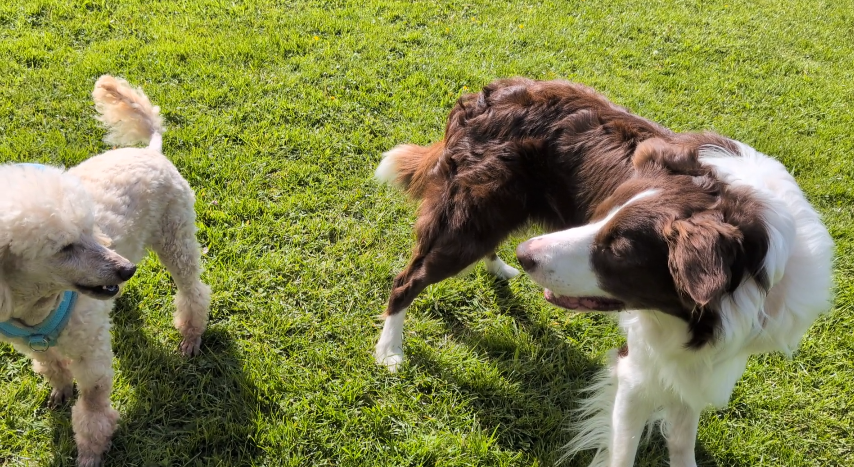
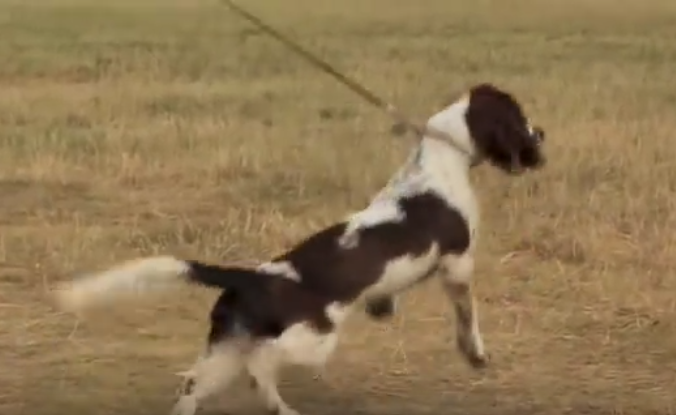
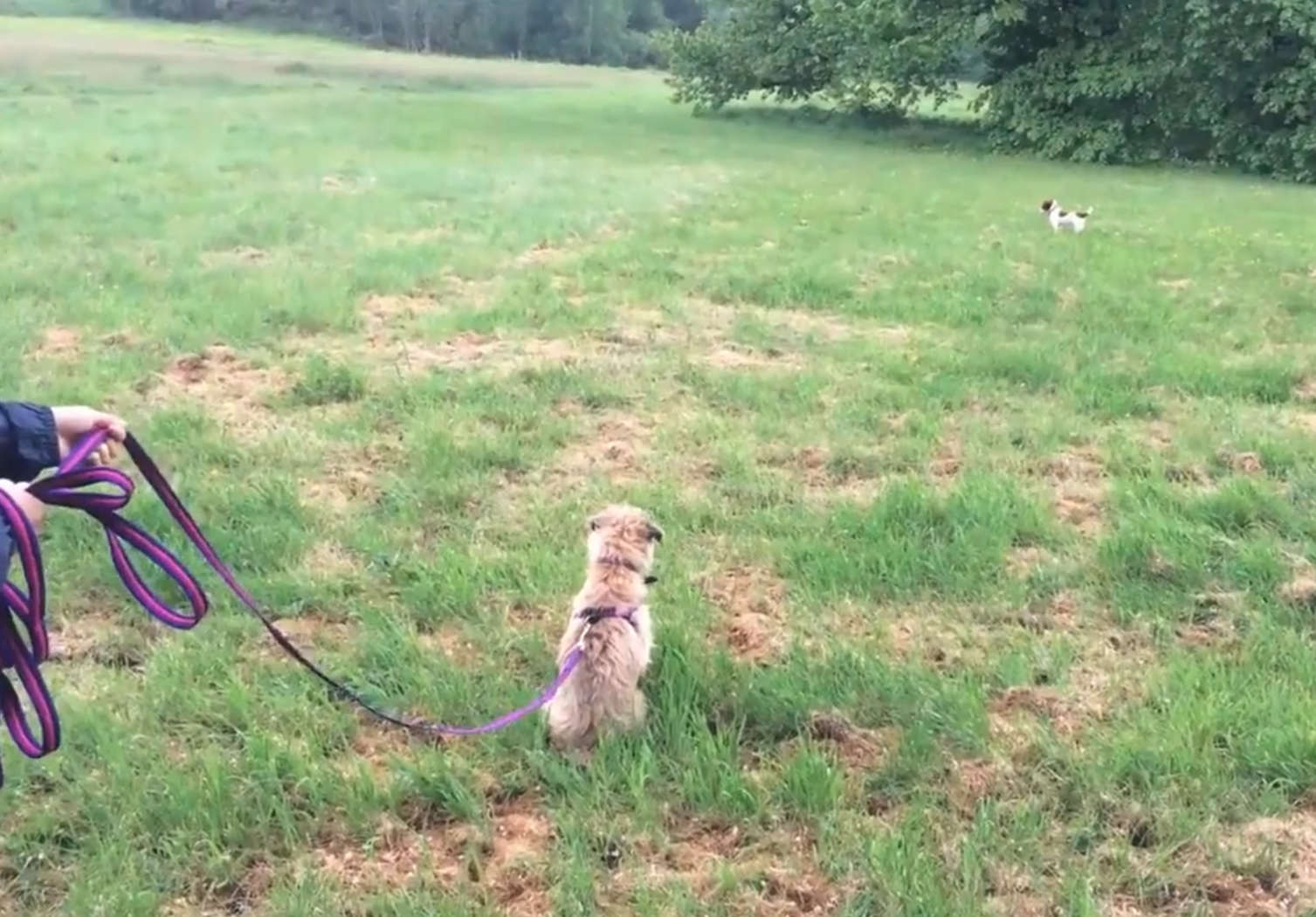
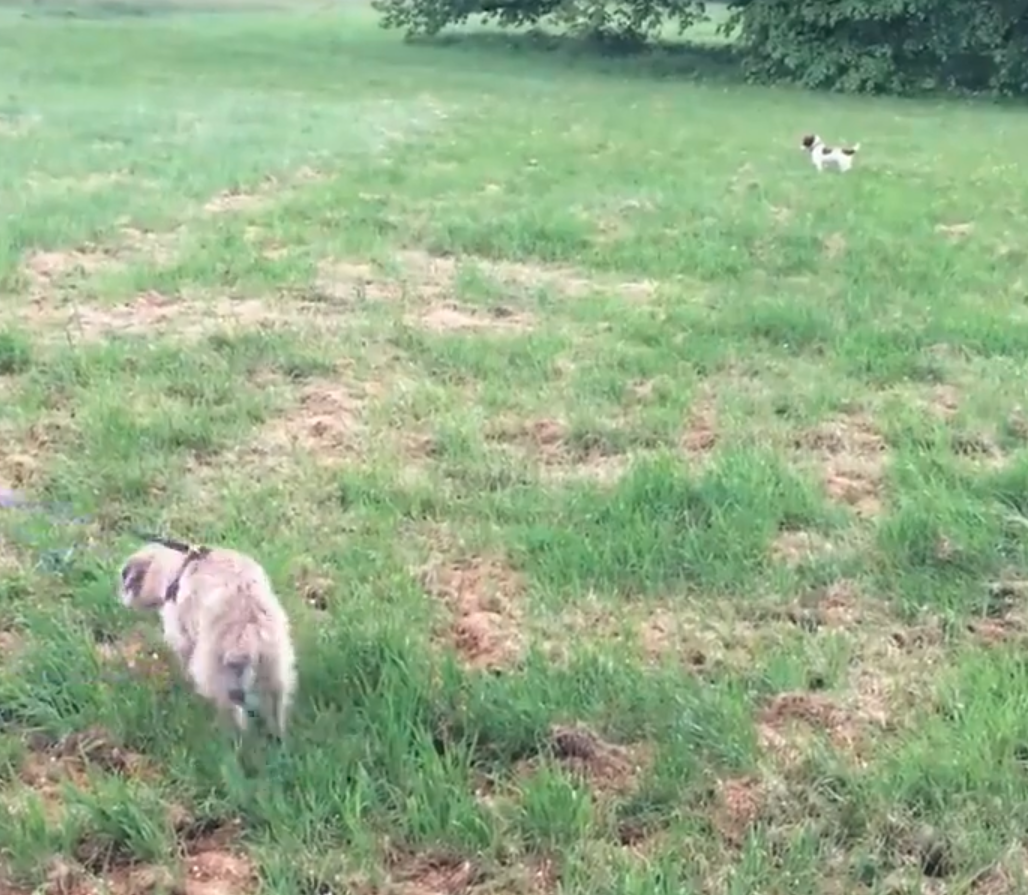
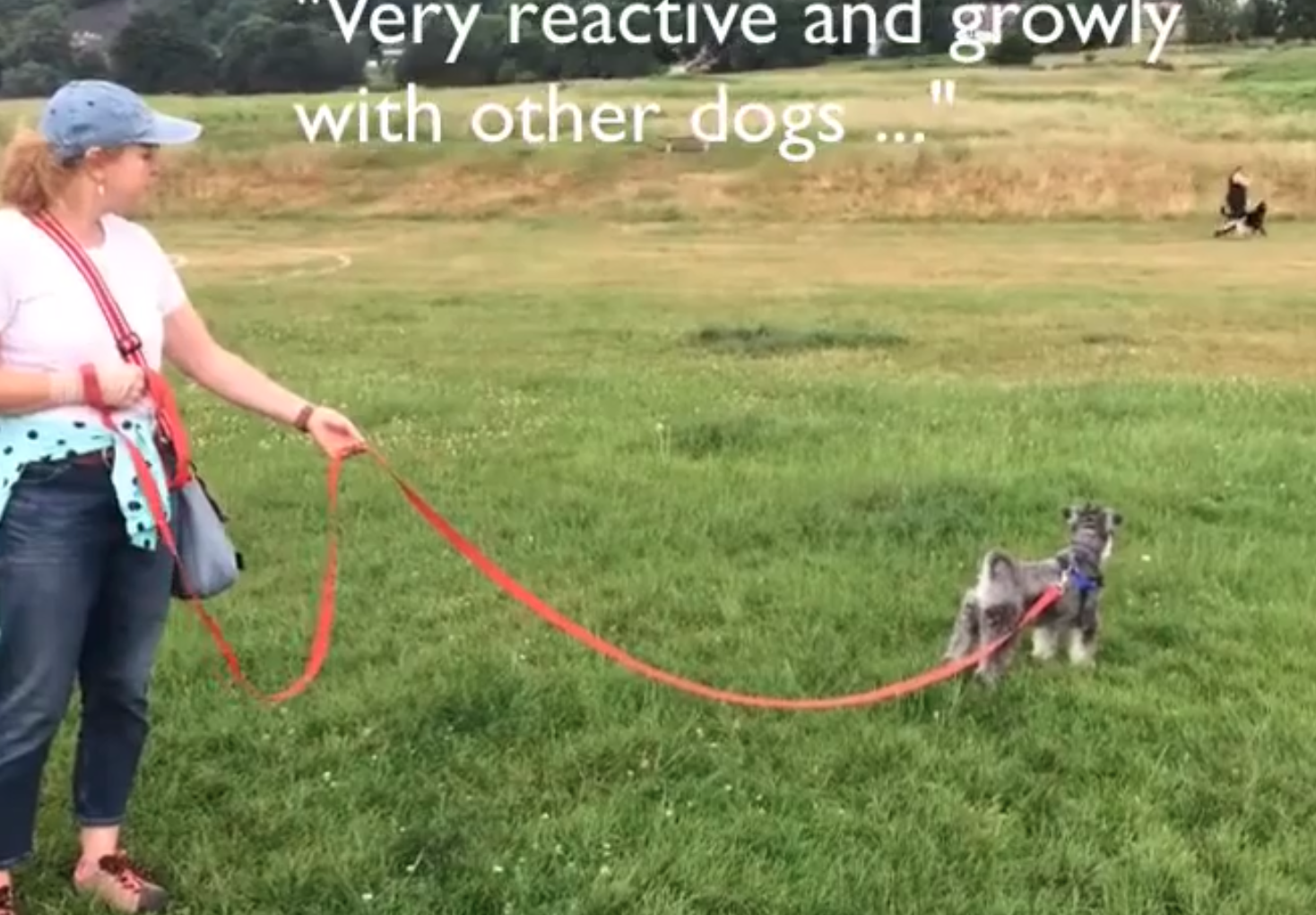
These images are excerpts from detailed videos from real BAT sessions with real growly dogs. They’re all in the comprehensive program, From Growly Dog to Confident Dog, with detailed analysis.

Come over to my.brilliantfamilydog.com and find out what you can learn there to make this dream a reality. Thousands of dog-owners already have - you won’t be alone! 

“ Beverley I want to thank you for helping me to:

  • Better understand my troubled dog

  • Be more self-aware

  • Think and act distance

  • Not worry about what others think

  • To slow things down

    The course is so clear and well laid out with logical progression. It has given me the confidence to put into practice what I knew to be the right way to live with my dogs.” SMcD

“The good news is that I can see that my dog and I have made loads of progress since starting this programme- we are both more confident (very rarely hear a low growl these days from either of us), lead walking is good, recall excellent, we are good friends (very good), He is more confident around other dogs off lead and can hold back or have a quick hello then move on, he can walk through a field of sheep (on lead) and not react and this morning did not bat an eyelid at a couple of horse riders who passed us. More recently we’ve made a real effort with BAT and he can watch other dogs at a distance calmly whilst being on the lead.” JS


“I can read and/or listen and comprehend pretty well. But when I visually SEE how something is done --THAT is what helps me learn the best. So your demonstrations of real dogs with real owners learning for the first time is HUGE and EXTREMELY encouraging. After I watched the BAT videos, I thought -- "OOOOH, we can do that!" Thank you so very much. Owning a growly dog has been quite unexpected and many times frustrating, so any pressure that can be removed is invaluable! Again--I cannot thank you enough. Looking forward to what the next few weeks hold with our new revelation of BAT! “TC

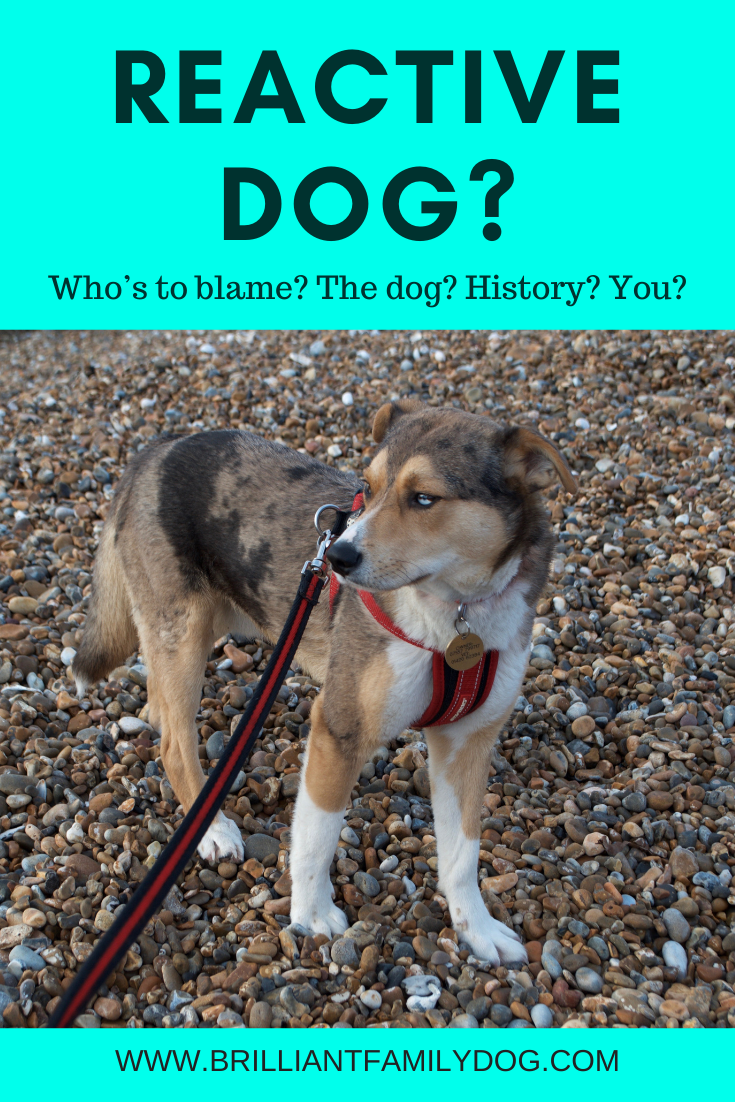
Why is my dog reactive?

It’s natural for people to question things.

And especially when that “thing” is having a major unwanted effect on their life!

So “Why is my dog reactive?” is a question I hear often.

And the questioner often furnishes what they think the answer may be. These “reasons” can range from:

He’s a rescue dog

I think he was beaten

He missed out on socialisation

He was over-socialised

He was attacked as a puppy (“attacked” can mean anything from being stared at to being torn apart, I have learnt)

He had a bad breeder / bad breeding / bad start

We went to a bad puppy class

He never went to puppy class

.. and so it goes on.

Now whether any of those things are true, and - more to the point - whether they have any bearing on how your dog is now, can never be quantified.

Keen to learn more to help your Growly Dog? Get our free e-course here and get started!

It’s been proven that fears can be hereditary. Even that the position in the womb can affect a puppy’s mindset! And while all the research goes on - you have a dog to look after.

The fact is that your dog is reactive!

.. or anxious, nervous, shy, “aggressive” …

This is what we know, for sure - so why not start there?

Start from where you are

It really doesn’t matter why your dog is reactive or fearful. He just is.

A family may have two or more children who are poles apart in character. Same parents, same genes, same environment, same diet, same everything.

And yet they are totally different. We all know families like this - maybe even have a family like this!

Perhaps one child is brave and fearless and dives into everything.

While another is shy and reserved, lacks confidence, and prefers to be a wallflower.

Thing is - we get the children we’re given! We don’t have too much say in the matter.

And we love them just the same.

Choosing your dog

So why not view your dog the same way?

Maybe you went to great lengths to choose a breed you thought would suit you, the gender that seemed right for you. You hunted till you found a good breeder, checked the lines, made your choice.

Or perhaps you took pot luck - picking a dog from a shelter, or inheriting a dog from someone else.

I can tell you now, that there is more variation between individuals than there is between breeds.

In other words, two dogs of the same breed - even from the same litter - will be individual. Not clones. Individual.

Your collie may be afraid of things that run fast, your spaniel may have no interest in using his nose, your GSD may be sound-sensitive, your lapdog may hate laps …

So, to some extent, no matter how carefully you choose, you are taking a gamble.

First of all, be kind

Your dog can’t help how he is. He didn’t choose to be afraid. He just is.

And fear of some kind, whether inbred or acquired, is at the bottom of most reactivity.

So let’s cut him some slack.

He may not be the dog you had hoped for.

He may never be a good agility dog, or working dog - which is why you got him.

He may never be comfortable in strange places, or with strange people or dogs.

But that’s not his fault!

It’s just the way it is!

No need for whywhywhy - it just is.

You chose him.

So you need to do what you can to make his life with you the best it can be. If that limits what you can do with this dog, then so be it.

More love on offer

Just about all the reactive dogs I have ever known are wonderful family pets. They are utterly devoted to their people. They are fun to have around - at home.

I’d go so far as to say there is no bond like the bond between your reactive dog and you.

You have to put so much work in to keep him - and you - happy.

And in so doing, you understand him so much better. You build his confidence, slowly but surely (this can take years).

And your dog knows (once he’s no longer a terrified screaming furry blob on a walk) that you love him and will protect him.

What better pet could you wish for?

Want some help with your challenging dog? Explore our free and premium courses for growly dogs, where you'll find practical, force-free training to help you understand your dog better and enjoy calmer walks together.


Have you got a reactive, anxious, Growly, Dog?

🐾 Are you one of those people who creeps about in the dark walking your dog, for fear of meeting … anybody?

🐾 Are you fed up with the snooty looks and snide remarks about “that vicious dog”?

🐾 Are you frustrated by finding only ‘trainers’ who want you to do nasty things to your dog, rather than loving them - as you do?

If so, I want to draw your attention to From Growly Dog to Confident Dog.

And rather than me saying what a wonderful program it is (well, I would, wouldn’t I!) I’m letting some of my long-term students say what they think.

Many of my students have been with me for years. Why?

Because this system works!

So here are pieces from three very different students with very different dogs:


See what you make of what they say! And if you are inspired to learn more, start with our free and premium courses


Brilliant Family Dog


When Lois was a puppy, I always dreamt and hoped she would be a cute little dog, a “well-behaved” little dog, that I could proudly walk down the street with - my calm, well-trained, obedient little “Angel”.

I soon realised that wasn’t to be!

She became a fearful, reactive dog. Nothing bad had happened in her life to provoke this behaviour, it’s just how she was. I dreaded walking out with her as her reactivity soon became unmanageable - ferociously barking, screaming, lunging, growling at every dog and child we came across. Taking her into pubs, cafés, shops, any public place, was unthinkable. She was a total nightmare. “What have I done” I would often think. Many tears were shed.

But then I discovered Beverley Courtney .. and after being misled by so many trainers prior, Beverley was our lifesaver. First I read her books, and I was so impressed. This type of dog training was kind, I loved it!

So then I worked through her brilliant courses. I soon learned how to understand WHY Lois behaved as she did, and how to manage her behaviour, and to be respectful, and be her advocate. Working slowly through Beverley’s modules, at our own pace, and never skipping anything, or starting midway, Lois and I became a team. Beverley was .. and still is .. there for us every step of the way. Her support is immense, and her willingness to share her knowledge is incredible.

Lois and I began to understand each other - she is encouraged to make her own choices in life, and she is NEVER forced into situations where she feels threatened or frightened. Yes it has taken time, hard work, and lots of patience, but she is now the calmest of dogs. And I can confidently walk out with her, knowing that she feels safe and comfortable with me, by using the strategies that Beverley taught me. I manage Lois’ reactivity in the kindest of ways. We get so many compliments now, and being with her gives me the most pleasure in life.

If I could wave a magic wand and change Lois into a non-reactive dog, would I do that? Absolutely NOT! I wouldn’t change her for the world. She is unique, she has character, she trusts me, and that’s what I love. She is Lois. 🐾

This is all thanks to Beverley ❤️ She has saved us from a life of misery and regret.

Carol Russell


Brilliant Family Dog

I am so relieved and grateful to have found the Growly Dog Program. Before joining Dudley was so anxious and reactive, and we wanted to find someone who would help with kindness and care.

This is exactly what you get from Beverley!

Apart from her many qualifications and experience she truly has the dog's best interest at heart. The step-by-step course is easy to follow and the monthly calls are invaluable. Questions are answered fully with great advice. The community is there so you can get help at any time with supportive people who really understand. 

Dudley is a much calmer happy dog. Thank you Beverley!

Sue Wright


I was very frustrated with my dog’s behavior, and honestly did not know where to begin.

I joined Beverley's Growly Dog online program in 2019, and my dog's improvement has been remarkable. As I write this, my reactive dog is lying on his bed chewing on his bone … what is amazing about this scenario is there are workers in the next room drilling! Prior to taking the course, my dog would have been running around the room barking nonstop causing us both a lot of stress.

Other areas of improvement include walking by my side instead of pulling; greeting people we meet on our walk, returning to me, and lying down by my feet as we chat; lying down beside me when people are visiting at our house; no more jumping, pulling, lunging, and nonstop barking.

I cannot overemphasize the amount of ongoing support offered by Beverley and her two trainers. You can ask questions in the online community and monthly Zoom coaching calls. You receive personalized advice specific to your needs. There are several other available resources that you can explore on her website.

My relationship with my dog has improved so much. He has grown more confident and less fearful by playing the training games I learned in the course. I have also grown more confident by learning strategies I can use to manage the situations we may encounter.

Sue Brandenburg


Read enough to spark your curiosity? Explore our free and premium courses and discover the Brilliant Family Dog approach for yourself. Start wherever feels right for you, and move at your own pace.

We're here to help you and your dog enjoy a calmer, more fulfilling life together.

Just like Sue, Carol and Sue, you can build the confidence and understanding that leads to lasting change.

Does your dog use the stairs safely?

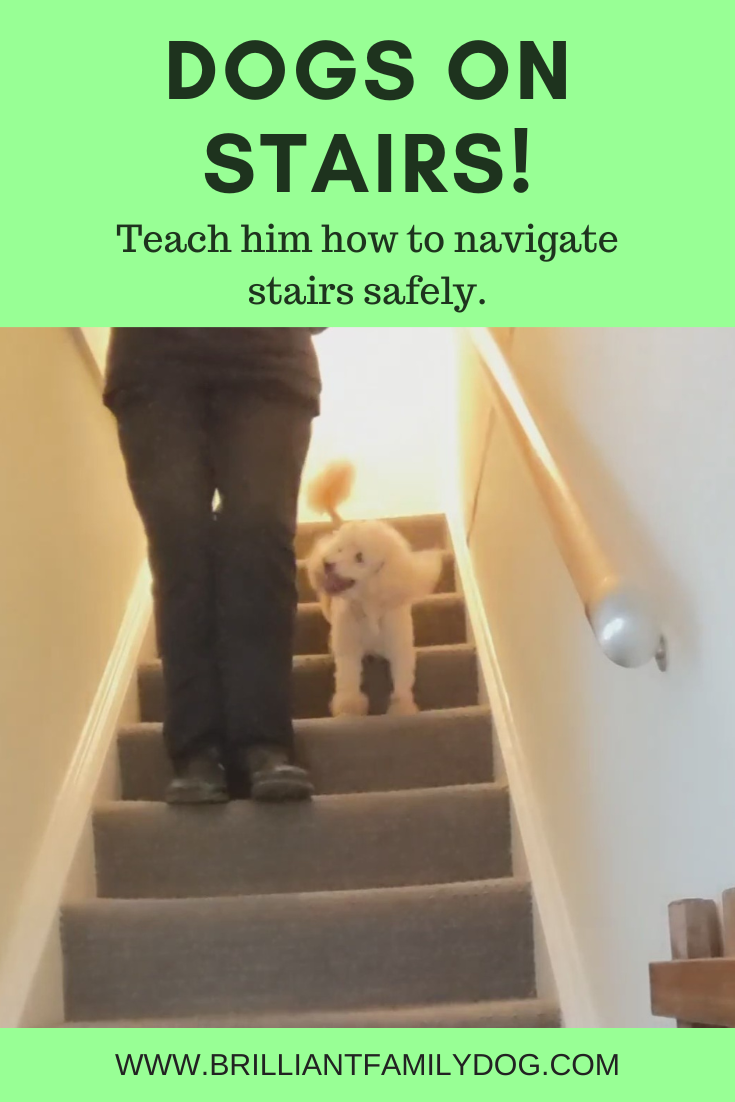
You’ll make life safer for yourself as well as your dog if you teach him from puppyhood how to navigate stairs safely.  Brilliant Family Dog is committed to improving the lives of dogs and their harassed owners through books and online learning, all


This is an especially important question for new puppy-owners! But we could all look to make sure we’re avoiding accidents - to us as well as to our dogs - by teaching them right from the start.

First of all, your stairs are safer if carpeted, but this isn’t essential. A mat or some sort of non-slip surface at the bottom of the stairs is important, especially as at the foot of most staircases there is a sharp turn. Puppies are particularly vulnerable to injury on slippery corners!

First of all, you want to make sure the stairs are gated, so there’s no free access to them without you being there to supervise.

And this is how you start: 

  1. At the bottom of the stairs, your dog is on lead

  2. Place a treat on the first step.

  3. Let your dog eat it then place a treat on the next step up.

  4. Step up beside your dog as he ascends, step by step, treat by treat.

  5. Slow and steady till you get to the top!


If your puppy is freaking out, just do two steps then lift him off. Work at this gradually till you can step all the way up. This will take as long as it takes.

Now you’re at the top! 🎉

So how to get down again?!

Use exactly the same method. You may need to keep the lead shorter now (without putting pressure on his neck, of course!) to make sure your dog doesn’t try to race down.

And it’s super-important to ensure there is a treat not only on the bottom step, but also on the mat at the foot of the stairs. You want to ensure your dog always steps all the way down and doesn’t leap off early! .. as you’ll see Coco does correctly in the two videos on this page.


Next stage

Gradually, you’ll be able to remove the lead from the exercise, and space the treats out a little more (though be very slow to remove the last two on the way down!).

And once you know your dog has got this, you’ll be able to let him go up and down on his own.

You’ll need to find other stairs for him to get used to as well - concrete stairs, other sorts of house stairs, metal stairs, log stairs …

Once you’re both expert at this, you can have some fun together, going up and down stairs:

Coco learns stairs


Safety for us!

Incidentally, there’s a lot of nonsense talked about who should go through a door first. Real nonsense.

Certainly, your dog shouldn’t barge through doors, but once they can wait for permission to go through, I always send mine through first. I don’t want an excited dog to take my legs out!

Same goes for stairs.

I always send my dogs up or down stairs ahead of me. It’s simple commonsense!


No need to get tangled up in dominance nonsense.


Stair agility!

Once your dog is comfortable on the stairs, you can develop his balance skills and have fun with some stair games

Here’s a video to give you some ideas - see how much Coco is enjoying this!


And for lots more answers to your questions, get our free email course here!

THIS FREE ECOURSE IS A BONUS FOR YOU WHEN YOU SIGN UP TO RECEIVE EDUCATIONAL EMAILS AND OCCASIONAL OFFERS FROM ME. YOU CAN UNSUBSCRIBE AT ANY TIME.
Privacy Policy

Want to know your biggest mistake?

Blaming anyone or anything for your dog’s worrisome behavior is counter-productive! Blame will get you nowhere! What you need are concrete strategies to make the changes you want, together with your dog. Brilliant Family Dog is committed to improvin…

Want to know your biggest mistake? 

It's thinking your difficult dog's behaviour is All. Your. Fault.

Don't you know that blaming yourself is not going to help one bit? or blaming the shelter, that dog in the park, your family, or your dog!

The only thing that will move you forward is understanding. Understanding what's going on with your Growly Dog, and knowledge. Knowing how to change it.

It's really as simple as that!

Loadsa money

But people try to make it appear complex and difficult, to make you think you can't do it on your own, that you have to pay them loadsa money to do things to your dog, giving you methods without explaining anything to you - the person the dog lives with! - as if your dog is broken and needs fixing.

Some trainers will suggest methods that go against your better judgment, your heart.

You got your dog as a companion, to love, to nurture, to share your life - not to punish and abuse.

I'm here to tell you that it is all absolutely unnecessary

There's no need to resort to mediaeval practices - things that are not allowed to be done to people! - in order to get your dog to behave.

In fact, the longer you're asking whywhywhy, beating yourself up, questioning yourself, and trying to put extreme tactics in place, the longer your dog will remain unchanged.

Some of the things you'll be told to do to your dog will actually make her worse. You see, many people, including - sadly - many so-called "dog trainers", think that your dog is being difficult, stubborn, aggressive, wilful - you name it.

Whereas in fact your dog is just AFRAID! 

Your dog is not bad, she’s just afraid.

Do things look different now?

Suppose that you were afraid of spiders. If I shut you in a room full of spiders would you be LESS afraid, or confirmed in your belief that spiders are all BAD?

I know how I’d feel!

But you’ll be relieved to know that you can carry on loving your dog. 

You can continue to see her as your companion. Someone to look after and protect.

And you can still get the change you want, so that your dog - whether anxious, hyper, shy, aggressive - or just plain GROWLY - can become easier to walk, easier to handle, easier to trust - easier to love again.

Hear what Elle said about her damaged rescue dog who was getting steadily worse with several dog trainers:

The reactive dog owner needs to exercise the greatest care in choosing a trainer! Many “dog trainers” will make your dog worse. You need a force-free trainer who has a specific understanding of reactive, shy, anxious, aggressive, Growly Dogs. Brilli…

“Thanks to you and your thorough, kind, humane and effective methods, we have come a long, long way. I never dreamed that we would have been able to come as far as we have. I am thrilled. 

Thanks to you, we are a beautiful work in progress and we have been able to establish an abiding, deep, and loving bond of trust which brings us joy each and every day…”


Want to restore your bond of trust with your dog and make it “abiding, deep, loving, and joyful”?

 I’ll be bringing you more over the upcoming weeks, so stay tuned.

 We can do this together! 


And to get started straight away with lessons to help your Growly Dog cope with our world, watch our

free Masterclass for Growly Dogs


All your eggs in one (dog) basket

https://brilliantfamilydog.mykajabi.com/evergreen-growly-reg

Now that the social distancing restrictions are being relaxed - a little - I’m delighted to see that many of my UK colleagues in the force-free dog training world are once more able to run their classes, albeit with many restrictions and caveats.

It has been a hard time for them. A business they had worked to build up over years of dedicated hard work - closed overnight.

Many got government relief, some did not.

And it got me to thinking about diversity of effort.

Diversity in everything

The more streams of income you can generate, the less dependent you are on just one. Many of these trainers - along with yoga teachers, personal trainers, cookery teachers, and the like - have discovered the joys of online learning. It kept them in touch with their audience while they couldn’t meet physically, and it kept some income coming in.

Many of these people have dropped this internet work like a stone, and gone back to face-to-face classes only.

There’s huge value in “live” classes, of course. And there are dog-owners who cannot see the possibilities of online classes. But this is usually based on a misconception - that the trainer has to see the dog behaving poorly in order to make change.

If you’re working with an expert, there’s a lot you don’t need to explain or show. I can’t tell you how many clients - when I visited their homes to help them with their reactive dog - would start putting on their coat so they could take their dog out on to the street to put him into a difficult situation and demonstrate to me just what their dog did!

Not only did I not want the dog to get stressed at the beginning of our session, but I absolutely knew already exactly what their dog did! It’s what I do! That’s why they engaged me! That’s why I was there!

So if you’re feeling concerned that working with a dog training expert without them actually seeing your dog won’t work - think again! I know from the response to my books and my online courses that physical presence is not necessary (and in some cases, entirely inappropriate) for massive change and improvement to happen.

Just be sure the trainer you pick is force-free! Using force with a reactive, anxious, aggressive - Growly - dog is not only cruel, but counter-productive. i.e. it makes things worse!

But we’re not out of the woods yet

What may happen if there’s another clampdown?

Not so many years ago, the internet was not even a spark on the horizon. There were no e-readers, no audiobooks. Phones were used for . . . phone calls! What we now take for granted was only seen in sci-fi films - strange visions of the future that we never really expected to happen.

Who knows what new things await us! This is exciting! And I for one want to be there, exploring the new possibilities to get our valuable message out to the world. There are billions of people who still see dogs as chattles, soulless, non-sentient beings, not worthy of respect. We are inching our way into changing this way of thinking. SO much more to do!

Being open to novelty is not only essential in our business lives. It’s just as important in our own personal life, and of course in our life with our dog.

One of the chief triggers for reactive dogs is novelty. The ability to accept and process new things is vital to their rehabilitation. So treading the same path (figuratively speaking), always having the same responses, dealing with the same reactions, feeling the same frustration, is not going to lead to change!

You know the old saying,

Your mind is like a parachute - it only works when it’s open!

An open and enquiring mind will lead us to the answers and directions we seek.

Change for your dog!

◆   “No matter how many times I say xyz, he still carries on the same …”

◆   “I’ve tried everything …”

◆   “There’s no hope for my dog, he’ll never change …”

All these statements I hear frequently suggest that what you’re doing isn’t working! Time to put your thinking cap on and find a new way.

Repeating the same actions and expecting a different result is not terribly realistic. And, as is attributed to Einstein,

“You can’t solve a problem with the same level of thinking that created it.”

Your dog is a sentient being - like you. This is happily enshrined in law in many European countries. He’s not a machine that just needs a few tweaks with a spanner to function correctly. Your journey with your dog is a journey you take together. It’s what’s happening between the two of you that will dictate the level of success you will reach.

So what are you going to do this week to make some changes with your dog? What new thoughts are you going to bring to your dog “problems”? What new approach might you try?

Let me know what you decide on, and what works for you. A new approach could be just what you need!

Is your dog or your little puppy throwing up more challenges than you anticipated? Check our free courses and find how to change things fast!