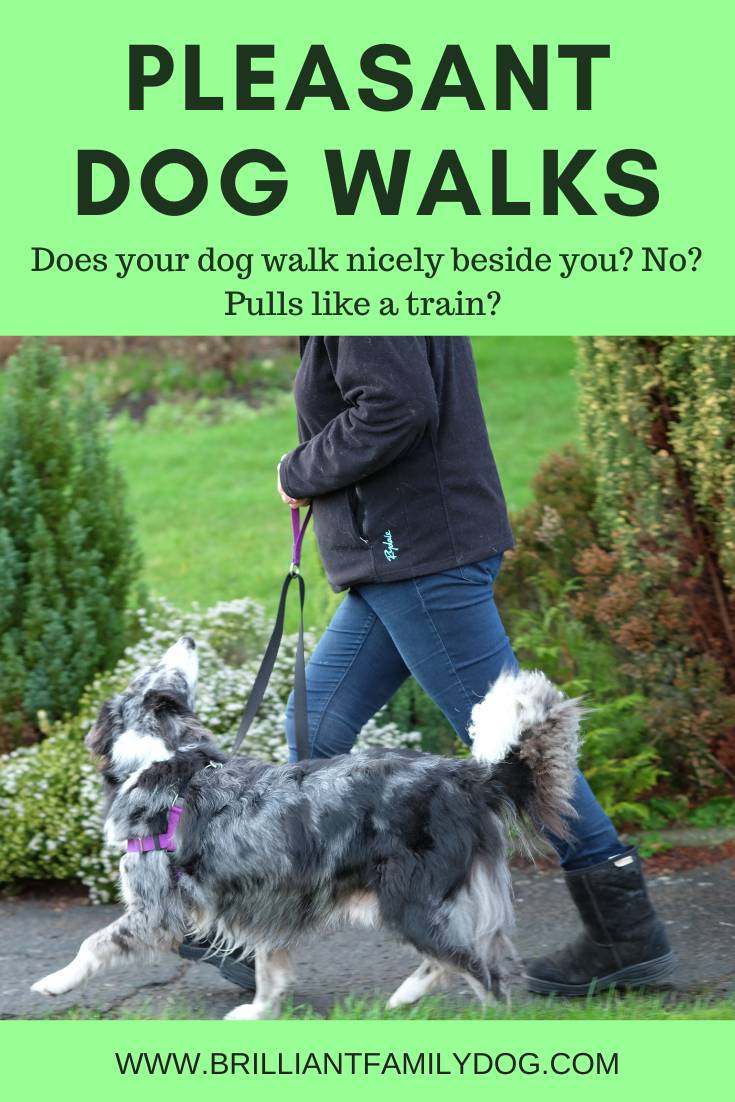
How can I stop my dog pulling on lead?


As I wrote in my post “How do I stop my dog doing xyz?” back in July, this is a very common question I get. 

And as I wrote … back in July (and many other times!) to have your dog STOP doing one thing, you have to teach him how to START another.

But so many methods of teaching your dog to walk nicely on lead are punishment-based. They don’t involve any teaching at all - just yank, stop, and turn. How can anyone enjoy a walk like that?

This is why people write to me. They’ve tried these daft suggestions - trying to STOP their dog - and have had zero success.

They tend to blame the dog (he’s “stubborn”, “stupid”, and all the rest) and never pause to see that they have to do something themselves to change this unhappy state of affairs!


Let’s Go!

So today I want to give you some of the first chapter of Let’s Go! Enjoy Companionable Walks with your Brilliant Family Dog, Book 3 in the series Essential Skills for your Brilliant Family Dog
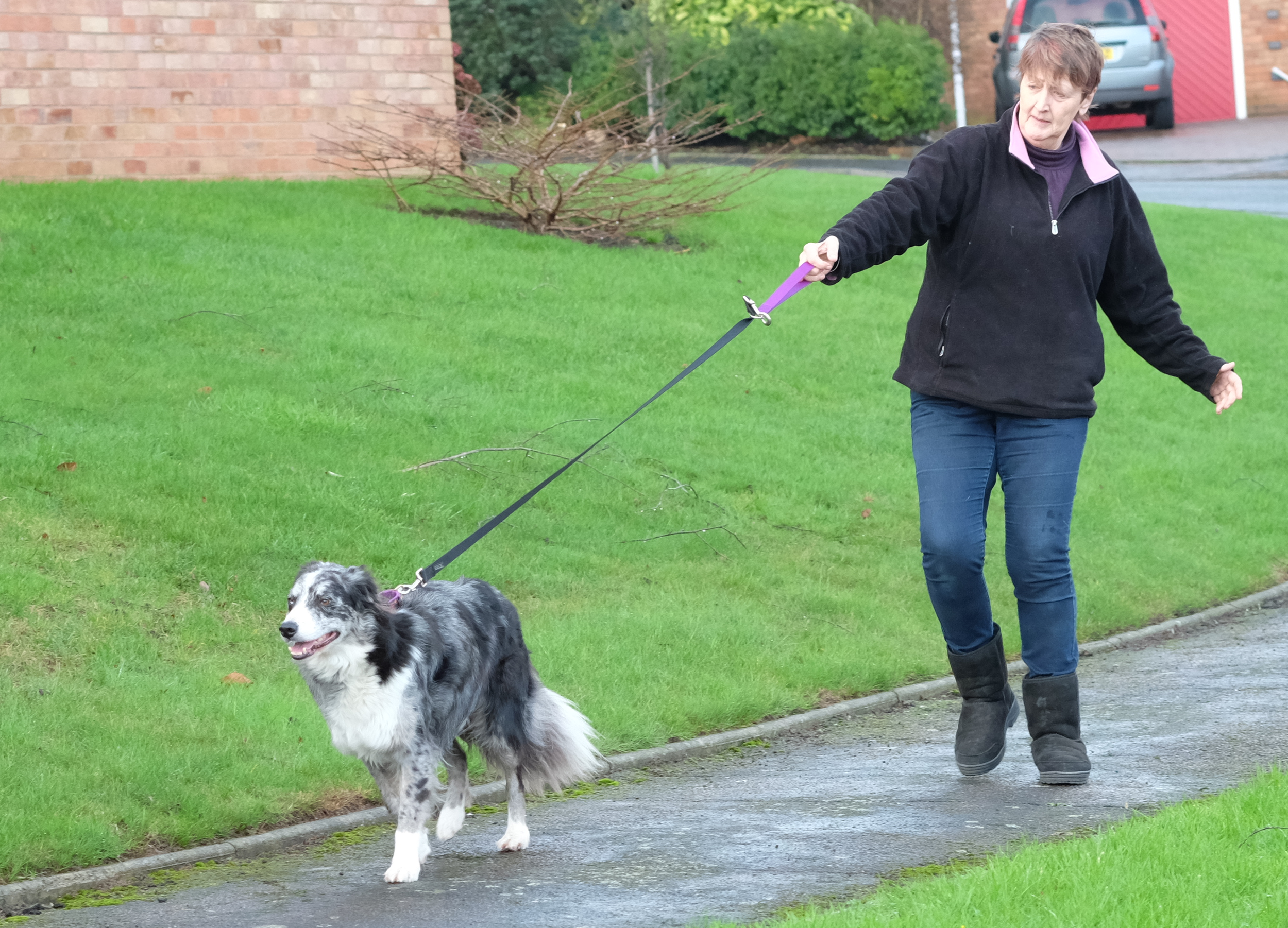
“You’re ready for your daily walk. You are full of hope because you know today is going to be the day your dog walks nicely beside you without pulling your arm out of its socket. You are deluded. Yep, it’s going to be just the same as usual.


Lead on = Carthorse mode.


She nearly pulls you over as you step over the threshold. She strains away from you while you try to lock the door. You reach the roadside, and it’s head down, PULL! She’s choking and spluttering, she’s scrab- bling along the pavement. She’s lurching and weaving - this is no fun for either of you!

I know you’ve tried lots of gadgets and methods to try to make things better - things suggested by people in the park, by friends, family members, and even trainers - some against your better judgment. But why aren’t any of them working? You’ve got collars and leads to beat the band - some of them designed to inflict pain or make holes in your dog’s neck. These devices are sold to prevent pulling, but they just seem to encourage her to pull harder. 

I’m guessing that you have been trying to teach your dog not to pull. This is sadly doomed to failure. If there’s one thing dogs don’t under- stand, it’s not doing something.

Dogs are doers. They do things. They can’t not do something. It makes no sense to them. What we have to do is show them something else to do instead of pulling.

Many people - and probably you too - have successfully taught their dog not to jump up for a treat by simply hanging on to the morsel until the dog is sitting. She can’t jump and sit at the same time, so the jumping dies out.

We can use the exact same system for teaching your dog to walk nicely beside you on a loose lead. Like sitting when a treat is on offer, keeping the lead loose becomes the default behaviour for your dog when she’s walking with you. She can’t pull ahead and be by your leg at the same time, so the pulling dies out.

Really, yes! It will work for you too!

I’ve taught this system to hundreds of puppies and dogs, and I’m always amazed at how quickly the dog gets it - once the owner gets it!

You don’t need any funny gadgets or kit - though I do have help for extreme kamikaze pullers - and there is no force, coercion, or intimi- dation involved. You’re not telling your dog, “You’ll do this because I say so.” You’re saying, “You do this because you like doing it!”

You got a dog to be your companion, not to fight with. You wanted to enjoy the great outdoors. You wanted a reason to get out every day to meet people, to visit new places, to get fit, and maybe shift a few pounds.

None of this is going to happen if your walks are a tussle and a misery!”


Go and check this book out - you can read a sample here, or listen to the audiobook here.

But you need to do SOMETHING!

Expecting your dog to change, miraculously, by having the neck pulled off him is never going to work!

Enjoy your walks together, in comfort and harmony.

Yes - even your dog can do this … just try it, as these people did, and see for yourself:


“Lexie is responding to the lead work beautifully - still early days but it's wonderful to walk her without making one arm longer than the other! All I needed was training - once I started doing it right she caught on no problems - thankyou.” LCS and her Cocker-poo

“Dodger is doing really well with his loose lead walking. I am so proud of him, I can't thank you enough for your help and support.” AD and her Staffy

“Lois pulled like a train on the lead, very strong for a little’un - now she has impeccable manners and walks like a dream. Has become the envy of our neighbourhood!” CR and her Mini Schnauzer

“Hi Beverley, I just wanted to tell you that your method of loose lead walking is brilliant! I have struggled for a year and a half with Molly lead walking and finally a method which works!!!!” KS and her Spaniel


How to keep your dog on your property!


This question arises from some I’ve been asked recently - about electric fencing - not the sort round cattle fields, but the secret menace people embed in their gardens to give their dog electric shocks. 😱

For some reason people seem to think this is A-ok. And it’s not! An electric shock, however given, is a punishment. It breaks down the trust your dog and you should have in each other.

And it’s a lazy option.

Regular readers of Brilliant Family Dog will know my opinion on electric shocks! If you wouldn’t do it to a toddler, you shouldn’t do it to a dog.


Teaching by punishment is not teaching. It’s coercion.


And the daft thing is that it’s just as easy to teach your dog to stay on your property without doing this! 


My fencing is just over 3 feet high, with inviting fields beyond.

In one part of the garden there’s just a single wire 2 feet above the ground.

Because I teach matwork from the start, and use crates and playpens and baby gates for my puppies, they understand very early on what boundaries are.

They could easily hop over those fences. But they don’t. The fence is simply an indication that this side is ours and the other side is not.

Once we’ve established the principle of a boundary, they’ve got it! They don’t need to be continually told. And they definitely don’t need to be continually punished.


Invisible fence hazards

It seems to me that there is some very efficient marketing going on with these “invisible fences”. Naturally enough, only the ease - being able to dump your dog in the garden and never having to supervise her - is emphasised.

But there are also hazards with these “invisible” fences. And you should be aware of them!

Only an animal with a collar on will get the shock. So that means ANY dog, cat, coyote, deer, mountain lion, or anything else, can stroll onto your property. Your dog will be at their mercy.

There are documented reports of horrible results from this.

And as any animal can get onto your property, day or night, they could also defecate there, leaving a rich harvest of worms, flukes, tapeworms - all kinds of disease.

There’s also the chance of your dog developing coprophagia. 🤮 OOER! Even if you clear up immediately, the eggs are still there in your grass.

The worst thing about “invisible fences”

The worst thing - and this is something particularly apposite for the people who actually want to work with their dogs, rather than against them - is the fear effect of an electric shock.

If you were eating an ice cream and got a violent shock from it, how soon would you be happily enjoying another ice cream?

(I love Chinese food. And once after a meal I got horribly sick. Despite the fact that I am an intelligent human with strong reasoning powers, I was unable to eat another Chinese meal for a good couple of years! How would this type of aversive experience affect a dog, without our level of knowledge?)

If your dog sees a dog, horse, child, cat - and gets an electric shock at the same time - how is he going to feel about what he was looking at when it happened?

You’re in danger of creating a new fear, a new reactivity, that you will now have to manage and live with.

I understand there are some properties in the world where you are not allowed to build a fence.

This is incomprehensible to me! What about children playing in the garden?

All I can say is that I would never consider living on a property I couldn’t fence and make safe for my family and my animals.

But it only needs to be a low fence! A hint of a fence!

Want to learn how to teach matwork? You’ve got two options - there’s a book and audiobook called Calm Down! here or there’s our free Workshop on getting your Dog to LISTEN! here.


Is your dog attention-seeking?

I often hear it described as “attention-seeking” when a dog is . . . seeking attention!

She may be dropping toys in your lap all day long, she may be resisting sleep during the day, she may be chewing things up, barking . . . There are all manner of things she may do to get your attention.

But why do you think your dog needs to do anything to get your attention, never mind by doing destructive and annoying things?

It’s because it works!

Dogs do what works

And the worst things usually get the most attention. She’s learnt that.

Or perhaps I should say, you’ve taught her that. 😎

And this begs the question, “Why does your dog have to jump through hoops to connect with you?”


Not “attention-seeking” but “connection-seeking”

It would be better if we were to take a different view of this.

How about changing your perception from an “attention-seeking” dog to a “connection-seeking” dog?


🐾 You chose to have a dog.

🐾 You chose this dog.

🐾 Why does she have to try all these things to earn your affection?


Busybusybusy

We are all busy, all the time. We get swept along from one day to the next, and unless something breaks or stops working, we don’t pay it any heed.

It’s a sad state of affairs if this includes the people in your household!

And dogs are people too.

We have to make an effort to fit what is worthwhile into our day. Maybe just two minutes here, three minutes there. That may be enough to give your loyal companion the connection she craves.


Schedule some fun!

So how can you schedule some fun for your dog and you? [HINT: dogs love getting the chance to use their brains - how about some trick training?]

And to start making a better connection with your dog, watch our free Workshop on getting your dog to LISTEN!

Is your dog obedient? Or is he happy?


The old-fashioned emphasis on “obedience” has led a lot of people astray.  

It’s strange that this fixation on obedience was abandoned in schools a long time ago. The pupil’s wellbeing and engagement is rated much more highly.

Blind obedience is only expected in the armed forces, not in everyday life!

And yet people still have an expectation that their dog should instantly and without thought OBEY their every “command”.

It’s all the wrong way of looking at it.


Happiness leads to “obedience”

The long and the short of it is that if you take care of your dog’s physical and emotional wellbeing, you’ll automatically have an “obedient” dog.

Why?

Because dogs are easygoing creatures who, like us, value a warm bed, a full stomach, and a life free of conflict. And like us, we appreciate those that provide those things.  

So naturally, dogs are ready to comply with whatever works to provide these essentials and these comforts. 

We just need to tap into that mutual admiration, and you will have a confrontation-free environment, a compliant and happy dog, and a happy owner!


Read this article in Psychology Today for more on this.


“But my dog …..”

If your dog does not fit this happy model, I suggest there are things happening that are interfering.

It’s not that your dog is disobedient. It’s that something in your relationship is missing.

Do watch our free Workshop on getting your dog to LISTEN! There’s plenty of sound advice there, and a lesson which people find amazingly transformative. If you only learn one thing, let it be this game!


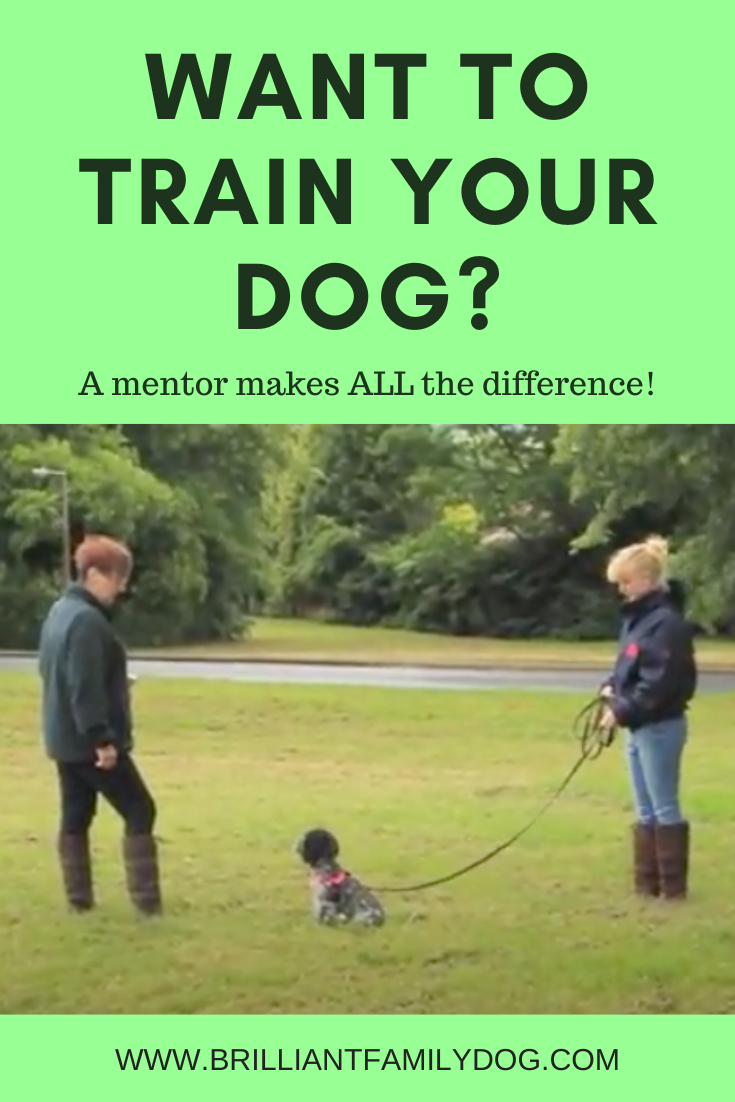
You *can* train your dog - with a bit of help!


I get a lot of mail. People have endless questions - and I’m happy to point them in the right direction. I take the time because it’s part of my mission of helping dogs.

But it’s sad when I get the third or fourth email from the same person. And they’re asking the same question as they did in their first missive!

I give them the same answers. Again.

Trouble is, their dog is now many months or even years older. Whatever their issue was is now entrenched, a habit.

If they’d only followed my suggestion the first time round, their issue would be long gone!


Why are they not helping their dog?

So I wonder .. why is this?

And the unfortunate conclusion is that they think that by asking me the question, they’ve solved the problem!

They don’t seem to realise that they actually have to DO something to put the advice into practice.

And before you throw up your hands and say, “How could anyone be so stupid?” just think of when we’ve asked someone’s advice .. did we always take it? Hmmm 🙄

Or did we perhaps think, “That’s too hard - I can’t do that!”

It could be for reasons of finance, commitment, time.

But here’s the thing: if you really wanted to fix your problem, you’d do what it takes to fix it!

And what it takes could be more than you’re currently able to manage on your own.

What it comes down to is lack of support.

You can fervently wish to change the thing that’s bothering you with your dog, but the advice given just seems too hard to do with the knowledge and experience you have right now.

That’s why you need to use someone else’s knowledge and experience!

We can’t know everything. We can’t be good at everything.

We need the humility to recognise when we’re beat, and that we need to ask for help.


I want help with my dog!

This is why students do so well in my programs. They recognise that they can’t do it alone, and they get that help.

The 1-1 coaching is available for as long as you like. You never get thrown out of the program - this is actually unusually generous. Many programs are for only a year, then you’re out. In mine - you just stick around and make friends!

My programs have continual input from me and my experienced trainer team. You never have to do this alone!

In From Growly Dog to Confident Dog, for instance, there are regular Coaching Calls with individual coaching.


Here’s what some of our Brilliant Family Dog students have to say:


“I am over the moon with the course and can see improvements every day. I am so happy I found this program. Thank you Beverley and Trainers.” DD


“Your communities are just fantastic! You have set the whole tone for support, friendly advice, constructive comments, a much appreciated touch of humour, encouragement, keeping up enthusiasm ... and more. It's a pleasure to be part of it, to dip in and out as life goes on and always to feel welcome.” JL


“I have started week two of the training with her and am already telling others how amazing the course is. If I'd only found Brilliant Family Dog before I got her!! I think your program is absolutely fabulous. Really enjoying the training.” LB


“Many thanks for being you! and for all you have taught me. My puppy is so different to all my expectations, because of you. Your training truly is brilliant!” CN


“I can’t start to explain how happy I am with the help and support I’ve had in the Brilliant Family Dog Academy, and its carefully-structured training.” SW


“Seems to me that you wear many different hats .... dog trainer, people trainer, educator, counsellor, support/outreach, author, etc - awesome!” LA


“Beverley, we will continue on our amazing journey, I am so pleased you are a part of it. Feel proud of what you do, it is invaluable and really does make this world a better place, especially for the canines who live alongside us.” SM


Want to get started with this guided learning?


Are dogs sentient beings?


Of course if you’re delving in www.brilliantfamilydog.com then you are fully on board with that idea!

Dogs think and feel. They feel pain, grief, affection. They feel fear, loss, joy and sadness.

We who live with the beasties know that.

But it’s horrifying to think of all those who either don’t know it, or simply deny it.

Here in the UK we can celebrate the efforts made to successfully get the new The Animal Welfare (Sentience) Act 2022 passed. It is now law.

Animals’ feelings must be considered when legislation concerning their treatment or environment is made.

And here in the UK a new law emphasises this sentience by making it a crime carrying up to five years' jail for stealing an animal.

The recognition of animals as sentient beings has been enshrined in EU law for a long time. And there are similar assurances of animal sentience in the USA.

Will other countries follow suit?


Insects too

Meanwhile, for those of you interested in all this, here’s an article from the Washington Post, The Consciousness of Bees.

It’s a fascinating read, showing that bees too experience fear and hope. They can think in order to solve problems, and have extensive learning memories, even recognising human faces.

Let us know what you think in the comments below!


Meanwhile, to find more about building a life with your dog that embraces mutual learning and excludes fear - watch our free Workshop on getting your dog to LISTEN!