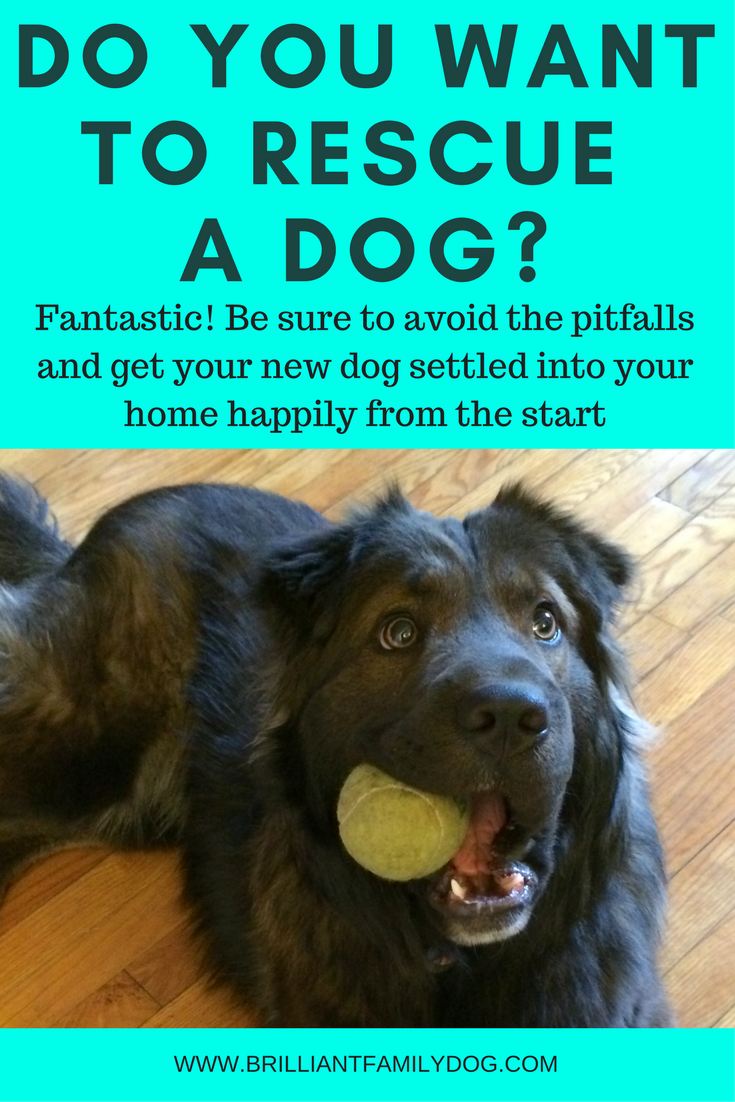
So you want to rescue a dog? Read this first!

Reactive dog, rescue dog, aggressive dog, fearful dog, dog behavior | Has your rescue dog become very difficult when out? Read here how to get things running smoothly for both of you | FREE EMAIL COURSE | #aggressivedog, #reactivedog, #dogtraining, …

You want to rescue a dog - give a home to a poor neglected beastie who’s had a bad start in life? Good for you! 

There are so many stories of spectacularly successful adoptions, where the dog fitted easily into her new home from Day 1, had few issues and was easy to train. 

But this isn’t by any means always the way it goes. So you need to go into this with your eyes open.

Different dogs, different folks ...

Is your new dog struggling with the outside world? Get our free e-course here and get started!

THIS E-COURSE IS A BONUS FOR YOU WHEN YOU SIGN UP TO RECEIVE EDUCATIONAL EMAILS AND OCCASIONAL OFFERS FROM ME. YOU CAN UNSUBSCRIBE AT ANY TIME.
Privacy Policy

Do not allow sentiment to cloud your judgment! Most dogs up for rehoming (unless they’re very young puppies) come with baggage - of some sort or another. We all have baggage - life experiences that have formed our worldview - some good, some not so good. 

And not every dog is the perfect match for your life. Some will have been neglected; some will have been abused; some have lost an adoring owner through death or other catastrophe; some were just not given the right care. 

But they all have a history, good or bad. 

Same as you would, if suddenly transported to a new home where people do things differently. There’s scope for a lot of misunderstanding and confusion here - even which way you hold your knife and fork, or how to make coffee! So imagine how hard it can be for a dog to adapt to such a major change in his life.

Sometimes the dog settles into his new home seamlessly and easily, but sometimes this baggage takes a lot of work, some expense, and much dedication, to unpack. 

Love alone is not enough.

Backstory

Any reputable rehoming shelter will tell you the truth about your chosen pet. But sometimes they don’t know the truth themselves! If the dog was found straying there is no history attached. And a dog in even the best and kindest rescue centre can be completely shut down and depressed - or continually hyper and mad. Neither of these states will reveal the true dog. Only once your new dog has been in your home for as long as two or three months will you know what he’s really like, and what issues he may have. 

If I moved into your house, for example, at first I’d be saying “Is it alright if I sit here?” and “Where does this cup go?”. After a couple of months I’d be feeling at home and sitting where I liked and leaving cups any-old-where! This is when you’d see the natural me. So it is with your new dog!

“My dog was so quiet and easy, and now, two months on, he’s starting to steal things, bark, dig up the garden … what am I doing wrong?”

That's a fairly common question. My answer?

“Nothing! You’re doing it all right and your dog is making himself at home and behaving in a relaxed and natural manner and being a dog. Now the training begins in earnest.”

By the way, not all shelters are created equal. If you arrive at a place and it’s noisy, the dogs are all racing about their pens barking, showing repetitive behaviours like circling or jumping off the wall, and some dogs are lying deathly still and have completely opted out, then you will struggle to see what your selected dog is actually like in reality. Stress has taken over and made the original dog unrecognisable. It can take many weeks for this dog to unwind.

Think of those poor children in camps in war-torn countries: we would absolutely expect them to have substantial damage which would take many, many years to repair. Why do we assume a dog will just be fixed in an instant?

There are shelters with enlightened policies of taking in fewer dogs (though successfully rehoming more!), giving all dogs more space and distance, keeping things calm and quiet, not allowing public access to all the dogs - only the ones they select to offer a particular family. 

Check out these resources to locate a shelter which follows the latest guidance for giving rehomes the greatest chance of success:

www.nawt.org.uk/open-paw

You may be working against a difficult history

Reactive dog, rescue dog, aggressive dog, fearful dog, dog behavior | Has your rescue dog become very difficult when out? Read here how to get things running smoothly for both of you | FREE EMAIL COURSE | #aggressivedog, #reactivedog, #dogtraining, …

Keep in mind that if this dog were no trouble he may not have been abandoned by his owners. That’s not exonerating those owners - they should have thought before even getting a dog in the first place. Giving up on an animal through their own neglect and idleness is utterly wrong, and unfair. 

He may have developed habits through lack of adequate care or training, that caused his first owners to get rid of him.

•  Maybe he’d developed a habit of running off, because he was never taught a recall.  

•  Maybe he was left alone all day and chewed up the furniture. Not his fault, but this could be the reason he was thrown out. Or rehomed. So now you have to train recall and staying alone from scratch. Check out the articles here at brilliantfamilydog.com, the free e-course, and you can get started with this mini-course:

• Maybe he was never properly socialised as a puppy, and has a distorted view of strange dogs and people and things as a result. Here you’ll have an ongoing task - to help him cope with our world. And this is the one which may cost a lot of money and a lot of time, but which will repay you many times over in watching your dog change and develop and gain in confidence. Check out the resources for Growly Dogs, the free course and premium course

Love alone just isn’t enough

Love and nurturing will do a lot of healing, of course. But to deal with any difficult issues - such as inability to cope with the presence of other dogs on the planet without lunging, barking, or screaming, threatening to bite if approached, stealing and guarding stolen items ferociously - you need professional help. There’s no need to struggle on for months while the situation gets worse and worse and you regret your decision to get your dog! Get the help you need straight away. Once you understand why your dog is acting as he is, changing it becomes straightforward.

Finding a true force-free trainer is essential. Any aversive or coercive methods (shouting, throwing things, yanking the lead etc) will only compound the situation and make it far worse in the long run. You’ll find a list of useful organisations at the foot of this previous article

There are plenty of rehomed dogs who have turned into Brilliant Family Dogs! This may be by luck or by judgment, but is a great outcome. In my line of work I naturally tend to meet a lot of the rehomes that cause problems.

And I’m happy to be able to say that the situation can always be vastly improved. It’s a joy to see the dedication of the new owners as they work to rebuild their new dog’s shattered confidence.

Cast off the rose-tinted spectacles!

Matching a dog to your family is a delicate and difficult task. Be sure to remove your rose-tinted glasses before you make any decision. You and your family will be living with this dog for anything up to the next 15 years or so. The placement must be right for you and your dog, but also your children and your spouse too, not to mention your cat.

While you’re still looking for your perfect companion, do a bit of research into what you’ll need. Here’s your Action Step: While you can’t purchase a crate until you know your new dog’s size, you can certainly do your homework and narrow down the choice so you’re ready to get one as soon as you expect your dog to arrive with you. Don’t cut corners - go for the best and most robust that fits your budget. This crate is not for confining your dog to keep him under control - it’s to give him a safe haven where he gets all his meals and toys, which he’ll love, and which will help enormously with separation - both night-time and daytime absences. 

And don’t forget the essential training! You can’t expect your new dog - who may be very confused about what people want of him - to just know what you want. You have to teach him, step by step. And while some of those steps may feel uphill, most will be successful - if you follow a force-free training program. There are some excellent dog training classes around the world where the instructor is firmly grounded in force-free training, treating each animal as an individual (refer to that list above for umbrella organisations).

But if you’re in a force-free “black hole” and there’s no class around that you would countenance taking a dog flea to, never mind your precious new dog, take a look at the articles here at www.brilliantfamilydog.com

They follow the same style of teaching as my books, which have received over 150 5-star reviews from pet-owners, who enjoy their directness, simplicity, and effectiveness (and humour!). You may have a challenging new dog - but with a little help and support you can turn him into your perfect pet.

Happy hunting for your new companion, and may you be one of the great rehoming success stories! 


Want to get off to a flying start? Get our free e-course here and get started!

THIS E-COURSE IS A BONUS FOR YOU WHEN YOU SIGN UP TO RECEIVE EDUCATIONAL EMAILS AND OCCASIONAL OFFERS FROM ME. YOU CAN UNSUBSCRIBE AT ANY TIME.
Privacy Policy


>

Just like us, dogs never do anything for no reason

Reactive dog, aggressive dog, fearful dog, dog behavior | Dogs don’t do things for no reason - learn their language!  | FREE EMAIL COURSE | #aggressivedog, #reactivedog, #dogtraining, #growlydog | www.brilliantfamilydog.com

One of Lacy’s cute things is to wham her face between our knees and keep it there for a while as we stroke her ears and whisper sweet nothings to her. (This is not to be confused with crotch-sniffing, which she doesn’t do.)

We call it “Wigwam” (it just seemed to describe it well).

I know that she’s doing this to get reassurance. She needs to feel that we are her people, her protectors. She’s anxious by nature, and you can hear her sigh and see her whole body relax as she wigwams.

But it took me a while to make the connection which explains why she does it.

It’s the muzzle-grab

Get the lowdown on why your reactive dog does what he does, and how to start a major change!

THIS E-COURSE IS A BONUS FOR YOU WHEN YOU SIGN UP TO RECEIVE EDUCATIONAL EMAILS AND OCCASIONAL OFFERS FROM ME. YOU CAN UNSUBSCRIBE AT ANY TIME.
Privacy Policy

The muzzle-grab is what an older dog may do to a younger one, perhaps a puppy who is getting out of hand. They open their mouth wide, and wrap it right round the pup’s muzzle to keep it shut. The teeth are covered - it’s not intended as a bite. It’s a very clear way of saying “Keep your mouth shut near me,” is painless, and effective. 

They can also do this in play to a close companion (one living in the same house, usually). A dog who doesn’t enjoy these privileges will get a real snap or face-down. It’s a reprimand for the family, just as we have things we may say only to family members. (In my family growing up, “FLO” - when we had visitors - meant “Family lay off” or “Stop eating all the cakes!”) 

Those hippo jaws that dogs play with are a precursor to a muzzle-grab, if they can get in the right position.

Reactive dog, aggressive dog, fearful dog, dog behavior, dog play | Good dog play is full of lessons for us - learn how to speak dog!  | FREE EMAIL COURSE | #aggressivedog, #reactivedog, #dogtraining, #growlydog, #puppyplay | www.brilliantfamilydog.…

But here’s the key: sometimes a dog will solicit a muzzle-grab from an older dog or a companion. This is to be reassured that they are still part of the group, meriting the kind of action normally directed to a puppy. They are loved and cherished, in other words. They feel they belong. 

It’s a bit like a cat purring to provoke affection, or a puppy nuzzling a hand for pets. 

And this is what Lacy is doing to us. She is provoking a muzzle-grab by pushing her head between our knees. She is putting herself in this vulnerable position - her eyes covered, her head trapped - to seek that feeling we all need to experience regularly. To feel loved and protected.

I knew what Lacy was doing. It satisfies my curiosity to know why.

Dog Body Language

This is just a glimpse into the complex and sophisticated body language dogs employ. We - especially the British with our history of empire - tend to expect everyone else to learn our language. If they don’t get it the first time, we shout at them! And this is how many people treat their dogs.

They assume because their dog doesn’t understand their words she’s being deliberately obtuse, stubborn - or just plain stupid. This is so unjust!

If we can just take the time to learn our dogs’ sensitive body language, not only do we have a new way of communicating with them, but SO MANY misunderstandings will be avoided! It’s not difficult to observe and note what our dog is saying to us. But many dog-owners have no idea. They just don't see it. They prefer to act the sergeant-major and shout at their dog.

Understanding your reactive - growly - dog

It’s especially important to be able to understand your dog if she has reactive tendencies - fearful, anxious, shy, aggressive - a Growly Dog in short. Once you can understand how your dog actually feels in a situation, it makes it so much easier to get a good outcome. This is definitely not a time for yelling ever louder at your “thick” dog!

This is something I go into in great detail in my course for reactive dogs: From Growly Dog to Confident Dog, and which brings lots of “Aha!” moments to students, who begin to see a way forward, at long last. 

And to get started straight away with lessons to help your Growly Dog cope with our world, watch our

Free Masterclass for Growly Dogs

He may be reactive but he’s still a dog

Reactive dog, aggressive dog, fearful dog, dog behavior | A reactive dog is still a dog! Don’t forget to train him just the same way as any other. The relationship will blossom and life will improve | FREE EMAIL COURSE | #aggressivedog, #reactivedog…

Got a reactive dog? One who barks and lunges at innocent passers-by; grows fangs and a forked tail at the sight of another dog in the same parish; or maybe just melts with fear at the sound of a bicycle? 

I feel for you!

I’ve been working with reactive dogs for years, and I have my own two Growlies too. So I know just what you’re up against. 

Fortunately more people are becoming aware of the issues, and that means slightly more people are beginning to understand that it’s not your fault! You’re not a terrible owner, and you haven’t got a horrible dog. He’s just not fitting in with the popular perception of what a pet should be.

But, as you’ll know, your difficult dog is the perfect pet at home. You know how friendly, biddable, loving, and fun your dog is - once the fears that dance around her when out are removed. You know how to soothe her, how to play with her, how to stimulate her great brain so that she loves to do things for you.

Your dog’s still a dog

And it can be hard to remember, when you’re out and about and dealing with her demons, that at heart that’s what she is. She’s a dog. Maybe not the dog you expected when you took her on. Not the dog you’d be able to go on group walks with, not the dog to compete in agility with, not the PAT therapy dog you’d planned - visiting the old and the sick and charming them all.  

[Actually there’s a good chance you could do the group walks … in time … and you can seek out agility teachers who understand and make the necessary arrangements for your dog to feel safe. PAT dog? Just maybe … in time.]

Get our free e-course to make instant changes in your growly dog!

THIS E-COURSE IS A BONUS FOR YOU WHEN YOU SIGN UP TO RECEIVE EDUCATIONAL EMAILS AND OCCASIONAL OFFERS FROM ME. YOU CAN UNSUBSCRIBE AT ANY TIME.
Privacy Policy

We can get so taken up with all the slightly different things we have to do with our troublesome pooch - like dodging into driveways, muzzle-training, learning sharp emergency turns, never being out without a supply of tasty treats - that we can overlook the basics. Building the bond with your dog is what it’s all about.

Building an unbreakable bond

I’ve noticed recently that a number of students in my plain vanilla dog training course (not geared for reactive dogs, in other words) are reporting - with surprise - that their dog is much less reactive when out, faster to settle, less likely to kick off at the dogs on tv.

Reactive dog, aggressive dog, fearful dog, dog behavior | A reactive dog is still a dog! Don’t forget to train him just the same way as any other. The relationship will blossom and life will improve | FREE EMAIL COURSE | #aggressivedog, #reactivedog…

Working through the course lessons has turned them and their dog into a TEAM. The old acronym Together Everyone Achieves More, is never more clear than when you’re working with your dog - especially a challenging one!

And it’s wonderful to see how things improve - not with lots of work outdoors in the thick of it - but by just playing some simple but cunningly devised games with your dog on a daily basis. You can see the change within the first few minutes of them being introduced to the game. “Suddenly,” thinks your dog, “this person understands me!” And you are left open-mouthed, wondering at the speed with which your dog has learned the new games, and how eager he is to play them anywhere, any place, any time.

As Sophie said: “We are doing the training every day, a few times a day. It’s doing wonders for us at home and we are using it on walks too!”

Just for Reactive, Aggressive, Fearful - Growly Dogs

This is why, when I’m working individually with a reactive dog, I teach them these relationship-building games right at the start. Regardless of what happens outside, I want the dog and owner to get these under their belt straight away. And it’s a delight to see an owner change from trying to command their dog all the time, to allowing the dog to express his own opinion and make his own (good) decisions.

See my last two posts for more on this:

Little things DO matter - for your dog everything matters
Once you remove the friction everyone is happier

Of course, the reactive dog owner does need strategies and techniques to improve their outside life, possibly opening up more possibilities in terms of where they can walk, and whether they can enjoy a cafe stop with their dog, like everybody else seems to be able to do. These learnings are vital to the success of the training. And I’ll be going into these in huge detail in my upcoming Growly Dog Course. It’s been tested out by the first group of students, and their suggestions and requests have changed the shape of the course so that it’s now everything they wanted.

That vital bond!

But none of this will work if the relationship is not there in the first place! It may be that you’ve been focussing so much on the trickier areas of your dog’s life that you’ve let slip this vital bond. I do understand how this can happen. You can try so hard to work on what’s going on outside - when a step back into harmony inside can have far-reaching results.

As one Growly Course student put it: “Your generosity in sharing techniques and ideas about dog training in general, which is also part of our growly dog puzzle, is helpful, and much appreciated.”

She got that it’s about all the other stuff in your dog’s life with you - not just the apparently difficult parts.


Is your dog throwing up more challenges than you anticipated? Watch our free Masterclass and find how to change things fast!

How can I stop my dog doing stuff I don't like?

Dog training, new puppy, puppy training | My dog keeps ... [insert annoyance here]! How to stop your dog doing stuff you don’t like | FREE EMAIL COURSE | #newpuppy, #dogtraining, #newrescuedog, #puppytraining, #dogbehavior | www.brilliantfamilydog.c…

People are often looking for an instant fix to something they don’t like. 

Me too! 

I’d like a magic wand to wave over life’s problems. Trouble is, people come to me thinking I can wave a magic wand over their dog’s problems and they won’t have to do a thing. 

A recent query was along the lines of, “My dog runs around barking all day in the garden. How can I stop him?”

You don’t have to be a genius to see that your first step must be - don’t leave him unattended in the garden! You can’t hope to change his behaviour until you’ve changed things enough to prevent him indulging in it.

My dog keeps … [insert annoyance here]!

Here are some starters for you:

    •    Jumping up on the furniture
    •    Raiding the bin
    •    Running off on walks
    •    Barking
    •    Destroying shoes
    •    you name it

Whenever someone tells me one of these things, I have one (smug) question:

“Where were you when he was doing all this?”

If you cannot yet trust your dog in any of these areas, then you shouldn’t give him the freedom to carry on doing what you don't like!

Practice makes Perfect - this doesn’t just apply to piano and tennis!

Every time your dog indulges in one of these annoying activities he’s getting more fun from it, and getting better at it. It becomes a habit - and we all know how hard habits can be to break.

The good news is that good habits are just as hard to break as bad ones.

Free online training workshop for you and your dog!

Free online training workshop for you and your dog!

  • If your toddler had a fascination for the oven, you wouldn’t be leaving her unattended in the kitchen.

  • If your 6-year-old is a danger on his bike, you wouldn’t let him out on the road on his own.

  • If your teenager was beginning to mix with the wrong crowd, you wouldn’t be cheerily waving him goodbye of an evening, knowing you’ll be finding him in the police station later that night.

So if your dog is doing something you don’t like, the first thing to do is make sure he can’t do it. 

  • You can shut the door to the front room when you’re not there (this will prevent chewing the furniture and barking at the window).

  • You keep your dog in the same space (room/garden) as you so he can’t chew shoes, raid bins, dig up the flowerbeds, bark at the moon.

  • And if he runs off on walks - you use a long line so that he can roam but not ramble.

That's just for starters ...

Now that isn’t the end of the story. And none of this should be forever. 

Once you’ve got a measure of control over the situation, and you’ve removed the frustration and the yelling, you can start to re-teach your dog what you’d like him to do. 

Dogs don’t exist in a vacuum. They can’t NOT do something - they’re doers.

So once you’ve eliminated what you don’t like, the way is open to change your dog’s habits to what you do like.

So come and join our free 5-day Workshop today! 5 days of free online training, with videos, text, and live broadcasts. You’ll get to meet a host of other lovely dog-owners who are looking to improve the connection between them and their dogs.


To change your dog you need to change yourself first! Watch our Free Workshop and find out how to transform your “deaf dog” into a LISTENING DOG!


Can I really train my dog by giving him a choice?

Dog training, new puppy, puppy training | Training your dog a choice is much easier and more effective than you may have thought | FREE EMAIL COURSE | #newpuppy, #dogtraining, #newrescuedog, #puppytraining, #dogbehavior | www.brilliantfamilydog.com

We all want to do the best for our dogs. Of course we do! 

We love them dearly and want only good things for them. That’s why you’re here!

But it’s so frustrating that when it comes to training for your pet there are often so few options in your locality. Either the classes are at difficult times, too far away, or there’s just too much going on in your life. You were already using your allotted 24 hours in full before you got a dog! Now you’ve got to fit all this in - maybe three hours out of one of your valuable evenings at home with the family. 

Then there’s the trekking to the class, perhaps in the dark, having to organise babysitters - many won’t allow children. The weather may be awful, you may be held up at work, your car may break down! It’s common for even the most dedicated of dog-owners to have to miss lessons from the local class they’ve enrolled at. Life happens!

Another problem is that you can’t find any trainers you’d want to work with. There’s an awful lot of harsh training out there, often masquerading as good training - making it very hard to know what you’re letting yourself and your dog in for. Having your dog shouted at by a “trainer” is bad - being shouted at yourself, belittled, shown up - is even worse!

So all in all I do understand why lots of people decide to pass on classes and “do it themselves”. 

Trouble is, that only works if you know the answers already! Otherwise you may just be passing on the old-fashioned methods and old wives’ tales handed down to you in your childhood.

You need to have access to the latest in scientific training techniques, with convenient classes led by an experienced and understanding trainer.

Times they are a-changing

Dog training, new puppy, puppy training | Training your dog a choice is much easier and more effective than you may have thought | FREE EMAIL COURSE | #newpuppy, #dogtraining, #newrescuedog, #puppytraining, #dogbehavior | www.brilliantfamilydog.com

Well, I may have an answer for you! As a trainer who uses only dog-friendly methods, based in science (no pixie dust or magic mushrooms!), and who genuinely has the dog’s wellbeing at heart, I could be just who you’re looking for. I’m also people-friendly! You won’t be shouted at or belittled as sadly so often happens in dog training classes.

I get amazing results very quickly, and it’s all done by giving the dog a choice - just as you do with your family and workmates. You don’t order them around and expect them to comply! You show them what you’d like, then encourage them to choose to do that for you.

As you know by now, I don’t talk gobbledygook. Look at these emails - representative of many that I get. Life is too short to be trying to unfathom deep mysteries! We want it explained in language we can understand.


“Thank you for sharing your easy-to-follow tips, helping us to help Smidge become our Brilliant Family Dog!”
Janet and Smidge Patterdale x

“Thank you for your books and articles - they are a great help: clear, simple and easy to follow and remember. I've read similar books, but almost all are much more wordy and hard to remember.”
Carol and Charlie in Singapore

“Wow! Back to Amazon! :-) I’m only partway through the first book but it’s great. So easy to understand. So well explained.”
Shirley and Hettie, Huntaway


So that is always my aim. It’s absolutely pointless having information about how the dog’s mind works, and being unable to convey it to the person the dog has to live with - through not understanding how the owner’s mind works!


Hmm … but just look at the map

BUT - I hear you cry! - you live in the middle of England and I live in Australia / West Coast of America / Hong Kong / Scotland / [insert your location here]. 

Thanks to the wonders of the internet, things are changing. Anything can be taught effectively online, from baking to weight loss, from ancient philosophy to astro-physics, there are even popular courses on blacksmithing and aerial dance! I have personally taken a lot of online courses and found them hugely helpful.

And dog training is another subject that works really well! You follow the course in your own time, and in your own home! If things are explained thoroughly and understandably, and you are shown videos of the training in action, you can learn really fast.  

Start the change with your reactive, anxious, aggressive - Growly - dog with our free Masterclass packed with ideas and strategies, all force-free


My dog’s NOT afraid of fireworks! But why?

Reactive dog, aggressive dog, fearful dog, dog behavior, fireworks | My reactive dog's *not* afraid of fireworks: Why?  | FREE EMAIL COURSE | #aggressivedog, #reactivedog, #dogtraining, #growlydog | www.brilliantfamilydog.com

Fears have been high up in doggy discussions recently. It’s the Fireworks season in the UK and this is what’s brought them bubbling to the surface again.

Remember, remember, the 5th of November - gunpowder, treason, and plot!

And one thing common to a lot of these discussion threads was the surprise registered by owners of reactive dogs who were not upset at all by the noise. Some of these new owners had got prepared for the onslaught and were expecting the worst - then were utterly astonished that their dog couldn’t care less about it all.

So perhaps a little look at the subject of fear would be helpful here. 

Free Puppy Socialisation Guide

Puppy socialisation free guide smaller

Learn new force-free ways to teach your new puppy!

THIS GUIDE IS A BONUS FOR YOU WHEN YOU SIGN UP TO RECEIVE EDUCATIONAL EMAILS AND OCCASIONAL OFFERS FROM ME. YOU CAN UNSUBSCRIBE AT ANY TIME. Privacy Policy

We won't send you spam. Unsubscribe at any time. Powered by ConvertKit

Is all fear the same?

Humans are born with only two fears: fear of falling and fear of loud noises. And these fears are stimulated in the Apgar tests for newborns, to elicit the startle reflex and check that all is well neurologically with the baby. All other fears are learned.

So fear of ghosts, planes, spiders, heights, and so on, are acquired on our journey through life. Many of these fears are developed early on, and can be heavily influenced by our family's response. A mother who is afraid of spiders can quickly transfer this fear to her children, while the mother who is happy to pick up an insect and take it to a place of safety is likely to have children who are curious about the other species in their environment and not fearful of them. It’s also true that a natural predisposition to be cautious around predators means that people are more likely to be afraid of creatures than of … bicycles, or trees.

Now the jury is out on whether dogs are born with any fears. Certainly there will be a predisposition to fear certain things, and the social influence of the mother and the environment in which the pups are reared are definitely going to have a big effect. Hence the supreme importance of early and proper socialisation for puppies up to the age of 12-15 weeks (jury is out on the timescale too).  

But we can certainly influence this fear by showing extreme fear ourselves. 

Will I make my dog worse if I cuddle her?

Fear is an emotion. And you cannot reinforce an emotion. It’s either there or it isn’t. You can only reinforce a chosen behaviour. While it is not possible to reinforce the emotion of fear - that is, to reward it and encourage it and make it stronger and more likely to occur - by giving comfort to a frightened person or dog, it’s certainly possible to plant the idea that fear is the correct response to something. Hence the general firework advice to mask the noises and flashes as much as possible (loud tv, curtains drawn, prepare a den) and carry on as normal yourself.  

You can't make your dog more afraid by comforting her.

You can't make your dog more afraid by comforting her.

And this advice also extends to not making your dog afraid of other dogs by being afraid yourself! So many people anticipate a bad outcome at the sight of another dog - maybe because their dog is reactive and has barked and lunged in the past - that they will tense up, breathe quickly, panic, tighten their grip on the lead, winding it six times round their hand to shorten it. This is telling your dog that you are afraid of the incoming dog, and that strange dogs are inherently dangerous. As you’ll see in the Growly posts on this site, your first response at sight of an incoming dog should always be

  • Relax hands

  • Relax shoulders

  • Breathe out

  • Relax lead

This will be telling your dog that you are ok with the incomer. (Whether you are or not is beside the point!)


What’s conditioning? And what’s counter-conditioning?

So fears grow in people and in dogs through experience, through social learning, and from a pre-disposition - self-preservation is all-important, so being afraid of things about to pounce on you is sensible. There’s also genetics to factor in. Some dog breeds are more alert to strange things in their environment than others, and are going to be faster to develop fears - unless that careful socialisation, familiarisation, and habituation, is done.

So your puppy is being conditioned to certain fears through his life experience. A snake appears and mum runs away from it: noted - snakes are dangerous.

Counter-conditioning is when we weigh in to lessen a fear, or lessen the impact the fear will have, by changing the association in the dog’s mind to something good. If every time that pup sees a snake you stuff pork pie in his mouth - his emotional response is going to change, over time! No, we don’t want him getting curious about the snake and approaching it - but we equally don’t want him to panic and run off - into the path of our modern-day killer, a car.

Your dog is going to be afraid of things he’s learnt to be afraid of. It follows that without that experience he’s not going to have the fear in place. Of course there are dogs who are so psychologically damaged that they have a generalised fear of everything. But even these can be brought to a level of comfort with patience and dedication, and possibly medication.

So being afraid of snakes is not going to make your dog also afraid of cars. And being afraid of other dogs is not going to make him afraid of horses, or sheep, … or fireworks. 

Cricket will sleep through a thunderstorm!


Cricket the Whippet will sleep through almost anything!

Cricket the Whippet will sleep through almost anything!

In my own household I have two (Lacy and Coco) who will ignore most fireworks, but bark at a very loud bang - it’s an “alert bark” not a panic attack - one (Cricket the Whippet, the professional sleeper) who is not at all bothered, and Rollo the usually independent Border Collie who gets very unhappy and worried.

During the firework season Rollo sticks to me like a limpet, wedging himself under my legs and following me pathetically wherever I go. It’s at least reassuring that I am considered a place of safety. The situation is manageable without medication, as he doesn’t panic and damage himself trying to escape - as some dogs do.

The interesting part - for the purposes of this discussion - is that Rollo is not what is commonly termed “reactive”, while Lacy and Coco most definitely are.

Border Collies are a sensitive breed with superb hearing. So if they’re going to be worried about anything it’s understandable that loud and sharp noises would be up there. But it’s not automatic that a Collie would be noise-sensitive, any more than the dog who is afraid of men in hats, for instance, should also fear children. 

So what you can take away from this is that fears will exist in your dog; you can minimise those fears with appropriate socialisation at the correct age; you can help make those fears manageable with careful training; and that a fear of one thing does not automatically imply a fear of anything else. 

Want some more help with your fearful or reactive dog? Here's a free email course that will get you on the road to success!

THIS E-COURSE IS A BONUS FOR YOU WHEN YOU SIGN UP TO RECEIVE EDUCATIONAL EMAILS AND OCCASIONAL OFFERS FROM ME. YOU CAN UNSUBSCRIBE AT ANY TIME.
Privacy Policy

Watch our free Masterclass to Start the change you want!