Why Did My Dog’s Reactivity Get Worse, When I’m Trying My Best?

First published on positively.com and reprinted here with permission


Many people will tell you to do nasty things to your reactive dog, to STOP him lunging and barking. But the harsher you are to your dog, the worse he will get. Brilliant Family Dog is committed to improving the lives of dogs and their harassed owner…

Does your reactive dog seem to be getting worse?

More fearful, anxious, or aggressive - not less?

There are a few key strategies you can put in place very easily that will make a dramatic difference to how your dog perceives the world.

Here’s an excerpt from my three books on Growly Dogs - Essential Skills for your Growly but Brilliant Family Dog


This is Chapter 5 from the first book Why is my dog so growly? It’ll get you started on the road to change.

Chapter 5: Why did it get worse, when I’m trying my best?

It will get worse - unless dealt with

There are some things that dogs do that will go away on their own. Some puppy behaviours, like chewing, submission-weeing, digging, will simply evaporate if carefully managed. But there are other things - usually the things we really don’t want! - that will build and build, getting worse and worse, until we decide to act.

When we do something for the first time, a neural pathway in the brain is built. To begin with this pathway is fairly narrow and hard to find. Think, learning to drive a car - it’s all foreign to us and hard to remember the sequences. But the more we repeat that thing, the wider and brighter the neural pathway becomes until we can just slide down it without a thought. It becomes our go-to response. We can drive on auto-pilot!

So every time your dog does something, he’s building those neural pathways bigger and stronger. He doesn’t have to think hard, as the learner-driver would to locate which pedal to press. It becomes his automatic, instant, response. In the case of our reactive dog: “See dog: bark!”

While this all started as a fear response, it’s now become a habit as well. So while we change the fear response, we will also be teaching new and better habits.

It works for the dog 

If there’s something that’s frightening you, your first instinct is to get away from it. If you can’t get away from it, you’ll try to get it away from you. Hence some manic responses to a wasp in the house!

When your dog puts on a song and dance routine of barking, whining, lunging, and prancing, at the sight of another dog, he’s trying to get it to go away.

And this often works! Either

  • the other dog is frightened off and moves away

  • the other dog’s owner thinks “this is a nasty dog” and turns away, 

    OR

  • the barking dog’s owner is shamed into beating a hasty retreat

If it works, he’ll keep doing it. Because he has no other course of action to rely on. 

Fight or Flight

This well-known expression really comes into its own with the reactive dog. It’s the reason many people think their dog is “fine” off-lead, but turns into a monster on-lead. As we saw in Chapter 1, this dog is usually not as “fine” as people think. It’s only because the off-lead dog has the freedom to move away (flight) that things don’t go badly wrong.

Once your dog is tethered to you, however, he knows he can’t flee, so this leaves only fight. This can all be made worse by the fact that he’s unable to express his body language and calming signals. It’s difficult to look nonchalant and relaxed if your head is being held up in the air.

Trapped in a tunnel!

Many people will tell you to do nasty things to your reactive dog, to STOP him lunging and barking. But the harsher you are to your dog, the worse he will get. Brilliant Family Dog is committed to improving the lives of dogs and their harassed owner…

This feeling of being restrained or trapped can also be made worse by being in a “tunnel”. This is the stuff of nightmares for many people: ahead is an all-consuming fire, behind is a crush of people and cars - panic!

For your dog this tunnel could be made up of walls and hedges and parked cars, as on a street pavement, or can be a real tunnel of a narrow footpath with walls and trees either side. Even being 10 yards from a field barrier - trees, or a hedge - can prompt the fight reflex, as the flight option is limited.

And what does the owner bring to this party?

Sadly, we often make this all far, far worse.

I know we don’t want to, and we think we’re doing everything we can to stop it. But we do tend to add fuel to the fire.

If you’re like 99% of reactive dog owners, you’ll be in a continuous state of shock and apprehension when out with your dog - just waiting for something to kick off. So you wind the lead round your hand a few times, just to be sure, to be sure. You keep your dog on a tight lead, close to you - as if creeping through enemy territory and waiting for mines to start exploding any moment.

And the second you spot another dog - BANG! Off goes the first mine. You gasp and breathe in sharply, you go trembly and flustery, you tighten that lead even further, gripping it to your chest. “Oh no!” says your dog, “What’s she so afraid of? What have I got to bark at?”

Your understandable fear and anxiety over your dog is now triggering your dog’s outburst. 

A loose cannon

It may be that, up to now, you’ve really had little understanding of why your dog behaves as she does. You know all too well how she behaves! It seems to you that she is unpredictable. She’s lovely at home, so why does she put on this other persona when out?

You’ve come to distrust your friend. 

And this feeling of unease, distrust, panic, seeps into even the calmest of walks. Your dog is now on her toes! If you’re afraid, then there must be something bad out there. Your dog will work hard to locate it and try and keep it away.

How stressful a pleasant walk with your dog has become!

This is no fun for either of you, and this is what we are going to change. But wait, there’s more you need to know first.

A social pariah

Maybe you’ve found that the only way out of this nightmare is to walk your dog at 5 in the morning, or at dead of night - at The Hour of the Difficult Dog. The only people you see are other owners of difficult dogs, who will scurry away like rats in the sunlight as soon as they spot you.

You have now become a social pariah. When you first got your dog, you had happy visions of companionable walks with friends and their dogs. What has happened? Walks have now become a chore. There’s no fun here for either you or your dog.

You know that what you’ve been doing up to now is not working. So here’s a complete turnaround for you - and you’ll be quite amazed at the difference it will make!

ACTION STEP 4

As soon as you spot another dog,

1. Relax

2. Soften your hands on the lead, keeping it loose


3. Breathe out


4. Say cheerily to your dog, “Let’s go!” while you turn and head the other direction

I can hear your protests already! Just try it. We’ll address problems and fallout later.

To read more, go to www.brilliantfamilydog.com/growly-boxset where you’ll find all three books in ebook and paperback and a box-set of all of them at once.

And to get started straight away with lessons to help your Growly Dog, watch our free Masterclass for Growly Dogs


"

Permission for Dog Training

If someone tells you to do something to your dog that you wouldn’t do to your child, they are WRONG! Follow your own inner voice and work with your dog in a purely dog-friendly way. Brilliant Family Dog is committed to improving the lives of dogs an…

Whose permission do you have to get to train your dog? 

NOBODY’S!!

🐾 You don't have to get permission from anybody to know how to look after your dog

🐾    You don't need my permission - and you certainly don't need some other dog trainer’s permission! 

You need to rely on what you know is right, what you feel is right. It's your integrity that counts in the end.

You KNOW what is the right way to treat other people. And so you KNOW what is the right way to treat animals in your care. 

Self-styled experts

There are, sadly, many so-called “dog trainers” who will tell you to do things that go against what you know to be right. They bamboozle you into thinking they know best, that your feelings are not important.

So many times people tell me that they were shamed into doing things with their dogs that they now deeply regret. It’s easy to understand how they were duped. They looked for professional help and sadly this is what happened to them. They were made to appear foolish and weak.

But the fact that they are now writing to me to thank me for turning their lives around and showing them a better way means that they have moved on! They no longer have to feel bad about something that happened in the past.

Here’s an excerpt from a long story sent to me by a reader of my Growly Dog Books (Essential Skills for your Growly but Brilliant Family Dog)

“I was told I wasn’t any good at helping my dog as I wasn’t winning respect with a firm voice (by this, our male trainer meant shouting) or not acting animated enough. I was told to condition her with punishment and when it failed, use pet corrector (spray) for reactivity, but my poor dog was just so terrified she shut down with the trainer (regrettably, and only thanks to you, I only know now that was her shutting down).

“On top of it, we were told to go out to the busiest road we can find and walk up and down it twice daily to expose her. As you can imagine, our dog got even more reactive afterwards. … I was pretty frightened of the trainer myself. He used to use us to show what not to do in front of a whole class; naturally, we were isolated in the class, with no one talking to us and poor our dog barking mad (literally!).

“My confidence level was pretty low then but I am so glad we stood by our dog until we found you. … We are forming a whole new level of bond that feels unbreakable. …

“I love the simplicity of being able to reward behaviour just because I like it. I feel so at ease and myself, not being told to shout or act crazy happy, which isn’t my natural temperament. Your books have shown me how to channel my instinctive mental states and behaviour to her in a helpful way.

“I feel guilty and ashamed to look back what I allowed both myself and our dog to go through with the other trainer. But the main thing is we are building a new relationship with her now. I am truly grateful.”  MR


If someone tells you to do something to your dog that you wouldn’t do to your child, they are WRONG! Follow your own inner voice and work with your dog in a purely dog-friendly way. Brilliant Family Dog is committed to improving the lives of dogs an…

I am so happy that this reader was ready to keep looking for the right help. She knew, deep down, that what was happening was WRONG. She found my books and discovered a new way of being with her dog that fitted her belief system.  

You can only act with the information available to you at the time. That’s why it’s so important to keep learning daily! To look forward with happy anticipation, not look back with regret. I spend a lot of money (many thousands of pounds annually) on increasing my knowledge and abilities, on an ongoing basis. Never stop learning!

“We are forming a whole new level of bond that feels unbreakable”

For me, this says it all. What’s it all about if you don’t enjoy the dog you got to be your companion? What’s life for if not to enjoy?

So don't go around looking for permission, or saying “I didn't know I could do that!” Find out what you need to do to make your dog happy

and just do that.

That way you can’t go wrong!


Want to make a start by getting your dog to LISTEN?

Watch our free Workshop and start the transformation that MR enjoyed!


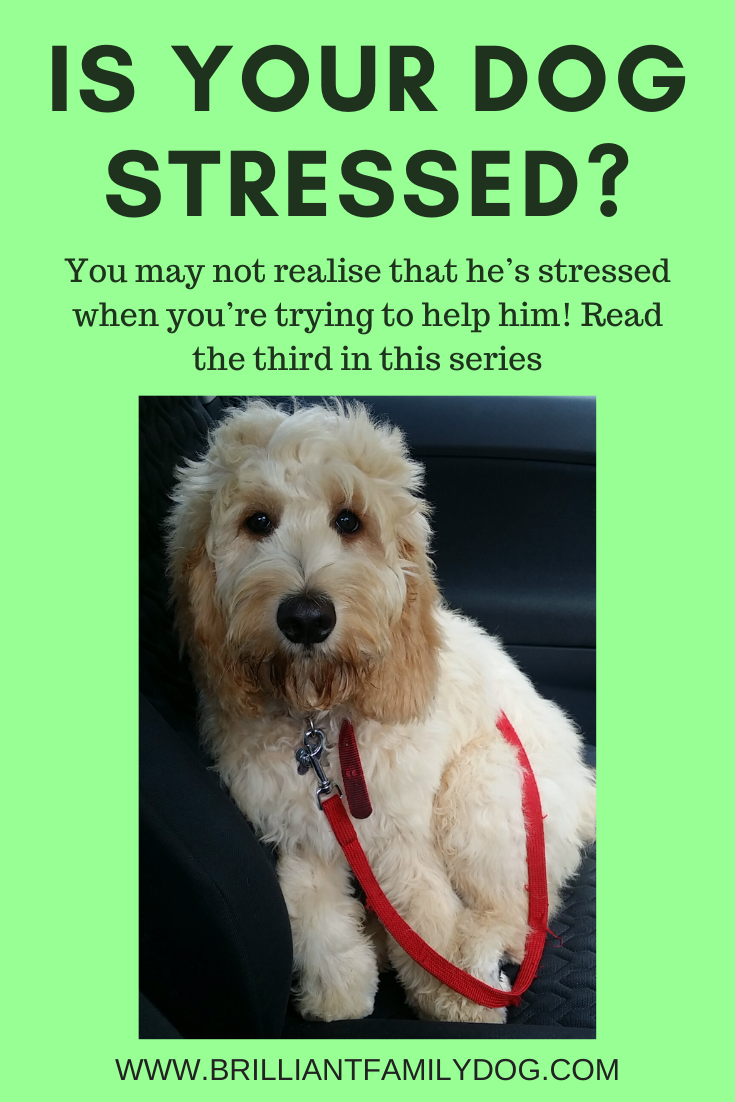
CAN MY DOG BE STRESSED? - PART 3

This post was first published on positively.com and is reprinted here with permission.

There are lots of stressors in our dogs’ lives - and it can be hard to see them. This third post in the series on dog stress pinpoints day care and dogwalkers. Brilliant Family Dog is committed to improving the lives of dogs and their harassed owner…

Here is the third excerpt from my book - Building Confidence in your Growly but Brilliant Family Dog - which points out an area which will be affecting your dog much more than you may imagine. You may want to read the first and second parts of this series first: Can My Dog Be Stressed? - Part 1 and Can My Dog Be Stressed? Part 2 

While you’re doing your best to improve the situation and you take a look at what may be making things worse, you cannot overlook stress.

  • Stress causes reactions to be exaggerated

  • Stress causes us to snap

  • Stress wears us out

And here’s another area of your dog’s life that could be building stress that may surprise you.

3. Daycare or a dogwalker

A very perceptive reader sent me this query recently: “My question is, what do you think of daycare for dogs? Are the dogs actually happy about it, or do dog owners just like to imagine they are?”

Some dogs love daycare. And some people love holiday camps with group activities. I have to say that’s not my kind of holiday, and I would find it very hard to cope and not one bit enjoyable.

I am not going to tar all daycares and dogwalkers with the same brush. There are some excellent ones, with dedicated and knowledgeable owners and good staff education programs. But I will say that you'll have to do extensive research to find a convenient, local one that is truly a safe place for your anxious dog to learn and develop. 


Management skills

Think of the skills you need as a parent to prevent open warfare in your own household! Then picture a gang of dogs being thrown together for a walk - or all day in a confined area - in the care of people who may have no dog training or behaviour qualifications whatever. “I love dogs” may help, but it’s not a qualification. And given how long it takes us to learn how to care for our own species - and that a lot of what people think about dogs is wrong - you’re going to be lucky to find somewhere safe for your dog.

I was recently shown a promotional video for a daycare by someone who’s been sending her very reactive German Shepherd pup there for months. Even in this 30-second video - meant to show how wonderful the place was - I could see bullying and intimidation of this pup by other dogs, and no one going to her aid. Imagine what this sensitive puppy is subjected to for ten hours a day, five days a week! No wonder her reactivity is already extreme at only six months of age. What the owner thought as “being perfectly happy at daycare” was in fact a dog that spent all day trying to avoid the other dogs (quite impossible with those numbers of loose dogs) - shut down, in other words. Not fine at all.

For many dogs, daycare is viewed with the same suspicion I view that holiday camp!

There are lots of stressors in our dogs’ lives - and it can be hard to see them. This third post in the series on dog stress pinpoints day care and dogwalkers. Brilliant Family Dog is committed to improving the lives of dogs and their harassed owner…

Dogwalkers

If you have a good and responsible dogwalker, you are indeed fortunate! A dogwalker arrived at my regular walking spot recently. She opened her van doors and out flew five or six dogs. One planted his feet on my chest while the others hurtled around the roadside car park alarming other dogs before heading off on their walk. After 20 minutes she returned and drove away again. Would you be happy paying good money for that level of care every day?

My personal solution to an enforced absence from home is to have someone I trust to come in to let the dogs out in the garden and play with them for a while during the day. A “walk” is not needed.

If anything goes wrong in a daycare or with a dogwalker, you will be paying for that for years - possibly the rest of your dog’s life. You can spend time observing at a potential daycare. If they don’t like you quietly watching - move on. Think hard, and do a lot of homework, before handing your dog over.

Regardless of where you live, there will be fantastic, dedicated dogwalkers and daycare facilities that truly put the needs of the dogs in their care above all else. So seek out those above-and-beyond caretakers, and you and your dog will certainly reap the rewards!

Here are excerpt 1 and excerpt 2

Did you find this excerpt interesting? Here's what Book 3 looks like!

Or you can choose to get all three books at once, in paperback or ebook.

For a free e-course to help remove the stress from your life, and your dog’s life go to www.brilliantfamilydog.com/growly


And to get started straight away with lessons to help your Growly Dog, watch our free Masterclass for Growly Dogs

Fights in a multi-dog household

There are options for you to change things if your dogs are not happy with each other. Check out this post to find them all. Brilliant Family Dog is committed to improving the lives of dogs and their harassed owners through books and online learning…

You enjoy having one dog so much, that you decided to get two.

And that’s where your troubles may have begun.

Carefully introduced, the dogs will get on famously and become firm friends.

In the image above, Lacy is chewing a bone while Cricket enjoys her body-heat. Both dogs content.

But sometimes things go wrong, and you find that either

🐾 the older dog resents the newcomer

OR

🐾 the newcomer rocks the boat and starts bossing the old guy around.

Either way, it was your choice to get a second dog, not the present incumbent’s choice. So you have to make sure to disrupt the dogs’ lives as little as possible while they learn that neither of them has anything to fear, and that they can trust you.

Have a look at this post which gives you guidelines to follow. Do follow them rigidly! Don’t rush ahead, or cut corners. This system works, whether your first dog is reactive or not, and whether you’re introducing a puppy or an adult dog into the mix.


Resource Guarding

Often, fights are a form of resource guarding. One dog has something and doesn’t want to share it, or lose it. This could be a sleeping place, a food bowl, or you and your attention.

So it’s essential to show your worried dog that he has nothing to fear over losing valued resources. Teaching turn-taking is an important part of the smooth running of a multi-dog household, and the easiest way to teach this is

  1. Teach Impulse Control around food

  2. Line the dogs up and say “Name, here,” as you hand a treat to one, and “Other name, here you go,” as you feed the other. Do this randomly, at odd times, and in a different order, and reward their patience warmly.

Along with spending a lot of time with each dog individually, and using a force-free training program to build an unbreakable bond with each dog, you can remove daily friction from their lives so that these tiffs become a thing of the past.


Here’s where you can start to develop a new way of interacting with your dogs! 

Odd dog

If one dog is ill or injured, the change in appearance or smell could upset the status quo. Similarly if one of them is undergoing a lot of hormonal change, this can stir things up. Before you do anything about this possibility, check out this post. (The changes are not what you may think!)

Fight!

If you’ve got fights going on already, you need to act immediately to change your systems. What may appear simply a spat can result in horrible (and expensive) physical damage, not to mention poisoning the atmosphere afterwards.

So turn your home into a village. Baby gates, crates, and playpens are your friends! It’s important to give each dog space to relax without fear. If the dogs are on edge all the time, this is no fun for anyone. Operate an airlock system if necessary, to move dogs around.

This is a lot easier than it sounds, but you have to make sure the whole family is on board with the new plan.

I never want to take the chance of coming home and finding bits of dog splattered about the place - just because someone knocked on the door at the same time as a gunshot sounded, or a dog barked. So my dogs each have their own place where they are secluded and safe. When I arrive home I am greeted by happy, cool, snoozy dogs. Once you establish a system it’s very easy to do, and the dogs are all happy.

Serious fights

If you’re suffering from fights that cause serious damage - especially if both are bitches, and/or terriers - then you may have no option but to rehome the new dog. I’d see this as a last resort. But if the quality of life for the household is suffering, and you have tried everything above without success, you may have to accept that this is the best course of action.

And before you consider another new dog, study the article linked at the top of this post, on how to introduce your dogs successfully!

Dog or Puppy problems? Get your free 8-lesson email course and solve them all painlessly!

THIS FREE ECOURSE IS A BONUS FOR YOU WHEN YOU SIGN UP TO RECEIVE EDUCATIONAL EMAILS AND OCCASIONAL OFFERS FROM ME. YOU CAN UNSUBSCRIBE AT ANY TIME.
Privacy Policy

Got a Pandemic Puppy?

Find a qualified force-free trainer to help you learn how to live with a dog - there’s a list here of where to look, along with our own online programs, both free and premium. Brilliant Family Dog is committed to improving the lives of dogs and thei…

There are loads of new dog-owners this unusual year. Being stuck at home means they at last are able to get a pet. So loads more people are discovering the joy of having a canine companion. Hooray!

But the flip side of this is that there are loads of people who were unprepared for dog-ownership, who perhaps purchased their dog on a whim, and are now finding out that it’s not quite as easy as they thought!

Not only that, but I’m afraid the nasties have crawled out of the woodwork to capitalise on people’s needs, and there has been a booming trade in puppy farmed dogs (aka puppy mills in the US). Not only have the poor bitches been worked even more relentlessly than usual so their selfish owners can cash in, but the prices have gone through the roof!

People are paying thousands of pounds for a crossbreed from a puppy farm, with no health checks, no parental pedigree, reared in a bare shed. Often they’re told the puppy is eight weeks old when it’s actually anything between five and twenty weeks or more.

These folk have no idea that dog-breeding can be such a dangerous place to wander into without research.

The real breeders, of course - those who work tirelessly to improve their breed, spend a fortune on genetic testing, and are ultra-fussy about who they hand their puppies over to - are still charging normal prices.

Add to this that because puppies are such a valuable commodity at the moment that many people are getting older dogs - thinking they’ll be easier to manage! And many more are buying imported dogs from Eastern Europe. They think they are doing a good thing by “rescuing” these unfortunate dogs.

What they’re actually doing is sentencing themselves to a lifetime of expensive and time-consuming remedial work, to try and get their foreign street-dog to fit into their comfy suburban lifestyle. 


Classes closed

As if this weren’t enough, many classes have been closed for at least part of the year, though my dedicated colleagues at the APDT have done valiant work to continue, according to the ever-changing edicts. They know how important it is for new dog people to find out how their dog ticks - they don’t arrive with an owner’s manual!

Another thing we’re seeing is problems with under-socialised dogs. Because there is such a poor understanding, generally speaking, of what “puppy socialisation” entails, people have been keeping their dogs at home, also teaching them that they will never be left alone. As the restrictions begin to lift, and people return to work, they’re finding that this is not working in their favour, and their dogs are naturally upset at their sudden abandonment.

All gloom and doom? Not at all!

But we can do a lot to help these new dog-owners enjoy their charge, and ensure a happy life for both owner and pup.

Find a qualified force-free trainer to help you learn how to live with a dog - there’s a list here of where to look, along with our own online programs, both free and premium. Brilliant Family Dog is committed to improving the lives of dogs and thei…

As I said, quality dog trainers are working in difficult conditions to keep their classes going. And those of us who have online programs are accommodating as many as we can. Most reputable online trainers have a large person-to-person component in their training programs, so it isn’t just a case of “pack ‘em in”!

So if you took your chance and rushed out and got a dog, and you’re now finding things beginning to fall apart - make your way to one of these high-quality, qualified, force-free, trainers. It’s a minefield, trying to wade through the trainerspeak jargon that many people use (usually those you don’t want to use!) so I list some organisations below.

And right now you can enjoy our free Workshop to teach your dog to LISTEN!

I’ve tried everything to change my dog …

Our dogs are living, sentient, beings, and can always change. But you have to know the science-backed methods to achieve this - without any force, fear, or intimidation!  Brilliant Family Dog is committed to improving the lives of dogs and their har…


I hear this loads!

◆           “I’ve tried everything …”

◆           “I tried this once and it didn’t work”

◆           “Nothing will change my dog.”


And I can tell you that you are mistaken. This should be music to your ears! There is a way forward, an end to your present frustration. Let’s have a look at these statements, one by one:


1. “I’ve tried everything …”

There are so many different methods in the world to train your dog - you can’t possibly have tried all of them! And there an awful lot you shouldn’t try at all, as they’ll actually make your dog worse. There are sadly, still many “dog trainers” and “dog behaviourists” who are - to put it bluntly - talking through their hats.

They dwell in a murky past where we are in control, and our dogs must do our bidding - or else. It’s the same mentality that used to beat children for naughtiness or “impure thoughts”. It’s been discredited for so long now, that I wonder which stone these people have been lurking under, that they have completely missed all the scientifically-backed discoveries about how our dogs’ minds actually work, and how we can get them to work in our favour.

You may have been misled by one of these people. It’s very hard for the “ordinary dog-owner in the street” to recognise them. And you went along with their suggestions, trying to do your best for your dog, only to discover that these actions made you feel sick, and made your dog worse into the bargain. Already afraid of the world, he’s now afraid of you - his only ally.

This comment from a student is something I see all too often:

“I never went back [to the class] but feel guilty to this day at having exposed him to that extreme and relentless intimidation, and not speaking up there and then.”

On the one hand it’s good because now this person has found a better way. But on the other hand it’s sad that they still feel guilty about it. I was able to reassure this person:

“We can only do our best with the information we have at the time. And you were doing your best. Sadly, those ideas are still prevalent in many places. So start from where you are. Don't worry about what went before.” 

This student is now enjoying working with her dog, not against him, and seeing real progress. “We love the games - so effective!”

Even if you work with trainers who genuinely espouse positive reinforcement, if you’re “trying everything”, it suggests that what you’re trying isn’t working! If you’re struggling with a dog who you can’t connect with, or who is overcome with fear or fury when out on a walk, then you need someone who has worked through all this already, and who can guide you through a structured program to achieve the change you desire.

Guess who?

Not got a Growly Dog, just a naughty one?

Check out our free Workshop on getting your dog to LISTEN!

2. “I tried this once and it didn’t work”

Can you guess what I’m going to say here?!

BABY STEPS! 👣 🐾

We didn’t learn Calculus in Kindergarten. We started by counting buttons. Only gradually did we get the results we now have in arithmetic (and yes, you can do sums, even if you don’t like them much!).

Learning a new process to work through with your dog is just the same. It’s not something you can try, inexpertly, once - then dismiss. You need to commit to making the effort your dog deserves. Only by working through the given steps and assessing your progress can you say whether something “worked” or not.

This is where the value of having a teacher working with you really scores! Just throwing information at someone is not going to help them get it. People hunt all over the internet without discernment or direction, ill-equipped to assess or judge the source of the information (see my point under no.1 above) - of course they end up confused! And this is why my books are filled with troubleshooting advice for individual dogs, and my courses have a strong element of personal coaching to help you interpret and get the best out of the lessons.

You need patience! Rome wasn’t built in a day! It’s the gradual accumulation of knowledge and experience that is the answer you seek.

Don't judge each day by the harvest you reap but by the seeds that you plant. Robert Louis Stevenson

Rollo winter sunset trimmed.png


3. “Nothing will change my dog”

This is possibly the saddest of all. Your dog is a living being! And like you, she can change.

I have seen “hopeless cases” become much-loved family pets. I have seen dogs about to be re-homed, puppies about to be returned to the breeder, who are still in their homes to this day, thanks to their owners making a last-ditch attempt to find answers.

I’m appalled when I hear of dogs being thrown out of training classes for being too disruptive, too difficult, too dog. This demonstrates not only a lack of ability on the part of the class trainer, but a complete absence of willingness to help someone and their troubled dog.

This I see as my mission in life! I have never turned a dog away from any class of mine, and I never will. As a church-going friend put it, “The church is for sinners, not for saints.”

So please don’t think that as you’ve tried things before that didn’t work; you tried something new - full of enthusiasm - only to find it let you down; that your dog cannot change. It simply means that up to now you haven’t found the help you need.

I would love to give you that help, and those of you with Growly Dogs may be excited to find what I have for you in just a few days’ time. Today is a new day!


And to get started straight away with lessons to help your Growly Dog cope with our world, watch our

free Masterclass for Growly Dogs