How to avoid reactive dog meltdowns 💥


Working - as I am - with a fearful youngster right now, I can tell you things do improve!

The brilliant thing about Yannick is that he loves people, but he’s going through that adolescent stage of being darkly suspicious of dogs.

Fortunately he likes bitches. 💕 💖

But after a couple of explosions demonstrated that he had developed an issue with strange dogs  - it only started after about a year - I have, of course, been working on it!

And he’s way, way better in a short time.

Adolescence is tough for dogs as well as for human teenagers!

So - what am I doing?

  • Look at That

  • Counter-conditioning

  • Enthusiastic exclamations when we see someone/something: “Ooh look, it’s a nice person/dog! Look!”

  • Chatting with the other owner


If he’s comfortable he’ll sit and sweep the road with his tail.

If he’s tense and pulling we look for shelter - a driveway, into a field, cross the road … As a reactive dog-owner, you’ll have these charted on your mental map as part of your walks!

But something that’s helped him enormously is to greet the person and actually meet the dog.

So I wait till the walker is in hailing distance, then ask them “is your dog friendly?”

Usually it’s a yes - I’d have known if not and we’d have been outa there already! Most dogs are friendly enough, though perhaps a bit anxious. If the dog is clearly better kept at a distance, that’s what we do, and turn away.

So a gentle approach and nose greeting is allowed. Count to three and draw your dog away happily. If both are happy, they can have another slightly longer greeting.

These tend to go really well, but it’s a good idea to keep both dogs moving if possible. I’ve discovered that Yannick is very gentle and encouraging with very shy dogs. He knows how they feel!

Now, assuming it’s not a “get outa Dodge” situation, I will engage the “victim” in conversation.

Just standing at a comfortable distance for the dogs and chatting has a marvellously soothing effect. That distance may be 3 - 5 - 8 yards - whatever works.

Slowly the dog can realise this dog/person combo is no threat - after all, you’re smiling and chatty with them! And they with you.


“Familiarity breeds contempt” they do say.


And in this case, familiarity breeds nonchalance and acceptance.


The dogs will soon be sniffing the ground and bored and ready to move on.

If Yannick is very wound up about the approaching dog, and can’t relate to me at all, I do simple counterconditioning: I’m just posting the treats into his mouth, encouraging his head round as much as possible (without lead pressure).

It still works!

Though we may only do that briefly then move away to safety.

But once you’re over this hump, I’d recommend giving the chat thing a try.

Do you use this already? Let me know in the comments.


And for more detail on how to do this counter-conditioning and Look at That, watch our free Masterclass for Growly Dogs great way to get you started managing your dog’s emotional state.



A new puppy PLUS a reactive dog: can it work?

I had this query from a reader recently, whose heart is clearly in the right place:


“I have a reactive/aggressive 8 year old I did not have from a puppy. As she has gotten older she has calmed down a bit however, we do not trust her around other dogs and do not even try to socialise her. She will cry, whine and sometimes growl which can be embarrassing.

I have longed for a dog that I can take everywhere with me and can get along with all dogs and people. I am considering getting another dog that is a little bit older than a young pup.

We do plan on introducing them slowly with the new dog being outside and our older dog inside watching through the window, then keeping them behind closed doors in the house etc.

One of my main worries is jealousy and the new dog picking up bad habits from the older dog. I also worry around the unfairness of walking them separately or is this something they will both quickly adjust to?

How do I make sure the new dog does not being aggressive also?”


Lots of questions here! And a few misconceptions too. Here was my reply to this caring owner:

“Well done on helping your dog get calmer - but don’t be embarrassed when your dog shows she’s uncomfortable! She’s giving you information. If others don’t understand, that’s not your problem - they will be impressed by your care.

New dog - I think you’d be better off with an 8wo pup. You’ll bring out the maternal instincts in your resident dog and she won’t see this baby as competition. Follow this article on introducing a puppy to a reactive dog to ensure a safe introduction and development.

Also, the young puppy will sleep so much that you’ll have plenty of time to give to your adult dog!

Walking separately is not unfair - most dogs prefer this undiluted time with their special person. I have four dogs and they all get their special times of solo walking with me.

There are a number of resources - from free to premium - on www.brilliantfamilydog.com/blog/how-best-can-you-help-your-dog-learn to help you. Do take advantage of them!”

As to how to introduce the older dog to the new puppy - and this goes for ANY older dog and puppy, not just a reactive dog - there is valuable information in that introduction article.

You can’t get a puppy and just chuck it into a multi-dog household and let it sink or swim. The outcomes are most unlikely to be what you’d like! There are plenty of parallels with children whose parents abdicate responsibility and the children rear themselves alongside their equally unguided peers. This can lead them down many unwanted paths . . .

So start as you mean to continue! Lots of 1-1 attention for each dog individually, and the puppy is reared more or less separately. After all, a puppy has a completely different physical timetable, with different requirements for training and exercising, so it makes sense.

Having a multi-dog household with the different characteristics of every dog within it is enchanting. They are so different!

And they need to be allowed to be. And not regarded as a pack.

Here’s a good place to start with your new pup:

Want a step-by-step guide to everything you need to know about your new puppy? Get New Puppy! here and start on the right paw!

Those early months are SOOOO important!

Let me know how you get on.


Is it your dog who needs to change, or is it you?


You can lead a horse to water, as the saying goes, but you cannot make it drink.

I have to keep this always in mind when someone asks my advice.

Sometimes they are pleading, desperate for help. It’s their last chance, they tell me. Things have to change. They need help now!

So I give it.

Either in the form of personal advice, or by encouraging them to enrol in one of my many programs.

Then what happens?

Well, of course, some avail of the fountain of knowledge 😊, get great results, and get their problems solved.

We love students who are prepared to put in the work! Like these:

“Many thanks - you have been a brilliant help and a breath of fresh air of information!”

“I've found your emails very helpful and am trying hard to implement.”

“I've been following your steps for four weeks now. Thank you very much for your guidance! It's been very helpful in sorting out Fitz's problems. You've been so helpful and I cannot thank you enough.”

“Your guidelines have been very helpful and reassuring for us to keep at this. Thank you.”

But it’s not a magic bullet.

Nothing happens unless the owner changes.

It’s not the dog who needs to change - it’s you!

As Wayne Dyer put it so succinctly:

When you change the way you look at things, the things you look at change.


What about those who don’t want to work?

As you know, I’m passionate about improving the lot of dogs.

And that means improving their home situation. It’s not a question of teaching the dog without referencing the whole environment. (That’s why residential training is a big no-no and doesn’t work.)

There’s so much misinformation about, and nobody can be blamed for doing it wrong when they were following guidance and trying their best. Once they arrive with me, we have a clean slate. We start from where we are.

But what I find very sad is when someone comes in desperation, asking for help. They are given appropriate help . . . and that’s the last I see of them.

As the Irish have it, some people don’t have the manners they were born with!

There’s never any excuse for not responding - even if it’s a Thanks but no thanks.

People who enrol in a program, ask for specific help - which is given to them in spades - then .. disappear.

Possibly worse are those who come back a year, two years later, with the exact same issue they first wanted help on. Only now the problem is entrenched. I think, “Why oh why didn’t you deal with this when we gave you the answers?!”


Oceans of help are washing over you, and you aren’t even getting wet.


And of course the reason is that they thought it was a problem with the dog, and not a problem with themselves.

They thought that just asking the question, getting it off their chest, would be the solution.

They didn’t factor in that THEY needed to do the work!

If you leave it alone, it won’t magically improve by itself.

We have to put the work in!

Are Agility World Champions just dogs who enjoy jumping? No! They are dogs who have handlers who work with them tirelessly to maximise their potential (and as long as the dog is enjoying it, that’s great.)

What about tracking dogs, like the police use? Search & Rescue dogs? Are they just dogs who enjoy mooching about sniffing things? No! They’re trained professionally, to an extraordinarily high standard. Someone’s life may depend on it.

Easy dogs

It’s true that some dogs are easier than others. They slip into the household and comply with everything without demur.

But most dogs (like most children, it must be said!) need quantities of teaching to shape them into the person we want to live with.

And this is where you come in.

Just like with those children, you can’t hand them a book and let them get on with it!

It’s hands-on, everyday, one-to-one, relationship-building and teaching.

Zig Ziglar has it well:

“If you are not willing to learn, no one can help you.

If you are determined to learn, no one can stop you.” 

Do you genuinely need help?

If you do, then you’ve arrived in the right place! And you’re very welcome.

There’s nothing I and my team like better than helping someone turn their life around with their dog.

And so often, it’s changing the way the owner views things (as Wayne Dyer says, above) that makes all the difference!


“Just acknowledging she's reactive on the leash, and still a wonderful dog was the best place to start for us.“

“I found it hard to accept that I did not have an easygoing 'normal' dog but once I accepted her for what she is it felt easier.”

“I've watched your free Workshop three times it's so good. Working now on training myself!”

So - are you determined to learn? Welcome to Brilliant Family Dog!

You can choose from free courses, premium video courses, books or audiobooks direct from the author. We have something to suit every learning style!


See you soon . . .

Are you able to look after a dog?

So exciting, getting a puppy!

But also - especially if this is your first venture into having a companion dog - fraught with hazards!

In my efforts to make the transition from “new dog” to “family dog” as smooth as possible, I have provided you with many, many resources.

There are over 300 articles here, and most important of these are the three-part series on Choosing a Puppy. Start here.

There’s New Puppy!  - a handbook to get you through the first few months.

And there are various free and premium courses

Total mindset change

But the most important thing in preparing for your new puppy or new dog, is the total mindset change you’re going to need to make!

As any new first-time parent will tell you, the whole thing is mind-bending and requires a huge change in your lifestyle.

You have no idea of the effect this new baby will have on your life - till it happens!

This applies to four-footed family members too . . .

Resentment of the invasion?

It’s not uncommon for me to receive complaints from people who’ve just got a new puppy, and can’t understand why they can’t carry on their life exactly as before.

Maybe they think they’re getting a stuffed dog, or a bicycle, or something. Not a living, sentient, being - who has hopes and fears, feelings and sensations, needs and desires.

So seeing the puppy blamed for its distress and the new owner’s lack of sleep is upsetting for me.

Would they blame a baby for crying and disrupting their sleep? Of course not! They’d try to find out what’s wrong and put it right.

Some of these entitled people even re-home their unfortunate pups after only a few days. They seem to think their comfort is far more important than caring for this little creature they have chosen to bring into their home.

Perhaps it shows that they bought their puppy or dog on a whim, with no thought about whether they were suited to have a dog living with them for the next 12-15 years.

You should be prepared for total disruption to your life!

It also tells me that the person who sold them the puppy or dog was simply trying to shovel off excess animals with no care of where they went. This is all too common, I’m sorry to say, with those “greeders” who are just in it for a fast buck.

It’s no good taking five days off work and thinking that will do the trick for your new puppy.

And if you work full-time away from home, how are you going to manage a creature who cannot be left for more than four hours? If you’re relying on a family member to mind your dog while you’re out - for free - I can assure you that such arrangements frequently break down when the person involved realises what a huge commitment this is and that they’re being used.

Is it about you, or about the dog?

If you think your sleep is more important than your puppy’s wellbeing, think again.

And if you think that scamping on food - buying the cheapest and feeding as little as possible - is the way to go: oh oh oh. I hardly know where to begin.

I have had people tell me they feed two meals a day - to an 8 week old puppy! Even giant breed puppies! Then they wonder why the poor starving creature is crying all night.

If you fit this category, I question the breeder of the dog.

A good breeder is concerned about the wellbeing of her pups, so anyone who gets a puppy while being out of the house ten hours a day has clearly gone to a puppy farm.

I had to complete a detailed questionnaire and write an essay before I could be considered for my latest puppy!

This is NORMAL.

A good breeder devotes months of her life to rearing her precious pups. She’s not going to let them go to any-old-body who has no understanding of how to manage them.

Would local authorities hand over a child for adoption without in-depth investigation? One would hope not!

Start the right way!

So start the right way. Read this article and kick off by making some choices about who you want to share your life with. Then do some serious research into where you can source your chosen dog.

The right breeder will be keen to help you learn what you need, to have a great start with your pup.

And a reputable shelter will not want to make a mistake with one of their charges, and find it bounces back for further re-homing.

Starting an adventure with a new dog is a thrilling experience! And just like how the excitement and anticipation of planning a holiday is often as good as the holiday itself, so a preparation period while you learn and research is so important to the success of this new relationship.

Please avail of the many resources available to you, dismiss fanciful notions and deal with facts.

Here’s that Puppy Book for you: 


How can I stop my dog stealing and chewing?

 I recently received this tale of woe with its heartfelt plea:

“My pup picks up everything from the floor and chews on it. She has plenty of chew toys and she is driving me nuts. I can’t even leave my shoes on the ground for the time it takes to take them off! I dropped a vitamin and she had it before I could bend down and pick it up. How do I teach leave it?”

This is a common refrain - but really, it’s not necessary!

I can honestly say that my dogs never chew anything that isn’t theirs. Sometimes I have to teach them, and sometimes they just know. My latest pup needed no teaching whatever. He knew that if it hadn’t been given to him, he couldn’t touch it. So he never had to be taught to leave food on the coffee table, for instance, and if his toy landed amongst a coil of electric flexes he’d simply stare at it till help arrived.

So I think a lot of this problem comes from a feeling that puppies chew and you have to expect it.

And as I often say - with dogs and the rest of your life,

What you expect is what you get

So the first thing to do is to change your expectations!

Know that this is an intelligent, thoughtful, being you’ve invited into your home - not a wild animal or a bicycle. People often actually teach their dogs to steal, chase, and chew, by reacting to what the pup does in such a way that guarantees repetition.

Simply saying Thank you, and accepting the object in exchange for a tasty treat (you do always have tasty treats to hand, don’t you?) is actually teaching the beginnings of your retrieve as well!

Start teaching this new 8-week-old baby in the gentlest way possible - no need for any NOs or Ah-ahs or anything else that expresses your displeasure.

You are teaching this young creature. Mistakes are an essential part of the process, and gentle redirection a standard requirement of parenthood!

And yes, offering a treat is a perfectly acceptable way of teaching how to make these choices. This seems to be a continual source of confusion for people.

If your pup makes a mistake and you toss a treat away for him to fetch, you are not rewarding bad choices!

You are rewarding the action of leaving the undesired thing. Think about that for a moment . . . and it’ll make sense to you.


Formal Leave It training

Once your pup is a week or two older you can start teaching this more formally, thereby ensuring that not only your possessions, but also foul stuff on the street, dropped pills, and the like, are out of bounds. This is where this skill can be a lifesaver!

I have often seen people trying to teach this, and because they’ve missed out a vital step, they are simply confusing their dog. It really is important to get into your dog’s head, understand how they think, and teach it the right way!

How to learn it?

You’ll be glad to know we have a full Impulse Control system within the Brilliant Family Dog Academy - teaching self-control around food and objects, of course, but also instilling a thoughtfulness into your dog so he can make the right decisions in the future.

You can learn about the Brilliant Family Dog Academy here, in our free Workshop, which is packed with lessons you can put into practice straight away!

As you can see, this is something I’m passionate about - not only for the health and wellbeing of your dog, and not only for the health of your home and possessions - but for the responsibility your dog accepts in fitting in with your requests (whether spoken or not).

This is a surefire way to bring about a better relationship between you and your chosen companion!

Prefer books about dog training?

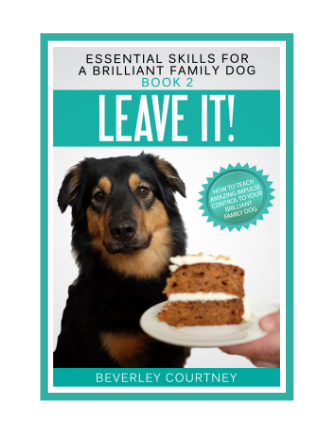
Then hop over and pick up Leave It! How to teach Amazing Impulse Control to your Brilliant Family Dog (Essential Skills for a Brilliant Family Dog, Book 2)

Here you’ll find a step-by-step method, complete with troubleshooting and what-ifs, to turn your thieving pooch into a model citizen!

Here’s another resource for you:

I can’t leave any food anywhere - my dog will steal it!

What about chewing?

Knowing what to give your pup to chew that is safe and effective is not as easy as you might think. A little guidance will help you:

What can my dog chew?

I can’t leave any food anywhere - My dog will steal it!

Digging, chewing, chasing, barking: Instinctive drives you love or hate?

In sum, you want to start as you mean to continue, and don’t assume you know better than those who’ve devoted their lives to force-free remedies for common puppy problems!

If I wanted to learn how to make cakes, I’d take a baking course, or at the very least read a step-by-step book. Same goes for any skill you don’t yet have. Learn from those who do have it!

This will save you from making so many mistakes from not quite grasping the lesson, missing some vital aspects and thoroughly confusing your poor dog!

I love it when people plan ahead for their new puppy or dog, and learn what to do before it happens, rather than give knee-jerk reactions when it does.

That’s why the cleverest people join the Brilliant Family Dog Academy ahead of getting their puppy - wise folk!


Are you limiting your dog (and yourself!)?

There are no limits to what you can achieve with your dog, nor what you can achieve for yourself.  Brilliant Family Dog is committed to improving the lives of dogs and their harassed owners through books and online learning, all force-free and dog-fr

I was meeting up with a friend recently and met his wife. “And how are you keeping?” says I. “Getting older,” she replied. 

And, I’m sorry to say, this theme was revisited time and again during my visit. Everything was framed as what she couldn’t do because of her age. Sadly, I think that joining a group of older people - who seem to be preoccupied with their health and what they are unable to do - had emphasised her feelings of gloom and despondency.

But you know me! I was not long about filling her mind with more positive thoughts, ways to move forward, make exciting plans, realise what she could do with her life with what she already had.

And she was a very different person when I left, thanking me for what I’d done for her, already full of ideas and making plans for her next project.

Why am I telling you this?

It’s about LABELS.

You may know that I have a bee in my bonnet about how people label themselves, their family and friends, and their dog!


Here are a couple of posts on the subject:

Hooray for change for your dog! Discard the old labels

Labelling your dog and yourself

Labels are limiting!

The thing is, applying a label to something is so limiting. It means it can never be anything else.

This is fine if it’s a table, or a car, that you’re labelling.

But when it comes to sentient beings, creatures interacting with each other, creatures who are growing and developing (or should be!), it is totally inappropriate.

Saying “I’m too old,” is going to prevent you from doing all the things you’re well able to do.

Things that will make your mark on the world, help society, move the world forward.

And saying, “My dog is … stubborn/stupid/untrainable/a rescue” is preventing you seeing your dog as a creature capable of huge learning and growth!

Blanket statements

Making blanket statements tends to be limiting.

“I’m no good at …”

“He always …”

“My dog never …”

We hear these all the time, and it’s equivalent to throwing out the anchor and parking yourself exactly where you are.

No possibility of change!

Replacement thoughts

How about replacing these thoughts in your mind with more enlightening ones:

“I’m open to trying new things.”

“I’d love my dog to … walk nicely on lead/retrieve/calm down ..”

“I have plenty of time left to me - I’m going to …”

“The only constant is change.” Heraclitus

And as Maria Popova says so well,

“A person is not a potted plant of predetermined personality but a garden abloom with the consequences of chance and choice that have made them who they are, resting upon an immense seed vault of dormant potentialities. At any given moment, any seed can sprout — whether by conscious cultivation or the tectonic tilling of some great upheaval or the composting of old habits and patterns of behavior that fertilize a new way of being. Nothing saves us from the tragedy of ossifying more surely than a devotion to regularly turning over the soil of personhood so that new expressions of the soul can come abloom.”

https://www.themarginalian.org/2024/05/15/gardner-self-renewal-meaning/

Budget mentality

Folk sometimes get stuck in limiting themselves to what they think they can afford.

Oh, what a bad road to go down!

You are only limited by your imagination.

If you decide you are going to do anything at all - move house, write a book, start a project - the last thing you should worry about is your budget.

If you leave that out of your calculations entirely, opportunities will present themselves which you would never have seen if you were focussing on what you could afford.

And - here’s the exciting part! These opportunities can bring rewards you could never have expected. Results that far outweigh any investment you made.

Students in the Brilliant Family Dog Academy, for instance, tell me they enrolled in the program because their dog was difficult, or pulling on the lead, or whatever, and what they discovered is a new way of being with their formerly challenging dog that has opened up a new life for both of them.

Here’s what Carol R had to say:

“We have both come a long way, and it is no exaggeration when I say she is a transformed dog 😊. Although we have now worked our way through the whole of the course, we are continually going back to work again through modules, and dipping into Beverley’s books as and when we need to. Our learning will be ongoing for life, but we don’t mind, we are really enjoying it. I’ve found it’s really strengthened our bond, and most of all, it’s fun!!“

We’re exactly halfway through the year - tell me in the comments what you’re going to do with the second half!