Time off for you and your dog

I had my first cold in six years a while ago - and boy, did it hit me!

So I had to cut dogwalks right down.


🚶🏼No walks for a couple of days.

🚶🏼🚶🏼Then ten minutes for the youngster.

🚶🏼🚶🏼🚶🏼Next day 15 minutes for the other two

🚶🏼🚶🏼🚶🏼🚶🏼🚶🏼Eventually back up to normal!


But the point is - nobody died!

No dogs got upset. No dogs climbed the walls - I wouldn’t have had the strength to do anything about it anyway!

Everyone was fine. Lots of cuddles, a few gentle games.

All was well.

Time for a break for both you and your dog?

So.

There is no need to feel worried if for some reason your dog isn’t getting the walks they’re used to.

We take care of them, and we know we have to stop walks when they are overwhelmed, injured, or unwell.

We have to take care of us too!

If we’re overwhelmed, injured, or unwell - then maybe walks need to go.

Of course, if you live in beautiful countryside and the weather is wonderful, and you have calm, non-reactive dogs, then it could be just what the doctor ordered.

But, if you’re blessed with a Growly Dog … then give it a miss till you’re feeling stronger.

We’re approaching the busiest and silliest season of the year. Maybe you’ll have a lot going on, with extra financial strain, visitors, travelling …

Don’t make your life harder!

The days are short, more dogs are out in a much smaller window of daylight.

As long as there is some entertainment or stimulation for your dog (and visitors and travelling are plenty of entertainment and definitely plenty of stimulation!) then you’re ok.

Perhaps some puzzles (lickimat, kong, cardboard boxes and tubes with treats inside, actual doggy puzzles).

A bit of Focus Game .. (Don’t know the Focus Game? Ooh - you need to check out the Brilliant Family Dog Academy: start here!)

Have you got a good retrieve? Now is the ideal time to teach it! You can teach the basics sitting or lying down - the dog will be doing the work. Here’s how

Then get back on the sofa.

Together.
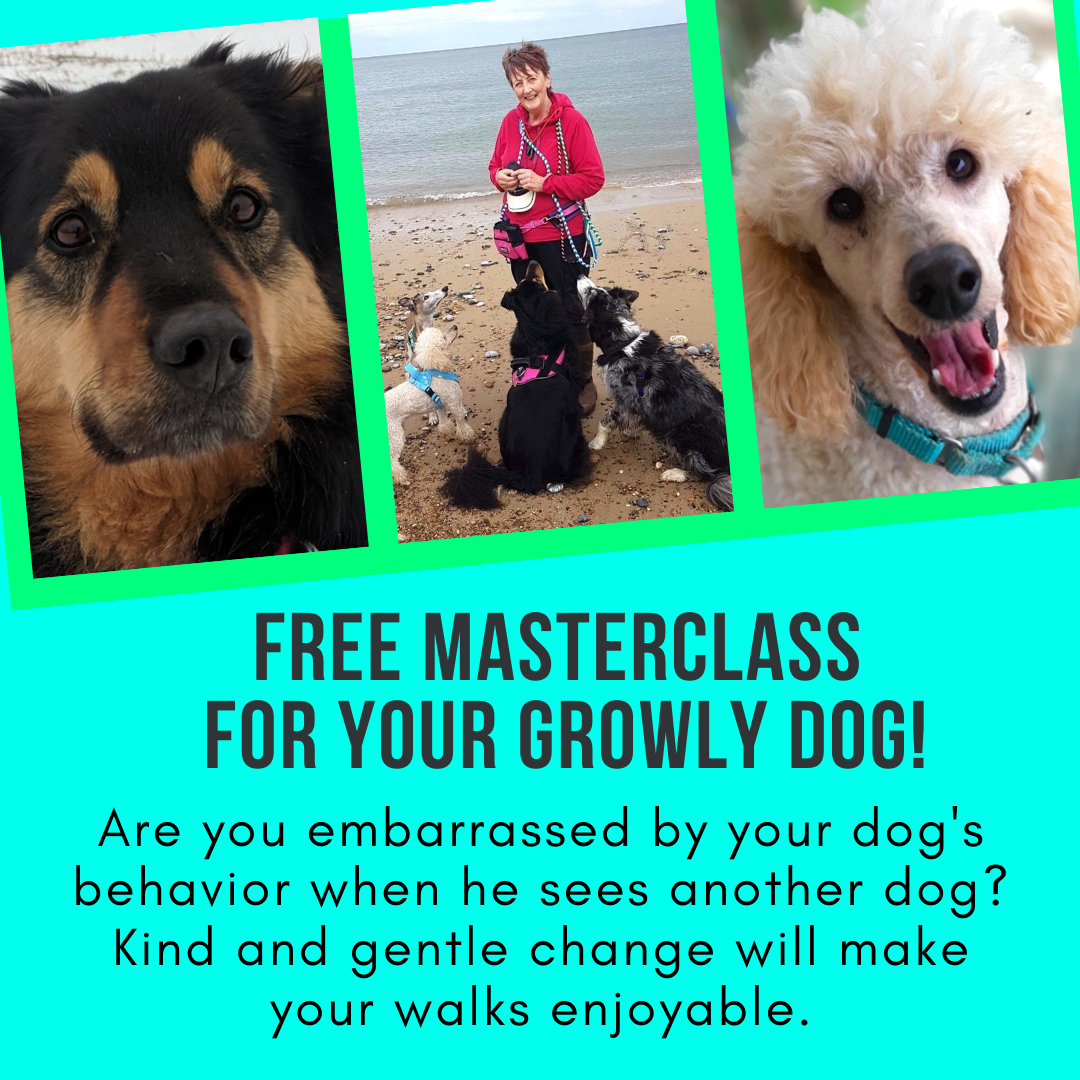
Stand up for your dog!


Stand up for your growly dog!

Be your dog’s ambassador!

And stand up for yourself while you’re at it! 😊

People will make hurtful remarks to you when your dog kicks off. 

🐾 Maybe he didn’t come back when you called and that annoyed them.

🐾 Maybe he barked frantically as they passed by with their dog.

🐾 Maybe he lunged at their off-lead dog who was in his face.

These people may be know-it-alls who think they could manage things better.

Or they may be blustering because their dog is out of control and caused the immediate issue!

Either way, usually this takes the form of 


🐾 “You should show that dog who’s boss”

🐾 “Don’t let him get away with that”

🐾 “Be the leader” and other such tosh

All punitive, bossy, stuff.

And none of it applies to you!

Glide on, regardless. 

Because YOU know that what you’re doing is right for YOUR dog.

YOU know that your dog is not, as they say, giving you a hard time, he’s having a hard time.

You know how lovely your dog is at home!

They don’t. They have no idea. And they certainly don’t want to be told.

So, say

“Thank you, I’ll keep that in mind”

OR

“Thanks - I’m off now”

OR

“That’s an interesting point of view …”

OR

just give them a cheery wave as you smile and depart.

You can dismiss them with politeness, and then toss their words out of your mind.

You don’t need them!

Some folk are honest enough to say that it was only when they got their fifth dog that they found out what reactivity was about. Up to then their dogs had been easy, compliant, no bother.

Our dog may be plenty of bother!

(But how rewarding he is for all that.)

We build an unbreakable bond with our growly dogs. We love them with a passion, and they love us with equal devotion.

Enjoy your dog. And pay these people no heed.

Would a stranger say to you,

“You shouldn’t let your husband do that”

Or

“You should keep your children in their place”?

They’d better not!

And you’d disregard their nonsense straight away. None of their beeswax.

Treat these hurtful remarks about your dog with the same contempt.

You’re doing fine!

And if you think you’re not doing fine, and they may have a point, watch our free Masterclass for Growly Dogs and learn some techniques you can put into practice straight away.


What does your dog fear?

Yannick took several minutes to study these new roadworks on our road before venturing nearer. You can see from his shadow how outstretched his neck was.

You don’t throw your frightened toddler into the deep end of the pool. You start by sitting on the steps of the baby pool, your toddler on your lap, and - after many sessions - eventually your child will be wanting to join the other children in the shallow end of the big pool. 

Lessening fears and building confidence is a lengthy process achieved by slow desensitisation to the fear and gradual exposure to cause of that fear in small steps.

But we are human!

We are impatient! 

“Oh, so I introduce my fearful puppy to another dog and it’ll all be fine!”

Nooooooo. 

Not like that.

Confronting the fear full on right off the bat is called “flooding” and is known to make the fear worse!

There’s a right and wrong way to do this, and it seems that even experienced dog trainers can get it wrong if they don’t understand it. 

I recently heard a dog trainer with quite a following, who normally follows a kind training method, reveal her mistake with her dog-fearful puppy.

She took her puppy to a new hall, positioned another owner and puppy at the other end, came in and closed the door behind them.

Chaos! The puppy was terrified and shrieked and they had to decamp fast.

Credit to that trainer for publicly admitting her mistake.

Overwhelming the dog

What went wrong?

  • It was a new environment for her puppy

  • It was an enclosed space - no escape!

  • It was an artificial setup

  • It was all or nothing


What should she have done (and I believe did do after her realisation)?

  • Choose a familiar place, though not on your own property

  • An open outdoor space! No close boundaries of hedges or walls

  • Seeing the other dog at a distance as a natural occurrence on a normal walk

  • Plenty of opportunity to retreat and regroup 

How to desensitise your fearful dog or puppy

It took a while for puppy Yannick to work his way towards this “goat” in the garden centre

Just how difficult is it to work this system? 

It’s easy! 

All you need is foresight, access to an open space with little opportunity of close contact with other dogs, and somewhere where there aren’t too many dogs, especially off-lead ones.

This may require a bit of research to find a suitable place and a good time to go there.

And it may take quite a while to build your dog’s confidence so they can say, “Hey-ho, another dog. Not to worry.”

But you can achieve this much faster, and without making simple novice errors, by joining us in From Growly Dog to Confident Dog.

You see I’ve been there before you, and so have my carefully-picked team of trainers. 

We know how you feel! 

And we know how to make life better for you and your dog.

Kick off with this free Masterclass and remember to start in “the baby pool”!


RESOURCES:

“Flooding is rarely used, and it can be dangerous.” https://www.simplypsychology.org/flooding.html


Flooding is “highly traumatic for patients and causes a high level of anxiety” https://www.tutor2u.net/psychology/reference/treating-phobias-flooding


Connecting with your dog

Walking nicely on the lead is something we all love to have.

Ambling through the highways and byways, our dog trotting happily beside us, the lead dangling …

But for some of us that’s a pipe-dream!

We see others who, without any apparent effort, have dogs who mosey along beside them, never pulling. And we wonder why - with all the work we put into teaching loose lead walking at home - we are still being hauled along by a frantic dog who seems to have an urgent train to catch.

But it may not in any way be your fault.

It may be all to do with what’s going on in your dog’s head.

It’s not that he doesn’t know how to walk on a lead.

 It’s that he can’t do it right here, right now - he’s overwhelmed!

Dog anxiety

Many of you, I know, have dogs who have been labelled reactive. That is to say, they travel the world reacting to things all the time.

Maybe another dog (horrors!), or somebody dropped something (eek!), a car door slammed (oof!), a flag fluttered in the breeze (yikes!), something moved at the end of the road (oh noooo!) … they can react to anything at all.

And mainly it’s to do with a change in their environment, or SEC as we dog-nerds call it - Sudden Environmental Change.

“There wasn’t a dog there last time we walked this way - what’s it doing there??” huffs and puffs your worrit dog. So he has to repeatedly check ahead, behind, above, either side …

And our job is to navigate the walk, managing all these alarums and excursions, without our poor frazzled dog having a meltdown.

But my dog loves walks!

But my dog sees walks as the high point of his day, you say. He gets so excited when he sees me get the lead.

That’s as may be.

But it doesn’t mean he’s not super-anxious about the whole venture. If you were stuck inside four walls all day, you’d be excited at the prospect of new scenery!

So why is it that when we get out of the front door, he goes into carthorse mode, and starts pulling as fast as he can?

Let’s look at it from his point of view, and see how we would be in a similar situation. If you were walking along dark alleys in a strange city at night, wouldn’t you be walking fast?

It’s because of anxiety.

The world is full of sights and sounds - most of which we weedy humans miss, our senses being so much poorer than the dog’s.

But your dog hears and sees them all!

The whisper of someone walking in the next road; the slight movement in the grass up ahead; and, of course, the scents which are filling his nostrils, of what’s recently passed this way - and might still be there … waiting to pounce!

Mental assault course for dogs

For the anxious, shy, nervous, type of dog, this walk is an assault on his senses - from every side.

Yes, he was excited to get out in the world.

But once he’s there, his only way to cope is to surge forwards, and get through this fast.

“What can I do to help my dog?”

So, what can you do to help? After all, you’d like your dog to enjoy his walks as well as your shoulders to stop aching!

You do need to teach Loose Lead Walking (we have a terrific, simple, system in the Brilliant Family Dog Academy so that your dog knows what you’d like him to do.)

And at home, indoors - where he’s not frightened of anything - you can get this going really well. Graduate slowly to doing a few steps in the garden. You may have to ‘go back to the drawing board’ as you re-teach in this new place. It may be your safe garden, but it’s outdoors, and there are all those sounds (that you probably can’t hear, or simply ignore) to disrupt the game.

Once you have a semblance of Loose Lead Walking indoors, you can start working outdoors, and then on a walk.

But you’re not going to expect him to walk nicely beside you.

“No? What am I to do?”

What you’re going to work on is connection. 

Connecting with your dog!

You want to establish a connection with your dog when he’s out.

Hitherto he has been too stressed to notice you. I could walk my anxious young collie for a good ten minutes before he’d turn and say, “Oh, are you here too?”

So what I suggest you do is spend some time before you set off on your walk, just feeding treats for any glance he gives you.

You can stand outside your front door, wander in circles on your drive, step through your gate and amble up and down twenty yards or so, and all you’re doing is chatting encouragingly to your dog, and feeding him a treat every time he makes eye contact with you - even fleeting eye contact.

To begin with you may do well to get him looking at you just the once!

But repeat this, boringly, every time you leave the house, and gradually he’ll find himself able to cope with this small familiar bit of the outside world, and give you more and more eye contact.

You may graduate to adding in some of his favourite tricks (a SIT is a trick to him), even incorporating a little of your nice lead-walking from inside the house. Maybe he’s a tactile dog and would like to feel your hand on his shoulder, or he can offer you some nose-touches to your hand.

Building this connection is the most supportive thing you can do.

It will allow him to connect with you when something worrying appears.

It will allow him to come out of a state of paralysed fear - or even a shrieking meltdown - much faster.

If he starts ramping up his anxiety during the walk, pause and repeat your circles and wanderings from the start of your walk, until the area you’re in has lost its terror for him and he’s able to relate to you once more.

Over time, you’ll be able to avoid the meltdown altogether, using some of the techniques we teach you in From Growly Dog to Confident Dog

Get started with your dog right now!

.. and let me know how it goes.

Keep in mind that this will take as long as it takes, but like all worthwhile things, you’ll be glad you stuck with it when you look back in a year or so, at how nightmarish your walks used to be!


RESOURCES:

The Brilliant Family Dog Academy

From Growly Dog to Confident Dog

Teaching a hand-touch

Does your dog terrify everyone?

The Brilliant Family Dog series of how-to books

Why is my dog reactive?

It’s natural for people to question things.

And especially when that “thing” is having a major unwanted effect on their life!

So “Why is my dog reactive?” is a question I hear often.

And the questioner often furnishes what they think the answer may be. These “reasons” can range from:

He’s a rescue dog

I think he was beaten

He missed out on socialisation

He was over-socialised

He was attacked as a puppy (“attacked” can mean anything from being stared at to being torn apart, I have learnt)

He had a bad breeder / bad breeding / bad start

We went to a bad puppy class

He never went to puppy class

.. and so it goes on.

Now whether any of those things are true, and - more to the point - whether they have any bearing on how your dog is now, can never be quantified.

Keen to learn more to help your Growly Dog? Get our free e-course here and get started!

It’s been proven that fears can be hereditary. Even that the position in the womb can affect a puppy’s mindset! And while all the research goes on - you have a dog to look after.

The fact is that your dog is reactive!

.. or anxious, nervous, shy, “aggressive” …

This is what we know, for sure - so why not start there?

Start from where you are

It really doesn’t matter why your dog is reactive or fearful. He just is.

A family may have two or more children who are poles apart in character. Same parents, same genes, same environment, same diet, same everything.

And yet they are totally different. We all know families like this - maybe even have a family like this!

Perhaps one child is brave and fearless and dives into everything.

While another is shy and reserved, lacks confidence, and prefers to be a wallflower.

Thing is - we get the children we’re given! We don’t have too much say in the matter.

And we love them just the same.

Choosing your dog

So why not view your dog the same way?

Maybe you went to great lengths to choose a breed you thought would suit you, the gender that seemed right for you. You hunted till you found a good breeder, checked the lines, made your choice.

Or perhaps you took pot luck - picking a dog from a shelter, or inheriting a dog from someone else.

I can tell you now, that there is more variation between individuals than there is between breeds.

In other words, two dogs of the same breed - even from the same litter - will be individual. Not clones. Individual.

Your collie may be afraid of things that run fast, your spaniel may have no interest in using his nose, your GSD may be sound-sensitive, your lapdog may hate laps …

So, to some extent, no matter how carefully you choose, you are taking a gamble.

First of all, be kind

Your dog can’t help how he is. He didn’t choose to be afraid. He just is.

And fear of some kind, whether inbred or acquired, is at the bottom of most reactivity.

So let’s cut him some slack.

He may not be the dog you had hoped for.

He may never be a good agility dog, or working dog - which is why you got him.

He may never be comfortable in strange places, or with strange people or dogs.

But that’s not his fault!

It’s just the way it is!

No need for whywhywhy - it just is.

You chose him.

So you need to do what you can to make his life with you the best it can be. If that limits what you can do with this dog, then so be it.

More love on offer

Just about all the reactive dogs I have ever known are wonderful family pets. They are utterly devoted to their people. They are fun to have around - at home.

I’d go so far as to say there is no bond like the bond between your reactive dog and you.

You have to put so much work in to keep him - and you - happy.

And in so doing, you understand him so much better. You build his confidence, slowly but surely (this can take years).

And your dog knows (once he’s no longer a terrified screaming furry blob on a walk) that you love him and will protect him.

What better pet could you wish for?

Want some help with your challenging dog? Hop over to our free Masterclass for Growly Dogs, which gives you practical techniques you can use straight away to make your your dog - and your walks - calmer


How much does your dog sleep?


I make no apologies for revisiting this vital subject! So many of the queries I get can be resolved by simply allowing or encouraging your dog to sleep more!

Dogs need 17 hours of sleep a day to function well.

And this doesn’t mean snatched minutes of shut-eye when nothing is happening for a few moments!

It means proper, deep, uninterrupted sleep, for at least an hour at a time - and, of course, all night!

Teach ‘em young

And this doesn’t just happen without careful management.

In the same way that most responsible parents manage their babies’ and toddlers’ sleep sessions, teaching them that a sleep will cure lots of upsets, we have to teach our puppies how to manage themselves.

This is valuable learning.

We put small children in cots to make sure they can’t race around exhausting themselves when they need to rest.

In the same way, we can use crates or playpens to manage our puppies - who often won’t stop till they’re nailed to the floor!

I honestly don’t know how anyone manages a puppy without a crate or a playpen! I think that without these terrific aids we’re giving ourselves a huge amount of extra work and stress.


If you struggled to manage your youngster over the holiday period, now is the time to double down on teaching him or her how to sleep.


💤 Alone.  

💤  Contained.

💤 Without you.

💤 Without distraction.


You’ll be so glad you did!

And for more gems on managing your dog, check out the how-to books here!

Check other post that might help your brilliant dogs:

I have a new puppy: will I ever get any sleep again?

How much time does your dog spend sleeping?

Errorless Housetraining and Crate Training

Puppy Crate training demystified

I love my dog AND I love my sleep!