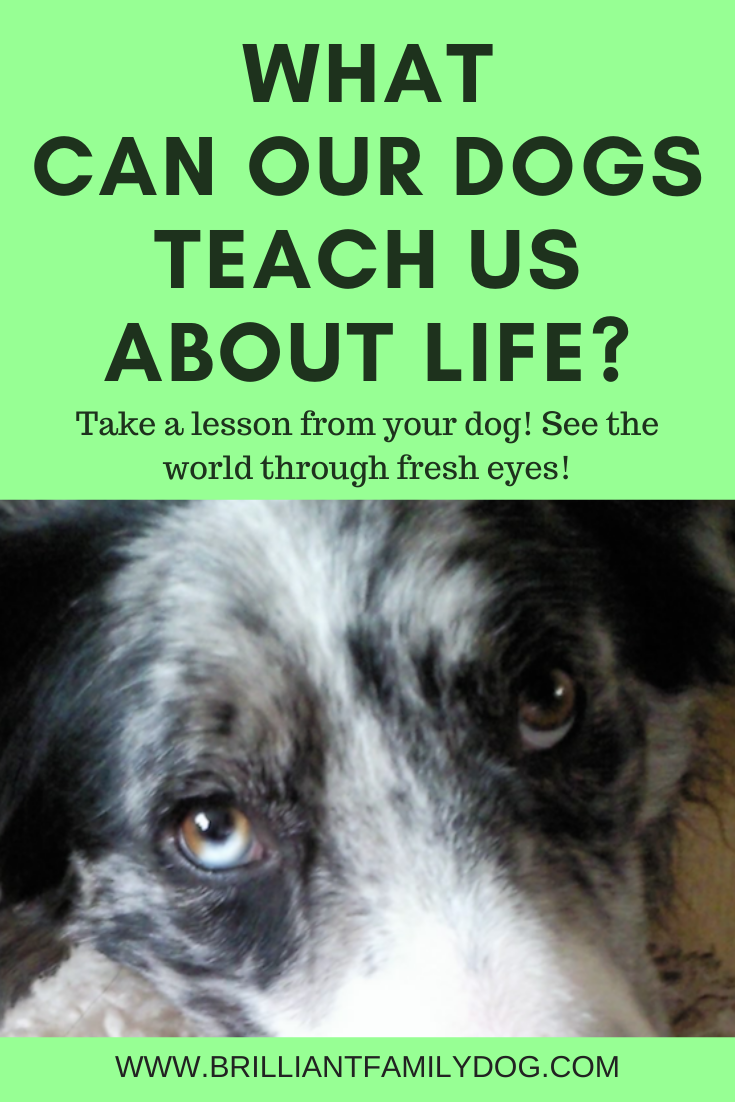
What can our dogs teach us about life?

Brilliant Family Dog is committed to improving the lives of dogs and their harassed owners. Rather than us continually trying to change our dogs, how about learning from them? You can have a more relaxed experience of life when you learn this lesson…

We seem to think it’s up to us to teach our dogs everything. I get questions all the time along the lines of “How can I make my dog do such-and-such?” “How can I stop my dog doing xyz?”

But how about looking at what our dogs can teach us?

One of the greatest realisations in my time on this planet is that

It’s not about us!

We see things through our own individual set of goggles. And those goggles have very smeary, scratched lenses!

They’ve been smeared and scratched by years and years of our life experiences, what we’ve been taught, what’s acceptable in our society, how we think we ought to behave.

Often we have felt that life is happening to us, without us being able to do a thing about it. We may have accepted everything we’ve been told or taught without question.

Where is the truth?

But, you know, the only thing you can be sure of, can trust, can know is truth, is your own reaction. Your own thought. Your own feeling.

For some of us, even those spontaneous thoughts have been crushed and buried because we thought they didn’t fit in with what we’re meant to think. It can take a little digging to find out what your true values and feelings are. We can cast aside the interpretations we put on the things that happen, we can stop meeting trouble halfway by our assumptions,

And this is where your dog comes in.

Our teacher - our dog!

When did he last read the paper, watch the news? When did he last ruminate over what someone said, asking himself endless questions, whywhywhy? Does he worry whether he is good enough?

(I’m talking here, of course, of the companion dogs in our homes, who are being given the Five Freedoms.)

Dogs are truly spontaneous - when we allow them to be so. They experience something, and they react. Or respond. Or ignore.

They don’t analyse it. They don’t ask endless questions - “Why did she look at me like that?” “What can he be meaning?” “Is it something I said?”

They just experience - and react.

Brilliant Family Dog is committed to improving the lives of dogs and their harassed owners. Rather than us continually trying to change our dogs, how about learning from them? You can have a more relaxed experience of life when you learn this lesson…

So, as dogs live entirely in the present, this keeps their lives comparatively simple. For example, they see something new on the ground:

“Can I eat it?”

“Can I climb on it?”

“Will I roll in it?”

“I’ll pass by …”

Nowhere do they say,

“What is the meaning of this thing?”

“Is this to do with what happened last week?”

“This means the world as we know it will disappear.”

“Why do these things always happen to me?”

Listen and learn from our dogs

So how about taking a leaf out of their book? When something happens, take it at face value. No need to let your imagination run riot when something goes slightly amiss, “This means the end of everything I value!” or “I will end up dead in a ditch!”

As Confucius apparently said, “Life is really simple, but we insist on making it complicated.”

Uncomplicate yourself. Be a dog. Live in the now.

And if you’d like to learn just how you can approach your life with pleasure and not trepidation, just ask me!

Want to learn more how to relate to your lovely teacher, your dog?

Watch our free Workshop and learn how to communicate effectively with your dog or your new puppy, right from the start!

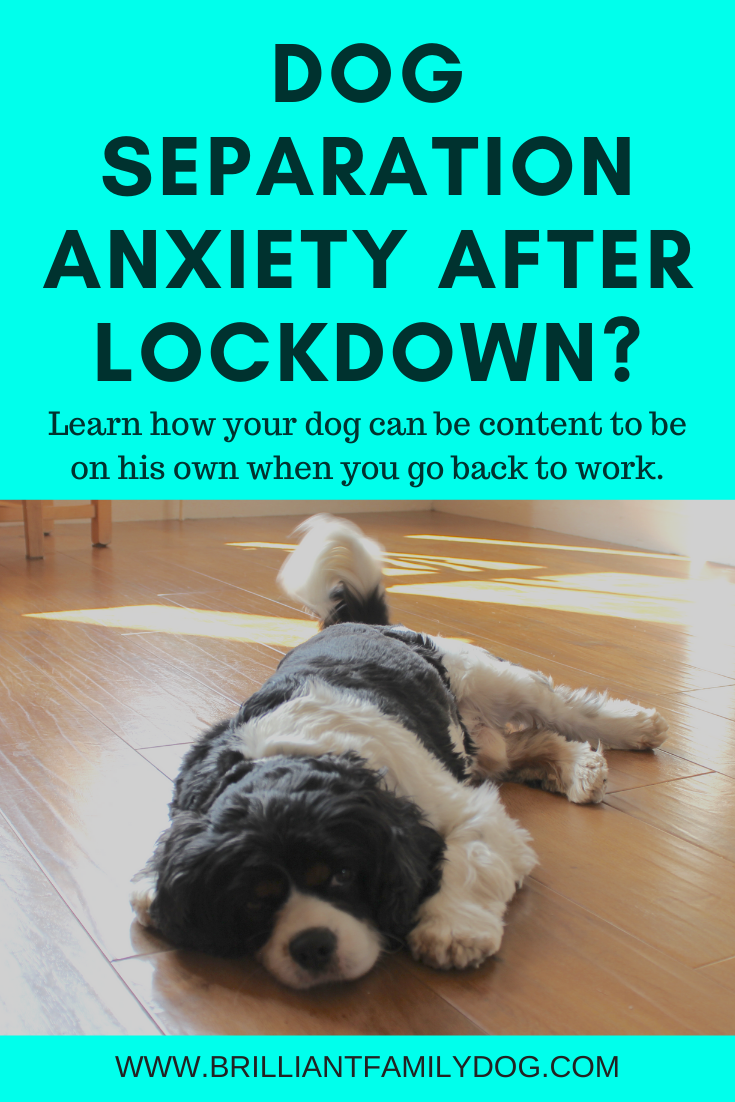
Dog Separation Anxiety after Lockdown?

Brilliant Family Dog is committed to improving the lives of dogs and their harassed owners. Teaching your dog to be content when alone is a vital bit of training people often forget, and so important right now as many of us emerge from lockdown | FR…

I received this request recently from a long-time follower,

“How about some advice on separation anxiety? Coming out of lockdown is going to be hard for many of our dogs. They are so used to us being around all the time. I’m ready to work on the problem.”

Advice? We-e-e-e-ll. That depends whether you want advice for your dog or advice for you!

The dog part is easy!

First, read the post Puppy Socialisation in Lockdown which will give you a greater understanding of what’s going on.

Note especially this bit: “One thing that will need careful attention while you’re at home is teaching him how to cope with your absence without distress. This is hugely important for any puppy - especially now, if you’re isolated. So short absences - even to the next room - must be built in from the start, and gradually extended.”

These absences should be incorporated as a normal part of any dog’s life with you, lockdown or no. So be sure to add them in daily.

When you need to go to the shops you can leave your dog safely in her crate, maybe with soft music and a chewtoy to help her settle. If you have two dogs, be sure to walk them separately some of the time (you should do this anyway!) so one is getting your full attention and training on the walk, while the other is learning to manage absence back at home.

Return calmly. Certainly greet your dog of course, but avoid mega-long-lost-greetings that make a big thing of it all, instead of just another aspect of normal life. Ignore any hysteria coming from the crate!

The more you do this, the faster it will all go. You owe it to your dog to teach her how to manage being alone. Just as we teach our babies how to be alone. Fortunately dogs, like babies, spend much of their day asleep anyway, so it’s pretty easy to utilise this zzz time for a bit of absence practice.

Most of what people fear as Separation Anxiety is simply an absence of this gradual training. There is a big difference between a bit of discomfort at being alone, and clinical “Separation Anxiety” which may need the help of medication as well as a structured desensitisation program to work through. I recommend Patricia McConnell’s “I’ll be Home Soon” book.

But what about the owner part?

Have a look at these two statements from that reader:

“Coming out of lockdown is going to be hard for many of our dogs.” 

“I’m ready to work on the problem.”

In both cases, this is perceived as a problem. What’s more, it’s a problem that doesn’t yet exist! This is popularly known as “meeting trouble halfway”.

Not only are you worrying about something that hasn’t happened and may never happen, but by focussing on it you are actually making it more likely!  

Brilliant Family Dog is committed to improving the lives of dogs and their harassed owners. Teaching your dog to be content when alone is a vital bit of training people often forget, and so important right now as many of us emerge from lockdown | FR…

Yes, that’s true. Worrying about something that may never happen is opening the door to it and saying “Come in, do!”

If you don’t believe in the power of manifestation, you can look at other parts of your life where your awareness is heightened for something relevant to you. If you’re thinking of buying a red car, you see red cars everywhere! If you’re pregnant, suddenly every second woman is pregnant!

So if you think your dog is going to be anxious when you go out, every little thing he does will confirm this for you.

What you focus on is what you get

So what is my advice to you?

  1. Ensure you get your dog or puppy gradually used to your absence, and used to being alone, right from the get-go. Starting now is better than not starting at all! The resilience he learns will be valuable for every aspect of his life.

  2. Stop worrying! Worrying helps no-one. If you perceive something as a problem and dwell on it, that problem will grow. If you realise that for every problem there is a solution, and you just have to find it, you’ll be able to instantly stop worrying while you search. Would you rather be pro-active or a helpless victim of circumstance?!

 To change your dog you need to change yourself first!

Watch our free Workshop and find out how to transform your “deaf dog” into a LISTENING DOG!


How can I get my dog to Listen?

Brilliant Family Dog is committed to improving the lives of dogs and their harassed owners. Join our free Workshop to find out just how you can teach your dog to listen, without nagging, cajoling, or bribery! | FREE WORKSHOP | #dogtraining, #newresc…

This is the single most frequent request I get from readers: “How can I get my dog to listen?

Sometimes it arrives in the form of “My dog doesn’t listen to me,” “He never listens,” “You’d think he was deaf!” and so on.

But in every case it’s the owner complaining about her dog’s fault.

How about turning that around????

How about looking at what you’re doing first, then look at what your dog is or isn’t doing in response?

You actually have to teach them first!

I find that folk arrive with me, complaining that their dog doesn’t listen, then they’re surprised when I ask them how they have taught their dog to listen.

They haven’t, of course. They expect the dog to arrive with Listening-to-Owner installed. They don’t realise they have to make it worth their dog’s while to listen to them - every time!

We spend a lot of time with our friends, family, even a prospective spouse, teaching them how to listen. We all want to be heard. And there are different levels of listening. We want the very best!

Your dog is the same! He needs to learn that listening to you is good, listening to you is worth his while, listening to you always results in good things.

And there’s a very real danger that if you don’t teach him what you like, then he’ll teach you what he likes!

In every relationship, one person is shaping the other. Sometimes it gets horribly one-sided, like in an oppressive marriage, or an unequal friendship. But that isn’t necessary. A little careful groundwork can start a relationship off right. True choice in a relationship comes when both parties can express themselves fully..

And that’s what we want with our dogs too.

We want a companion dog who enjoys our company, chooses to hang out with us, is alert to our needs, and eager to please. Note that this doesn’t imply slavery, grovelling, or self-abasement! We want an honest relationship with our dog, the same as with everyone else.

I know the frustration your dog’s apparent ignoring can cause - when you do your best to do what you’ve been told in training your dog - only to find it doesn’t work. It causes the opposite of what you want! Antagonism, distrust, loss of love.

There is a better way. A way which works.

And, importantly, a way which does not involve any force, coercion, or intimidation. The same way as you choose to treat your family and friends.

I love my dog, but he just doesn’t listen!

Brilliant Family Dog is committed to improving the lives of dogs and their harassed owners. Join our free Workshop to find out just how you can teach your dog to listen, without nagging, cajoling, or bribery! | FREE WORKSHOP | #dogtraining, #newresc…

Would this be you? Have you got a dog who simply doesn’t listen to you? Well, you’re in luck! I’ve just made a new training workshop with exactly you in mind!

You can find it here - it’s free, by the way, as is so much that I give you.

Why do I give so much away for nothing? Some suspicious people even say “What’s the catch?”!

Well, there are two reasons:

1. I am passionate about changing the lives of dogs, and this means changing how their owners are with them. Getting these folk to dip their toe in the water of Choice Training is a great start!

and

2. I know that a number of those people I help will want more - they’ll want to work with me in person, through one of my programs. Hooray! Now I get to help them in depth! That’s the fullest expression of my passion to help dogs be understood.

Understanding leads to harmony.

As Carol, one of those students, put it just recently,

“I’m amazed at how much me and my dog have changed, and what we’ve now become. A proper team.”

Don’t lose another minute!

Register for this free Workshop here and get stuck in! You’ll come away with solid strategies you can put into practice TODAY, to change things in your life with your dog, remove that conflict and frustration, and build an unbreakable bond.

Start the change with your puppy or dog with our free Workshop packed with ideas and strategies -

all force-free!


How can I stop my dog’s aggression?

Brilliant Family Dog is committed to improving the lives of dogs and their harassed owners. Join our free Masterclass to find out just how you can change your dog’s “aggressive” behavior for good! | FREE MASTERCLASS | #growlydog, #dogtraining, #newr…

I frequently get this question. An owner gets in touch with me because their dog - who is wonderful at home with them and their family - behaves “aggressively” when seeing strange dogs or people. This could be when out and about, or with visitors to the home.

And the first thing I’ll ask them is what their dog is actually doing!

You see, I absolutely understand that when their dog appears aggressive, this brings up feelings in the owner of

  • Confrontation

  • Challenge

  • Conflict

They fear their dog has turned nasty, and has to be restrained so that he can’t damage another dog or a person - with all the horrors that entails. Vets! 😢 Doctors!! 😳 Lawyers!!! 😱

So it’s natural that their dog’s actions should provoke a strong reaction in the owner!

But you need to look at what your dog is actually doing - something that you are labelling as “aggression” - when it’s most likely for another reason entirely.

Common reactions to something the dog sees can include

Growling

Backing off

Hiding

Grumbling

Staring

Moving forwards

Stiff body and legs

Hackles raised

Tail up

Barking

Lunging

Snapping

And people may think this will automatically lead to biting.

Well . . . in some cases it could. But normally, if whatever is upsetting the dog is removed - or the dog is removed from where he is upset - this is enough for everything to die down again.

So this is just aggression, right?

I can tell you that in most cases that I work with, the dog is not actually aggressive. What’s happening is that he is afraid.

Brilliant Family Dog is committed to improving the lives of dogs and their harassed owners. Join our free Masterclass to find out just how you can change your dog’s “aggressive” behavior for good! | FREE MASTERCLASS | #growlydog, #dogtraining, #newr…

Something has appeared that he can’t cope with, that he’s afraid will hurt him (it doesn’t matter if he’s right or wrong - this is his perception! It’s real enough to him!) so he fires out some warning shots in order to keep the dangerous thing away from him.

That’s why if you can keep the dangerous thing away from him in the first place, or remove him, he will have no need to take the law into his own hands and try to keep it away himself.

Compassion

So instead of trying to STOP what you perceive as aggression, look at it with compassion and work out what the cause of this usually noisy display is.

Instead of trying to stop this by yanking the lead, shouting, nagging, dragging your dog away, trying a new gadget to physically hurt him (I include the misuse of headcollars here, never mind real nasties like collars with spikes pressing into the neck, or any device using batteries), and all the other things I see people do - perhaps acting out of character because of their embarrassment . . . instead of focussing on STOPPING what you don’t like, look at how to teach what you DO like!

You’ll get some ideas of how to approach this mindset-shift in this article.

Understanding is half the battle. Once you’ve got the measure of WHY your dog is doing this, only then can you work out what you’d like him to do instead, then formulate a plan to teach him!

You see, dogs can’t exist in a vacuum. They can’t NOT do. Dogs are doers. So if you want to change what your dog is doing, you have to find him something else to do instead!

How?

Glad you asked!

Your first step is to watch our free Masterclass, and Learn the 3 Biggest Mistakes Growly Dog Owners make - and what to do instead!

You’ll find there some terrific strategies for making great changes with your Growly - reactive, anxious, shy, “aggressive” - Dog, changes which will last.

You can ask your personal questions in the chatbox, and start looking at a new way to work with your Growly Dog to effect a happy life for both of you.

You may not like your dog’s actions - but you can be sure that he doesn’t like them either! Let’s get started on changing them . . .


Start the change with your reactive, anxious, aggressive - Growly - dog with our free Masterclass packed with ideas and strategies, all force-free


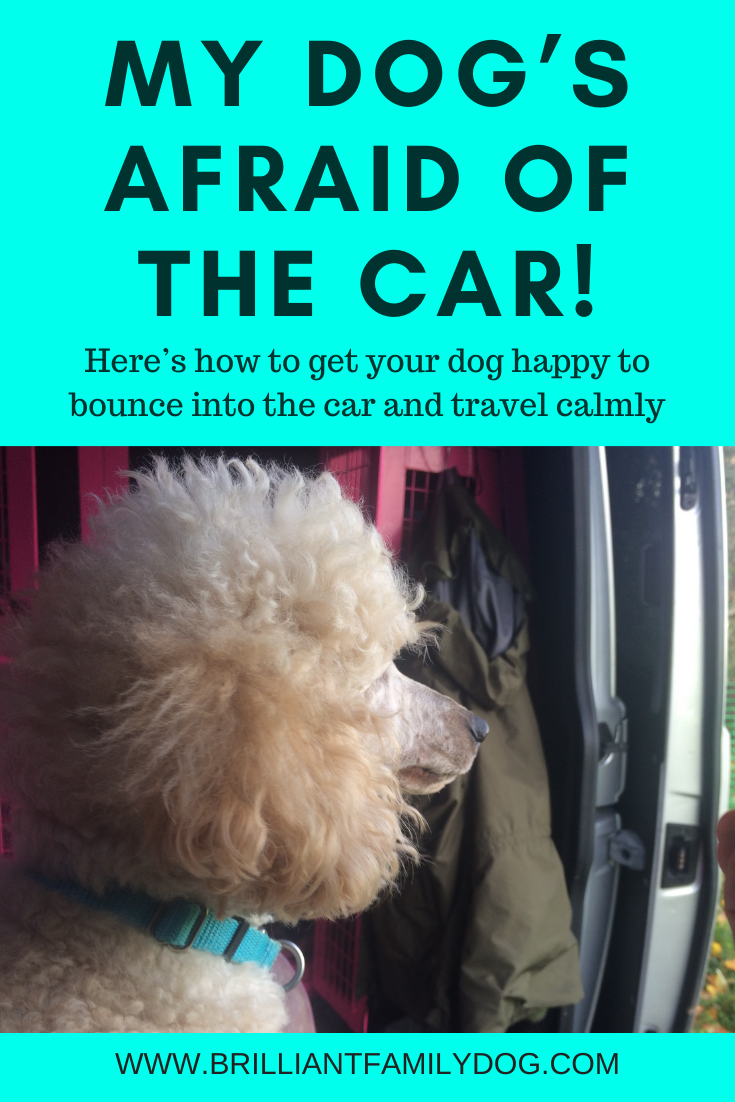
My dog is afraid of the car: 10 steps for change!

Blog Pins Part 2.pngBrilliant Family Dog is changing the world, one dog at a time. You may or may not know WHY your dog is afraid of the car - but he is! Here’s how to build up your dog’s confidence so he can travel happily | FREE COURSE | #newpuppy…

Why is my dog afraid of the car?

This is a tough one! You’re dying to take your dog out on lovely walks with the family - and she quakes and quivers at the sight of the car.

This is usually only found in rehomed dogs who have had a bad experience in a vehicle. But it can happen also with the family dog who used to enjoy car journeys till there was a motor accident.

The most carefully-nurtured puppy may be afraid of the car because it means carsickness. Some pups are carsick, some never are. Travel your puppy in the front seat of the car - between the wheels - where there is less movement, take corners slowly, and have a bucket ready. You can strap in his crate with the seatbelt. This phase will gradually pass.

If your dog’s reaction is extreme, with shaking, scrabbling to get away, drooling, and evident misery, you may need to talk to your vet about a mild sedative to calm the dog enough to start on a protocol to readjust her attitude to the car.

There are some very good herbal remedies which do not require a prescription which may help - they are often marketed as a calmer for firework nights.

The last thing to do is try to force the dog into the car!

This will only increase the fear and anxiety. What you can do is slowly and gradually change her view of the car as somewhere safe and pleasant to be.

Jet the young black Labrador had to be lifted into the car as he was fearful of getting in by himself. I suggested to his owners that they shut the garden gates, prepare his food as usual, walk out to the car, open the boot and place the bowl in the car as far back as possible from the edge. Then leave the dog to figure out how to get this food all by himself.

I hinted it could take a few days.

Next morning they reported back to me: they’d placed the food in the car, and started to walk away only to hear Jet leaping into the back of the car and scarfing down his dinner! One happy owner.

Here are 10 steps to change your dog’s approach to the car

Brilliant Family Dog is changing the world, one dog at a time. If your dog’s afraid of the car it can spoil your planned family outings! Here’s how to build up your dog’s confidence so he can travel happily | FREE COURSE | #newpuppy, #dogtraining, #…
  1. For some dogs, it’s the vibration and noise of the car engine that is the problem. So take your dog out to the car, sit in the car yourself without the engine running, leave ALL the doors open, and toss top-class treats (sausage, raw steak) to her outside the car. Let her decide when she’d like to get closer to you. She can climb in beside you if she likes, have some more food, then you can both get out and leave it for the day.

  2. Repeat this a few times and your dog will be keen to get in with you. Once you’ve achieved that stage, you can start to close the doors for a moment, then get out.

  3. If your dog loves playing fetch, a great game of tossing her favourite toy into the back of the car, or right through it (all doors open) can work wonders.

  4. Next step is, with doors and windows closed, turn the engine on for a short while, ensuring the exhaust isn’t blowing back into the vehicle. Do NOT drive the car! But keep up the flow of treats. These steps will take as long as they take. Don’t be in a hurry to push forward till your dog is really happy about the previous step.

  5. After a few times doing this step, you may notice that your dog is calmer and exhibiting less anxiety (tension in face and ears, wide darting eyes, paddling the feet, etc). Now you can actually roll the car forward or back a little way, and that’s it for the day.

  6. When you first pull out of your drive and actually move along the road, make it a very short journey ending in something spectacular - a run in the park, a visit to granny, or just straight back home for a great game.

  7. Another thing that can help: ensure that there is a door or window open when you shut the boot. The shockwave from the boot-slam can be very distressing for a dog. Sit in the car yourself with doors and windows closed while someone else slams the boot shut and you’ll see what I mean.

  8. For some dogs, travelling in a cage they can’t see out of is very effective. It could be to do with carsickness, fear of cars approaching behind your car, or just that they want to bark at everything that moves as they pass.

  9. If your dog is happy in the car but hesitant to get in, you may need a vet check to rule out a physical issue. It can be an advanced warning of hip trouble. Meanwhile, a ramp or sturdy step can help.

  10. And never let your dog - especially a young dog - jump out of the car onto a hard surface (road, dry or frozen ground)! This can seriously damage his shoulders.

Barking in the car can be completely solved by either covering the crate or using blackout material to cover the inside of the windows. Never was there an easier solution to a common and aggravating problem!

Experiment and see what works for your dog. And once you’ve worked out how to get him into the car, check out this post to find the best way to keep secure.

Now you can head off on some of those great country walks!

Did you enjoy learning this?
Loads more tips just as good in this free ecourse

THIS FREE ECOURSE IS A BONUS FOR YOU WHEN YOU SIGN UP TO RECEIVE EDUCATIONAL EMAILS AND OCCASIONAL OFFERS FROM ME. YOU CAN UNSUBSCRIBE AT ANY TIME.
Privacy Policy


Celebrate your Dog while you still have her

Brilliant Family Dog is committed to improving the lives of dogs and their harassed owners. Understanding our dog is crucial to building the kind of relationship we want with them. It’s too easy to take them for granted …  | FREE COURSE | #growlydog…

This article was first published at Medium.com

Many people are shattered by the loss of their dog. People reveal the depth of their feelings and their desolation at the sudden absence of their friend. The strength of these feelings can come as a bit of a surprise.

Our dogs creep up on us. Too late we realise how far they have tunnelled into our lives, our beds, our hearts, our souls.


As with any loss there can be feelings of regret: all those times I was too lazy to play with her; when she made do with scraps because I’d forgotten to prepare her food; when she missed out on a walk because it was raining; when I came home exhausted from my fulfilling day to my lonely dog — and then was too tired to give her a little of my time.

Let’s see how we can change this, with a truer understanding of how our dogs’ minds work! Get our free email course here.

THIS FREE ECOURSE IS A BONUS FOR YOU WHEN YOU SIGN UP TO RECEIVE EDUCATIONAL EMAILS AND OCCASIONAL OFFERS FROM ME. YOU CAN UNSUBSCRIBE AT ANY TIME.
Privacy Policy

Your dog commits totally to you. And in return we can take her for granted.


But She’s Just a Dog

I think that we often underestimate our dog’s intelligence and ability to reason. It’s very easy to bark commands at her and expect her to know what on earth it is that we want.

But how often are our expectations of what we want her to do unmatched by time spent on teaching her those things? We expect her to arrive with human-world behaviour installed, or to learn it by osmosis.

How unfair we can be!

It’s a truism that a trained dog is a happy dog. But it’s also the case that an untrained dog is a very confused dog.

How hard it can be for our dogs to continually try to guess what will please us; guess what will annoy or frustrate us and cause our displeasure — which hurts them so much!

She doesn’t have the whole world to love — she just has you.

I insure against some of the pain of the loss of a dog by having plenty of them! I usually have three or four and am always planning the next puppy. If I could have only one dog, I’d be thinking ahead to the next one. I couldn’t live without that joy and beauty in the household for long.

And the more dogs who spend their lives with me, the more I can see how totally individual and different they are.


Brilliant Family Dog is committed to improving the lives of dogs and their harassed owners. Understanding our dog is crucial to building the kind of relationship we want with them. Learning what makes your dog tick is the answer …   | FREE COURSE | …

Your Dog is a Teacher as well as a Learner

We can teach our happy-go-lucky, outgoing, everybody’s-my-friend dog some calmness and moderation, and we can encourage our shy, diffident dog to venture forth and gain confidence, but the dog’s character will remain.

Through years of living with several dogs at a time, my takeaways are:

  • Your appearance does not matter. Sometimes it’s puzzling if someone takes against you because of the colour of your hair or the length of your nose. But that’s their problem. Your dog is not going to change his hair colour for anyone. Neither should you.

  • Other people’s opinion is not of much interest. If you want to roll in the muck and they don’t understand, that’s their loss. Be proud of who you are.

  • Take every opportunity to rest and regroup.

  • If someone encroaches on your personal or psychological space, just move away. Dogs are in the main all for a quiet life.

  • Enjoy every moment and live in the present. It doesn’t matter if you’re cold and wet later — leap in the pond now!

  • Never tire of telling your special people that you love them.


They don’t live long enough — that’s for sure!

Yet they give so much.

Let’s give our dogs our time and attention now, in the few short years they’re with us. If we build our relationship to the fullest, we won’t be astonished by the gap they leave when they die, nor be filled with regrets at having failed them.


Is your dog throwing up more challenges than you anticipated? Watch our free Masterclass and find how to change things fast!